


In the 2019 film The Lighthouse, two 19th-century lighthouse keepers – played by Willem Dafoe and Robert Pattinson – live a damp, difficult and isolated life manning a lighthouse alongside a tempestuous sea. Reminiscent of the feeling of sitting on a rocky boat, it’s an incredibly disorienting film, one full of ominous scenes that bend reality, taking the viewer on a roller coaster between dream-like states and drunken superstition.
The story revolves around a lens, specifically a Fresnel lens, with which one of the lighthouse keepers becomes so infatuated that he – always in an intoxicated stupor – stumbles up into the tower to bathe himself in the light as it beams and rotates into the darkness surrounding him.
Lighthouses have always held a mysterious lore about them, which the film captures to artistic extremes (and on 35mm black-and-white film, no less). They are places often in harsh coastal conditions, where ocean climates and stormy seas meet the land and generate thick blankets of fog that hug the shore and blind ships. They were important structures, typically in the windiest places. Their light was intended to communicate and effectively prevent shipwrecks from happening, not an uncommon occurrence at the time.

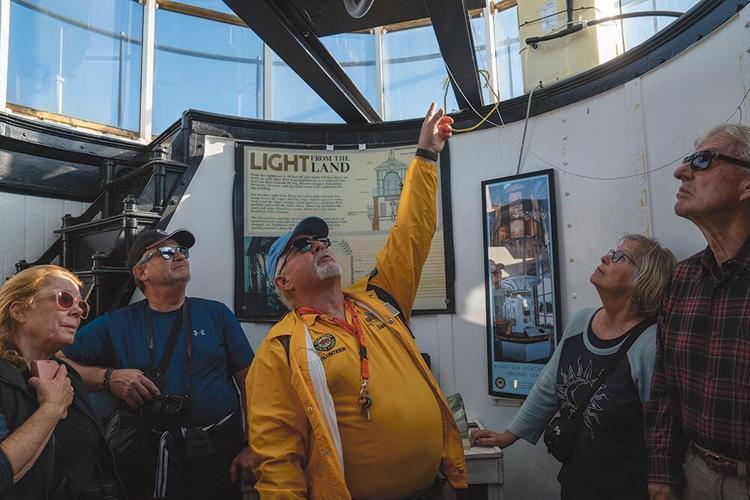
Steve Stiles, a docent with the Central Coast Lighthouse Keepers, leads a group of visitors on a tour into the lighthouse tower, pointing up at where the Fresnel lens would typically be.
On a tour of one of these historic places in Big Sur, two docents, John Hansen and Steve Stiles, guide 14 guests up a 361-foot-tall rock known as Point Sur, which, in 1866, was put aside for a future lighthouse. The feature is composed of volcanic rocks – a type of basalt – they point out, as they inch up the path, telling stories of shipwrecks and life in Big Sur in the 19th century.
Construction began in 1887, and two years later, the buildings were finished. The light in the tower was officially lit on Aug. 1, 1889. Eighty-three years later, the lighthouse keepers left, and the magic of the tower’s very own Fresnel lens was removed, eventually making its way into storage where it remains to this day.
“It was a hard life,” says Hansen, who has been a docent at Point Sur for 22 years. He goes on to explain that in the late 1800s after the lighthouse was established, only families were encouraged to operate the lamp due to how lonely and difficult the job was known to be. By the 1920s and ’30s, five families lived there, keeping each other company until Highway 1 was completed in 1937, expanding access to Monterey.
Hansen keeps a set of tour notes for reference, and under “Family Life,” one line reads: “Nice place to raise children if you can keep them in the yard.” He shares stories during the tour of children falling off the rock – some 50 feet – only to be saved by shrubs below.
“A common misconception among visitors is that they think lighthouse keepers were completely alone,” Hansen says. “In reality, each station was its own little community.”
But still, that community was isolated. Docents tell stories of how the large rock was located a half mile from “real land,” separated by a sandbar, and that the lighthouse keepers would spend eight hours a week just on cleaning – wiping the lens with linen and vinegar, scrubbing down the hundreds of fragile glass panes.
Today, the lighthouse is still far from its original lens, sitting in storage with State Parks, and volunteers are working to get it back.
ROUNDING THE CORNER up the rock, the white lighthouse tower comes into view, standing tall over Point Sur. Beyond it, the Big Sur coastline sparkles on an especially clear, windless day.
“Very unusual,” Hansen notes. “The wind can max out at 75 miles per hour.”
Also in view are three, newly renovated bridges that stand out against the historic backdrop. Just before the pandemic struck in 2020 nonprofit Central Coast Lighthouse Keepers (CCLK) and State Parks had wrapped up years of renovations to restore a total of five bridges. Established in 1993, the group was founded to preserve the history of Point Sur, the lighthouse and surrounding rock. Working in collaboration with California State Parks to support Point Sur State Historic Park, the group is entirely run by volunteers and has no paid employees. Over the years, they’ve researched the lighthouse’s history, collected and written detailed records and raised millions to restore the site.
Point Sur Lighthouse has a peculiar relationship with the land that surrounds it. While the rock and the lighthouse is operated and managed by Point Sur State Historic Park, established in 1986 and a part of the California Department of Parks and Recreation, the area that surrounds it is privately owned. State Parks officials asked that the Weekly not take photos of the historic ranchland surrounding the rock, nor name it in this story, even though El Sur Ranch is labeled with signage on fences along Highway 1, and can be viewed from public places.
In order to visit the state park property, visitors must arrive early (it’s first-come, first-served), where tours are offered only three days a week (Wednesdays and weekends). Upon arrival, visitors must wait for a docent to unlock the gate and guide them through El Sur Ranch to their destination.
Halfway to the top during a tour, a lesser-known fact emerges. As one docent tells the story of the USS Macon, a 785-foot dirigible that famously crashed and sank off the coast of Big Sur in 1935 during a storm, he stops to explain why the bridges were rebuilt.
Of course, the fortification of the bridges is needed for tours so people can walk safely up to the lighthouse and the keepers’ cabins at the top. But the bridges were a major step forward in a decades-long fight to return a beloved and important piece of history to its rightful place: the first order Fresnel lens.

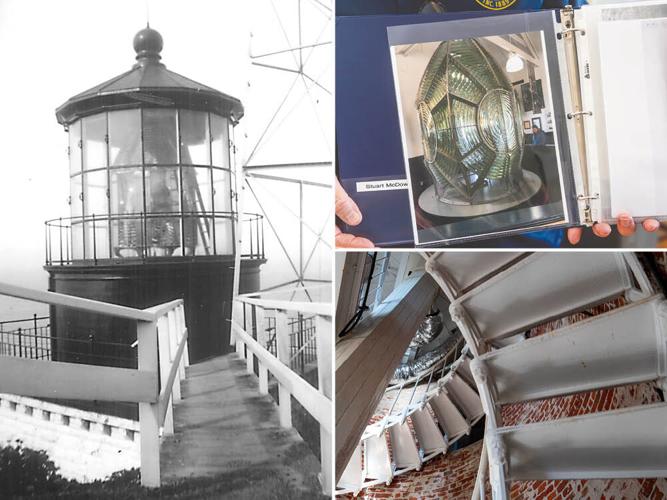
(top) A docent at Point Pinos Lighthouse in Pacific Grove holds up a binder depicting a first order Fresnel lens. He notes how small the person in the background of the photo appears; first order Fresnel lenses hovered around 8 feet tall. (bottom) The interior stairway to the top of the tower.
THE FRESNEL LENS came out of the early 19th century, invented by a French physicist named Augustin-Jean Fresnel who died in 1827 at age 39. It was a revolutionary invention for its time, able to manipulate and catapult light into space using an array of curved, glass segments. The lenses came in different “orders,” or sizes, depending on how powerful they needed to be, which was contingent upon the size of the lighthouse and its location. The size of the lens would, to an extent, determine the staffing at the lighthouse – the bigger the lens, the more maintenance was required to monitor it.
The first order Fresnel lens is the largest most powerful lens of them all, used in lighthouses with the tallest towers and capable of reflecting light miles from shore.
“The French were kind of leading society in science back in the 1800s,” says Stiles, the other docent leading the tour group into the lighthouse tower. He points to an area above where he’s standing, as people pack the hot room like tinned sardines. “Our light sat right up in here. It basically filled the room close to the glass windows on the side.”
Part of the draw to these Fresnel lenses – beyond their beauty and magnificent design – is their versatility and the unique role they played at each lighthouse. The lenses could either be fixed, shining a steady beam out to sea, or rotating, blinking at set intervals to increase visibility and give each lighthouse its distinctive light characteristic.
Even in these seemingly straightforward technical details, lore persists. Myths about these lights and their design have led to the common misconception that a lighthouse’s light source changes intensity. In reality, the light remains constant – it is only the lens that creates the effect.
The first order Fresnel lens is 8 feet high and 6 feet in diameter, with 16 panels and 568 glass prisms, weighing almost 4,000 pounds. Including the hardware, foundational structure that holds the prisms and mirrors in place, and its turning mechanisms, the entire assembly weighs 12,700 pounds and stands 18 feet high. A lens this size and weight would not be able to make it up to the tower via the bridges in their original state; in 1960, one of the five bridges failed when a delivery truck was driven across it.
As technology advanced and lighthouses became less essential, the lens at Point Sur Lighthouse became automated in the 1960s. And in 1978, the lens was moved to the Monterey Maritime Museum, now Monterey History and Art at Stanton Center, located at Custom House Plaza in Monterey.
“The Fresnel lens was a quantum leap forward in technology,” says Stuart McDowell, a docent at the Point Pinos Lighthouse in Pacific Grove, which still has its original lens in place – a smaller, third order Fresnel lens. “There is no other system that works as well at refracting light.”
He adds that the design of the lens was such that only 10 percent of the light escaped – capturing 90 percent of it. Today, this design is used most notably in car headlights, where a small light behind the plastic or acrylic lens turns into a spotlight. At Point Pinos Lighthouse, they make a point of this by placing a 4-watt bulb behind a fourth order Fresnel lens, a much smaller lens around 2 feet 8 inches tall, enabling visitors to observe the light beam out from the glass.
“When we took over the lighthouse in the early 1990s, CCLK started restoring the place because it was in such bad shape,” Stiles says. “We hired a company from New York to handle the restoration – they also restored Pigeon Point – to bring it up to standard so we could get our Fresnel lens back.”
Nearly a decade after CCLK began working to get the Fresnel, it still hasn’t returned.

Carol and John O’Neil have led the Central Coast Lighthouse Keepers, overseeing much of the funding and restoration efforts, as well as collecting and preserving historical documents for Point Sur.
PEOPLE WHO ARE DRAWN TO POINT SUR LIGHTHOUSE and the meaning of this lens relish in the details, from the steam-powered fog signals and kerosene-fueled light to the geological intricacies of the site: the Franciscan greenstone (a type of rock) and the old Farallon tectonic plates that played a significant role in shaping the Big Sur coastline and the rock through metamorphism.
Docents undergo a minimum of 70 hours of training, which includes attending classes, alongside independent study time, several visits out to Point Sur to shadow tours, and, of course, creating their own tour plan – detailing both the information they’ll share and how they’ll guide their visitors.
“It’s a pretty big commitment. The training goes anywhere from three-and-a-half months or so,” Hansen says.
CCLK and State Parks have spent roughly $4 million on the bridges alone, with additional funds directed toward restoration projects related to Point Sur.
Outside of the lighthouse stands a series of keepers’ homes where the families lived. Today, these homes are carefully restored, full of historical mementos and furnishings that reflect the era in which the families lived – thanks to the volunteers and a series of grants they secured over the years. It is estimated that the volunteers put in $125,000 worth of labor, not including the furnishings, according to Point Sur historian and CCLK member Carol O’Neil.
“The whole point of doing that is to evoke some sort of emotion,” O’Neil says, speaking to the curated setup of the space which brings a guest back in time. “We get that response from a lot of people, especially the chrome dining set, people will come in and say, ‘My grandma had that!’”
While the Fresnel lens remained at the Maritime Museum for a couple decades, CCLK members over time grew concerned about its state and care. All lenses are technically owned by the U.S. Coast Guard, and when they’re in museums, they’re on loan. After the Maritime Museum fell on hard times in 2010, Carol O’Neil’s records show that volunteers from Point Sur were called to help clean the lens. Eventually, the calls stopped, which caused concern among the group.
The tricky thing about million dollar lighthouse lenses, O’Neil says, is that once you remove a Fresnel lens from a lighthouse, it transforms from a piece of equipment into a museum piece – an artifact. Once an artifact, it is precious, and requires special ways of taking care of it. It needs to be in a climate-controlled environment, there must be control over the way the light hits the glass, there need to be alarms established in case of disaster and the building has to be earthquake safe.
Eventually the museum could no longer care for nor cover the cost of transferring the Fresnel lens into storage, which had to meet the U.S. Coast Guard requirements. As a result, the CCLK paid for a lampist – an expert in handling and transporting such equipment – to oversee the transfer. CCLK volunteers put in additional work, assisting the lampist by building specially designed wooden crates to safely store the disassembled lens.
“I think [the U.S. Coast Guard doesn’t] have the capacity for managing these lenses,” says Matt Bischoff, cultural resources manager of California State Parks Monterey District. “We have that expertise. So in our case, it makes sense that we manage and maintain it for them.”
With the lens in storage and knowing that Point Sur would be interested in having it, CCLK members approached the museum curator for the U.S. Coast Guard to inquire about returning the lens.
The curator agreed: The Fresnel lens could go back into the lighthouse, provided several conditions were met. CCLK had to prove that the lighthouse could safely house the lens as an artifact, not just as a piece of equipment.
“Our nonprofit actually flew the curator out here so she could meet with us and see what we could do,” O’Neil says. “They convinced her that we could take the lens and put it back in the tower, you know, make it like a museum.”
Despite the hurdles, O’Neil explains this story simply, just a matter of process and time. Restore the bridges, retrieve the required permitting – protecting a rare blue butterfly in the process – and last, but certainly not least: seismically retrofit the lighthouse building. The bridges were restored to ensure safe passage and facilitate the transport of materials, forcing tours to shut down for about 14 months. Just as the light station was set to reopen, the pandemic extended the closure.
The butterfly habitat – there was a pause.
“We had some kind of buckwheat along the road and hillside, and that is habitat for the rare Smith’s blue butterfly,” O’Neil says. “It’s kind of a ‘don’t ask questions you don’t want the answers to,’ but it ended up costing millions.”
As part of bridge renovation permits, CCLK paid thousands to the state’s only approved blue butterfly expert to prove there were no Smith’s blue butterflies, despite the presence of buckwheat. The expert found no butterflies – a hurdle CCLK and State Parks officials thought was cleared.
But the required authorization letter from the U.S. Fish and Wildlife Service never reached the right hands in time, O’Neil says, stalling the process. Missing the deadline set off a chain reaction of delays, ultimately costing them their contractor and increasing the cost four-fold.
What was initially estimated to cost a little over $1 million – to reconstruct the five bridges – ended up costing around $4 million.
“We need to comply with a variety of state laws and policies, and protect all resources, not just cultural,” Bischoff says. “The Smith’s blue butterfly habitat is just one of the resources that we’re charged with caring for. So it can be a very difficult environment.”
Five planting sessions and $500,000 later, State Parks officials had successfully planted the buckwheat in a place where the wind and sand would not cover their efforts. To this day, volunteers with CCLK have never seen a blue butterfly.

A docent stands next to one of the newly renovated bridges, one of the tasks the CCLK took on after Point Sur fell into disrepair, and one of the requirements needed to ensure the lens could return safely to the lighthouse.
THE BIGGEST CHALLENGE – and the reason it’s taken so long to return the lens to the lighthouse – lies in the need to retrofit the structure for seismic activity, yet preserve its historic integrity.
State Parks and CCLK have been working with an engineer to finalize the treatment, navigating through a complex set of plans to fortify the buildings on Point Sur against earthquakes, ensuring both the lighthouse and its iconic lens are protected from catastrophic damage. The engineer, as it turns out, is actually a descendant of one of the lighthouse keepers.
“It’s not just about the lens, it’s about the lighthouse. It’s a beautiful building with an incredible story to tell, and we need to preserve that artifact as well as the lens,” Bischoff says. “It’s a tough balance, it really is.”
A daunting task, but CCLK and State Parks believe seismic retrofitting is not only possible – even in a rugged place like Point Sur – but possibly achievable within the next year or two. The initial cost estimate was $1.5 million, though Bischoff notes those numbers will be refined as plans are finalized.
“You can’t protect 100 percent – if the epicenter is right under the rock, there’s no guarantee. But you mitigate risks as best you can with the least impact on the building,” he adds.
The irony in all of this is that, to this day, the lens sits in storage in Monterey in crates custom built by CCLK. It begs the question: What is the true worth of such an artifact? And whether, if taken elsewhere and brought out of storage, this massive piece of equipment would carry with it the same meaning. Fresnel lenses exist all over the world that have belonged to their own lighthouses, but this one is Point Sur’s.
For those who visit Point Sur, the journey is intentional. Visitors go out of their way to show up early for first-come, first-serve tours, waiting alongside Highway 1 after a drive of sometimes hours along the coast, then hike up 300 feet to learn about the lighthouse, the keepers, the Fresnel lens and the rock itself. Point Sur has also appeared on television, most famously in the paranormal investigation series Ghost Adventures on the Travel Channel, as well as in California’s Gold, hosted by Huell Howser in 2000.
Perhaps, in a future without CCLK, if the condition of the lighthouse were in shambles, there could be some justification for the lens to remain in crates, waiting for someone to care for it.
Still, after the millions of dollars spent, the restoration of butterfly habitats for species never actually seen in Big Sur’s sandy, windy environment, the lens remains unseen, locked away.
LIGHTHOUSES AND THEIR HISTORY are found in places like Point Sur. They’ve always been in relatively rugged, remote locations. If Point Sur can’t be seismically retrofitted to survive an earthquake, might it not be the most fitting fate for the lens to stay where it belongs, in the place that suits it best? Alternatively, if the group had existed at the time of its removal, would the lens still be sitting in the tower today, with no renovations, no alarm systems and no seismic retrofitting plans in place?
While the U.S. Coast Guard is technically responsible for such artifacts, its care and fate have largely been in the hands of the volunteer group.
These queries are not necessarily those of the Central Coast Lighthouse Keepers – though O’Neil does not wholly disagree. In any event, the group trudges onward, close yet still far from reclaiming the magic of their lens.
“These lenses are very valuable,” O’Neil says. “But [the lighthouse] is where it belongs.”
(2) comments
I've had the good fortune to visit the Big Sur Lighthouse, so I was happy to read this wonderfully thorough article detailing the history of this precious local resource and the efforts that have gone into preserving its history for future generations to enjoy. A BIG THANK YOU to Katie Rodriguez for this extremely interesting and thoughtful article. I learned a LOT from your research! And another BIG THANK YOU to all those volunteers who continue to share their time and expertise so that the rest of us can continue to enjoy this valuable piece of local history.
Wonderfully detailed and written story. You have the skills of a professional historian!
Welcome to the discussion.
Log In
Keep it Clean. Please avoid obscene, vulgar, lewd, racist or sexually-oriented language.
PLEASE TURN OFF YOUR CAPS LOCK.
Don't Threaten. Threats of harming another person will not be tolerated.
Be Truthful. Don't knowingly lie about anyone or anything.
Be Nice. No racism, sexism or any sort of -ism that is degrading to another person.
Be Proactive. Use the 'Report' link on each comment to let us know of abusive posts.
Share with Us. We'd love to hear eyewitness accounts, the history behind an article.