

A poetry reading is wrapping up at the Henry Miller Memorial Library on a balmy July night. A few dozen people mingle on the wooden deck that reaches around back, nestling into the duff of a redwood grove. Sinewy young guys bounce at the ping-pong table while middle-aged women in high-quality sandals help themselves to tea off a redwood table stacked with Weekly newspapers and leftover wedding cupcakes.
A couple of dark-haired volunteers work inside the store stacked with books by Henry Miller and his contemporaries, books on Henry Miller, Big Sur nature guides, a crate of vinyl and other artsy merchandise. The wooden walls are hung with framed pictures of Henry Miller, always with that ironic but satisfied smile, and posters from concerts played on the HMML stage by artists including Philip Glass and Yo La Tengo.
The library’s tongue-in-cheek motto is “Where nothing happens.” But chances are good, if you pick up any given issue of the Weekly, you’ll find an event listing for something happening there. Just this month, it hosted five short film screenings, three audio story nights, three book readings, two low-key concerts, a Gypsy-flavored Shakespeare performance, a festival featuring a Burning Man art car and a ping-pong championship. The June big Big BIG Sur Fashion Show, the library’s annual circusy showcase of over-the-top non-fabric fashion and local artistry, sold out in a matter of hours.
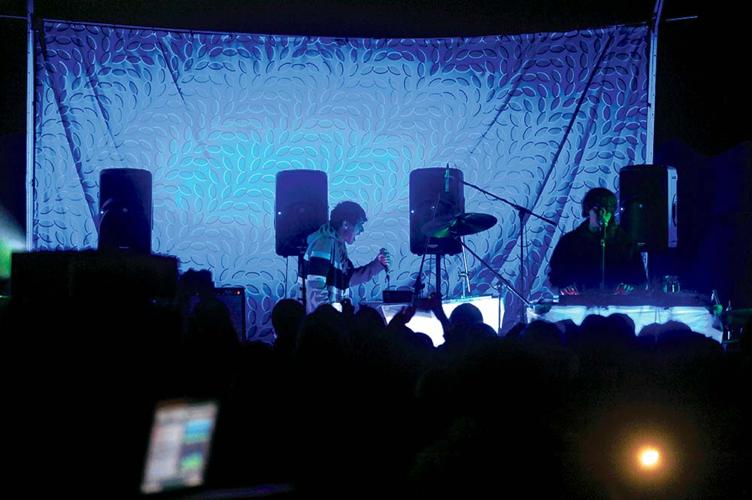
Parties like that make the HMML one of Monterey County locals’ most beloved venues. But it’s concerts by big-name bands like Flaming Lips, Arcade Fire, Red Hot Chili Peppers and MGMT – with tickets capped at 300 heads – that build the library’s international reputation as an earthy, edgy artistic destination.
“The tourists who come to Big Sur anyway will stop by and buy a book or two, and maybe put a donation in the jar,” says HMML Executive Director Magnus Torén, who’s headed the venue since 1993. “That’s ultimately who we are. If we were to stop having those kinds of events, that would really tie a knot in our operation.”
One problem there: The library doesn’t have permits to host concerts. As far as county health code is concerned, its two toilets can only handle a crowd of 80. It doesn’t have enough parking – technically, it has noparking. It doesn’t own the entire property it sits on or the well it draws water from. And that water’s not legally potable.
The county is finally calling the library on it, but with surprising leniency. That dance between code-driven government and inherently kooky nonprofit brings up the same electric tensions that dog the greater Big Sur community: the charged dynamics between visitors and locals, regulations and independence, hipness and peace.
“The library’s a great forum for talking about a deeper understanding about what’s happening in Big Sur,” HMML board member Chris Lorenc says. “What does it mean to live here, and what is the right way to make this available for travelers to experience this coast?”
The permitting problems started when a woman complained to the county that there weren’t enough bathrooms at a concert, prompting the county to issue a code enforcement letter in December 2011. At least, that’s the short story. HMML managers had figured the place was something shy of code-compliant for a long time.
“The library has in essence been operating under the radar since 1981. Throughout that time, there was this little gnawing concern about not being completely up to county and state standards,” Torén says. “Nobody here really wanted to ask the question unless it had to be asked. If the bear is sleeping, the county kind of likes that, too.”

Animal Collective plays at the Henry Miller in April 2011.
The bathroom complaint woke up the bear. Now the County Planning Department is processing a case file more than 3 inches thick. The big issues:
• • •
Bathrooms. County health code requires one toilet per 40 people at events. The library has two single-seat bathrooms. An HMML schedule on file with the county counts 46 events in 2012: seven of them at the 300-person maximum, three at 150 and the rest at 50-100. County planners are telling HMML to either stop hosting events with more than 80 people or provide more toilets. Each new permanent bathroom needs its own leach field to filter the liquid waste from the septic tank.
Water. The library draws its water from a well tapping Graves Creek. Under state regulations, that surface water has to be filtered and disinfected to be potable. The well itself sits on the neighbor’s property.
Lot line. In the early 1980s, soon after Miller’s pal Emil White donated his 0.63-acre property to Big Sur Land Trust, staff did a survey and found the lot line goes right through the office/storage shed next to the main library. Part of that building, too, encroaches on the neighbor’s lot.
Parking. The dirt pullout in front of the HMML can accommodate 11 cars. When those fill up, visitors park along the highway shoulder to the north, sometimes crossing the two-lane highway at a treacherous curve on the coastal bluff.
The permitting process has revealed the library’s parking area is Caltrans property – so officially, as county planners see it, the library has zero onsite parking.
Even if planners go with the unrealistic formula of four people per car, the library’s full-capacity events require 75 spaces. There’s no room for them onsite.
Permits. The library property is zoned for watershed conservation. Under that designation, it’s allowed to host literary events like book signings and poetry readings. But planners say HMML needs a coastal development permit for things like weddings, food festivals and concerts.
“The events they are having, they never did get permits from our office,” Senior Planner Luis Osorio says. “Most people would agree this is a cultural venue for the community and tourists. We understand that. It doesn’t mean they’re not subject to the regulations.”
• • •
My wedding at the library was in less than three months, and I was scoping the space so I could plan those awful bridal details like table rentals and decorations.
I walked through the library gate and froze: What had been a quaint green lawn on my last visit was now, in March 2012, torn-up dirt. Torén told me crews had just installed new leach fields. Seeing seeds of panic in my eyes, he assured me they’d be covered with nice mulch by June.
I tried to picture a wedding on wood chips. They’d stick in my dress. My toddler would try to eat them. I was all for water conservation, but we were paying a few thousand for the venue rental. It had to be grass.
A week before the wedding, I was back at the library for the big Big BIG Sur Fashion Show: circus acts, fabulous salvaged fashion, 300 beautifully hatted and feathered heads – and a tender green lawn. Torén, decked out like a dapper ringmaster as the show’s MC, asked everyone to be gentle with the sprouts.
The lawn looked great for the wedding. I’m forever grateful.
There will always be a gooey caramel place in my heart for HMML, the enchanted setting for the best day of my life. And it’s not just me. Feeding the magic of that redwood-ringed lawn are the innumerable souls sharing superlative memories. For some, the night Red Hot Chili Peppers played was the best concert ever. For others, maybe, Big Sur Food & Wine dished the best pork belly ever. Just this week, someone probably posted on Facebook that the Big Sur International Short Film Screening Series was their best cinema experience. Ever.
Considering all the code violations, county planners could have threatened to shut down the library. Instead they’re giving HMML leeway to find resolutions for each problem:
Bathrooms. Torén stresses HMML won’t add bathrooms unless the county issues its event permits. “We didn’t raise money to build bathrooms,” he says. “We raised money to bring the library into compliance with county regulations.”
Current plans place the potential new bathrooms in the northeast corner of the library’s main building, adding 144 square feet to the library’s current 782 and bringing the number of toilet seats to four. Two new leach fields to accommodate the additional wastewater are already done.
Roger VanHorn, senior environmental health specialist at the Monterey County Health Department, says until the new potties are built, library managers can still hold up to 10 events of more than 80 people per year, using portable toilets for each additional 40 heads.
Water. For now, the library is selling bottled drinking water. A chlorinator treats water coming out of the tap, and VanHorn expects the library to install a slow sand filter to make it potable. “We want them to get their treatment system online as soon as possible,” he says.
Lot line. Library managers are in talks with HMML’s neighbor, Tim Gill, to buy the roughly 0.04-acre chunk they need to expand HMML’s property line around the encroaching office building. They’re also discussing an easement allowing HMML’s continued use of Gill’s well. “A resolution is imminent,” Gill says.
Parking. Caltrans says library visitors can keep parking outside the highway white stripe, or fog line, both in front of the library and along the highway.
“Anyone is allowed to park along the shoulder,” Caltrans spokeswoman Susana Cruz writes by email. “If for some reason there was a row of cars blocking a patrol car’s access to pull off the road, then [California Highway Patrol] would handle that aspect of enforcement.”
Still, the library needs some legitimate event parking on the books. Osorio says planners and library managers have agreed to limit full-capacity events to 10 per year and designate 75 offsite parking spaces for a shuttle system.
HMML Board President Maria Teutsch says the library is working with the county on a traffic plan including new lights, signs, shuttles and carpool requests. She expects the library will have to adjust either the number or the size of its events: “We want to keep it safe.”
Permits. Once all of the above issues are addressed, Osorio says, the library will be issued a proper coastal development permit and can carry on.

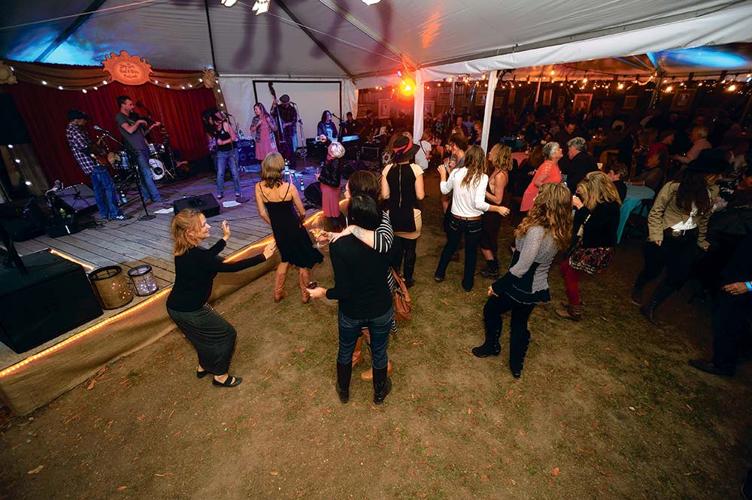
Library visitors feast to live music at last year’s Big Sur Food & Wine Festival.
Actually, it can carry on regardless. Because no one wants to be the jerk who shuts down the Henry Miller Library.
• • •
In late 2011, when the Weekly first reported HMML’s bathroom shortage, VanHorn pinned the cost of similar septic upgrades at $50,000.
The next year, HMML participated in the annual Monterey County Gives! charity campaign. The library’s application stated HMML could be forced to stop hosting events if it didn’t modernize its water system and improve its bathrooms. The project budget: $140,000.
Readers dug deep to support HMML. Their donations earned the library matching funds and two bonus grants of $1,000 each. Gives! presented the library with a little over $51,000 in early 2013, according to Dan Baldwin, president/CEO of The Community Foundation for Monterey County, the Weekly’s partner in the Gives! campaign. (Dollar amounts in this story are rounded to the nearest thousand.)
Almost a year and a half later, there are still no new bathrooms – an observation that’s raised questions about how the library is handling those funds.
An HMML budget spreadsheet, provided to the Weekly via library accountant Jaci Pappas, shows $29,000 of the Gives! donation went into the HMML capital fund established in 2012 to pay for the code-compliance upgrades. The rest went into the library’s general operations fund – not the use specified in the library’s Gives! application.
But the capital fund is fairly flush for a project this size: $284,000, minus the $111,000 already spent. Pappas says the remaining $173,000 should be enough for HMML to finish its county permit process, but not enough for the bathrooms.
Teutsch says the cost estimate keeps going up. “It’s like whack-a-mole,” she says. “It’s this little delicate watershed, so our number-one concern is to keep that intact.”
Another unexpected cost: increased property taxes. HMML hasn’t paid much in the past; its 2012 income tax forms value the land and buildings at $40,000. But that same year, when Big Sur Land Trust signed over the library title to the nonprofit HMML Foundation, the County Assessor’s Office reassessed the property at $383,000 – $40,000 of it tax-exempt. The resulting property tax bill, according to County Assessor Steve Vagnini, was $3,600.
Torén pushed back hard, arguing the library shouldn’t be taxed. “Why were we targeted? What methodology do you use?” he wrote in a letter to Vagnini.
Arguing that the library’s events carry out HMML’s charter, he adds: “Will 65 web links satisfy? Or 102? Links to stuff in France? Greece? What about China? Articles about us in Calcutta? How much outreach is enough for the county?”
Vagnini says his staff reviewed the library’s nonprofit status but found, even if concerts are considered part of the mission of promoting Henry Miller’s works – and that’s a stretch – the fact it hosts weddings dissolves its tax exemption.
“What’s so special about the Henry Miller Library that we have to treat them differently?” Vagnini asks. “He made it sound like I was going to put him out of business.”
That Henry Miller Memorial Library will have to shut its doors without quick, generous help was a message library staff pushed after the county issued its code enforcement letter.
The San Francisco Bay Guardian music blog, for example, wrote in 2012, “[T]he library will face closure this fall unless it manages to raise $150,000 to upgrade its water system to existing code.” The Weekly has published similar statements.
Almost all nonprofits rely on public and private generosity to stay afloat, and HMML is no exception. The library is a modest institution, with total assets at about $796,000 – more than half of that value in the archival collections, according to the 2013 accounting spreadsheet.
But it isn’t floundering financially. Revenue last year was $627,000, a healthy $102,000 in the black. Sixty-five percent of that revenue was from events, 25 percent from sales and 9 percent from donations.
Lorenc, the HMML board member, says it was fair to frame the compliance issue as a threat to the library’s existence back in 2012. “At the time, I think it was,” he says. “That’s what it felt like.”
Now, with the permitting process on a clear path forward and the library’s finances stable, he’s not worried about HMML closing. “It’ll still go on,” he says, “and it’ll still be great.”
The library’s public image as a cultural treasure is the key to that greatness. HMML’s volunteers love the library so much, they sweep its floor, make coffee for its visitors and help out at its events. Musicians love it so much, they do live shows for a fraction of their regular fees. The media love it so much, HMML doesn’t have to advertise. “We never spend a dime on PR,” Torén says. “We always have people like the Weekly supporting us and writing about our events.”
With that usual stream of positive press, library managers seem thrown off balance by questions about HMML’s accounting and permitting. Both Torén and Teutsch flash hostile at times in the writing of this story.
“You are bent to write about this, and it’s going to hurt the library,” Torén says. “The risk is, if [county planners] go very much by the books, the library may have to be very much curtailed. To have these kinds of things in the public discussion would not be good.”
It’s a typical Big Sur point of view: fiercely independent and wary of outsider influence, despite its dependence on tourism. At HMML, cell phone reception is sketchy, the redwoods tell quiet stories and weirdness is normal. It’s the straight stuff – bureaucracy, county code, property taxes – that feels out of place.
Even the county planners in Salinas seems sensitive to that: They’re tackling 30 years of broken code and missing permits in the gentlest ways they legally can. As long as the permit application is being processed, Osorio says, the county isn’t telling HMML to stop hosting big events. There are no deadlines. “Everybody’s making an effort toward a resolution,” he says. “At some point in time, everything will be fine and we’ll move on.”
Torén appreciates that leniency. “The county’s very generous, and they have been very cooperative,” he says. “I totally agree with the regulations.”
When HMML is finally up to code, he adds, the community can expect another big fundraising campaign.
Flanking the library’s walkway, like long draped coffin lids, are enormous wood slabs imbued with memories of weddings, concerts and quiet epiphanies. They came from the 500-year-old redwood tree called Henry’s Erection, which leaned over the library’s lawn toward the highway at a 60-degree angle. BiG SuRCuS acrobats contorted on that tree for the howling crowd at the fashion show. A disco ball dangled from that tree during the Flaming Lips concert.
I got married under that tree two springs ago. Precisely six months later, the trunk split at the base and snapped, landing theatrically on the parking lot. It spared the main stage, crushed no cars and hurt no one. Instead, like a sacrificed lamb, it provided astonishingly high-quality lumber, free of rot and termites.
Torén and his assistant, Mike Scutari, had it milled into 48 slabs, each 12 feet long. Torén says two have already sold for $9,000 each, another for $5,000. The rest will be auctioned off Aug. 9.
It would be understandable if he considered it a sign from someone in the spirit realm who, with an amused smile, decided to drop the library a gift.
“Henry Miller was such an enthusiastic consumer of culture,” Torén says. “Anything you bring to a place like this within those categories of art, I feel like Henry’s hanging out from above and egging us on.”
The permitting issues reflect HMML’s growing pains as it becomes more of a high-profile cultural center.
“I’d like to see it continue to function, but there is some concern in the community about the ongoing events,” says County Supervisor Dave Potter, who arranged a meeting today between Torén, county staff and Caltrans.
On a coast that’s had a lot of code exceptions gradfathered in, Lorenc says, the library has a unique opportunity to plot a sustainable path forward. “The county permitting process is going to tell us how big the canvas is,” he says.
In the future, Torén says, he’d like to expand the library’s film and storytelling programs. He also plans a bookshelf dedicated to the late Big Sur documentarian Jeff Norman.

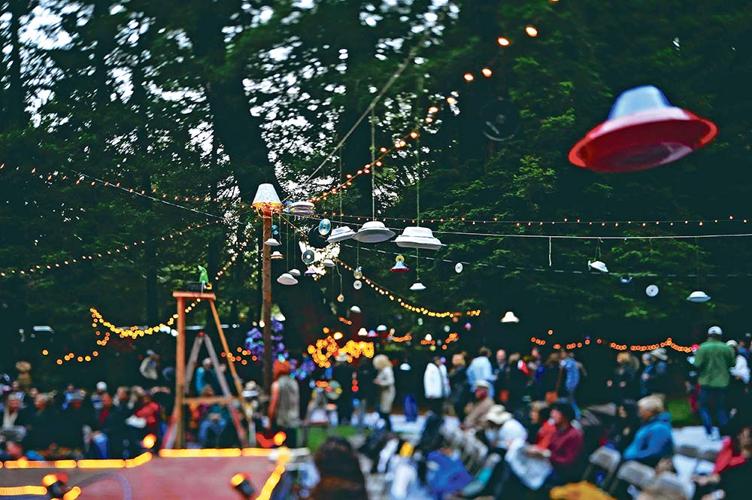
The HMML maypole anchors quirky decorations at the 2011 Big Sur Fashion Show.
“My vision is to significantly enhance the presence of the natural and cultural history of Big Sur in the library itself,” he says. “[The library] is to continue to serve the visitor as a little oasis within this marvelous coastline. That includes keeping it non-commercial – at least the illusion of non-commercial.”
(0) comments
Welcome to the discussion.
Log In
Keep it Clean. Please avoid obscene, vulgar, lewd, racist or sexually-oriented language.
PLEASE TURN OFF YOUR CAPS LOCK.
Don't Threaten. Threats of harming another person will not be tolerated.
Be Truthful. Don't knowingly lie about anyone or anything.
Be Nice. No racism, sexism or any sort of -ism that is degrading to another person.
Be Proactive. Use the 'Report' link on each comment to let us know of abusive posts.
Share with Us. We'd love to hear eyewitness accounts, the history behind an article.