
On a sunny Saturday afternoon on June 29, scores of people are gathered at Indian Canyon, about 14 miles south of Hollister in a forested, mile-long stretch at the eastern base of the Gabilan Range.
It’s a singular place – it’s the only federally recognized Indian land on the Central Coast, and according to Anne Marie Sayers, who owns it, it’s the only piece of land in the region that never fell out of Indigenous ownership, and during the Mission era, was a refuge for Indigenous people fleeing enslavement at Mission San Juan Bautista.
The canyon, bisected by Harlan Creek, is lined with cottonwood, sycamore and oak trees, and feels like a place barely touched by Western civilization – it’s off the grid, and at the end of a road.
The day’s celebration is Indian Canyon’s 27th Annual Storytelling Gathering, a fundraiser for nonprofit Costanoan Indian Research, and Sayer’s daughter, Kanyon Sayers-Roods, who also goes by her native name Coyote Woman, is emceeing the gathering.
Sayers-Roods is an artist, educator and tribal consultant, and like her mother, she grew up on this land, and while in front of the mic as attendees watch on lawn chairs and blankets, she pays respect to her mother. “Without her, this would not be happening,” she says, adding that her mom passed down these words of wisdom: “Honor the past to shape the future.”
Before introducing the kickoff to a ceremonial dance in the New Arbor, a sunken, wood-lined circle for ceremony just behind her, Sayers-Roods shares some of her own words of wisdom.
“All peoples, all nations, all of us, we all have had Earth-based spiritual practices in our family lines, in our timelines – when you honor your elders, your ancestors and your ancestors’ ancestors, we all have Indigenous lineages in our families,” she says. “We all have Earth-based practices that our ancestors practiced, and they all have their indigenous lineage from wherever they come from…
“I’m so privileged as an Indigenous person to always know where I come from, who always knows who my ancestors are, and I recognize how lucky I am even in the Indigenous community,” she continues. “But think about how we can all honor our Indigenous lineages, even if we feel disconnected or unrooted. As long as we’re in community together, we’re aligning in a good way.”
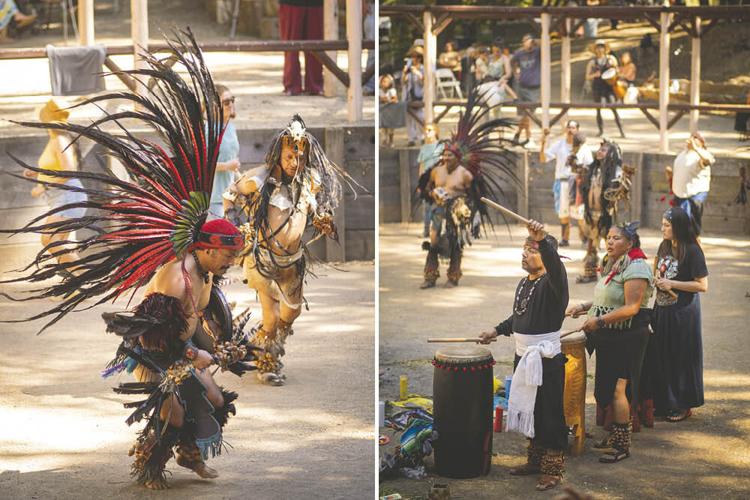
Minutes later, the singing and dancing begin.

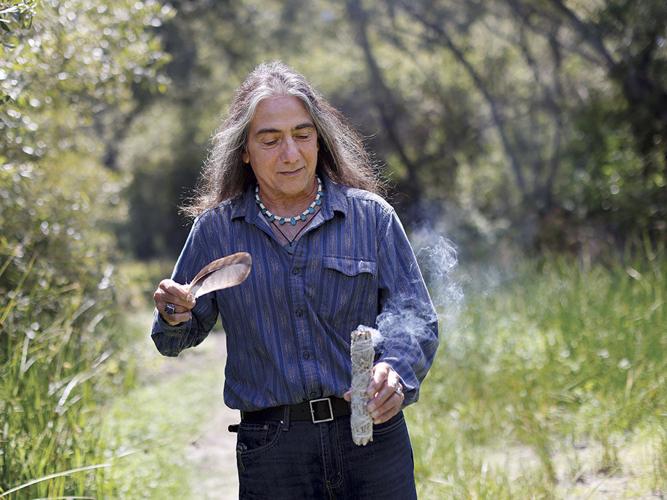
Seaside resident Anthony Mondragon, the great-grandson of the last speaker of the Mutsun language, is trying to revive the Mutsun Tribe locally.
SEASIDE RESIDENT ANTHONY MONDRAGON, a Monterey native, is less rooted in his Indigenous heritage, but he’s sowing the seeds to change that.
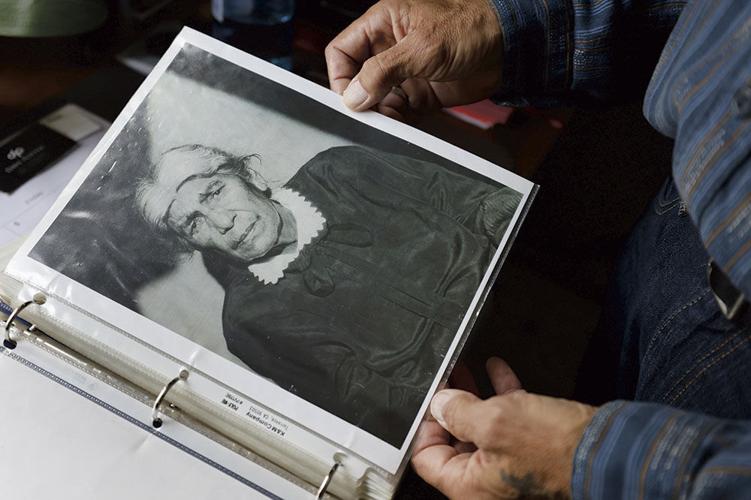
Mondragon’s great-grandmother was Ascencion Solorsano, the last known full-blooded member of the Mutsun tribe (pronounced “moot-soon”), whose ancestral lands stretched from the San Juan Valley west to Watsonville and Moss Landing, south toward the Pinnacles and north into the Santa Cruz Mountains and Gilroy. It’s estimated that when the Spanish colonizers arrived to the Central Coast in 1769, there were about 2,700 Mutsun speakers in the Pajaro River watershed.
Ascencion, as she is referred to throughout this story, was also the last known native speaker of the Mutsun language, and in the months before she died in Monterey on Jan. 29, 1930 at the age of 74, she was interviewed extensively by John P. Harrington, a linguist and ethnologist from the Smithsonian Institution in Washington, D.C.
Mondragon, who’s a contract painter, decided in 2019 to start a nonprofit that would strive to become something much like Costanoan Indian Research and Indian Canyon, a place for ceremony, education about Indigenous heritage and reconnecting people with nature. And not just anywhere, but in Monterey County, where he’s from.
He’s trying to put the Mutsun on the map – of all the Indigenous tribes that once existed in Monterey County, there is arguably none more obscure.
And Mondragon, 60, is uniquely positioned to help shed some daylight: On a recent day in the backyard of his house in Seaside, he pulls out a tote packed with Mutsun-related documents his father, who died in 1999, collected in his later years. Some of its contents are one-of-a-kind, and many others are hard to otherwise unearth.
He inherited them about a dozen years ago, and hasn’t even gotten through them all yet – they remain unorganized, just papers stacked upon each other. He has three more totes he hasn’t even tapped into yet.
Much of the story that follows is based on those documents, but some things are based on research uncovered independently, before even meeting Mondragon this summer.
Mondragon is not an academic, or even an activist – he just knows that his heritage is rich, and that the records he inherited are a priceless treasure, and he wants to spread the wealth and knowledge of the Mutsun.
Like Ascencion, and Sayers-Roods and her mom, his dream is to help keep the stories of the past alive in the present.

Ascencion Solorsano, in a photograph John Harrington took before she died in 1930.
ASCENCION WAS BORN IN SAN JUAN BAUTISTA ON JULY 22, 1855, to full-blooded Mutsun parents who preferred to speak Mutsun in the home, but encouraged their children to speak Spanish or English when out and about – it was the best way to survive and maybe get ahead.
As Harrington, of the Smithsonian, wrote in an obituary of sorts after she died, “her life was indeed like a bridge between modern and earlier times.”
There have been many stories written about Ascension’s life (Harrington was moved to write a poem; see p. 26). She was a singular woman, a medicinal healer and keeper of Mutsun ways who provided health care, often for free, to any in her community.
Her father was a farmer and later coffin maker, and according to Harrington, their family moved to Watsonville when she was young, but despite that, he writes that she never saw the ocean until she was 50.
But when she returned to San Juan, as it was then called, and when it was still in Monterey County, “she associated with the oldest Indians then surviving, many of whom were born in the [18th century]. It was during this period that she picked up her knowledge of the customs of the Indians, and learned many facts directly from those who had been eyewitnesses, although she acquired further information constantly by being with father and mother during the latter three-quarters of their lives, so that she knew whatever they told or talked about.”
In Harrington’s writings, which contain scores of ephemeral, folkloric stories, as well as Mutsun language, his praise for Ascencion and her contribution to history could not be higher.
“Her remarkable memory and truthfulness, unhampered by any crowding of her mind with English, resulted in her being able to hand this information to students of history and ethnology in a very usable form,” he wrote. “Her mind is as active as ever, her memory perfect and alert. The information she is giving is simply wonderful.”
Among the most interesting things written about Ascencion since Harrington’s writings is a 1978 article in Journal of American Indian Education, an academic journal. Penned by Margo Angel Man, who’s of Indigenous descent, it’s titled, “In the Gardens of Popeloutchom.”
In Man’s telling, Popeloutchom was essentially like the Mutsun Garden of Eden that for them existed in the present. She adds that the Mutsun, in their language, simply called themselves “Westerners” – they lived in the West.
Ascencion lived the latter part of her life in Gilroy where, Man writes, “She was known because of her mystical curative powers… Her wisdom was the accumulation from several generations of Westerners. Each year hundreds of sick and lame Indians made the journey to her home.”
Ascencion then did her best to cure them with tonics and ointments made from local roots and herbs.
But finally, Man writes, Ascencion, who was suffering from cancer, had a vision of her death in three days time – it must have been in 1929 – and so she took the black, silk dress she intended to be buried in and left her Gilroy home to stay with her daughter in New Monterey, where she expected to die shortly.
But death didn’t come as soon as she’d believed. Not long after she arrived in Monterey, Harrington, having heard there was still a speaker of the Mutsun language, showed up in Monterey to record everything Ascencion could remember, and have the energy to articulate. Harrington lived at the house for a few months, taking notes as Ascencion told stories lying on her deathbed.
In a letter Harrington wrote to a colleague in August 1929 about meeting with Ascencion, he says, “I certainly place this above everything else in California as regards immediate urgency.”
The Mutsun language had barely been spoken since 1850, and gaining her knowledge would be “filling a great blank in California ethnology.”
When Harrington arrived, Man writes, Ascencion told him, “You are a vehicle of God that comes to see me in the eleventh hour to save my knowledge from being lost. I will teach you up to the last day.”
In distilling Ascencion’s story, and what she told Harrington, Man writes that “aged women, it was believed, had the power to control the growth of plants” and that “nature provided such abundance of food that the Westerners always had an oversupply of wild fruits, grains and seeds.”
She adds that the secret of the Mutsun’s health, Ascencion insisted, was bathing in cold water every morning. Bows, meanwhile, were expertly constructed, and arrows affixed with eagle feathers could cut through even bears, while baskets woven by the women with grasses were so tight they could hold water without leaking.
Man writes that as Harrington was beside her in her final months in the fall and winter, others came to join him at her bedside: “The audience increased as word of the wise woman spread.” The last line of Man’s story reads, “It was January, 1930, when the last Westerner, Ascencion Solorsano, left the ruins of the garden of Popeloutchom.”
The gift Ascencion gave to Harrington, and future generations, wasn’t just decoding a language – it was stories, a bridge back through time.
Thankfully, Harrington took a lot of notes.

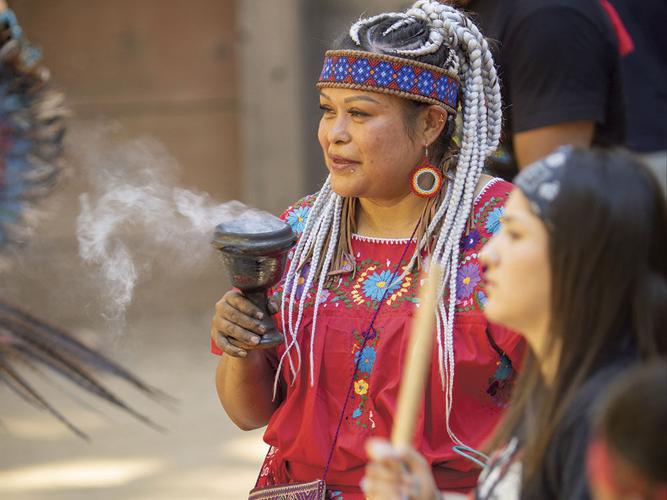
At a storytelling event in Indian Canyon in late June, singers, dancers and attendees took part in ceremony and celebration.
MONDRAGON SITS ON A PILE OF RICHES that even he admits he doesn’t yet fully appreciate.
In his collection of documents is a binder with hundreds of pages of Harrington’s notes, typewritten, that are filled with the folklore of the Mutsun, and the Costanoans – an umbrella term, along with Ohlone, to describe the many Indigenous tribes of the Central Coast.
And while Harrington’s notes are available in the Library of Congress, including digitally, accessing them is painfully cumbersome. The notes are disorganized, and most of them are handwritten and often not legible.
But the collection that Mondragon’s father assembled late in his life separates some of the wheat from the chaff, and it’s worth taking a brisk tour through a few of the more colorful stories Ascencion passed down, many of which lean into magic realism.
There was a woman, Dona Tomasa Mendias, who was a devout Catholic who lived along the Watsonville lagoon. Yet she had a son who forsook Catholicism and became a Mason, and when he fell ill and did not mend, Mendias put out a call for help.
Harrington’s notes channel Ascencion’s voice, not his, and he writes, “He was lying upstairs about to die, when… a buggy arrived with two men in it very well dressed, in black, and they drove up in front of the house. They stopped the buggy and into the house they went, they brought him downstairs, they raised him into the buggy and they left with him. The children and mother were horrified. They rushed upstairs to where he was lying, and there they found him dead. Surely those were demons that came to take him away.”
The stories in the notes also contain much tradition – when the Mutsun tried to encourage rain, they would make a fire in a sweathouse and the men would sing and dance. Every time a song finished, the women would throw seeds they had gathered into the fire, which would then pop, and then the singing started anew.
There’s also a lot of ephemera. One story of a child-eating Indian called One Leg – he reportedly only had one – is believed to be a devil of sorts, who after being hunted down is then cut into pieces and fed to ants, which apparently would prevent him from being brought back to life.
There’s a snake that climbed up and lived in a redwood tree in the Santa Cruz Mountains that, the story goes, squeezed people to death and ate them. There’s a story of an Indian girl who loved to bathe and “gave no heed to her mother,” who then later told her, “A fish shalt thou become.” She then turned into a mermaid, the story goes.
Some of the notes are brief asides: “The Indians of the [San Joaquin Valley] were very good medicine men but they could not bewitch the Indians of the coast. Their witchcraft did not avail over in this direction.”
One of the most delightful inclusions in the stories is that Fremont Peak, which the Spanish and Mexicans called Gavilán Peak, was called by the Mutsun “Tooyohtak,” which roughly translates to “the place of the bumblebee.”

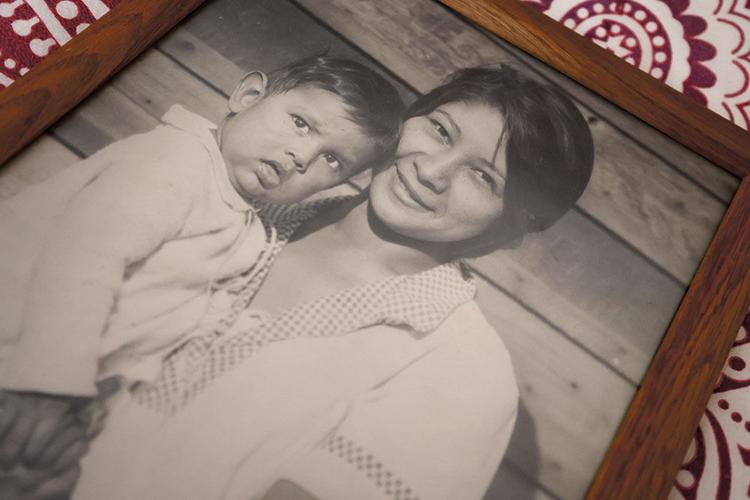
Ascencion’s daughter (and Mondragon’s grandmother) Maria, with his father Victor.
THE MOST COMPELLING ACCOUNT OF ASCENCION’S LIFE is arguably an unpublished, undated manuscript, written by an anonymous author.
Mondragon deduced, through the process of elimination, that it was written by his aunt Martha Herrera, who was born in Gilroy in July 1912, and who surely would have spent a lot of time with Ascencion in the years before she passed.
“Grandma was not an ordinary woman,” it reads. “She was born on that edge of time which separated her from the Stone Age and flung her forcibly in our 1800s. Her whole life, brimful with adventure, existed in the tiny area around San Juan Bautista. The longest journey Ascencion ever made was only 30 miles away, when she saw the Bay of Monterey.”
Herrera writes of Ascencion’s youth spent playing along streams and creeks where willows grew, and that willows were integral to Mutsun life – their branches provided limbs for shelter, in cold or heat, and its sprouts she used to make baskets. “This was the lesson of the willows,” Herrera writes. “Awareness was the bequeath from Ascencion’s Indian heritage and no one is closer to nature than an Indian.”
She writes that, “By instinct the Mutsun Indians were a thoroughly peaceful people. Plans of spoliation rarely entered their minds but if suspicions arose they plotted magic songs with no names mentioned, to express their frustrations.”
Historically, she writes, villages had dwellings a few feet apart built of willow poles and walled with tule or grass. Before the arrival of the Spanish, Mutsun men typically wore no clothes, while women would wear just a loincloth. Deer skin coats provided warmth, when needed. (The Spanish forbid them from going naked; they also forbid them speaking their native language.)
“They were the Earth children… They gave back to the Earth reverently what they took. Their life was not a tangled web of pollution, speeding cars, inflation, computers and bombings. Their legacy was fresh air, water and among the family group, old age security.”
In Herrera’s telling, Ascencion’s father Miguel took their family to live at a ranch below the Pinnacles when she was young, and that the place “abounded in rattlesnakes and wild animals.” Food was sparse, however, and while her father was away on business, Ascencion and her mother Barbara survived on little but greens. “Ascencion told her mother she could even eat an owl if she could kill it. Her wish came true.” Ascencion reportedly clubbed it to death with a stick, and “Mother and daughter ate the owl.”
In adulthood, after marrying and settling in Gilroy, Ascencion turned her home into a convalescent resort of sorts – she would care for people until their health improved. Sadly, though, while Ascencion had 18 children, all but four were taken by diseases to which they had no immunity.
Herrera writes, “Perhaps her finest accomplishment was the gift of conscious pride in their race. They learned of joy in small things. One fine gift handed down by Grandma to her present-day grandchildren (now 50 to 70 years of age) is the spirit of independence. They retained enough Indian knowledge, completely invisible to their neighbors, to know they could exist if necessary again on what nature produced for their forefathers. They can tell you that many of the plants that grow beside a country actually when stewed are remarkably appetizing.”
Of the Mutsun language, Herrera wrote, “Time had muffled all its sounds. Indian corners had disappeared into history, its people had succumbed to the white man’s life, the youth were absorbed into modern times.”

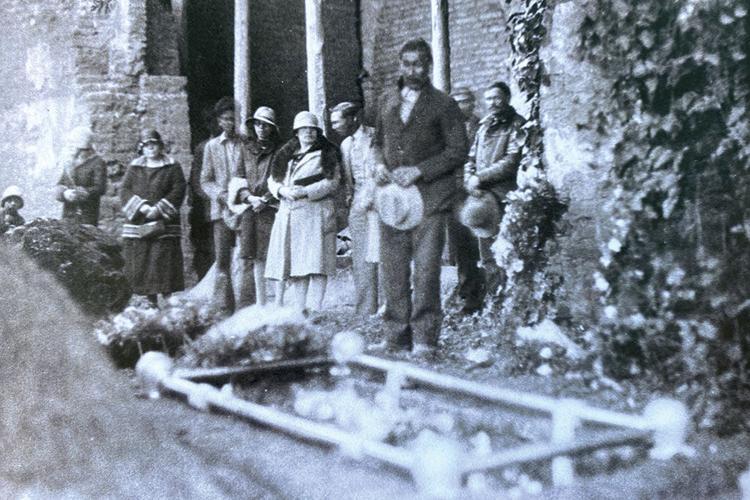
Ascencion’s burial at Mission San Juan Bautista, just a few days after she died in 1930.

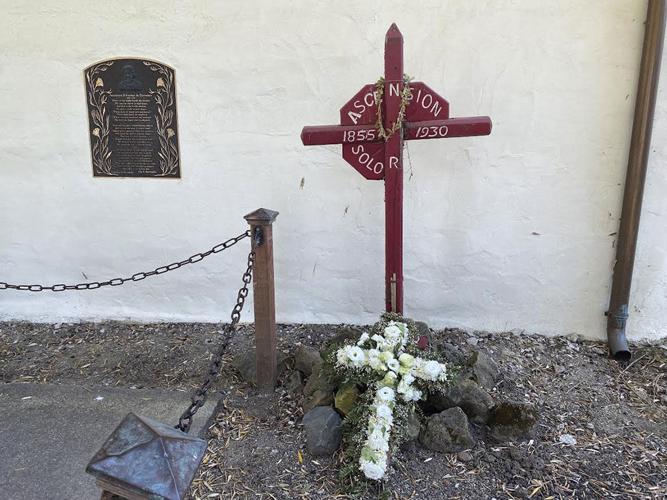
Ascencion’s grave in the Indian cemetery at Mission San Juan Bautista is it looks today; it’s the only marked grave in the cemetery.
MONDRAGON WAS ONE OF THOSE YOUTHS. Growing up in the ’70s, he would skateboard all around Monterey and Pacific Grove, and was friends with cowboys in Carmel Valley.
His father never talked much about their heritage, Mondragon says, and in fact, his father says that when he was growing up, he was told by his parents to keep his heritage secret – being Indigenous was frowned upon.
“He really didn’t start talking about our heritage until I was an adult, and he and my uncle Joe started looking into the history,” Mondragon says.
But he’s diving into his heritage now, and is reflecting on how he can carry on Ascencion’s legacy – he’s the caretaker of so much of the Mutsun knowledge she and Harrington helped keep alive, before the candle burnt out, and he wants to carry it into the future.
And part of his vision for his nonprofit, Mutsun Tribal Foundation, is seeking help to acquire some Mutsun ancestral land to steward and protect for future generations. Ideally, he says, that would be land that Mutsun descendants and like-minded people could also live on and have ceremonies, and that would host retreats that strive to bring people closer to nature. Seeking federal tribal recognition is also on the table, and he’d also like to help repair Ascencion’s grave marker at Mission San Juan Bautista – it’s the only grave in the Indigenous cemetery with a name on it. He’d also like to potentially set up a museum about the Mutsun, with artifacts, somewhere in Monterey County.
“It’s unbelievable what we can do,” he says.
Mondragon feels like the Mutsun are a forgotten tribe, and he doesn’t understand why: “We have more documentation than most tribes in most of North America.”
As it stands now, he says, “Mutsun people are kind of like ghosts… The deep history is not known.”
Mondragon is trying to change that, just like his great-grandmother did a century ago: “I want it to never disappear.”

At a storytelling event in Indian Canyon in late June, singers, dancers and attendees took part in ceremony and celebration.
Ascencion Solorsano
By John P. Harrington
Where on the height beside the meadow
The ancient church its vigil keeps,
Enfolded in the kindly shadow,
’Tis there a noble woman sleeps…
Whose deeds of mercy were uncounted,
Whose duty found her unafraid,
Whose charities increased and mounted
The more she found them poorly paid.
~ ~ ~
Born mid the past’s bright-burning embers
She learned the ways of earlier times
Talked with a vanished folk’s last members,
And heard the belfry’s pristine chimes.
That lore of earlier horizon,
Caught from her lips, shall not be lost –
Her wisdom science now relies on
Her knowledge now is history’s boast.
~ ~ ~
Let her be known in near and far land
As one whose act was true as word;
Let mercy grace her with its garland,
And service bless her with reward;
Let all who love the ancient history
That once camped round the Mission spire
Bless her who hath revealed its mystery
And led us to its hidden fire.
----
Correction 8/15/24: This story has been corrected to reflect that Ascencion died at age 74, not 84. Additionally, the line that originally read that she lived most of her life in Gilroy has been changed to the "latter part of her life."
The Weekly regrets the errors.
(2) comments
The loss of native language and culture has been taking place all over the globe. Each language is amazing and unique, and should be preserved for posterity. Sadly, it appears that the Mutsun language is lost to the ages. We need a center for preservation of such. Ishi was a famous indigneous Californian, who spent his latter years with Western culture, sharing his indigenous knowledge. Perhaps we should found an Ishi Center for preservation of indigenous language and culture. I have a place in mind, though it would take some strong lobbying effort to secure it (currently owned by UC Systemwide).
MCN: my faith and experience taught me that heath, happiness can be found within me. i wish the tribe the same. hire a good lawyer as advocate...that's helpful too...
Welcome to the discussion.
Log In
Keep it Clean. Please avoid obscene, vulgar, lewd, racist or sexually-oriented language.
PLEASE TURN OFF YOUR CAPS LOCK.
Don't Threaten. Threats of harming another person will not be tolerated.
Be Truthful. Don't knowingly lie about anyone or anything.
Be Nice. No racism, sexism or any sort of -ism that is degrading to another person.
Be Proactive. Use the 'Report' link on each comment to let us know of abusive posts.
Share with Us. We'd love to hear eyewitness accounts, the history behind an article.