There’s a moment of tolerable heat. Then come tears, a constricted windpipe and ungodly sweating. A half-hour spectacle ensues, radiating waves of scorched tongue, throat and stomach painful enough to send a few adventurous eaters to the hospital. A tiny sliver of a ghost pepper delivers enough intensity that, as its burn ebbs and flows for hours thereafter, even fingertips tingle.
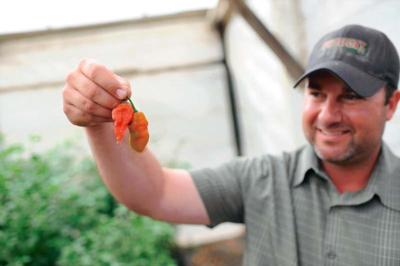
The guy who grows them won’t eat them. Golden Field Greenhouses nursery manager Chris Peck has watched enough people sample them to leave well enough alone. But as he walks through his Castroville company’s South Salinas greenhouse thicket of bushy, towering pepper plants, he could conceivably eat what appears to be a ghost pepper without incident. These plants present a game of vegetative Russian roulette: Pick a pepper. Bite into it. It may be mild enough to suit a hummus platter. Or it may be the world’s hottest.
With a pocket knife, Peck slices one of the pumpkin-orange two-inchers open, and the spicy aroma stings his nostrils – evidence this one’s a true bhut jolokia, or ghost pepper.
“You don’t know what you’re going to get,” Peck says.
For this potentially lucrative operation, that’s the problem. For all their prodigious power, ghost peppers are fragile, finicky little things. And as their heat doesn’t discriminate, neither do their pollinating patterns, which breeds the roulette situation that threatens to keep the project from taking off, just as ghost pepper popularity – among heat seekers and foodies alike – is peaking.
:0 :0 :0
At the Chile Pepper Institute of New Mexico State University in Las Cruces, students assigned to extract ghost pepper seed suit up in full protective gear, complete with respirators, boots and goggles.
Institute staff officially affirmed the pepper’s leading position as the world’s hottest with a 2007 paper published in HortScience, identifying it as the only pepper to rate more than 1 million Scoville heat units, the measure of capsaicin, the heat-producing component of chilis.
Peppers evolved capsaicinoids as a defense mechanism, but humans outpaced them with their penchant for heat.
“There’s a huge following of people out there who just want to go hotter and hotter,” says Denise Coon, an agricultural research assistant at the institute.
Ghost peppers pack more than three times as much cringe-worthy, mammal-deflecting capsaicin as habaneros. Those whose eyes water after a bite of measly jalapeño, with just a 5,000 average Scoville rating, play a timid Bruce Banner to Hulk counterparts who can brave the real thing.
Emboldened after a few duds in a round of pepper roulette, one of the Weekly’s graphic designers ventured a big bite, then couldn’t think of anything besides the burn even as she paced and chugged a quart of milk. The palms of one writer – who asks the kitchens of Vietnamese restaurants for bags of their hottest peppers to supplement his breakfast – started sweating. The veins in his head and neck swelled purple.
That people are drawn to an explosive flavor that makes your head feel like it’s going to spontaneously combust is only somewhat surprising (though Coon’s student researchers prefer milder New Mexico Hatch Chilis). The Weekly’s tasters described euphoria after the burn faded, and also a surprising sense of mental clarity.
Besides those pseudo-Zen associations, there are studies linking hot peppers to anti-inflammation, pain relief (they’re used in topical arthritis creams) and lower cholesterol.
Chili peppers originated in South America, then accompanied explorers to bland cuisines across the globe. Ghost peppers evolved in India, where chilis were first identified in the mid-16th century. Bhut jolokia, the Assamese words for ghost pepper, comes from an old idiom: Eating something this hot scares the ghosts away.
:0 :0 :0
They may be to spirits what garlic is to vampires, but ghost peppers are plenty social when it comes to pollination. They prefer crossing with neighboring, related plants over self-pollination, unlike most modern seed.
Though they’re reluctant to pollinate in the first place, when they do, they’re so free-loving that one ghost pepper plant might produce a new generation of peppers that have been fertilized by any number of different varieties – making a definitive ghost seed supply hard to come by.
Golden Field operates the Salinas greenhouse for Gilroy-based Uesugi Farms in what is the first known attempt to commercialize ghost peppers in the Western Hemisphere. To get started, Uesugi Farms procured seed from a few different sources, including the Chile Pepper Institute, which first got a handful from a traveler who’d passed through India in 2001.
This fall, gloved crews are culling plants that produce mild doppelgangers, deceptively similar peppers that fall anywhere on the heat spectrum from bells to habaneros, as they aim to develop a pure seed supply.
In this case, the only way to catch a ghost is to taste a pepper.
:0 :0 :0
Mighty as they may be, ghost peppers are notoriously unproductive, low-yielding plants. They’re bountiful when it comes to forming small, star-shaped white blossoms – but because they’re picky pollinators, most of the flowers will never produce a fruit, shriveling instead.
Pete Aiello, owner of Uesugi Farms, fingers a pepper-laden plant in the greenhouse. “It’s an imposter,” he says.
Greg Orsetti, vice president of sales at Orsetti Seed Company, one of Uesugi’s suppliers, recalls one long day when a breeder, aided by liquid yogurt, tasted pepper after pepper.
“Some look like jolokia,” Orsetti says. “So we have to taste test them.”
Uesugi’s been shipping ghost peppers to market for two months, with only “a handful” of complaints about mildness, Aiello says. “We just try to give a caveat to some of our customers that there might be a dud in there.”
Orsetti says he’s found a way to get pure seed, though the method is proprietary (in other words, he’s not telling).
“It’s not like a bell or a jalapeño,” he says. “It takes a little bit more know-how to do it. It’s not really easily done.”
That means backyard gardeners parading around homemade salsa as the world’s hottest may be full of hot air.
:0 :0 :0
There’s good money in ghost peppers – for now. “At the moment, it’s such an intense novelty,” Aiello says. “But pretty soon, other people are going to figure this out.”
Until they do, and some watered-down imitation makes it to the Tabasco-dousing masses, hotheaded provocateurs set the tone. CaJohns Fiery Foods in Columbus, Ohio sells a few of ghost pepper-packed hot sauces (and a portion of sales go to the Chile Pepper Institute for research) with names like Holy Jolokia, Kiss My Bhut! and Angry Cock.
Meanwhile, recipes – from ghost-pepper eggplant parmesan to ghost-pepper patty melts – are proliferating online. High-end restaurants are increasingly infusing their way to things like ghost-pepper sorbet.
As long as Uesugi’s leading the market, for which demand outstrips supply 20 to 1, they can charge as much as the produce industry will bear.
The unspoken rule is that $30/pound forms the absolute ceiling, and Uesugi commands $29.95 from mostly Midwest grocers. (Compare that to bells, for which a buck a pound gets Aiello’s sales team daydreaming: “We’re like, OK, let’s go to Tahiti!”) So ghost peppers represent a particularly promising side project for Uesugi Farms.
:0 :0 :0
As the greenhouse tour winds down, Peck and Aiello start tracking an unseasonably early storm on their iPhones, and it looks like heavy rains and possible hail are headed straight for the Gilroy-area fields where Aiello’s major bell pepper crop and pumpkin patch are still being harvested.
Protected from storms by huge greenhouses, these bhut jolokia plants will still be here, flowering and producing peppers, until at least this time next year. From there Uesugi Farms will continue to grow them – but only if their search for ghosts keeps getting warmer.
Order local ghost peppers through Uesugi Farms’ sales office at (408) 842-1294 x427 or www.uesugifarms.com
(0) comments
Welcome to the discussion.
Log In
Keep it Clean. Please avoid obscene, vulgar, lewd, racist or sexually-oriented language.
PLEASE TURN OFF YOUR CAPS LOCK.
Don't Threaten. Threats of harming another person will not be tolerated.
Be Truthful. Don't knowingly lie about anyone or anything.
Be Nice. No racism, sexism or any sort of -ism that is degrading to another person.
Be Proactive. Use the 'Report' link on each comment to let us know of abusive posts.
Share with Us. We'd love to hear eyewitness accounts, the history behind an article.