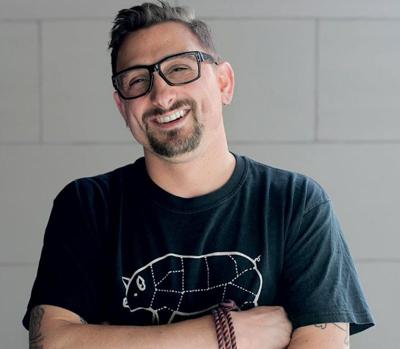
What would Wolverine eat?
No really, what would the Marvel Comics superhero eat? It’s a subject that had buried into the brain of Chris Cosentino, the San Francisco powerhouse chef best known for bringing guts to the masses, spreading the message that offal – an animal’s brain, heart, liver, pancreas, lungs, spleen, feet, tail and head, to be precise – can be just as tender and tasty and beautifully presented as a well-aged cut of prime beef or perfectly cooked rack of lamb.
Comic books in general, and Wolverine in particular, had been fixtures of Cosentino’s Rhode Island childhood. But it took a burgeoning Twitter relationship with C.B. Cebulski, a Marvel writer/editor/talent scout (and, it turns out, a frequent diner at Cosentino’s Incanto restaurant) to get the chef thinking about the dietary desires of the fictional mutant super-soldier.
And what started as Cosentino possibly being written into an issue of Wolverine evolved into him writing his own issue of Wolverine, one that has the superhero residing in San Francisco and enjoying the city’s culinary scene.
“You understand Wolverine has lived for many years, and he’s lived all over the world. He’s traveled everywhere and eaten everything,” Cosentino says during an early afternoon break before the heavy work of prepping for dinner service at Incanto. “He was a government toy, an ops guy who can’t die. But everyone needs to eat at some point.”
Wolverine, he says, has a fondness for Japanese food, because he spent a lot of time training in Japan. He likes German dishes like spaetzle and sauerbraten and wild boar, too, because Wolverine is of Northern European descent.
The Cosentino-driven issue of Wolverine hits the stands July 3, about six weeks after Cosentino hits the Monterey Peninsula for the latest iteration of the Monterey Bay Aquarium’s annual Cooking for Solutions event, where he’ll join the blockbuster Friday gala and lead a sold-out “pranzo Italiano” lunch at Casa Palmero in Pebble Beach.
Consentino is of the most grounded chefs working today. “Every day I do as it is,” he says. “I try not to grand plan too much.” And when it comes to working, he works his ass off. First there’s Incanto, where in addition to pioneering a resurgence of parts cooking (those offal dishes), chef-partner Cosentino has created dining experiences like “Leg of Beast,” a braised beef shank at the center of a three-course meal served family-style and meant to be shared by parties of six to eight. Then there’s his artisanal salumeria Boccalone, the S.F. Ferry Building’s paean to meat, where eaters can snatch up items including fresh sausages; sliced-to-order cured and cooked salumis like lardo Iberico, soppressata and orange-wild fennel; and a variety of panini with names like “The Mess Piggy,” a sandwich of pulled pork with spicy pickled peppers.
So he has the two joints, and between them 40 employees, to look after. He has a growing television presence: Cosentino won season four of Food Network’s Top Chef Masters, competing on behalf of the Michael J. Fox Foundation for Parkinson’s Research. He has his status as a soccer dad: He and his wife, Tatiana Graf, who goes by the Twitter handle @MeatMaven, have an 8-year-old, soccer-loving son. He loves spending time on his bike: He’s a semi-pro road racer. He released a book last year through Weldon Owen Publishing that focuses on Italian-style first courses, with hot-and-cold antipasti recipes organized by season. There’s his website, offalgood.com, that teaches people about the wonders of offal. And now there’s his relationship with Marvel.
“I’m always running,” he says. “It comes from being hyperactive and having ADD [attention-deficit disorder], but it’s also how you can survive in this business. It’s part of the nature of forever moving and working.”
All told, it takes a lot of guts and brains to be Chris Cosentino. But even he can’t even say how much guts and brains with any precision.
“No clue. I have no clue how many pounds we go through in a week,” he says.
It’s not that the joke is lost on him. It’s just that he’s heard them all before.
~::~
Cosentino grew up on the coast of Rhode Island, moving between Providence and Newport and between the Italian-American world of his father – which helped inspire the Aquarium lunch theme – and the stiff-upper-lip world of his English-American mother.
“I’M ALWAYS RUNNING. IT COMES FROM BEING HYPERACTIVE AND HAVING ADD [ATTENTION-DEFICIT DISORDER] BUT IT’S ALSO HOW YOU CAN SURVIVE IN THIS BUSINESS.”
His parents divorced when he was a kid. Cosentino says flat-out there was a lot of stuff he wouldn’t eat then: “My Italian grandmother would make tripe and I would run screaming,” he says, “and I would only eat raw carrots, but I wouldn’t touch raw tomatoes.” But food was at the center of almost everything he did. There was a farm in the backyard where his family grew potatoes, and the rotten ones became ammo for homemade potato launchers. He went clamming with his grandmother on the beach right in front of her house, and he fished for bluefish with his grandfather. He then fished commercially as a teen and started lobstering, because that’s what Rhode Island kids did in the summer.
“We grew up with everything right there at our fingertips,” he says. “It was the way we lived our lives.”
That way is also what taught him about true sustainability. You catch a perfect piece of fish and you not only don’t want to screw it up, you want to maximize every piece of it.
“You can end up throwing away too much because you can’t figure it out,” he says. “That’s why it’s important to understand where a product is from and how to treat it. And you do that by doing it with your hands. You go fishing or you go work on a farm.”
He references Japan, which often gets a bad rap for not focusing enough on sustainable practices, as a country he believes does it right. “In Japan, every fish is seasonal and they use every last scrap of it. They use the bones and the gills and the head. That’s what I consider sustainable,” he says.
It’s also the way he looks at Incanto, which is to serve only in season – only what farmers like Andy Griffin of Watsonville’s Mariquita Farm can bring him – and to apply the best techniques possible.
In an interview last year with the website Food Republic, Cosentino told the interviewer he thinks people focus too much on what’s not important when it comes to sustainability.
“Everyone is stuck on the fucking Styrofoam container,” he said, “instead of worrying about the ramifications of factory farming and knowing where food comes from.”
It’s a stance he maintains, but now he takes it a step further.
“How food is raised or grown is really important, but I think in the food movement, there’s too much focus on the sustainable farming and fishing, not enough on sustainable eating. We need to teach people to eat sustainably,” he says.
Some simple steps? If you buy leeks, use the green tops too, and not just the whites. If you eat radishes, eat the greens too. If you eat sardines, use the bones. Learn to make stock from them, and from the parts and cuts you might otherwise overlook.
“Appreciate everything for what it is,” he says. “Everything has its applicable use, place and time.”
CHRIS COSENTINO can be found on Twitter (@offalchris) and online at www.offalgood.com His book, Beginnings: My Way to Start A Meal, is available on Amazon.com.
(0) comments
Welcome to the discussion.
Log In
Keep it Clean. Please avoid obscene, vulgar, lewd, racist or sexually-oriented language.
PLEASE TURN OFF YOUR CAPS LOCK.
Don't Threaten. Threats of harming another person will not be tolerated.
Be Truthful. Don't knowingly lie about anyone or anything.
Be Nice. No racism, sexism or any sort of -ism that is degrading to another person.
Be Proactive. Use the 'Report' link on each comment to let us know of abusive posts.
Share with Us. We'd love to hear eyewitness accounts, the history behind an article.