

Editors Note: This story has been updated to reflect that Higher Level of Care, a dispensary in Seaside, is current on its tax payments to the city as of this issue's publication date.
THE TWO-MINUTE SHORT DEBUTED IN FEBRUARY 2019, MELDING TRADITIONAL ADVERTISING AND HOLLYWOOD GLAM. MedMen Enterprises Inc., a darling of the cannabis industry that raised $110 million in private investment before debuting on the Canadian Stock Exchange, enlisted Spike Jonze, the quirky producer/director best known for the films Being John Malkovich and Adaptation, to direct a commercial heralding the legality of cannabis. Voiced and co-written by actor Jesse Williams, the spot, titled “The New Normal,” opens with a shot of George Washington (also played by Williams), surrounded by slaves on his hemp farm.
Growing hemp back then “was normal,” Williams says. “You know what isn’t normal? America’s 80 years of unjust prohibition, which hasn’t made us any safer.”
That prohibition, he says, led to policies like New York City’s “stop and frisk” policy that targeted men of color for harassment by police. It led to long prison sentences for people caught carrying just a few ounces of weed. It inspired the laughably bad propaganda film Reefer Madness.

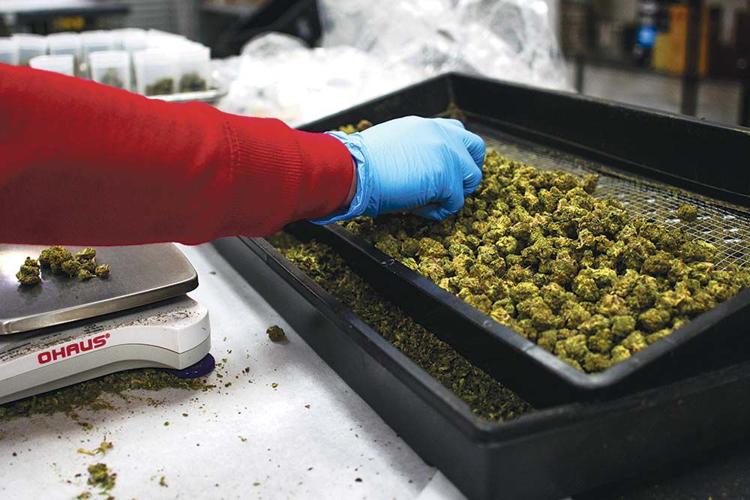
An employee of Grupo Flor’s co-packaging business weighs cannabis nuggets to prepare them for packaging and sale.
“Madness? How about wellness?” the narration continues. And the images come in rapid succession: a group of military veterans sitting in a group therapy session; creative types being creative; a woman holding a profit-and-loss statement, working in the office of a cannabis business; a happy couple loaded down with shopping bags, one bearing the MedMen logo, standing outside their cookie-cutter suburban home.
“The symbol of counterculture is, at long last, just culture,” he says. “It’s normal again. Here’s to the new normal.”
Six months later, the animated series South Park ran an ad of its own. “Tegridy Farms” also starts with the Founding Fathers standing in their hemp fields. The founders knew the meaning of hard work because they had integrity – or, as the narrator pronounces it with a hard Southern twang, ’tegridy. The spot also references the long and dumb war on drugs (really, the narrator says, a war on people) before it gets to now, when “a bunch of young corporate banker types come along telling us we’re all in the new normal as they try to turn God’s green miracle into an easy buck for themselves.
“They even hire fancy Hollywood directors to make them look all hip and cool,” the narrator says. “But you know what? Fuck those guys. They ain’t got no ’tegridy.”
An industry that’s hip and cool, producing a product that’s therapeutic and relaxing: Aren’t those good things? And if some investment bros who lack ’tegridy make a few bucks along the way, so what? If local growers and distributors and retailers and manufacturers and everyone they employ also make a few bucks, resulting in revenue flowing in to local and state tax coffers to fund more police and fire and roads and public services and youth programs, aren’t those good things too?
For every dollar Indus is making,
they’re losing $1.70.
But just as quickly as they developed a taste for cannabis investment, investors lost that taste. As capital markets funding growth in the cannabis space seized up and as the industry in California spasms under the boot of a Byzantine regulatory and tax system, the good times have come to a screeching halt.
That includes some of the big players in Monterey County, who just a few years ago had positioned themselves to be giants in the emerging cannabis market.
Remember the dot-com boom, when investors were throwing crazy money at companies like Pets.com (a $300 million loss) and GlobalCrossing.com (which reached a market cap of $47 billion, never achieved profitability and filed for bankruptcy two years later) to see what stuck? Remember the bust that happened, when $1.7 trillion in market value was lost?
Substitute cannabis for dot-com, and that’s where we are now. It’s no longer a matter of imagining a bright future for the cannabis industry – it’s a matter of imagining survival.
Much like the dot-com bust, once the smoke clears from the cannabis implosion, not everyone is going to be left standing.
ON THE MACRO LEVEL, TO UNDERSTAND WHY THERE WAS SUCH AN IMPLOSION IN 2019, you have to go back to what investor Jason Spatafora calls the “arms race” of 2017. Spatafora, who analyzes trends and publishes cannabis news and research via his website marijuanastocks.com, says that in ’17, investors began ramping up for the legality that was coming to huge marketplaces – California and Canada – in 2018.
“Everyone was trying to acquire as much as possible,” he says. “Money was flowing and the market was super hot and bankers were extending massive lines of credit and everyone overspent. We saw acquisitions going on all over the place.”
But what people failed to realize is that after October 2018, there were no more catalysts for investment. For companies, it came time to execute their business plans, and a lot of them couldn’t do it.
Companies that went public began reporting their numbers, and the numbers were grim – far off the revenue those companies had projected.
MedMen’s shares, for example, dropped by 17.27 percent in the first 10 months of 2019. Overall, shares of cannabis stock across the industry dropped by 60 percent last year, and acquisitions also ground to a halt, as the number of deals went from 36 in 2018 to three as of November 2019, according to Bloomberg News.
The investment bankers shut off the money faucet to the industry in the middle of 2019.
“It was a lot of greed. All of these operators came in and sucked the liquidity out of the market and the problem is that when these negative times come to pass, most of them don’t have the liquidity to support (growth),” Spatafora says. “Everybody made a lot of money at a time when any fool could make money, not realizing the hard part is keeping the money.”
As for individual cannabis investors, many of them took it in the shorts. Spatafora says he’s never held a cannabis stock for more than six months and currently holds no cannabis stock at all. He might get back to it in the next few months.
“You have retail investors who have no business playing in this space, using an old method of buying and holding for years, which you can’t do with pot stocks,” Spatafora says.

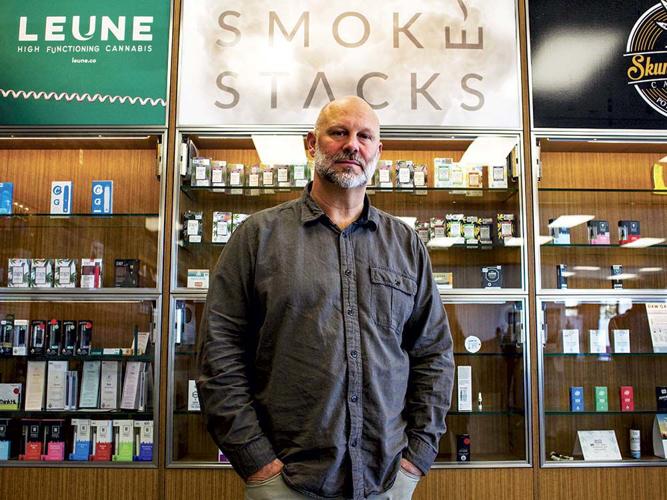
Gavin Kogan took over as CEO of Grupo Flor following the departure of Paul Henderson. Kogan, a founder of the company, says the company’s East of Eden dispensary (below) in Salinas is profitable, but that Grupo will spend 2020 digging out from under some heavy debt.
CLOSER TO HOME, CALIFORNIA HASN’T MADE IT EASY TO OPERATE A CANNABIS BUSINESS, WITH THREE REGULATORY AGENCIES – the Bureau of Cannabis Control, the Department of Public Health and the Department of Food and Agriculture – all involved. That’s expected to end this year as cannabis regulation will be consolidated into a single new department, the Department of Cannabis Control.
But Monterey County’s own cannabis licensing program is widely regarded as extra-special dysfunctional. While adult recreational use was legalized in 2018, Monterey County only allowed greenhouse grows, and officials making the rules had little understanding of how a cannabis greenhouse would function. For example, as decrepit greenhouses from the flower-growing industry were bought up or leased and then modernized, the county began requiring fire suppression systems to be installed, and construction done to residential standards rather than light industrial or agricultural – things that were never required of the cut-flower industry. And the county also required new cannabis greenhouses to conduct traffic studies and water studies.
It added costs at a time when businesses were ramping up and money was still tight, before the big surge in investment capital started flowing.
While the county moved last year to launch a pilot program and allow outdoor grows in certain areas, they also made the setbacks so restrictive that only one grower, deep in Carmel Valley, qualified. Indoor grows are taxed by square footage, or “canopy” space, and not by what is actually produced. If a section of a greenhouse isn’t growing at a particular time, it doesn’t matter – you’re still paying per square foot. And if a crop fails, for whatever reason, you’re taxed on that too.
Meanwhile, between the rules for indoor grows, and the restrictions on legal outdoor grows, the black market continues to flourish, with one knowledgeable insider estimating there are 300 separate and substantial illegal grows dotting Monterey County. There’s a small measure of enforcement on the illegal grows, but the District Attorney’s Office is going after the low-hanging fruit and targeting legal operators for issues that include having their license numbers printed too small on billboards or in advertisements and threatening five-figure fines and criminal prosecution.
Carmel Mayor Dave Potter, who currently heads the Monterey County Cannabis Industry Association and works as a cannabis lobbyist, was a county supervisor when the county developed its regulatory and tax framework. He regrets advocating for a canopy tax, calling it a mistake on the part of the Board of Supervisors. And the industry is bracing itself for a mandatory $1 per square foot tax hike that’s due to kick in this summer.
“We should have never done it by square footage. You still have to pay on failed crops,” Potter says. “I looked at it as an opportunity for the county to make money. This was the only form of new money coming in and everyone ran to tax the hell out of it. [But] You can always amend an ordinance if there’s political courage.”
The other issue, as Potter sees it, is while adult recreational use is legal, it doesn’t mean cities are allowing business to open. In Carmel, for example, 68 percent of voters backed adult use at the polls in 2016, but not a single dispensary has been allowed to open in the city.
Same for the city of Monterey, which has prohibited any cannabis businesses from opening since adult use was legalized. After a lengthy battle and a 4-1 vote by the City Council last month, Scott Willard will open a testing facility called Coverton Labs at Ryan Ranch.
A Cannabiz Media study from last September shows there is one dispensary for every 2,356 people in Oklahoma; by comparison, there’s one for every 67,972 people in California. Potter says that’s not enough, and most everyone in the industry agrees.
But just because there’s market demand doesn’t mean business is thriving.
“There aren’t enough labs and there aren’t enough dispensaries and the products just aren’t there,” Potter says. He estimates the state only has about 600 dispensaries open, when it needs more like 6,000. “Some of the existing businesses are undercapitalized or not professional enough. Just because you’re a good grower doesn’t mean you’re going to be a good businessperson.”
ON A MICRO LEVEL, HERE’S HOW THINGS ARE PLAYING OUT for some of the big players in Monterey County cannabis.
Culver City-based MedMen, which went public in 2018 and acquired Seaside-based Sugarleaf Trading Co. last April, operates a dispensary on Broadway Avenue in Seaside. The company laid off 190 employees last November, following an 11-month freefall in which their stock lost two-thirds of its value; its price, as of Feb. 11, was a dismal $0.35 a share. The company’s co-founder and CEO resigned on Feb. 1 and the former Attorney General of Louisiana, now an attorney in private practice, is investigating investor claims that MedMen and certain officers and directors engaged in fraud, negligence or other corporate malfeasance.
MedMen “has gotten so behind on their ability to pay growers, they’re offering stock in the company instead of cash,” according to one Monterey County grower.
In Salinas, Emerald Skyway, the first dispensary to open in that city, is about $190,000 in arrears on its tax payments to Salinas, representing three consecutive quarters of non-payment.
A city official says the company had promised to get fully current on the bill by Feb. 14. (As of Feb. 18, City Finance Director Matt Pressey was unable to confirm the payment had been made because the staff member who handles such payments was on sick leave.)
According to the city of Salinas, all other licensed cannabis businesses are current on their tax payments.
Emerald Skyway is owned by Robert and Lonna Lewis-Blodgett, who launched the first dispensary in the county in 2015 with the Del Rey Oaks-based Monterey Bay Alternative Medicine. Del Rey Oaks City Manager Dino Pick says that as of Feb. 11, the store is a month behind on its tax payments and that last year, the payment history became so shaky that the city “had to get serious with them.
“We were at the point of essentially threatening to close them down,” Pick says. “I have been leaning on them pretty hard to get straight, because in order to be in good standing, they have to pay their taxes.”
There was a time, both in Del Rey Oaks and in Salinas, when the line of customers at the Blodgetts’ locations snaked out into the parking lot – a perk of being the first to open in both places. But competition has arrived, with multiple dispensaries now open in DRO’s neighbor, Seaside, and in Salinas.
Robert Blodgett attributes the difficulties to the high cost of doing business. In Salinas, an annual cultivation permit for Blodgetts’ grow (of less than 10,000 square feet) is $35,000. The state also charges $37,000 for a permit for each retail location. There are taxes at every step along the way.
“We needed to make some immediate changes to survive.”
“There’s a huge distance between the price you pay for legal retail and the price you pay for black market product,” he says. As for the taxes owed to Salinas and DRO, he says, both cities have given them time to pay and “we’re almost current.”
In Seaside the city is waiting on tax payments from Higher Level of Care and Plantacea for the period running from Oct. 1-Dec. 31, 2019, the second quarter of the fiscal year. In emails between Seaside City Manager Craig Malin and Finance Director Kimberly Drabner, Drabner says her department is reaching out to those who haven’t made payments. Higher Level, she writes, was supposed to pay the week of Feb. 2 and Plantacea had promised to send a check. Higher Level, as of this issue's publication date, is current on all its taxes.
“This is unusual,” she writes. “I wonder if the delay relates to their end of the year close.”
And that’s just the smaller players.
Two larger Monterey County-based companies, Indus Holding Co. (the parent company of Altai Brands) and Grupo Flor set their sights on becoming major national and international businesses, but their finances are also shaky.

Indus Holdings went public on the Canadian Stock Exchange last year during a time of heady growth for the industry; then the stock price quickly tanked as institutional investors lost their taste for cannabis investing. At center, left, one of the premium edibles Indus produces under its Altai label.
ALTAI BRANDS, WHICH BECAME THE FIRST LICENSED CANNABIS BUSINESS IN SALINAS when it opened its artisan edibles manufacturing plant in 2015 – a full three years before cannabis was legalized for recreational adult use in California – saw its star shine even brighter when its parent company, Indus Holding Co., went public on the Canadian Stock Exchange in 2019.
Founded by hospitality industry veteran Rob Weakley (Los Angeles Magazine once called him “the Willy Wonka of Weed”), who co-founded, among other ventures, Pebble Beach Food & Wine, LA Food & Wine and the food-centric Coastal Luxury Management Group, Indus heralded its status as a “vertically integrated” cannabis company. It would manufacture its own products (many from recipes created by co-founder and pastry chef Mark Ainsworth, another hospitality industry veteran, who uses premium Guittard chocolate in the company’s pips and chews) and manufacture products for other brands, including Canna Stripe and Dixie Elixirs. Indus would also extract oils used in the manufacturing process, develop a massive distribution network, open locations in other states and grow its own cannabis in a massive greenhouse operation on Zabala Road.
Right now, the greenhouse buildout is tied up in the county’s approval process. Indus has a distribution operation in Salinas and Los Angeles, and cultivation and manufacturing operations in Las Vegas and Oregon.
The company had some problems before going public. In 2016, Weakley was sued by a primary investor who alleged the co-founder lied about the level of his own investment, used investment money from others to fund a lifestyle that included private jet travel and luxury hotel stays, inflated the value of the company and fired the chief financial officer to keep the scam under wraps.
The plaintiff, Hannaford Holdings LLC, dropped the suit in October 2016.
Going public was seen as a way to infuse capital in a rapidly growing company whose products were in high demand. Indus raised $49 million in private investment through two rounds of funding before debuting on the Canadian Stock Exchange last May.
The stock hit a high of $15.95, some shareholders made some money and they were poised for growth. Things were going swell. Until those pesky capital market investors pumped the brakes.
“I can look at the stock over time and tell you what I see,” says Spatafora, the investment analyst. “They did absolutely nothing to help their stock. I can see they didn’t do any marketing. And then in November, when their restricted shares became unrestricted, the bottom dropped out, on their stock in particular.”
Dun & Bradstreet, which analyzes a company’s creditworthiness and provides data and analysis for businesses, puts Indus in the “moderate to high risk of severe financial stress” category, and the “moderate to high risk of severe payment delinquency” category. Its viability score is 7 on a scale of 1 to 9, with 9 being “high risk.”
Looking further, Spatafora says, he sees that for every dollar Indus is making, they’re losing $1.70.
“Someone like me will look at this company and see by the volume, or complete lack of volume, they won’t be able to do any financing, so it either becomes a matter of they put their heads down and execute, or they go under,” he says. “You either have to dilute the shareholder base and hope or take money that basically is a death sentence because of the terms.”
Speaking of that kind of death sentence, in January, Indus issued a press release “not for distribution to U.S. news wire services or for dissemination in the U.S.” announcing it had taken a short-term, revolving loan of $1.5 million from Hadron Capital and three of Indus’ own board directors – Sam Tramiel (who since resigned his position from the board), Arthur Maxwell and William Anton.
The interest rate is a breathtaking 20 percent. And in exchange for the cash influx, the board required Weakley to vote his 202,590 super voting shares as the majority of the board directs him, effectively stripping him of his power.
Indus was due to announce earnings results the week of Feb. 16, putting them firmly in a U.S. Securities and Exchange Commission-mandated “quiet period” in which the company and its officials aren’t allowed to speak publicly.
On Feb. 11, there was a huge sell-off of shares and the stock closed at $0.20 per share. On Feb. 18, it closed at $0.30.
The market cap – the value of a publicly traded company’s outstanding shares – dropped to $5.3 million, according to Bloomberg. One other analyst site, Simplywall.st, adds that Indus has less than one year of cash runway left, and the company isn’t forecast to become profitable over the next three years.
“Companies like Indus, if they’re not looking at a merger or acquisition, they’re done,” Spatafora says. “If you’re illiquid, you can never raise any money. You’re just dead and screwed.”
ONE OF THE CO-FOUNDERS OF INDUS IS GAVIN KOGAN, a lawyer who appeared on theWeekly’s cover in 2014 in a story about attorneys getting ready for cannabis legalization. He’s still a shareholder, but left Indus in December 2015 and launched Grupo Flor in March 2016. East of Eden, the Salinas dispensary Grupo Flor owns, carries Altai products.
Grupo, though, was never just about a retail store. Like Indus, it was vertically integrated, encompassing 1.5 million square feet of real estate in the form of greenhouses it leased from property owners, then sub-leased to cannabis growers. There’s a co-packing operation, where Grupo workers package the product of other brands, then sell it at the retail store. There was a trading desk, which much like traditional agriculture products, pairs people with products to sell with buyers looking to purchase.
“Money was flowing and the market was super hot and bankers were extending massive lines of credit and everyone overspent.”
There were international partnerships too, as Grupo expanded into Mexico and Latin America. There were plans for a statewide distribution network as well. And there were hires that carried gravitas; Grupo wooed Paul Henderson, then Indus’ chief financial officer, to become its CEO. Prior to cannabis, he had been with Goldman Sachs and GE Capital, then was worldwide financial services manager for Apple. They brought in Joe Fletcher, a veteran concert promoter who served as director of finance for Jimmy Panetta’s first congressional run, to manage the property division; he became Grupo’s sales director.
To fund growth, Grupo, which is privately held, raised a $5 million round of investments in 2018, and tried to raise eight times that in 2019. Before the second round of fundraising, Grupo was valued at $280 million.
Remember when the capital faucet got turned off? Kogan sure does.
“The round was three times oversold when we started the process and we had three times as much verbal commitment to participate,” Kogan says. “Then everyone ran. It was like someone flicked on the lights and the cockroaches ran for the corners. It was really catastrophic.”
Customers along the supply chain stopped paying their bills, and Grupo stopped paying some of its bills. (They took six months to pay the Weekly $2,747 for advertising, sending out two form letters talking about the industry’s financial woes as a reason for the delay.)
Last July, Grupo pumped its own brakes, Kogan says.
“We were probably one the first to recognize that the capital markets weren’t coming back and to say, ‘Wait, this is unsustainable,’” he says. “We needed to make some immediate changes to survive.”
The company went into triage mode. Some of the changes include shutting down statewide distribution and international operations; selling some assets and reducing the number of dispensaries it was opening from 12 to four; getting out of joint ventures that weren’t productive; and eliminating almost 60 percent of the company’s headcount.
Among those no longer with the company: Henderson and Fletcher, along with Chief Operating Officer Chuck Drake. Henderson and Fletcher are gearing up to sue over unpaid bonuses, Kogan says, and have filed complaints with the state as a precursor to a lawsuit.
Reached via email, Fletcher says he and Henderson both signed nondisclosure agreements when they left the company and declined to comment. Henderson is now president at High Times, a media company that launched in 1974 and focuses on cannabis.
A healthy company, and one run by not just one lawyer, but two (Salinas attorney Stephen Kim is also a Grupo founder) can withstand a lawsuit. They can probably withstand two.
But for the next year, and maybe longer, Grupo is going to be digging out from one hell of a lawsuit brought by the closest thing Monterey County has to a bona fide mogul – businessman Nader Agha.

Businessman Nader Agha sued Grupo Flor and one of its founders, Mike Bitar, claiming the company and its officers tried to defraud him after subleasing space at his Moss Landing Commercial Park to cannabis growers. Grupo’s Gavin Kogan says Agha’s suit was a revenge play to cut them out of leasing the commercial park to collect all the rental income on his own.
AGHA HAD DEVELOPED A CLOSE RELATIONSHIP WITH GRUPO FOUNDER MIKE BITAR.They’re both Middle Eastern (Agha from Syria, Bitar from Jordan), they’re both in real estate (although Bitar’s license was suspended and then revoked in 2014) and Agha, perhaps most importantly in the cannabis realm, owns the Moss Landing Commercial Park.
It proved to be a great place for a massive indoor grow, so massive that one media outlet described it as the largest indoor grow in the state. Grupo set up growers in the space, those growers paid rent to Grupo and Grupo in turn paid rent to Agha.
But a massive falling out between Agha and Bitar ensued, and it led to lawsuits: Agha sued Bitar, alleging he had forged Agha’s name on documents and lied about how much rent Grupo was taking in from tenants at Moss Landing. Grupo counter-sued, alleging Agha cut them out as middle men so he could collect cannabis rents himself.
The case went to trial last October. At the end of that three-week jury trial, during which Grupo’s three attorneys from the San Francisco firm Baker Botts were ensconced at the Hyatt, the jury decided both parties were a little right, and a little wrong – both acted in good faith in some situations, and in bad faith in others.
Monterey Superior Court Judge Susan Matcham ordered that neither side was going to receive money from the other.
Grupo put out a press release trumpeting the decision as a win, and Kogan maintains that it was. On Jan. 30, Agha’s attorney appealed Matcham’s decision. And separately, Agha had filed a different lawsuit against Bitar, alleging elder abuse and fraud over a South County real estate deal that went sideways.
If they don’t have to pay Agha, why will it take a year or more for Grupo to dig out from under? Attorney fees that have run into the multiple millions of dollars. (Kogan won’t name the exact amount, but says it’s less than a $5 million figure circulating in the rumor mill.)
“The lawsuit was about destroying Grupo Flor, not about him getting money. There’s no amount of money that would have ended it,” Kogan says, adding they made multiple attempts at settling, all of which were rebuffed. “This was a personal attack by Nader Agha to destroy us, economically and energetically, and it was a huge waste of time.”
Sales at East of Eden are good, he says, and they continue to grow. Grupo considered selling the dispensary to settle their debts and pay off the attorneys, but Kogan says the pivot and the refocus of the business model will take care of it.
“If I didn’t have the debt from 2019, I’m profitable,” he says. “We’re opening the four new dispensaries with investors and I’m going to put as much money as I can to the debt. The more money I make, the faster I can pay.”
ONE INDUSTRY INSIDER PUTS IT THIS WAY: The cannabis industry was never set up for success in California because it was predicated on the idea that everyone was going to be making money forever.
But Potter says that as the legal industry enters its toddlerhood, the steep learning curve growers had in dealing with the government has smoothed out, at least a little. “What you’re seeing now is good quality growers parntering with people with business expertise,” he says.
(1) comment
WOW! What an article! Mary Duan you have always been the absolute best, both to the cannabis community and to the institution of journalism. You deserve 100 lotteries!
Welcome to the discussion.
Log In
Keep it Clean. Please avoid obscene, vulgar, lewd, racist or sexually-oriented language.
PLEASE TURN OFF YOUR CAPS LOCK.
Don't Threaten. Threats of harming another person will not be tolerated.
Be Truthful. Don't knowingly lie about anyone or anything.
Be Nice. No racism, sexism or any sort of -ism that is degrading to another person.
Be Proactive. Use the 'Report' link on each comment to let us know of abusive posts.
Share with Us. We'd love to hear eyewitness accounts, the history behind an article.