
2
Common is one of the most respected rappers walking the Earth. His sales may not necessarily reflect that. He’s cracked the Top 100 album/R&B/rap charts in the U.S. plenty, and reached No. 1 a handful of times, but he’s never gone platinum; there are a plethora of hip-hop artists with less talent, work ethic or maturity who have.
But Common’s place in contemporary music culture is more enduring, creative and important than a lot of hyped-up rappers who have come and gone.
His high-quality output started in 1992, and he was blazing right out the block. His music was smart, soulful, jazzy, bumpin’, creative, lyrical, informed, filled with conscious lyrics about liberation, corruption, empowerment, love and peace, an ethic reflected in his work on Rock the Vote, AIDS/HIV awareness and his own Common Ground Foundation.
He’s worked with the top echelon of rappers and producers, including Tribe Called Quest, Pharrell, Pete Rock, Kanye West, Mos Def, Canibus, Lauryn Hill, The Roots, Kid Cudi and J Dilla.
Common’s been known to mix it up on a more street level, sparking diss tracks with heavy hitters like Ice Cube and Drake. One track, “I Used to Love H.E.R.,” about the evolution of hip-hop culture, ignited a little East Coast/West Coast beef, which was settled amicably. But he was deemed conscious and positive enough to perform for the Obamas at the White House.
He’s made moves that seemed aimed to cross over. Like collaborating on a song with the Jonas Brothers, wearing bohemian and hippie clothing, doing movies, fashion modeling and commercials. The man stayed true to the most appealing parts of hip-hop with a relentless positivity that some embraced and others found too bright.
His new song “The Day the Women Took Over” is a reinterpretation of Dr. Dre’s L.A. Riots track “The Day the Niggaz Took Over.”
But Common makes it an ode to women like Michelle Obama, Oprah Winfrey and Rosa Parks. Here is the positivity again, leaning toward platitudes. Common seems comfortable being the more nice guy, coming with righteous positivity instead of righteous anger in “The Day the Women Took Over”: “We openin’ doors and pullin’ out chairs again… Toilet seats down. That’s a no-brainer.”
That works just right for his entry into the Monterey Jazz Festival. Common has utilized his popularity to bring audiences along on his creative renewal. In 2015 he and John Legend won the Oscar for Best Original Song for “Glory” from the film Selma. And last year he released one of his most acclaimed and freshest albums in years, Black America Again.
Jazz and hip-hop have crossed paths many times. Hip-hop acts who have gotten down with jazz include Digable Planets, US3, Gang Starr (whose Jazzmatazz series enlisted players like Kenny Garrett and Lonnie Liston Smith), Nas, Mac Miller and CeeLo Green.
And plenty of jazz cats have dabbled with hip-hop: Branford Marsalis, Don Byrd, Ron Carter, Maceo Parker, Quincy Jones. Herbie Hancock’s “Rocket” was a staple in breakdance battles.
Hip-hop has graced Monterey Jazz Festival stages. Robert Glasper, who came out in 2011, busted out some hip-hop beats. That same year, Puerto Rican rapper Rico Pabon performed with the John Santos Sextet.
Common is still an anomaly in a jazz festival setting, but not a shock.
The title track of Black America Again is a sweeping and urgent message song produced by Robert Glasper and features Stevie Wonder on vocals and Esperanza Spalding on bass. On “Pyramids” he samples Ol Dirty Bastard and raps furiously over an ’80s synthesizer line: “I walk like an Egyptian on a mission to listen to conditions/ Envision a vision of what we wishing/ I’ve been commissioned to de-prison the prism of your mind/ Spit the wisdom of the one divine.”
On “Unfamiliar” he samples John Cameron’s “Half Forgotten Daydreams,” but cut up like he took the record and smashed it into pieces, then put it back together, disjointed but still working.
There is just enough dissonance and protest to flirt with art music and flip a middle finger to the pop charts. The album is oblique and jazzy and soulful, a mash-up of black music that’s lyrical enough that hip-hop heads may can dig it, but not so on fire that it drives away the old heads in the main arena.
One key may be if jazz fans don’t pay too much attention to the repetitive samples – which are more like a bed of percussion and rhythm than a traditional melody or accompaniment – and pay attention to the lyrics. That’s where it’s at. The samples are the concrete that the rapper stomps, strides and dances across.
Common is on a mission. You can feel it. That’s going to be something to see live.
COMMON performs at 3:20pm on Sunday, Sept. 17 on the Jimmy Lyons Stage. thinkcommon.com

3
Chris Thile & Brad Mehldau was recorded at the famed Avatar Studios in New York City over a frantic three-day period that straddled late 2015 and early 2016. The two accomplished musicians – multi-instrumental mandolinist Chris Thile, the newly-appointed host of NPR’s beloved A Prairie Home Companion, and intrepid pianist Brad Mehldau, a go-to collaborator of jazz guitar virtuoso Pat Metheny – churned out originals and covers.
Thile and Mehldau are set to make their Monterey Jazz Festival debut as a duo. Mehldau performed the festival in 2000; it’s Thile’s first MJF appearance. Attendees lucky enough to experience this duet, dubbed “Progressive Bluegrass Pacesetter Meets Influential Jazz Master,” should try to ignore the genres suggested in the program title.
Other than being Nonesuch labelmates, Thile and Mehldau had little in common before their debut performance in 2011, during Mehldau’s Wigmore Hall residency in London. The two felt a deep connection. Over the next four years, any time their demanding schedules allowed for it, they’d forgo break time for gigs together; a quick nine-city tour in 2013 and a pair of sold-out concerts at Manhattan’s Bowery Ballroom have been the extent of their live performance history, which provides more of a reason not to miss their MJF performance.
In a festival that combines big-stage experiences with more intimate stages, expect Thile’s and Mehldau’s show to lean toward the latter, and make you feel like you’re in a living room surrounded by friends.
CHRIS THILE and BRAD MEHLDAU perform 7pm Sunday, Sept. 17 on the Arena Stage.
4
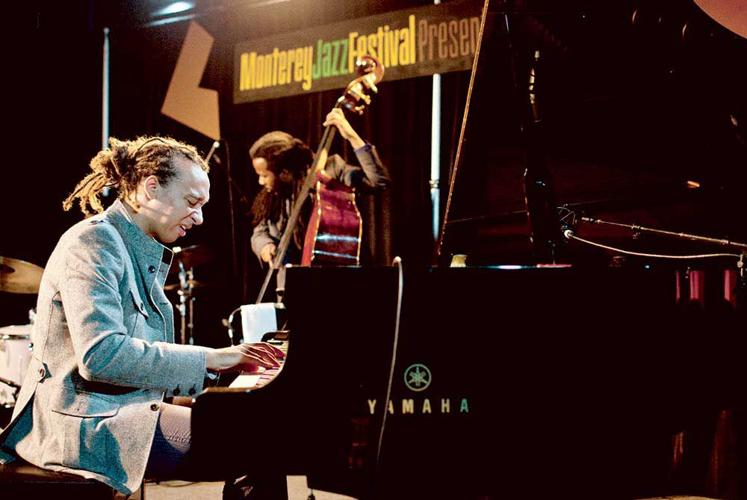
When pianist Gerald Clayton talks about jazz, he distills it down to its most basic components. “It’s the same 12 notes for everyone,” he says. “It’s a different language or a different vocabulary, but the same expression and the same journey.”
This weekend, the journey brings 33-year-old Clayton back to the Monterey Jazz Festival, where he performs as the artist-in-residence alongside his father, bassist and composer John Clayton, and drummer Jeff Hamilton. It’s the first time in MJF’s 60-year history that a father and son have been chosen as artists-in-residence, but the Clayton family has been here before: John Clayton and Hamilton were artists-in-residence in 2003, along with John’s brother, Jeff Clayton, as the Clayton-Hamilton Jazz Orchestra. (That group will be performing this year’s commision piece, Stories of a Groove: Conception, Evolution, Celebration.)
Gerald Clayton has also made the rounds at MJF before, starting in 2000 and 2001 when he was a student at Los Angeles County High School for the Arts and won the soloist award at the Next Generation Jazz Festival. He also remembers being a little kid and seeing his dad onstage. “It’s nice to be able to reflect when you’re there on the stage, compared to the times you were in the audience looking at the musicians,” he says. “The appreciation for jazz really has a lasting effect. It’s about putting good music in the ears of young kids.”
Part of his musical education was the Next Gen Jazz Festival, which he views as indispensable to learning to trust your ears and be confident enough to break the rules. “I spend a lot of time thinking about what is useful for high school students,” he says. “Too often it seems like students focus on learning music charts instead feeling the music themselves.”
Clayton started studying music at age 6, with classical piano, and grew up listening to jazz at home with his dad.
“We’re products of the music we’re exposed to,” he says. “I identified with music – like jazz – that deals with the freedom of improvisation.”
Clayton says MJF provides a place where he can concentrate on creating an honest sound, while honoring the lineage of great musicians who came before him.
“I think the purists want to preserve what they know as they know it, but what I want to do is expand their mind,” he says.
He explores that consciousness with a concerted, but cool intensity: “I try to have a very relaxed headspace, which allows me to experience different levels of the music.”
He’s been playing with the other musicians in his group off and on for about 10 years, which allows them to know how each person voices themselves.
“The trio allows for a lot of communication, like having an intimate conversation,” Clayton says. “We’re expressing the entire range of how we’re feeling.”
John Clayton concurs. “Art is always a platform for experimenting,” he says. “As times goes on and more styles of music show themselves, there is more to learn.”
That includes learning from his son. “I’m intrigued by his musical vocabulary. His approach is different,” John says.
When it comes to performing together, John says it’s a neutral relationship. “It’s only afterward that I think, ‘Oh yeah, he’s my kid,’” John says. “When we’re playing, it’s just another great piano player.”
In 2009, Clayton received a Grammy nomination for Best Improvised Jazz Solo for his debut album as a leader entitled Two Shade. Two years later, he picked up a second Grammy nod for Best Jazz Instrumental Composition and a another nod for his second album Bond: The Paris Sessions for Best Jazz Instrumental Album.
Clayton says his influences come from far and wide. He’s been listening to rapper Kendrick Lamar, Spanish pianist Frederico Mompou and blues from the Appalachian foothills.
For Clayton, he’s not a jazz musician, but simply a musician who explores that world accordingly:
“I like what Duke Ellington says: There is only good music and bad music.”
GERALD CLAYTON plays with the GERALD CLAYTON TRIO at 10pm on Friday, Sept. 15 on the Night Club Stage, and with the the Clayton-Hamilton Jazz Orchestra at 7:30pm on Saturday, Sept. 16 on the Jimmy Lyons Stage.

5
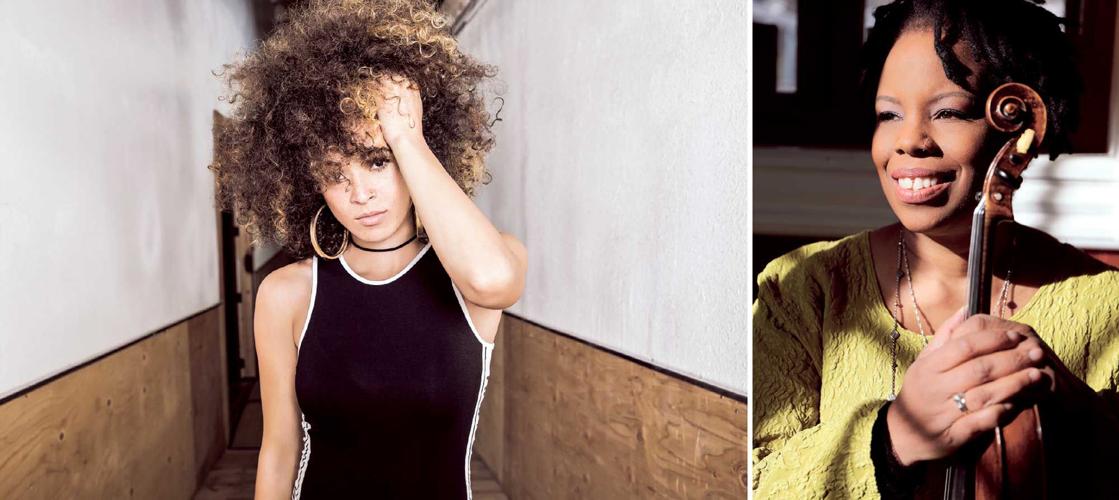
Linda May Han Oh has been playing music since age 4, starting with piano, then bassoon. She listened to her older sister’s eclectic collection of CDs, which included some jazz selections – Weather Report, Bill Evans, Jaco Pastorius. It wasn’t until she heard the Oscar Peterson Trio’s album Night Train, at 17, that she decided to start playing upright bass. Since then, she’s risen fast in the jazz world. The current bassist with Pat Metheny, she’s won numerous awards, and released her latest album, Walk Against Wind, in April. She’ll play tunes from that new album when she appears at the Monterey Jazz Festival this weekend with the Linda May Han Oh Quintet.
The 33-year-old was born in Malaysia and raised in Australia. She now lives in New York, and spent much of the summer teaching in Europe and Canada. She caught up with theWeekly from the airport before taking off for France, where she was traveling to record.
Weekly: When you’re the bandleader and songwriter, does the bass become more prominent?
Oh: I wouldn’t necessarily see the bass as in a different role when I’m the leader. I still think it should be a strong supportive foundation as part of the rhythm section.
The repertoire is different. I wanted the bass to have more responsibility in these compositions. I wanted the bass to have more than just the root of the harmony.
What’s your songwriting process like?
It varies. Each tune is different. The title for this album, Walk Against Wind, was inspired by a pantomime routine by Marcel Marceau.
What does pantomime have to do with jazz music?
I talk to students about nonverbal communication – what we can do without words and lyrics, just feelings and sounds. It’s important when you’re playing improvised music. When you are in the middle of creating something, you can’t yell at the person next to you, “‘A’ section!” or “bridge!” or “softer.” A lot of that can be done with nonverbal cues.
It encourages awareness. People can get caught up with their own music. So much is about being open and responsive to your fellow musicians.
Your new album has some interesting titles, like “Speech Impediment.” You say it’s a love story, of a man who can’t express his love to a woman because of his stutter. I can really hear the urgency, and you communicate a pretty complex story through music, without lyrics.
The overarching idea is about empathy – looking for substance in a person as opposed to the exterior and what they present, because it’s so often not real. In a time when there’s so much emphasis on social media and appearances, it’s a song about encouraging people to look beyond that.
As a performer, do you feel tension between who you appear to be and who you really are?
Being in any business where you have to be in the public eye, there’s some sort of navigating between what’s public and personal. You want to be a role model for people. I don’t think that’s a bad thing. I wouldn’t say there’s tension, but thought has to be put into it.
It’s about awareness. Being a female musician, you do think about, what are you going to wear? Inevitably, there may be comments. That’s for women in any male-dominated world.
You’re enthusiastic about the eco-conscious elements of your new album. Tell me about that.
It’s a different format. It’s a piece of origami FSC-certified paper art, with vegetable-based ink. Inside is a digital download code. We experimented with different packaging techniques, and there is no plastic, even when we send it.
That’s a creative form of activism. Did Donald Trump’s election change anything for you?
It’s a wakeup call not to take things for granted. It’s interesting to travel and experience different points of view. That helps me solidify where I stand. I’m trying to see the positive. I think everyone is. And just trying to do our best to counteract whatever damage may be done.
The LINDA MAY HAN OH QUINTET plays at 4:15pm Sunday, Sept. 16 on the Garden Stage. 373-3366, lindamayhanoh.com
More like this...
Common is one of the most respected rappers walking the Earth. His sales may not necessarily reflect that. He’s cracked the Top 100 album/R&B/rap charts in the U.S. plenty, and reached No. 1 a handful of times, but he’s never gone platinum; there are a plethora of hip-hop artists with less talent, work ethic or maturity who have.
But Common’s place in contemporary music culture is more enduring, creative and important than a lot of hyped-up rappers who have come and gone.
His high-quality output started in 1992, and he was blazing right out the block. His music was smart, soulful, jazzy, bumpin’, creative, lyrical, informed, filled with conscious lyrics about liberation, corruption, empowerment, love and peace, an ethic reflected in his work on Rock the Vote, AIDS/HIV awareness and his own Common Ground Foundation.
He’s worked with the top echelon of rappers and producers, including Tribe Called Quest, Pharrell, Pete Rock, Kanye West, Mos Def, Canibus, Lauryn Hill, The Roots, Kid Cudi and J Dilla.
Common’s been known to mix it up on a more street level, sparking diss tracks with heavy hitters like Ice Cube and Drake. One track, “I Used to Love H.E.R.,” about the evolution of hip-hop culture, ignited a little East Coast/West Coast beef, which was settled amicably. But he was deemed conscious and positive enough to perform for the Obamas at the White House.
He’s made moves that seemed aimed to cross over. Like collaborating on a song with the Jonas Brothers, wearing bohemian and hippie clothing, doing movies, fashion modeling and commercials. The man stayed true to the most appealing parts of hip-hop with a relentless positivity that some embraced and others found too bright.
His new song “The Day the Women Took Over” is a reinterpretation of Dr. Dre’s L.A. Riots track “The Day the Niggaz Took Over.”
But Common makes it an ode to women like Michelle Obama, Oprah Winfrey and Rosa Parks. Here is the positivity again, leaning toward platitudes. Common seems comfortable being the more nice guy, coming with righteous positivity instead of righteous anger in “The Day the Women Took Over”: “We openin’ doors and pullin’ out chairs again… Toilet seats down. That’s a no-brainer.”
That works just right for his entry into the Monterey Jazz Festival. Common has utilized his popularity to bring audiences along on his creative renewal. In 2015 he and John Legend won the Oscar for Best Original Song for “Glory” from the film Selma. And last year he released one of his most acclaimed and freshest albums in years, Black America Again.
Jazz and hip-hop have crossed paths many times. Hip-hop acts who have gotten down with jazz include Digable Planets, US3, Gang Starr (whose Jazzmatazz series enlisted players like Kenny Garrett and Lonnie Liston Smith), Nas, Mac Miller and CeeLo Green.
And plenty of jazz cats have dabbled with hip-hop: Branford Marsalis, Don Byrd, Ron Carter, Maceo Parker, Quincy Jones. Herbie Hancock’s “Rocket” was a staple in breakdance battles.
Hip-hop has graced Monterey Jazz Festival stages. Robert Glasper, who came out in 2011, busted out some hip-hop beats. That same year, Puerto Rican rapper Rico Pabon performed with the John Santos Sextet.
Common is still an anomaly in a jazz festival setting, but not a shock.
The title track of Black America Again is a sweeping and urgent message song produced by Robert Glasper and features Stevie Wonder on vocals and Esperanza Spalding on bass. On “Pyramids” he samples Ol Dirty Bastard and raps furiously over an ’80s synthesizer line: “I walk like an Egyptian on a mission to listen to conditions/ Envision a vision of what we wishing/ I’ve been commissioned to de-prison the prism of your mind/ Spit the wisdom of the one divine.”
On “Unfamiliar” he samples John Cameron’s “Half Forgotten Daydreams,” but cut up like he took the record and smashed it into pieces, then put it back together, disjointed but still working.
There is just enough dissonance and protest to flirt with art music and flip a middle finger to the pop charts. The album is oblique and jazzy and soulful, a mash-up of black music that’s lyrical enough that hip-hop heads may can dig it, but not so on fire that it drives away the old heads in the main arena.
One key may be if jazz fans don’t pay too much attention to the repetitive samples – which are more like a bed of percussion and rhythm than a traditional melody or accompaniment – and pay attention to the lyrics. That’s where it’s at. The samples are the concrete that the rapper stomps, strides and dances across.
Common is on a mission. You can feel it. That’s going to be something to see live.
COMMON performs at 3:20pm on Sunday, Sept. 17 on the Jimmy Lyons Stage. thinkcommon.com
Chris Thile & Brad Mehldau was recorded at the famed Avatar Studios in New York City over a frantic three-day period that straddled late 2015 and early 2016. The two accomplished musicians – multi-instrumental mandolinist Chris Thile, the newly-appointed host of NPR’s beloved A Prairie Home Companion, and intrepid pianist Brad Mehldau, a go-to collaborator of jazz guitar virtuoso Pat Metheny – churned out originals and covers.
Thile and Mehldau are set to make their Monterey Jazz Festival debut as a duo. Mehldau performed the festival in 2000; it’s Thile’s first MJF appearance. Attendees lucky enough to experience this duet, dubbed “Progressive Bluegrass Pacesetter Meets Influential Jazz Master,” should try to ignore the genres suggested in the program title.
Other than being Nonesuch labelmates, Thile and Mehldau had little in common before their debut performance in 2011, during Mehldau’s Wigmore Hall residency in London. The two felt a deep connection. Over the next four years, any time their demanding schedules allowed for it, they’d forgo break time for gigs together; a quick nine-city tour in 2013 and a pair of sold-out concerts at Manhattan’s Bowery Ballroom have been the extent of their live performance history, which provides more of a reason not to miss their MJF performance.
In a festival that combines big-stage experiences with more intimate stages, expect Thile’s and Mehldau’s show to lean toward the latter, and make you feel like you’re in a living room surrounded by friends.
CHRIS THILE and BRAD MEHLDAU perform 7pm Sunday, Sept. 17 on the Arena Stage.
When pianist Gerald Clayton talks about jazz, he distills it down to its most basic components. “It’s the same 12 notes for everyone,” he says. “It’s a different language or a different vocabulary, but the same expression and the same journey.”
This weekend, the journey brings 33-year-old Clayton back to the Monterey Jazz Festival, where he performs as the artist-in-residence alongside his father, bassist and composer John Clayton, and drummer Jeff Hamilton. It’s the first time in MJF’s 60-year history that a father and son have been chosen as artists-in-residence, but the Clayton family has been here before: John Clayton and Hamilton were artists-in-residence in 2003, along with John’s brother, Jeff Clayton, as the Clayton-Hamilton Jazz Orchestra. (That group will be performing this year’s commision piece, Stories of a Groove: Conception, Evolution, Celebration.)
Gerald Clayton has also made the rounds at MJF before, starting in 2000 and 2001 when he was a student at Los Angeles County High School for the Arts and won the soloist award at the Next Generation Jazz Festival. He also remembers being a little kid and seeing his dad onstage. “It’s nice to be able to reflect when you’re there on the stage, compared to the times you were in the audience looking at the musicians,” he says. “The appreciation for jazz really has a lasting effect. It’s about putting good music in the ears of young kids.”
Part of his musical education was the Next Gen Jazz Festival, which he views as indispensable to learning to trust your ears and be confident enough to break the rules. “I spend a lot of time thinking about what is useful for high school students,” he says. “Too often it seems like students focus on learning music charts instead feeling the music themselves.”
Clayton started studying music at age 6, with classical piano, and grew up listening to jazz at home with his dad.
“We’re products of the music we’re exposed to,” he says. “I identified with music – like jazz – that deals with the freedom of improvisation.”
Clayton says MJF provides a place where he can concentrate on creating an honest sound, while honoring the lineage of great musicians who came before him.
“I think the purists want to preserve what they know as they know it, but what I want to do is expand their mind,” he says.
He explores that consciousness with a concerted, but cool intensity: “I try to have a very relaxed headspace, which allows me to experience different levels of the music.”
He’s been playing with the other musicians in his group off and on for about 10 years, which allows them to know how each person voices themselves.
“The trio allows for a lot of communication, like having an intimate conversation,” Clayton says. “We’re expressing the entire range of how we’re feeling.”
John Clayton concurs. “Art is always a platform for experimenting,” he says. “As times goes on and more styles of music show themselves, there is more to learn.”
That includes learning from his son. “I’m intrigued by his musical vocabulary. His approach is different,” John says.
When it comes to performing together, John says it’s a neutral relationship. “It’s only afterward that I think, ‘Oh yeah, he’s my kid,’” John says. “When we’re playing, it’s just another great piano player.”
In 2009, Clayton received a Grammy nomination for Best Improvised Jazz Solo for his debut album as a leader entitled Two Shade. Two years later, he picked up a second Grammy nod for Best Jazz Instrumental Composition and a another nod for his second album Bond: The Paris Sessions for Best Jazz Instrumental Album.
Clayton says his influences come from far and wide. He’s been listening to rapper Kendrick Lamar, Spanish pianist Frederico Mompou and blues from the Appalachian foothills.
For Clayton, he’s not a jazz musician, but simply a musician who explores that world accordingly:
“I like what Duke Ellington says: There is only good music and bad music.”
GERALD CLAYTON plays with the GERALD CLAYTON TRIO at 10pm on Friday, Sept. 15 on the Night Club Stage, and with the the Clayton-Hamilton Jazz Orchestra at 7:30pm on Saturday, Sept. 16 on the Jimmy Lyons Stage.
Linda May Han Oh has been playing music since age 4, starting with piano, then bassoon. She listened to her older sister’s eclectic collection of CDs, which included some jazz selections – Weather Report, Bill Evans, Jaco Pastorius. It wasn’t until she heard the Oscar Peterson Trio’s album Night Train, at 17, that she decided to start playing upright bass. Since then, she’s risen fast in the jazz world. The current bassist with Pat Metheny, she’s won numerous awards, and released her latest album, Walk Against Wind, in April. She’ll play tunes from that new album when she appears at the Monterey Jazz Festival this weekend with the Linda May Han Oh Quintet.
The 33-year-old was born in Malaysia and raised in Australia. She now lives in New York, and spent much of the summer teaching in Europe and Canada. She caught up with theWeekly from the airport before taking off for France, where she was traveling to record.
Weekly: When you’re the bandleader and songwriter, does the bass become more prominent?
Oh: I wouldn’t necessarily see the bass as in a different role when I’m the leader. I still think it should be a strong supportive foundation as part of the rhythm section.
The repertoire is different. I wanted the bass to have more responsibility in these compositions. I wanted the bass to have more than just the root of the harmony.
What’s your songwriting process like?
It varies. Each tune is different. The title for this album, Walk Against Wind, was inspired by a pantomime routine by Marcel Marceau.
What does pantomime have to do with jazz music?
I talk to students about nonverbal communication – what we can do without words and lyrics, just feelings and sounds. It’s important when you’re playing improvised music. When you are in the middle of creating something, you can’t yell at the person next to you, “‘A’ section!” or “bridge!” or “softer.” A lot of that can be done with nonverbal cues.
It encourages awareness. People can get caught up with their own music. So much is about being open and responsive to your fellow musicians.
Your new album has some interesting titles, like “Speech Impediment.” You say it’s a love story, of a man who can’t express his love to a woman because of his stutter. I can really hear the urgency, and you communicate a pretty complex story through music, without lyrics.
The overarching idea is about empathy – looking for substance in a person as opposed to the exterior and what they present, because it’s so often not real. In a time when there’s so much emphasis on social media and appearances, it’s a song about encouraging people to look beyond that.
As a performer, do you feel tension between who you appear to be and who you really are?
Being in any business where you have to be in the public eye, there’s some sort of navigating between what’s public and personal. You want to be a role model for people. I don’t think that’s a bad thing. I wouldn’t say there’s tension, but thought has to be put into it.
It’s about awareness. Being a female musician, you do think about, what are you going to wear? Inevitably, there may be comments. That’s for women in any male-dominated world.
You’re enthusiastic about the eco-conscious elements of your new album. Tell me about that.
It’s a different format. It’s a piece of origami FSC-certified paper art, with vegetable-based ink. Inside is a digital download code. We experimented with different packaging techniques, and there is no plastic, even when we send it.
That’s a creative form of activism. Did Donald Trump’s election change anything for you?
It’s a wakeup call not to take things for granted. It’s interesting to travel and experience different points of view. That helps me solidify where I stand. I’m trying to see the positive. I think everyone is. And just trying to do our best to counteract whatever damage may be done.
The LINDA MAY HAN OH QUINTET plays at 4:15pm Sunday, Sept. 16 on the Garden Stage. 373-3366, lindamayhanoh.com
More like this...
advertisement
(0) comments
Welcome to the discussion.
Log In
Keep it Clean. Please avoid obscene, vulgar, lewd, racist or sexually-oriented language.
PLEASE TURN OFF YOUR CAPS LOCK.
Don't Threaten. Threats of harming another person will not be tolerated.
Be Truthful. Don't knowingly lie about anyone or anything.
Be Nice. No racism, sexism or any sort of -ism that is degrading to another person.
Be Proactive. Use the 'Report' link on each comment to let us know of abusive posts.
Share with Us. We'd love to hear eyewitness accounts, the history behind an article.