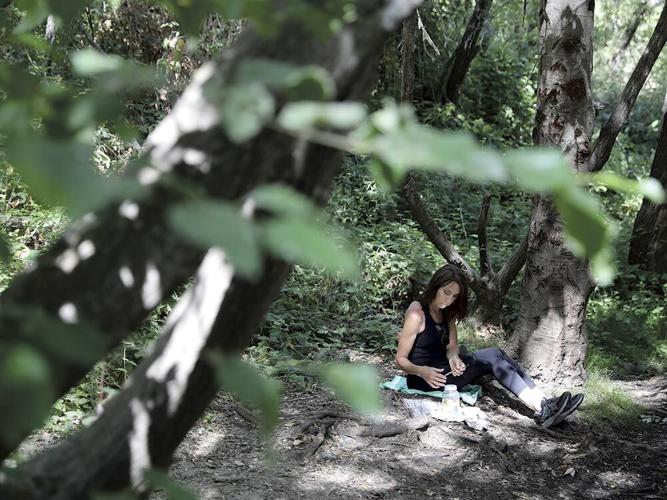

The sun hangs low and shines bright over the northeastern ridge of Carmel Valley on a recent weekday morning, and Maria Best is guiding a forest bathing session for one at Garland Ranch Regional Park.
Sitting in a grassy field just south of the Carmel River, facing the sun, a breeze ripples through the trees along the river’s banks, and the calls of birds punctuate the air.
When Best begins her guided meditation, seated in the field, the mind is quickly transported, and day-to-day concerns start to wash away.
“When you’re ready, just soften your gaze and close your eyes. And just begin to be with the breath and recognizing that your body is breathing. And just remembering that it does this without us even asking,” she says.
“And a few good inhales, and some nice big exhales. Just exchanging breath in this place. And in your next inhale, inhale through your nose, and just begin to sense the smell of this place… And I wonder if the smells take you anywhere.
“And staying with the sense of smell as you breathe in, I wonder if the air tastes any different since you’ve arrived…
“And drawing your attention to your skin, feeling the warm sun on your skin versus the feeling of the skin under your clothes…
“And drawing your attention to your ears and sounds. I wonder what the furthest away sound is you can hear… And I wonder what the closest sound is. And I wonder if there’s a melody to this place…
“And I’m drawing your attention to your imagination. I invite you to imagine that there are roots coming out from underneath of you, starting to peek into the soil. And imagine that the Earth is welcoming those roots, and it wants to meet your roots…
“And drawing our roots back up into our body, thanking the Earth for letting us visit. And I invite you to consider all the people that have been here before us, and that they, like us, been have on a journey… And drawing your attention to your heart, just feeling and remembering that you have a heart and that it’s beating, and it’s working together with the breath. And I wonder what your heart beats for…
“In a moment I’m going to invite you to open your eyes but not yet, take your time. And when you do open them, I’d like you to consider that you’re seeing this place, and the sun, for the very first time, as well as considering that the light can also see you…
“So when you’re ready, just open your eyes.”
FOREST BATHING, AS A MEDICINAL PRACTICE, originated in Japan in 1982 as part of a government-led preventative health care program. The Japanese term for it is shinrin-yoku, and the first experiments were conducted in the Akasawa forest in the Nagano prefecture, considered one of the most beautiful forests in Japan, a lush country filled with beautiful forests.
That the practice originated in Japan makes sense: Japan’s two predominant religions, Shinto and Buddhism, are both intrinsically linked with nature, and in Shinto, spirits are not separate from nature, they are nature. Mt. Fuji, for example, is considered sacred, a home of deities, but even a small waterfall might have a Shinto shrine built next to it. In the waterfall – or the place itself – there is a kami, a spirit of the natural world that is also our own.
Shinrin-yoku developed out of a growing recognition that as technology advances, and our eyes are increasingly glued to screens and we just seem to get busier and busier, it is important to release and reconnect with the natural world we evolved in.
The term “forest bathing” derives from a translation of shinrin-yoku: In Japanese, shinrin means “forest” and yoku means “bath.” And the idea behind the practice is not to achieve some sort a fitness goal, it’s to commune with nature, not conquer it. It calls for us to relax, and reconnect.
There is a growing wealth of scientific evidence indicating that forest bathing has numerous health benefits, and even though it’s not crucial to understand why, we’re starting to understand that too.
Qing Li, a doctor at Nippon Medical School in Tokyo, is arguably the world’s leading expert on forest bathing – he’s dedicated his career to studying it. His 2018 book Into the Forest: How trees can help you find health and happiness (the book was subsequently retitled Forest Bathing), helped introduced a lot of people in the West – including Best – to an activity that humans have been practicing for millennia, but that we are just now starting to understand from a scientific perspective.
Around the same time forest bathing was being formalized as a practice, the late E.O. Wilson, a longtime entomologist at Harvard and one of America’s most famous science writers, published a book in 1984 titled Biophilia – a term derived from Greek meaning “a love of life and the living world” – in which he argues humans are “hard-wired” to connect with the natural world, and that “our existence depends on this propensity, our spirit is woven from it, hope rises on its currents.”
Li’s book, published 34 years later, rides that same current, and brims with poetic wisdom.
“Some people study forests. Some people study medicine. I study forest medicine,” he writes.
It’s a lovely read, and filled with details about the relationship forest bathing has with Japanese culture.
“Being in nature can restore our mood, give us back our energy and vitality, refresh and rejuvenate us,” he writes. “We know this deep in our bones. It is like an intuition, or an instinct, a feeling that is sometimes hard to describe. In Japanese, we have a word for those feelings that are too deep for words: yûgen.”
Li also writes that “many Japanese folk stories are about kodama, a kind of nature deity that lives in a tree,” and adds, “knowledge of trees that have kodama living in them is passed down through the generations, and those trees are protected. If you cut down a tree that has a kodama living in it, you will be cursed.”
At the Akasawa forest, where the first experiments were conducted to prove the science behind forest bathing’s health benefits, there are eight designated forest bathing trails – all at or below two miles – for the public to engage in the practice. There is even medical staff on site from May to October, offering consultations in the trees.
Li became convinced forest bathing was real in 1988, while camping with friends for a week on Yakushima, a small island south of Kyushu, the southernmost big island in the country. Yakushima, a subtropical rainforest, became listed as a UNESCO World Heritage Site in 1993, and is home to Japan’s oldest trees, cedars known as yakusugi. Some are thousands of years old, and they preside over a magical landscape that is both ancient, yet bursts with new life. (This reporter also backpacked across Yakushima, in 2004.)
That “fascinating, inspiring” experience changed Li, and, he writes, “was to have an important impact on the whole direction of my life and my future research.”
The most groundbreaking research has been conducted in Iiyama – which, like Akasawa, is also in the Nagano prefecture – where the first scientific evidence showed it can boost the immune system, increase energy levels, decrease anxiety and reduce stress.
In 2006, the forest in Iiyama where those studies were done became the first place to receive forest-therapy certification from the Japanese government. There are now at least 65 certified sites, and the number continues to grow.
And in Li’s book, he just keeps piling on the data to prove that forest bathing isn’t some woo-woo New Age trend. The benefits are real, and humans have been experiencing them for millennia, whether or not they knew it.
Those include boosting the levels of cancer-fighting “natural killer” (NK) white blood cells in the body for as long as 30 days.
The salutary health benefits are largely believed to be the result of phytoncides – essential oils emitted by trees – and they also seem to promote a boost in creativity.
“Trees help us think more clearly, be more creative, and make us nicer and more generous,” Li writes.
“Is it any wonder,” he continues, “that Buddha found enlightenment sitting under a tree?”

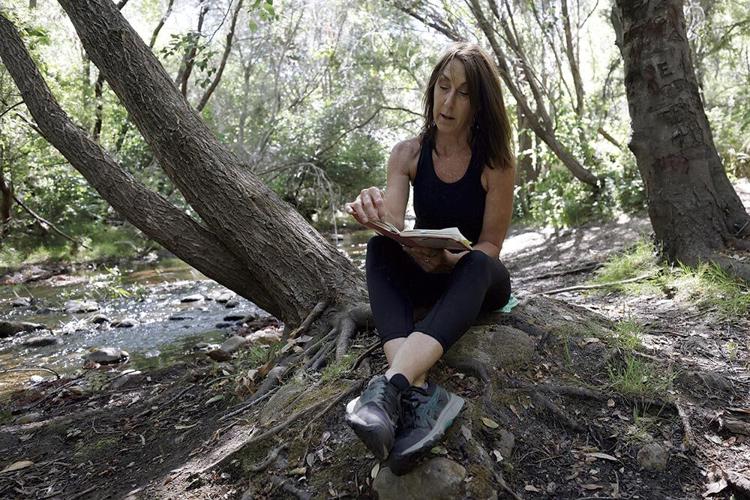
Maria Best, sitting on the bank of the Carmel River, reads passages from her notebook while guiding a forest bathing journey.
IT WAS LI’S BOOK that inspired Best to investigate forest bathing, and it changed her life.
“All of a sudden I had this revelation,” she says, adding, “Everybody got that book from me for Christmas that year.” In 2020, amid Covid lockdowns, she enrolled in an online course to get certified as a forest bathing guide. As part of that process, she had to choose a “sit spot” in nature that she was intended to visit at least twice a week for 20 minutes or more.
Where she landed was under a sycamore tree in Marks Canyon, in Toro Park.
“It’s about allowing yourself to find a place you can become familiar with, and that can become familiar with you,” she says. “The longer one sits, the more one may notice.”
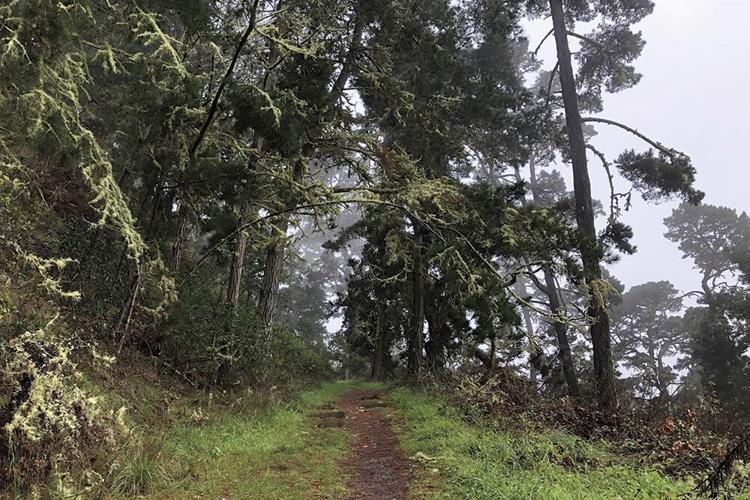
The tree Best chose to sit under in 2020 burned in the River Fire just two weeks later, and so Best, who lives in Salinas, had to pivot. She rediscovered Royal Oaks Park in Watsonville, and also found a redwood to curl up in at The Forest of Nisene Marks State Park in Aptos, which has become one of her favorite places to forest bathe.
Now certified, Best helps introduce others to this healing modality. She offers guided forest bathing sessions for clients on an individual basis for about $200, and in groups the rate runs about $20 per person. She’s not making a living off of it – it’s just one service in her portfolio, as she also works as a professional organizer and is training for her certification in feng shui.
Best’s goal with her clients is to get them to “start to form a relationship” with nature if they don’t have one already, and to show people how beautiful nature can be.
“Nature wants to be in a relationship with us,” she says. “We need it. It’s very reciprocal… It is kind of like magic. It helps people want to love it and take care of it back.”
Marianne Rowe, who’s based in Pacific Grove, has been a certified forest bathing guide since 2017. An eco-therapist and eco-psychologist, Rowe happened upon the concept while researching a trip to Sedona, Arizona, and immediately knew it sang her music.
Rowe grew up close to nature, playing in the woods in Georgia, and spent much of her youth in creeks or climbing trees. And forest bathing taps into the most important vein of eco-psychology: “It’s recognizing that many of our physical, social, and psychological problems are rooted in our separation from Earth and all her beings,” she says, emphasizing that the problem has continued to get worse over the past 50 years. “Which is why when we spend time in the forest,” she says, “we feel better emotionally. It’s because we’re coming back into alignment from something we’re stepping away from.”
Rowe is also very careful not to use the word “nature.”
“It’s an objectification,” she says. “We are nature.”
Neither Best nor Rowe are doing much guiding at present – for both, it’s a side gig. Best says she guides about once every few months, and she’s hoping to increase it to twice a month. Rowe says she hasn’t been guiding regularly since the pandemic hit. Instead, she’s been pursuing a certification in climate psychology, which she sees as an increasingly important psychological issue.
“There’s so much anxiety and grief, and it’s overwhelming,” she says. “People don’t want to talk about it.”
But no matter which field Rowe is practicing with her clients, a throughline is that she’s always trying to connect them with the Earth, which is where she finds joy in her work. What’s been most surprising to her, she says, is how people without her depth of experience in the outdoors can quickly “drop into a relationship” with it when she’s guiding.
She recalls a walk she guided a few years ago with a Salinas resident who hadn’t had much exposure to the outdoors: “He immediately dropped in within 15 minutes.”
Our senses are there, they just need to be awakened sometimes.
Or all the time.

Maria Best, sitting on the bank of the Carmel River, reads passages from her notebook while guiding a forest bathing journey.
AS BEST WRAPS UP HER GUIDING TRIP ON A RECENT WEEKDAY MORNING, she settles into a sitting position on the southern bank of the Carmel River, which is flowing gently and glistening with sunlight coming through the riparian canopy.
After several minutes of quiet contemplation, Best offers some tea brewed from lavender, lemon and bay leaf. Each of us present (we are only three) add our metaphorical offering to the tea – gratitude, curiosity, sounds – and then she serves it up. The tea is warm and delightful, an elixir in which lavender is the star.
Then Best reads some passages. The first is from Francis Hodgson Burnett’s The Secret Garden, published in 1911. “Sometimes since I’ve been in the garden I’ve looked up through the trees at the sky and I have had a strange feeling of being happy as if something was pushing and drawing in my chest and making me breathe fast. Magic is always pushing and drawing and making things out of nothing. Everything is made out of magic, leaves and trees, flowers and birds, badgers and foxes and squirrels and people. So it must be all around us. In this garden – in all the places.”
Best pauses for a few seconds, and then reads a quote from John Muir’s Mountains of California: “Climb the mountains and get their good tidings. Nature’s peace will flow into you as sunshine flows into trees. The winds will blow their own freshness into you, and the storms their energy, while cares will drop away from you like the leaves of Autumn.”
The river is quiet. Dappled sunshine lights it up in places, and where it does, waterbugs glide across its surface, swirling atop the water in a dance that has been rehearsed for millions of years.
Magic is everywhere.
(1) comment
My favorite time in the woods is February. The morning moisture drips off the 'Spanish moss' (lichen) hanging from the oaks, and the ground has its earthy smell, with the plants growing at their best.
Welcome to the discussion.
Log In
Keep it Clean. Please avoid obscene, vulgar, lewd, racist or sexually-oriented language.
PLEASE TURN OFF YOUR CAPS LOCK.
Don't Threaten. Threats of harming another person will not be tolerated.
Be Truthful. Don't knowingly lie about anyone or anything.
Be Nice. No racism, sexism or any sort of -ism that is degrading to another person.
Be Proactive. Use the 'Report' link on each comment to let us know of abusive posts.
Share with Us. We'd love to hear eyewitness accounts, the history behind an article.