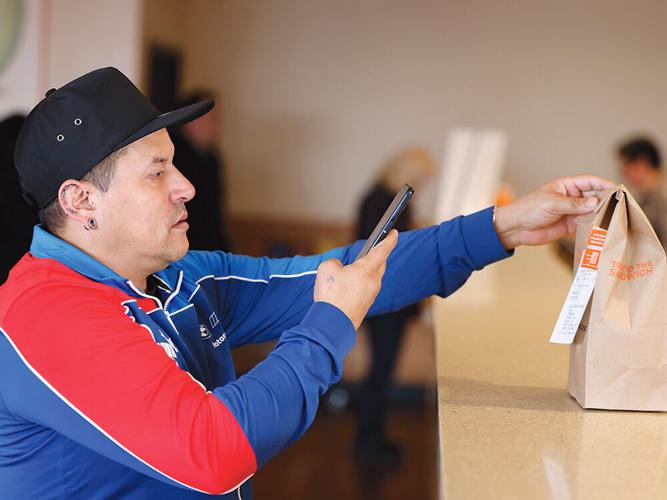
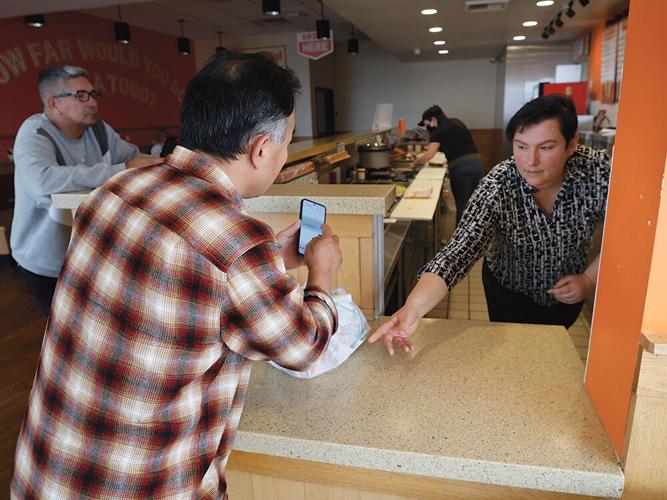


A DoorDash driver uses the app to confirm pickup of an order. Below, details provided by the app allow drivers to check that everything is correct.
AN ORDER FOR A DELI SANDWICH APPEARS ON A SCREEN AND IT IS QUICKLY ASSEMBLED. As this is happening, money changes hands electronically. Finally a person appears at the counter flashing a cell phone. With a tap of the screen, that person picks up the order and disappears out the door. Perhaps the name attached to the order is mentioned. Otherwise barely a word is spoken through the process.
Just 20 years ago, such a transaction would have seemed extraordinary. In 2025, however, third-party app orders are becoming the norm, especially at fast casual restaurants. Surveys report that almost one-third of Americans turned to delivery services multiple times a week in 2024 – a figure that is growing at a rapid clip. Experts project the global market to top $90 billion by 2030, up considerably from its current $4 billion mark.
“Delivery isn’t just a trend, it’s how people eat now,” says Uber Eats spokesperson Zahid Arab. “Customers have come to expect it.”
IF AMERICANS ARE IN THE MIDST OF A DRAMATIC CHANGE IN THEIR INTERACTIONS WITH RESTAURANTS, the benefits and burdens fall on the owners and staff of dining establishments. Certainly the delivery app option became critical to the survival of many restaurants during the pandemic. Unable to visit their favorite dining rooms, people instead turned to third-party delivery. According to the U.S. Department of Agriculture’s Economic Research Service, use of delivery from sit-down restaurants alone quadrupled over the course of Covid – jumping to $400 million from a mere $100 million. Meanwhile, mobile orders from the quick-service sector rocketed to $1.4 billion.
Other studies push the numbers much higher. Incognia, an identity solutions consulting firm, pegs spending on food delivery in all forms at $26 billion in 2020 alone.
While the numbers have calmed since, the apps continue to allow restaurants to tap into potential revenue. “We would die without it,” says Ivana Ranansky, owner of the Togo’s sandwich shop franchise in Seaside. Delivery – often to workers in need of a quick lunch – makes up 40 percent of her business.
According to the 2024 Uber Eats Merchant Impact Report, a survey of small and medium-sized businesses partnered with the service, 81 percent credit the service for improving their bottom line and expanding market presence. The BJ’s Restaurant chain took advantage of the option to create Slo Roast, a delivery-only brand.
At first reluctant to join the fray, Ashley Wolff of JeJu Kitchen in Carmel recently added DoorDash. “What I’ve come to realize is that we have customers who wouldn’t otherwise come to Carmel and deal with parking,” she explains.

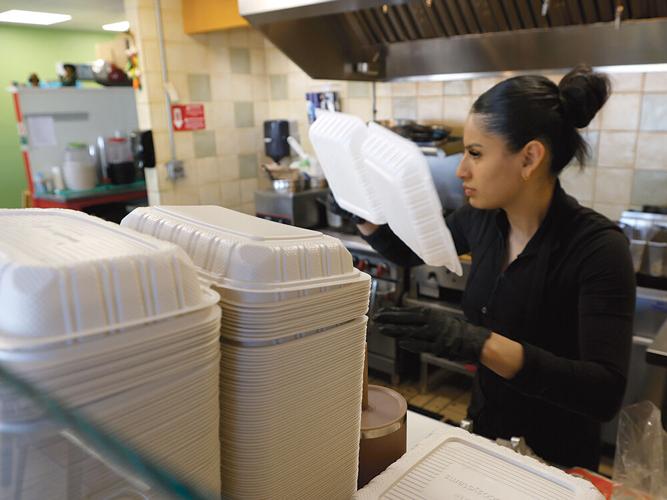
An Uber Eats order sends staff at El Cantaro in Monterey into action. The vegan Mexican restaurant is both popular and highly rated on Uber Eats and DoorDash.
But the pros are balanced by a list of cons, some of greater concern to restaurateurs than others. The most visible of these are pricing and scams.
Restaurant owners are sensitive to costs. Keeping a wary eye on expenses is a key to success. Although the formula varies depending upon the type of establishment, in general a full-service operation aims to keep food, labor and other costs – rent, utilities and so on – around 30 percent each, leaving a profit of 10 percent.
When the California minimum wage stepped up to $16.50 an hour in 2025, when the price of eggs shoots up by more than 90 percent in one year, they are faced with some unpleasant options. Do they cut quality or service? That’s unthinkable for a fine-dining location. Raise prices? There is only so much customers will pay for a plate of pasta.
Which leaves profit margin on the cutting board.
DoorDash and Uber Eats account for 90 percent of the mobile app delivery market, with the former carving out a massive 67-percent share, according to the delivery software provider Deliverect. And in structure they operate much the same, applying fees to both customers and restaurants.
“They want to take 30 percent off the top,” says Michael Foley, who owns Heirloom Pizza in Monterey and Salinas’ Live@Heirloom. “How much money do you think I make on pizza?”
Both companies offer tiered costs for restaurants, ranging between 15 and 30 percent per order through their apps for delivery, with a lower rate for take-away orders (a flat 6 percent at Uber Eats). At 15 percent, restaurants get in the third-party delivery game – but only just. Increasing the agreement to 20, 25 or 30 percent brings perks.
For example, committing to 25 percent with Uber Eats puts a restaurant on a dynamic visibility platform, making it easier to find based upon order patterns, customer approval and other factors. At 30 percent the restaurant is more likely found toward the top of the page. And at both levels, delivery fees are waived for certain customers, making the restaurant more budget-friendly to some diners.
“Our merchant pricing plans are designed to meet merchants where they are,” explains Uber Eats spokesman Arab. “No two businesses are alike, and our partnership options reflect that.”
To entice JeJu Kitchen, DoorDash offered Wolff the service free for two months, allowing her to gauge its value. And while she says joining the app has been a good decision, delivery is not the primary function of the restaurant.
“When we’re busy, I do have to toggle it off or add to the wait time,” she says. “The people seated in the restaurant are the priority.”
To compensate for the additional cost, restaurant owners can either increase their menu prices across the board or tack on a premium for third-party delivery orders. Visit Elli’s Great American Restaurant in Salinas and you will find a print menu listing carne asada fries at $15.99 and skirt steak from $31.99. Venture on the DoorDash website and the same dishes run $19.19 and $38.39, respectively – a 20-percent markup.
Foley decided to take a hit when joining Uber Eats. Despite paying out 15 percent per delivery order, he increased third-party pricing by just 8 percent.
“That mitigates a bit of the loss,” he says. “I want to have a delivery option.”
Thus far customers have been willing to bear the cost, which includes delivery fees from the third-party service and tips, in addition to higher menu prices – totaling up to 40 percent above in-person dining levels. If this trend continues, restaurants might realize a slight bump in revenue compared to traditional phone orders.
Data presented by Deliverect suggests that pizza parlors average 18-percent more revenue from online ordering than those made over the phone. The report goes on to speculate that consumers are willing to spend more thanks to the ease of searching and ordering on digital platforms, “benefitting restaurants and delivery platforms alike.”
“The fast food industry brought the mindset that food can be easy,” Wolff observes. “But you pay for convenience.”
And for some restaurant owners, the gain is still tenuous.
“There is almost zero margin in this,” Ranansky says, adding that marking up menu prices is the only way to profit. Gesturing at Togo’s dining room, she adds, “If I carry the 30 percent, I’ll have to close this.”
THE SCENARIO OF THE DELI SANDWICH – ORDERED AND SMOOTHLY DELIVERED – happened at Togo’s. But the transaction is not always without trouble.

Ivana Ranansky, owner of the Togo’s sandwich shop franchise in Seaside, double checks an order with a delivery driver. Orders through third-party delivery apps account for 40 percent of her business.
Imagine instead that the order is accounted for by a driver who shows the correct customer name to a staff member from his or her phone. The driver then heads out the door. A few minutes later a second driver arrives at the counter, looking for the same order.
It’s a scam that occurs with enough frequency to be noticed. On a recent Reddit thread among DoorDash drivers, one “Dasher” claimed to run across situations where she accepts an order that turns out to have been picked up already at least once a day.
“There are humans involved – what could go wrong?” Heirloom’s Foley observes with a laugh. “Sometimes the food gets picked up but not delivered.”
Natasha Ushakoff, the manager at Togo’s, knows the drill well. A driver in search of free lunch will accept an order and pick it up, but not toggle the button on the phone. Instead, the driver sends notification through the app that he or she is now unable to make the trip. So the order goes back on the app for another driver to accept.
“It’s a cycle that affects the business, the customer and the other drivers who are trying to make a delivery,” Ushakoff says.
DoorDash and Uber Eats drivers act as independent contractors. They can pick and choose deliveries. While some may commit fraud, they are more often the target. There are a number of phishing or impostor scams affecting the delivery companies and drivers. Arab points out that Uber Eats employs two-factor identification and other tools to combat each new threat. A few, such as tech support scams, hit restaurants, as well.
“There’s a scam where they will call and say our Uber tablet is down,” Ushakoff says. “We don’t have an Uber tablet.”
Incidents where drivers apparently take a meal are a nuisance not unlike other non-delivery-related scams restaurants must contend with. Ranansky recalls the time a man ordered two large sandwiches for takeout. Later, after pickup, he complained that they were prepared incorrectly.
“I looked at the camera [footage] – everything was correct,” she says. Unhappy with the failed attempt, the man and his wife then posted negative comments about the Togo’s location on social media. This allowed Ranansky to check his background.
“He’s an injury lawyer,” she says. “A scammer by nature.”
According to Ranansky, her restaurant loses about $7,000 a year to such cases. Banks, she adds, tend to side with the customer on chargebacks, especially if the credit card was not physically present at the restaurant.
Imposter and chargeback scams predate the internet, of course. The non-delivery of food is a problem of the third-party system. Ranansky admits that it tends to occur when the shop is busy.
Some places with high delivery volume even set orders on racks for driver pickup, with no effort at confirmation.
“You shouldn’t be careless,” says Wolff, adding that JeJu Kitchen has not experienced scam attempts. “If you aren’t having staff take the time to check – every driver has to show us the name.”
It’s also ideal if a staff member watches the driver tap the button acknowledging a pickup.
“For customers, our goal is simple: every order, delivered,” Arab notes. “If something goes wrong and they’re charged for an order they never received, we ask them to reach out right away.”
DoorDash and Uber Eats work with law enforcement when crimes such as robbery from a driver occur. But food-related scams may slip through. There were no reported incidents on the Monterey Police Department log book for a recent two-week span. But Lt. Jake Pinkas says that such thefts are no different than “porch pirates” stealing Amazon deliveries.
“Monterey Police Department will never have a problem investigating a theft,” he says. Admittedly it may be difficult to identify the person responsible, and the delivery services compensate restaurants and ensure the delivery is made. But, Pinkas adds, “It doesn’t mean [victims] can’t call.”
Ushakoff says that the restaurant cannot initiate an investigation, but that DoorDash and Uber Eats follow up on customer complaints. Third-party intervention can prove beneficial.
“If we make a mistake, the customer can get a chargeback,” Foley explains. In cases where the fault is on the company or its driver, “We still get paid. They cover their mistakes.”
The damage is minimal, other than food costs for a second order or a frustrated customer.
“For some reason people tend to blame DoorDash mishaps on us,” Ushakoff notes.
Last year Grubhub agreed to a $25 million settlement following accusations of deceptive business practices in an apparent bid to grow its profile in a DoorDash-Uber Eats world. The company listed some 325,000 restaurants on its app without a partnership agreement – without even informing the restaurateurs.
This not only resulted in confusion, it also led to delayed deliveries, order cancellations and frustration. A Federal Trade Commission statement noted that “diners blamed the restaurants, causing reputational and other harm.”
PERCEPTION IS PERHAPS THE MOST CHALLENGING HURDLE FOR RESTAURANTS IN THE DELIVERY AGE. Success comes to those in the service industry – hosts, servers, bartenders and chefs – who can understand guests and set a mood.

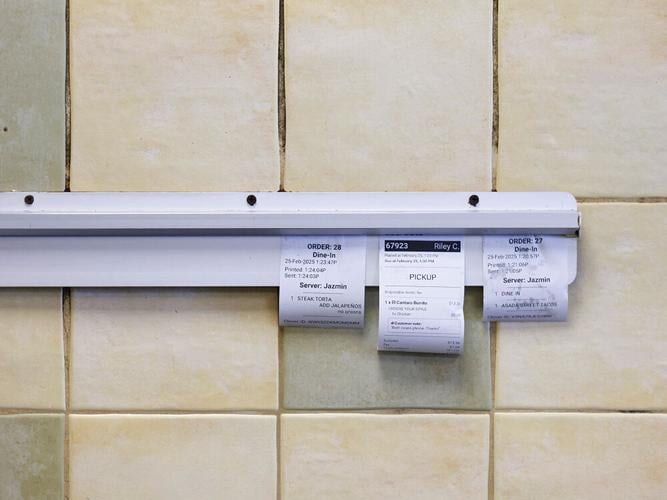
Tickets for deliveries begin to mount at El Cantaro.
Third-party delivery reduces guests to a name on a bag. There is no feel for the diner’s mood or sense of urgency. There is no interaction, no chance to offer guidance.
Uber Eats and DoorDash excel at providing tools, such as marketing aids or programs that track, filter and provide insight into recurring issues. “Uber Eats launched a suite of products to help merchants generate demand, attract new customers and grow their business,” Arab reports. The company also added a “grow your store” asset that tailors recommendations to the particular shop.
The most recent DoorDash survey of dining activity over a one-month span found that ordering food delivered edged in-person dining, by 70 percent to 68 percent. It suggests that the way people dine is becoming more impersonal.
“If someone comes in and waits, we’ll pack it up for them,” says Federico Rusciano, chef and owner of Bistro Moulin in Monterey. “But they aren’t getting the restaurant experience.” He has adamantly refused to engage a delivery service, even during the Covid shutdown.
“It defeats the purpose of a restaurant,” Rusciano explains, speaking of atmosphere down to details such as plate appeal. “It’s utilitarian.”
The way Americans approach restaurant dining has changed over the years. Ted Balestreri, owner of the iconic Monterey destination Sardine Factory, likes to talk of the days when fine dining venues insisted on protocol and guests willingly donned coats and heels. But recent generations prefer comfort. The fast-casual sector boomed. Shared plates became the norm.
Perhaps those who order to-go care less about plating, even quality.
Many items do not travel well. Pizza crust suffers, fried foods lose their crackle, pasta heated in the microwave after a 20-minute drive turns tacky. The warming containers carried by drivers, or even just residual heat, can lead to overcooked steak or fish. Omelets will dry out. Sandwich bread might soak through. The list goes on.
Some chefs stake limits on their delivery menu. In the absence of an in-person vibe, the only way to represent one’s cooking is the food itself. And even a simple tray of nachos for the Super Bowl can become a sodden mess.
Yet according to the 2024 DoorDash survey, the top five foods ordered in the U.S. include spicy chicken sandwiches, mozzarella sticks and – at number one – French fries.
“Fries, no matter what, are going to be soggy,” Wolff observes. “They’re sitting in steam.”
It doesn’t appear to matter. Since 2013, Dashers have delivered more than 600 million orders of fries in the U.S. alone.
THROUGHOUT THE 2010S, THIRD-PARTY DELIVERY GREW AT A FASTER RATE THAN IN-PERSON DINING. While the restaurant industry experienced a respectable 4-percent annual growth rate before the pandemic, the market for delivery expanded at an 8-percent clip.
It has been rocky at times. Cybersecurity Insiders reports that at one point, the delivery companies were chasing losses of $1.5 million each month due to fraud. But as each wave hit, they found ways to locate and secure weaknesses in the platforms.
That’s the nature of conducting business online.
At the same time, companies like DoorDash and Uber Eats are causing restaurants to make decisions: delivery or none, full menu or select items, 15 or 30 percent. The nature of restaurant dining is in the mix.
“There are pros and cons,” Wolff says. “There are a lot of benefits, but it has to be paid for.”
🍔
(0) comments
Welcome to the discussion.
Log In
Keep it Clean. Please avoid obscene, vulgar, lewd, racist or sexually-oriented language.
PLEASE TURN OFF YOUR CAPS LOCK.
Don't Threaten. Threats of harming another person will not be tolerated.
Be Truthful. Don't knowingly lie about anyone or anything.
Be Nice. No racism, sexism or any sort of -ism that is degrading to another person.
Be Proactive. Use the 'Report' link on each comment to let us know of abusive posts.
Share with Us. We'd love to hear eyewitness accounts, the history behind an article.