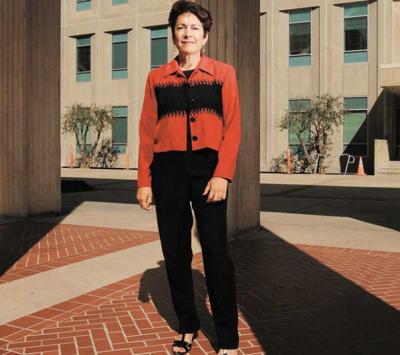
Anna Caballero looks for a familiar face in a San Jose banquet room full of union heavyweights and politicians. Though she’s tired from ping-ponging across two sprawling districts, the Salinas Valley assemblywoman doesn’t show it as she strides past the lunch line in a charcoal pantsuit and her trademark wavy coiffure, and shares a friendly handshake with the Seaside mayor, carpenters’ union organizer Ralph Rubio.
The occasion is a charity barbecue thrown by the Santa Clara and San Benito Counties Building and Construction Trades Council. There are enough local elected officials and candidates in the International Brotherhood of Electrical Workers Local 332 hall to form opposing football teams. The miner’s daughter is officially here representing Assembly District 28, but this public appearance also counts as a campaign stop in her bid to upgrade to the state Senate.
The centrist Democrat is trying to take over Jeff Denham’s Senate District 12 seat. If she wins, the Dems could be one vote shy of a two-thirds Senate majority, which could nearly silence the GOP minority on big-tickets items like the state budget.
Her rival is Anthony Cannella, a Central Valley conservative who opposes gay marriage rights and wants to stall the state’s groundbreaking climate change bill. Cannella, a civil engineer, has backing from some of the biggest agribusiness companies in Caballero’s backyard and recently won an endorsement from the Salinas Police Officers Association, as part of a bidding war to claim one of the few competitive seats in the state.
Aline Sanchez, Caballero’s district director, drops a paper plate of barbecue chicken in front of the candidate while she chats with Rubio, who’s representing Carpenters Local 605. At her table sits Steve Preminger, chair of the Santa Clara County Democratic Central Committee, and Poncho Guevara, executive director of Sacred Heart Community Service.
When a D-Day veteran recounts a war story, Caballero listens intently with her legs crossed and two fingers placed steadily on her thumb.
There’s no money here for Caballero. But the point is to be seen by the union leadership supporting her, in the hopes that they continue donating – as of Sept. 30, labor groups have contributed $208,000 to her campaign – and help get Dems to the polls. Before most guests have discovered the cake table, Caballero shakes hands and exits through a side door, trailed by two campaign staffers.
Her schedule is as dense as the charity barbecue’s prime rib and chili. She’s simultaneously trying to stay on top of budget negotiations in Sacramento, build political support in the Central Valley and keep her Salinas base happy. It’s a balancing act that has kept her on the road for days and won’t slow down until she gets home Saturday evening after a morning campaign rally in Modesto and afternoon fundraiser in Greenfield. “I’ve become a gypsy,” Caballero jokes outside the IBEW hall.
The majority of District 12 lies in the San Joaquin Valley, where the politics, like the weather, are heated. Salinas and South County cities hold the district’s far western outpost, and San Benito County runs down the center. About 20 percent of district voters live in Monterey County, while twice as many reside in Stanislaus County. Caballero’s toughest test will be winning the more conservative eastern flank.
“She has to dominate in and around in Salinas and reduce [Cannella’s] margins in the Central Valley,” says Ethan Rarick, director of the Robert T. Matsui Center for Politics at UC Berkeley.
• • •
The Republicans won’t easily give up the seat the party has held for 16 years. Denham termed out and is running for Congress. With Republican Sam Blakeslee narrowly defeating Democrat John Laird for the other competitive Senate seat, all eyes are on the District 12 race.
There’s hope for the left: More than half of District 12 is registered Democrat. Caballero is well armed with $1.9 million in contributions between April 2009 and September 2010, including $1.3 million from the Dems.
But she’s also politically vulnerable.
She could have run comfortably for another term in the Assembly, but now Watsonville Mayor Luis Alejo is lined up to replace her. Although Caballero has never lost an election, from Salinas City Council to two terms in the Assembly, this is her biggest leap yet.
Canella, mayor of Ceres (outside of Modesto), is getting loads of dough too, receiving a $433,000 boost from the GOP and raising almost $1 million since last year. He may be a political newbie, but his small-business-owner image and deregulation message are resonating with business and agricultural trade groups.
Caballero’s own dance with her constituents is a bit of a two-step. Her efforts crafting the now-delayed $11 billion water bond was directly aimed at her Assembly district’s strong agricultural base. At the same time, she’s peeved some ag companies by supporting statewide health insurance and voting for a United Farmworker’s Union-sponsored effort to make it easier for field laborers to join unions.
“She claims to be a friend of the ag industry, but she picks and chooses which issues to support,” says April England-Mackie, vice president of finance for the Monterey County Farm Bureau.
Caballero won bi-partisan stripes for teaming up with Sen. Roy Ashburn (R-Bakersfield) on a $10,000 tax credit for homebuyers. Some liberals, however, cringe at her recent support of Chelsea’s Law, which will lock up child molesters longer at a time when prisons are as crowded as L.A. freeways.
Caballero’s M.O. seems to be to focus on mainstream issues and avoid political fights. But it remains to be seen whether her moderate stance will be enough to energize voters frustrated by foreclosures and a bleak job outlook.
• • •
As Caballero crosses Lincoln Avenue in Salinas, her office assistant, Lisa Belnas, chases her down with her schedule.
“This is so I know what I’m supposed to be doing,” Caballero jokes after grabbing the blue folder.
Over a root beer at a Mexican restaurant on West Alisal Street, with media consultant Janell Beland listening in, Caballero recounts how her father and relatives worked in a small copper mining town in southeastern Arizona.
“Every job in town tied back to the company,” Caballero says.
Her childhood shaped her worldview and quest to advocate for worker rights. After graduating from UCLA, Caballero came to Salinas in the late ’70s to work as a farmworker attorney for California Rural Legal Assistance. Here she met her husband, Juan Uranga, a Georgetown-educated attorney who grew up in El Paso, Texas, where his grandfather, an immigrant from northern Mexico, started a family-run grocery store.
Soon after joining CRLA, Caballero fought to win benefits for workers laid off at the Spreckels Sugar Company plant after it was bought out. In 1982, she formed a private law practice with CRLA alums Tim McCarthy and Susan Matcham, now a local judge. Caballero specialized in criminal defense.
“She is not the type of attorney that would be poring over the books all night long,” Matcham says. “She would be able to go into court, figure out a case quite quickly and present it well.”
Although Caballero started serving on the Planning Commission in ’85, her husband took the first stab at elected office. In 1989 – the same year Uranga helped form the Center for Community Advocacy, a nonprofit that trains farmworkers to push for better housing conditions and healthcare – the city switched from at-large to district elections, a key step in ensuring Latino representation on the City Council. Current county supervisor Simón Salinas defeated Uranga for the East Salinas seat.
“[Caballero and Uranga] became like the people that weren’t accepted in East Salinas, in the Latino community,” says David Serena, a Salinas activist who worked for the UFW when Caballero was at CRLA.
Uranga, who is now CCA’s executive director, has a different takeaway from the race: “The big lesson that I learned is that I am not a good political candidate.” Since then, he has been a member of his wife’s strategy team.
After adopting their third foster child in 1990, the couple moved to Creekbridge and became active in the homeowner’s association. A year later, Caballero won a City Council seat “in a district that was more white than brown,” according to Serena.
Supervisor Salinas recalls working with her as a councilmember on opening up Las Casitas Drive, the outlet that connects the old Alisal neighborhood to the newer Creekbridge. He says they were the first ones to cruise Las Casitas in a ’66 Impala: “We were low-riding through the beautiful streets!”
In 1998, Caballero became Salinas’ first woman and first Latina mayor, the local matriarch of a new breed of Latino politicians. On the one hand, she had roots as a strong advocate for farmworker rights. But at the same time, she courted the county’s top industry by befriending big ag companies. She still has support and money coming from execs at Tanimura & Antle and Scheid Vineyards, who have reps on Uranga’s CCA board. That’s when she became more politically cautious, Serena says, rarely deviating from central station.
“She emphasizes that she’s Latina, but she doesn’t wave the Mexican flag,” says Pedro Castillo, professor of Latino history at UC Santa Cruz. “If you are running in Salinas, you can’t run too hard to the left, because the farmers and the growers are always there.”
• • •
Caballero later founded Partners for Peace, a violence-prevention organization that made a run at getting at the roots of gang violence until funding dried up. The nonprofit is still active in anti-gang activities such as promoting literacy and family bonding.
Under Caballero’s leadership, the city adopted its general plan – a document that’s progressive for its emphasis on pedestrian-friendly neighborhoods, but still opens up thousands of acres of farmland for development.
“We would have preferred much less expansion,” says Gary Patton, who was executive director of LandWatch Monterey County at the time. “She did respond on urban design issues.”
She was elected to four terms as mayor, but still has bad blood with her former rival, Jose Casteñeda, an Alisal Union School District trustee, whom she handily defeated in 2004. Casteñeda complains that Caballero is only concerned with advancing politically and making deals with her friends while ignoring the city’s troubles.
“Salinas has had the same issues for the last 15 years: gangs, education, housing. And she hasn’t done a darn thing.”
Caballero was at the center of the dais when Salinas nearly became the first city to close its libraries in 2005. State raids on city coffers and rising employee healthcare and retirement costs set off a financial storm. Caballero, though criticized for not acting sooner, led the fundraising campaign, Rally Salinas!, that kept library doors open until the city passed a half-cent sales tax hike that raises about $10 million a year.
Caballero moved up to the state Assembly in 2006, defeating Watsonville’s Ana Ventura Phares in the primary and ultimately succeeding Simón Salinas. She took flack for receiving money from Republican donors; many labor unions supported the more progressive Phares.
“When she first ran, we endorsed her opponent,” says Neil Struthers, CEO of the Santa Clara & San Benito Counties trades council, whose wife, Nora Campos, is the leading Dem candidate for the 23rd District Assembly seat. “But she has turned out to be someone who has gone to work for all people.”
Caballero maintained a scandal-free image through her first term. But in 2008 her adult son, Miguel Martin Uranga, was arrested for robbing a cell phone store and attempting to steal a Corvette in Salinas. Anonymous commenters on local newspaper websites eviscerated Caballero over her son’s crime. Casteñeda says she’s a negligent foster parent: “If she treats her own family members like that, you can only imagine how she feels about the rest of the people she serves.”
Caballero, who attended her children’s sports activities and coached their soccer and tee-ball teams, says it’s fundamentally unfair to attack parents for the misdeeds of their adult children. “I never used my kids as a way to get elected,” she says. “They were never in pictures with me.”
Miguel pleaded guilty to armed robbery and was sentenced to five years in prison. A public defender represented him; county prosecutor Doug Matheson says he never saw Juan Uranga or Caballero at their son’s hearings.
With tears welling up in her eyes, Caballero says she has talked to Miguel, but hasn’t visited him behind bars: “Many people have turned their life around after an experience like that, and that’s what I’m hoping for him.”
• • •
For the past two years, Caballero has been working on a solution to the state’s water crisis. She led the Democrats’ charge for an $11 billion water bond to restore water capacity to the Central Valley, which has seen dried-up fields due to drought and an antiquated irrigation.
“It was a really good snapshot of what could happen if we didn’t manage our water resources better,” Caballero says. “I saw an opportunity to craft a solution to bring Republicans and Democrats together.”
The bond would fund improvements to the Sacramento-San Joaquin Delta and require conservation measures. The measure authorizing it was slated for the November ballot, but with public support waning, Gov. Arnold Schwarzenegger requested the initiative be put off until 2012. Caballero says she’s disappointed about the delay, but wants to see the economy in better shape before moving forward.
She says she got involved with the issue at the behest of San Benito County farmers, and sidesteps criticism that her work was politically motivated: “It’s a cynical view to say that I worked on an issue of statewide importance in order to prepare myself for the Senate.”
Her campaign’s first TV ad focuses on her support for Chelsea’s Law, which allows prison sentences of life without parole for adult predators who kidnap, drug, bind, torture or use a weapon while committing a sex crime against a child. Caballero teamed up with Assemblyman Nathan Fletcher (R-San Diego) to co-author the bill, which Schwarzenegger signed Sept. 9.
In her follow-up ad, she talks about taking state government control back from special interests – yet, as her opponents point out, the Democratic Party and powerful labor groups are bankrolling her own campaign.
Both ads portend a serious and concerned side of Caballero that seems to target right-leaning voters. Her slogan: “A New Start.”
Funny thing is, her opponent is promising something similar.
• • •
When Anthony Cannella takes a call from the Weekly, at first he tries to play it off like he’s at a campaign event in Calaveras County. But when asked for details, he offers: “I’m actually playing golf with some friends.”
Cannella, whose cropped hair is graying at the temples, grew up and lives in Ceres (pronounced “series”), a city of 42,500. His father, former Democratic Assemblyman Sal Cannella, took the family’s first shot at District 12 as a Dem in 1998 but failed to unseat Republican Dick Monteith. Now his son has switched teams and is trying to win it for the GOP.
Anthony says he became a Republican in 2000 because he doesn’t think Democrats or labor unions are defending working-class interests any longer. “I think the party lost me, rather than me leaving the party,” he says.
The 41-year-old UC Davis alum has run a civil engineering firm since 1997. He is trying to position himself as a business-savvy family man who will bring a unique perspective to a state capitol dominated by career politicians.
In terms of experience, Cannella is what Caballero was four years ago: a mayor running for state office for the first time. When Cannella was elected mayor in 2005, he says, he helped address a $2 million shortfall in the city’s budget. “I questioned every item: Why do we need new computers? Do we really need five new copies of Adobe Acrobat?” In Sacramento, he says, he’d take a similar approach to cut spending.
Now is not the time for tax increases, he adds, citing unemployment figures nearing 20 percent in Stanislaus County: “[Residents] can’t afford to support a state government that is bloated.”
Cannella embraces Schwarzenegger-like proposals such as establishing a rainy-day fund for bad budget years and capping raises to state employees making more than $150,000 a year. But unlike the governor, he supports Proposition 23, which would put off AB 32, the state’s greenhouse-gas-reduction bill, until the economy recovers. “Ultimately, [AB 32 is] going to drive more jobs out of this state,” he says.
He also voted for 2008’s gay marriage ban, Proposition 8, saying he supports civil unions but wants to keep marriage between a man and a woman. He supported Caballero’s water bond, but notes it wasn’t pork-free. “Who can go to Sacramento and make things better for people in their state? Who can put people back to work?” he asks. “It’s me.”
His campaign dispatches claim that he and his wife, Julie, have knocked on more than 50,000 doors in District 12. He touts his endorsements from the district’s farm bureaus and chambers of commerce, including the Salinas Valley Chamber and Monterey County Hospitality Association.
“With record unemployment plaguing this state and Senate district, business leaders understand that they cannot afford to keep Anna Caballero as their elected representative,” says Cannella spokeswoman Sabrina Lockhart.
England-Mackie of the Monterey County Farm Bureau is impressed with Cannella’s ability to run both a small business and a small city. “Most of the time, we find that career politicians don’t necessarily get things done that are to the benefit of agriculture and business owners,” she says.
Hollister Mayor Victor Gomez agrees Cannella will bring relief to everyday entrepreneurs: “[Caballero’s] focus is on how to create more government.”
Although Caballero is far from a LandWatch ally, Gomez sees her voting record as aligned with the Sierra Club. That’s only half true: According to the group’s 2009 legislative scorecard, Caballero voted for 8 out of 15 key environmental bills.
• • •
After meeting with constituents at her district office, Caballero is closing out her day in Salinas with a ceremony for a resolution she authored that will designate a portion of Highway 101 between Soledad and Chualar as the Bracero Memorial Highway.
Twelve braceros – temporary agricultural workers from Mexico – died from asphyxia while traveling in the back of a truck on the 101 in 1958. Another 32 were killed south of Chualar in 1963 when a train struck their farm labor bus. Local activists like Juan Martinez lobbied Caballero to support the highway designation, which will use private funds to put up road signs.
Last year Caballero introduced a resolution that aimed to extend the time for braceros to claim the unpaid wages that were deducted from their paychecks between 1942 and 1964. While riding shotgun en route to the ceremony, she recalls how nervous the old farmworkers were at the Sacramento hearing. “They said, ‘No one ever said thank you.’ That was an important thing to have happened.”
The bracero event is held in a house where immigration legal services are offered, just a few doors down from John Steinbeck’s childhood home. A vinyl record of Mexican guitar music plays; the front room displays enlarged copies of news articles from the bracero accidents and Cesar Chavez-era memorabilia, including a red CRLA banner.
Some 30 years ago, Caballero came to Salinas to assist farmworkers. Now, she’s come full circle to legislate on their behalf. The bracero resolutions are uncontroversial, however, and progressive Latinos gripe that she hasn’t stuck out her neck enough for farmworkers. She may have helped striking workers while at CRLA, but she isn’t likely to hold a UFW flag and march with fieldworkers today.
As a moderate, she takes blows from both the left for not doing enough for poor people, and the right for erecting barriers to job growth. Her husband feels she’s worked the balancing act well.
“If you want to build bridges, you absolutely have to be authentic,” Uranga says. “She came here to work for farmworkers, and that’s where her heart is.”
If she wins the Senate seat, Caballero could cast crucial votes as part of a Democratic force just one senator short of a supermajority.
“She can take the seat back,” Supervisor Salinas says. He isn’t worried about Caballero losing sight of serving the Salinas Valley: “She will be able to help us and guide us there.”
As she advances politically, however, she may be tempted to compromise her social justice passion for conservative positions. The middle may be a safe place to stand, but when it really matters, she will have to choose sides.
(0) comments
Welcome to the discussion.
Log In
Keep it Clean. Please avoid obscene, vulgar, lewd, racist or sexually-oriented language.
PLEASE TURN OFF YOUR CAPS LOCK.
Don't Threaten. Threats of harming another person will not be tolerated.
Be Truthful. Don't knowingly lie about anyone or anything.
Be Nice. No racism, sexism or any sort of -ism that is degrading to another person.
Be Proactive. Use the 'Report' link on each comment to let us know of abusive posts.
Share with Us. We'd love to hear eyewitness accounts, the history behind an article.