The landscape of Monterey County elicits a powerful reaction from us ordinary mortals. We’re confronted by the relationship between our own terrifying insignificance and the vast unknowable universe– or the wild comforts of God. Or both.
No matter how many times we’ve seen it, we’re still stunned by the sight of marine fog receding over the golden hills and crown oak, a winter swell’s gnash and grind against granite, the turn of a hawk above the redwood groves or a deer stepping gingerly into a street in Pacific Grove. Every day brings unexpected ritual pause, an unanticipated reminder that we live in a natural cathedral.
Of course, this is also what inspired and informed the work of two American literary giants. Robinson Jeffers and John Steinbeck used the rich palette of their surroundings to create powerful literary meditations on our mortality and our eternal souls.
Beginning Oct. 4, the National Steinbeck Center presents Jeffers & Steinbeck: Habitat of Thought, an exhibition of writing and photography that juxtaposes the work of Jeffers and Steinbeck with the landscape that inspired them. The exhibition, which runs through Nov. 30, is one of several events that make up The Big Read: The Poetry of Robinson Jeffers, part of the NEA’s recent Big Read project. (See schedule of events, pg. 24.)
The Big Read is the single largest federal literature project since the Works Progress Administration, Franklin Roosevelt’s massive New Deal stimulus package. It was a time when Steinbeck’s literary star was on the rise, fueled by the popularity of works like The Grapes of Wrath, while Jeffers was falling out of favor for his views on “evil works of his fellow man.” In fact, Jeffers nearly disappeared from the American canon in the ’30s and ’40s, partly because of his opposition to the coming World War II (he had also opposed World War I). Steinbeck too was famously linked to politically risky sentiments, but the Pulitzer Prize-winning author didn’t recede from the national consciousness the same way Jeffers did.
While political themes flow through both writers’ work, their strong views are embodied by characters and imagery firmly planted among Monterey County’s Eden-eseque topography. Their use of landscape imagery contrasts the imperfect human being against the overarching beatitude and grace of God.
Jeffers, who was born in 1887 and died in 1962, once wrote that “poetry’s function” is “the passionate presentment of beauty.” Yet his work did more than paint vivid portraits of the natural world– it also explored the “secret rainbows/ On the domes of deep sea-shells.” It grappled with our awe in the face of unfathomable beauty and it forced us to question how a higher power could not exist when confronted by such brilliance.
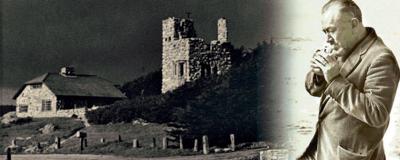
When Jeffers first started building Tor House, a home hand-hewn from thick hunks of Monterey granite, in 1918, it was a meditative exercise in patience. The house is now a national treasure and a monument to his literary themes. What is man’s place in nature? How do we resolve our brutish, clumsy meat with wind and water and stone? How do we reconcile the battle between our reason, our desires and our fear of death?
Jeffers dovetailed his humanity into the natural architecture of the Monterey Peninsula. He found a way to not be at odds with the savage and divine essence of our landscape. Yet as a result, he demanded too much from his fellow humans. He perceived our moral imperfection, our lack of discipline and integrity, as a direct affront to his relationship with God and the natural environment around him.
From “November Surf”: “Some lucky day each November great waves awake and are drawn/ Like smoking mountains bright from the west/ And come over the cliff with white violent cleanness: then suddenly/ The old granite forgets half a year’s filth:/ The orange-peel, egg-shells, papers, pieces of clothing, the clots/Of dung in corners of the rock… ”
Jeffers’ work suggests he wanted to see a great wave arrive on the horizon and wipe every trace of human weakness from the Peninsula. He was a predecessor of radical ecological writers like Edward Abbey and activist organizations like Earth First! His work worshipped the environment, explored nature’s resonance in his soul, but bemoaned his fellow man’s seeming indifference, the development of nuclear energy, and the cold rationality of American capitalism. His vocal opposition to the direction of U.S. social, economic and foreign policy made him a pariah in the last years of his life and buried his work in the graveyard of unpopular literary geniuses populated by writers like Zora Neale Hurston– or Ezra Pound. But time heals all wounds and Jeffers has now been restored to his rightful position as an important literary voice of Monterey County– and the nation.
In contrast, Steinbeck wove human weakness into the landscape of his prose. His novels were sympathetic to the naturals– fishermen, drunks, prostitutes. He elevated instinctual behavior to the level of the landscape. As a result, he was reviled as a writer by Christian moralists and viewed in some quarters as anti-American. He brought poignancy and depth to a people who, at the time, were considered as important as windblown Oklahoma dirt. Novels like The Grapes of Wrath were a threat to those whose businesses relied on cheap, silent labor, then and now.
And that, of course, is what makes him so important. Very little has changed. Steinbeck is still a revolutionary voice because he speaks of undeniable humanity and reason. (Ironically, at the end of his career, he took a hard turn to the right, supporting the Vietnam War.) While Jeffers may have occasionally copped a righteous, inaccessible attitude, Steinbeck dug into the trenches of the fertile Salinas soil and held fast. His vivid descriptions of the cannery life, of capturing frogs for drinking money on the Carmel River, of agricultural work in the windswept fields of the valley, to name just a few, eternally melded rich human personalities to our landscape.
ROCK AND HAWK
By Robinson Jeffers
Here is a symbol in which
Many high tragic thoughts
Watch their own eyes.
This gray rock, standing tall
On the headland, where the seawind
Lets no tree grow,
Earthquake-proved, and signatured
By ages of storms: on its peak
A falcon has perched.
I think, here is your emblem,
To hang in the future sky;
Not the cross, not the hive,
But this; bright power, dark peace;
Fierce consciousness joined with final
Disinterestedness;
Life with calm death; the falcon’s
Realist eyes and act
Married to the massive
Mysticism of stone,
Which failure cannot cast down
Nor success make proud.
(1935)
“It doesn’t matter that Cathy was what I have called a monster,” he writes in East of Eden. “Perhaps we can’t understand Cathy, but on the other hand we are capable of many things in all directions, of great virtues and great sins. And who in his mind has not probed the black water?”
Steinbeck sympathized with our imperfection. In his literary view, it was OK to be the rabbit caught in the open field by the hawk, the seal snatched in deep water by the white shark, the man baffled on the street by liquor and unemployment. The ugly was as natural in Steinbeck’s writing as a rainbow off Lovers Point.
Of course, many of Steinbeck’s quotes describe a Monterey County that no longer exists. “A few miles south of Soledad, the Salinas River drops in close to the hillside bank and runs deep and green,” he pens in Of Mice and Men. “The water is warm too, for it has slipped twinkling over the yellow sands in the sunlight before reaching the narrow pool.”
We have taken an ungodly toll on our landscape. Jeffers probably rolls in his grave as frequently as a wave hits Carmel beach. But that’s the reality of the modern world. The question then is, What are the boundaries of “natural”? By Steinbeck’s definition, nuclear war and insecticides are as natural as the tide. By Jeffers’, they are defilements of a pre-constituted natural order.
Regardless of which side of this philosophical fence you’re on, the exhibition Jeffers & Steinbeck: Habitat of Thought provides ample ideas for discussion. Its curator, Lisa Staples of CSU Monterey Bay, combines photography and paintings with the words of Jeffers and Steinbeck to convey the intense intimacy these two artists, and every one of us, shares with the Monterey County landscape.
“My perspective is as an art historian,” she says. “I’ve combined images, photos and paintings that reflect the themes of [Jeffers’ and Steinbeck’s] work. Monterey art was dismissed in the mid-20th century and now it’s highly valued as a distinct and important movement.
“There’s a lot of variety among landscape artists in the early decades, tonalists and impressionists, but almost all of them responded to the majestic oaks, the skeletal cypress, the waves crashing.”
Among the visual artists Staples has chosen to represent Jeffers’ and Steinbeck’s words are Gottardo Piazzoni, Mary DeNeale Morgan, Arthur Mathews, Burton Boundey, Edward Weston, Ansel Adams and Morley Bear. (There’s a great portrait of Jeffers’ wife, Una, by California artist Maynard Dixon in Tor House in Carmel. Information: www.torhouse.org.)
“[The Big Read] is extraordinary,” Dr. Staples says. “We haven’t seen anything like this in a long time.”
Last May, NEA Chairman Dana Gioia joined U.S. Representative Sam Farr, D-Carmel, at the National Steinbeck Center to announce grants to three California organizations for The Big Read: the Robinson Jeffers Tor House Foundation, the National Steinbeck Center, and the University of California, Santa Cruz.
Gioia, who recently announced he would be resigning his post, is a poet from Sonoma County and a Jeffers aficionado. In “Fallen Western Star,’’ a famous essay on the Northern California literary scene, he wrote: “Neither Jeffers nor [Yvor] Winters, [Kenneth] Rexorth nor [Robert] Duncan, [Josephine] Miles nor [William] Everson ever won a Pulitzer? Did these estimable West Coast writers lose to greater talents? An examination of the Pulitzer winners suggests that literary quality mattered less than proximity to the Manhattan-based committee. For example, in the two decades that Jeffers published his best collections– from The Women at Point Sur [1927] through Hungerfield [1945] the prize went to New York writers, Leonora Speyer, Audrey Wurdermann, William Rose Benet, Robert P.T. Coffin, Marya Aturenska, Mark Van Doren, and Leonard Bacon, a New York-born Rhode Islander… Is even the best of these poets comparable to Jeffers?”
The Robinson Jeffers Tor House Foundation received a grant of $15,000 to support the month-long bilingual celebration of Jeffers throughout Monterey County. The National Steinbeck Center received a grant of $17,000 to support an exhibition showcasing Jeffers’ poetry along with photographs of the poet, Tor House and California. Jeffers is the first poet, and only the second writer other than Steinbeck, to be the focus of a Steinbeck Center exhibit. A third grant of $5,000 went to the University of California, Santa Cruz, to host a symposium on the work of Jeffers.
(0) comments
Welcome to the discussion.
Log In
Keep it Clean. Please avoid obscene, vulgar, lewd, racist or sexually-oriented language.
PLEASE TURN OFF YOUR CAPS LOCK.
Don't Threaten. Threats of harming another person will not be tolerated.
Be Truthful. Don't knowingly lie about anyone or anything.
Be Nice. No racism, sexism or any sort of -ism that is degrading to another person.
Be Proactive. Use the 'Report' link on each comment to let us know of abusive posts.
Share with Us. We'd love to hear eyewitness accounts, the history behind an article.