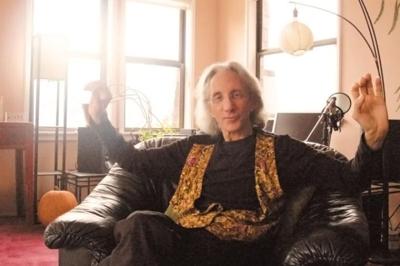
Rob Brezsny looks to the stars.
“There’s big sky here,” he says, his all-black Converse high-tops planted on the second-story deck of his Marin County home, his wavy gray hair falling further down the back of his sequined vest as he lifts his chin upward. “Watching the moon and sun cross it is an education in itself.”
It’s a fitting thought for an astrologer, but as any member of the telescoping tribe that follows his Free Will Astrology column (p. 45) knows, the sky’s no limit when it comes to inspiration for his unique oracle-esque intuitions. While Brezsny trusts what he calls the “omens” the planets’ paths provide – he calls them guides, not puppeteers – he ultimately engineers an alchemy that stirs in catalytic clues ranging from the epic (the Iliad and the Odyssey) to the obscure (Online Noetics Network), the pop mainstream (Pink) to the philosophical fringe (poet Linh Dinh). He feels our fortunes, like his own belief system, cannot be constructed from one or two philosophical, spiritual or interpretive girders. As often as they are etched in the heavens, they are co-authored in less celestial places, like, say, the skanky restroom wall of a Roy Rogers restaurant in North Carolina’s Golden Triangle.
“I got Santa Cruzified and Californicated and it felt like paradise,” read the inscription a young Brezsny found just as he was pondering a pilgrimage west. “You know you’ll never become the artist you were meant to be until you come live in Santa Cruz.”
“In that moment,” he writes in his recently revised and expanded Pronoia is the Antidote for Paranoia: How the Whole World is Conspiring to Shower You With Blessings, “my fate gelled.”
It was Monterey Bay-side where he channeled profound and profane poetry, fronting popular bands Tao Chemical and World Entertainment War – and started writing Real Astrology (which has since become Free Will Astrology) for Santa Cruz Good Times. Today, FWA appears in more than 120 publications; this month marks 32 years of uninterrupted insights delivered in a diversely descriptive way that defies description, though that hasn’t stopped his followers from trying. One author calls him “a word wizard for the soul”; actress Marisa Tomei says he’s “the best prophet in a starring role.” Brezsny has called himself a “funky pagan tantric poet”; his matrix of Facebook affiliations includes beauty and truth addicts, aspiring masters of curiosity, spiritual freedom fighters, ethical outlaws, rebel messiahs and flux lusters.
His greatest loyalty, though, may be to the imagination, which he insists must govern life in harmony with the heart and intellect, and he weaves all three into his extra-columnar activities religiously. His just completed project, the expansion of his half-decade-in-the making Pronoia by 60,000 words, has only deepened a life-affirming manual that unleashes liberating lessons when cracked at any interval of its nearly 400-page existence: Its 888 ingredients include telling anecdotes, Taoist folk tales, “sacred advertisements,” thought experiments, “primordial gossip” and such “homeopathic medicine spells” as “Most Americans would vote against the Bill of Rights if it was presented in a referendum,” and “babies often stink.” He’s currently two hours of material into This Is the Perfect Moment, a double-CD musical accompaniment to Pronoia – “my music feeds my writing and my writing feeds my music” – and actively incubating his next project, a book on mastering a “chronic form of ecstatic awareness.” Meanwhile, he continues to conduct a live performance art series that has visited Burning Man three times. As he says, “Nothing is ever done.”
The Weekly tapped the mythic mind of its longtime contributor over the course of two conversations, including one at his home office, as a blue moon rose over the last day of the decade.
For more on Brezsny, Pronoia and Free Will Astrology, visit www.freewillastrology.com.
Let’s see: You went from starring in a North Carolina band whose brand of hippie-rock poetry wasn’t quite working for the state fair and frat party crowd, then a message scratched under the towel dispenser of a restaurant bathroom helps trigger the next step…
I had the good fortune of going to a bad restaurant.
You almost make it capital-B Big with World Entertainment War, run for Santa Cruz City Council, and have your “ass saved by poetry” somewhere in the process. How does Pronoia fit into the arc of your life?
I had to go through a long period of ripening my own cynicism and deep critique of modern culture. I couldn’t earn the right to speak on the universe showering us with blessings until I made peace with my dark goddess. [My 2000 novel] The Televisionary Oracle, was about that long encounter with [the] dark goddess, becoming better allies with one’s own shadow, understanding how my own negative imprints made me a hypocrite, and was ruining my own happiness by attracting experiences that weren’t interesting or fun. There’s an element of that in everyone’s life.
I needed to do that in order to live by the hypotheses of Pronoia [Evil is boring. Cynicism is idiotic. Fear is a bad habit. Despair is lazy. Joy is fascinating. Love is an act of heroic genius. Pleasure is your birthright. Receptivity is a superpower.]
One of the axioms of psychotherapy is that the degree that you face up to your pain or your ignorance represents how much of a possibility you have to transform. There’s no other way around it. You can’t will the fear away, but we try to do it anyway, to scrunch it – errrgh it – away. In the dreamwork taught by indigenous cultures like the Senoi culture of Malaysia, they teach their kids that if they see [a demon], do not run, turn around and face it, try to make friends of it and, if anything, negotiate a gift from that enemy.
Can you get into some of the specifics of those shadows?
That’s a very personal thing. But it’s what launched my writing of Televisory Oracle. I was a feminist at 18. I began to read goddess lit at an early age, wanted to value the feminine as much as the masculine, because the feminine has been devalued for many years. I made a lot of headway, but I had to acknowledge too much of me still objectified women, was focused too much on how they looked. I was split between my ideals and actual attitudes. The book was my school I went to, to unlearn that bad habit.
When you say bad habit, that makes me think one of society’s frightening habits. We’ve got right-wingers cultivating the fear of everything from homosexuals to functional health care. Left-wingers seem spooked of everything from overpopulation to tsunamis. Glenn Beck’s proselytizing fear expertly, and TV commercials traffic so many symptoms of all sorts of ailments, it’s crazy. As you point out, there’s “a hundred derivations of doom that spill from the hysterical imagination of various prophets in the last two millennia.” What do we do to combat that?
One of the major additions to the new book is [the chapter] “Glory in the Highest.” It’s eight times longer than the original. I went gung ho tracking down glorious things happening. I wonder, is there something wrong with me? Do I have some perversion to be on the lookout for these things?
Just to sum up a few examples – it’s dramatically more peaceful on the planet, there’s been a steep decline in weapon sales and refugees, crime’s at its lowest since they started measuring the statistic, the number of people living in poverty worldwide has fallen a third. We’re healthier than our ancestors by far, and our life expectancy is rising. There’s a lot of valid attention to torture these days, but it’s practiced at a much lower rate – it used to be a significant part of many legal systems. I love gathering that data. Things aren’t quite as bad as you’re saying. There’s a value in gathering all the information about things that are working as a whole. They are parallels of things working in one’s own life personally. I’m not saying we should be ignoring bad things, but pay more attention to that glory. Try keeping a list of all the things that work for you, and it will fill you with delight.
A recent column references evolutionary psychology, economic historian Robert Fogel, astrophysics, Ayurvedics, ancient Egypt, traditional medicines. Then you’ve got Pink, Chris Rock, the return of Saturn and observations from a nature walk. You haven’t had a deadline hiccup in more than three decades. What’s the process to stay freaky, fresh and diversified with that kind of staying power?
After a while I realized if I was going to do this over the long haul I would have to have a significant quotient of delight in the column. I’ve become a much better listener, opened my eyes wider, become more curious, more surprise-able than I used to be. I enjoy finding the sacred in the profane and the profane in the sacred. I really have the intention to be overcome by pleasure with an insight or experience I’ve never had before.
I see a lot of permutations of that theme in your column: F*** boredom, always dodge ruts. In Pronoia, you write: “Evil is boring” and “Thou shall not bore God.”
The best way to avoid ruts is to cultivate surprise – ability and curiosity, right up front – to make it close to the heart of who you are and how you approach the world. Every time I go out, I know something is coming that I’m going to be interested in.
I assume God is like me. He/she wants to be interested, that’s why he/she started this thing: He/she wanted a game that would amuse and teach him/her – to the degree we’re boring ourselves and boring each other, we aren’t giving the gift God wants.
I’m a big believer in giving goddess the gifts she craves. One of our main tasks is to play this mysterious game of life, this incredible work of art, this unsolvable riddle, with all of our ingenuity engaged, all of our desire aroused to explore and differentiate this great mystery.
The derivation of evil is boring: We’ve gotten to a point where there’s a lot of fundamentalism – not just Islamic, Christian or Jewish, but anyone. Scientists can have scientism. In my field, there are plenty of astrologers who practice a form of fundamentalism – their interpretation of reality is correct and all others are wrong. I have pagan friends who would never admit there could be any value in studying the life of Jesus Christ.
John Keats said, “If something is not beautiful, it’s probably not true”; only now there is a group of people who feel if it’s not ugly, it can’t be true. There’s a fundamentalism in there, and a popular belief that in order for something to be true it has to involve depravity, the failure of civilization, death. I find that boring.
Ugly can be beautiful. Like a pug.
But there are different ways of presenting ugliness. I just saw The Dark Knight, [a portrayal of] the most desolate possible view of human beings, which makes me sad, and truly breaks my heart. It’s emblematic of our culture: Many of the greatest artists are showing human nature as “life is a bitch, and then you die” – it’s so sad that greatest artists are about that. There’s plenty of ways to convey the suffering of the world without coming to the conclusion that life is just suffering. One can describe suffering and depravity, but should always have some redemptive statement. That’s what I aspire to. As a society, we’re a long ways off.
The entertainment industry is something that you’ve railed against for its role in this. Do I hear you saying it’s getting worse with some of the things it’s programming us with?
I think it is getting worse. Because technology is so much better: Depictions they can make of the sickness are so much more vivid. With our band World Entertainment War, that was one of the seeds to our music: The power of the media to insert these insidious images. To commit genocide [on] the imagination of people who create.
Some people want to characterize you as a feel-good, pop-utopian, New Age guy. They miss the cultural warrior underneath.
I don’t think they read my work very closely.
There’s a real strong ethic of agency in that work, where you ask readers to embrace assignments – reject cultural assumptions, take a different route to work, think about someone they can’t stand in a very positive way – to get at bigger lessons. Their role is critical. How does that collaboration feed your work? And what’s your favorite reaction from readers?
I started out as an artist 35 years ago thinking my imagination is a shrine that feeds from the depths of my creativity – not that that’s wrong, but over the years, I came to see that my imagination and creativity flows from the interaction of me and the world. Everything I create is a collaboration: who’s touched me, moved me, hurt me. It affects how I treat readers, makes me wiser, and able to draw from deeper sources, and not just my personal unconscious. As I go on writing my column, I approach work as great writers and great musicians and filmmakers do, actively incorporate mash-ups in the column, and in Pronoia too. This is blatantly a co-creation. In my column I write, “Picasso says, ‘I always do what I don’t know, and I learn by doing.’ Then I make it work for Aquarius. The other party involved is the Aquarius I’m writing it for.
There are ways I’m demonstrating a very unusual archetype in our culture. In Old Hawaii there were actual committees of poets who would get together and write poems. Write a joint poem? That’s unheard of in our culture – ‘I’m a genius unto myself.’ When I got that my work could be drawing from my creativity and interacting with others, that was the combustion point where I moved into a higher octave, and accessed information I couldn’t before.
It’s become one of my values. I’m illustrating this synthesis: I am a star, you are a star. It’s a synthesis of communism and capitalism. A synthesis of a deep urge to individuate and the urge to be a part of community – to be a fantastic artist and a collaborator, a product of everything we’re influenced by.
My favorite thing when it comes to how they’ve taken my work in would be how my column has helped readers become more themselves, inspired them to access parts that weren’t previously accessible, that were oppressed, a part of their conditioning. I got a note from a guy in Massachusetts. It read, “Thank you. You helped me become a person, to become me.” I broke down a little bit. If my work has somehow done that – it didn’t say you helped me become more like you, but you helped me become more like me – that’s the best thing.
There are these great universals in Free Will Astrology – everyone could read the whole thing and pull nuggets from each sign’s horoscope. By the same token, there’s stuff that really makes specific sense for Aries types or Cancerians. So there’s this universal element and something very targeted: You know these oversexed Scorpios well – but the same goes for Pisces and all the other zodiac tribes. How do you do that?
There’s some great mystery about the job I do that I’ll never figure out that keeps evolving. That’s part of the fun. It’s always beyond my understanding. There’s a telepathic relationship between me and my audience, people projecting me their longings, who they are, what they’d like me to say. Sometimes I encounter those people at parties, on the street, and there’s beaming from all of the people who read it.
I think I’m actually set up to receive that. When I was starting up, I saw a psychic in Santa Cruz; she told me there are two types of psychics – one-on-one, “like me,” she said, “a narrow band psychic, who teaches and works with individuals” – then there’s broadband, and “you’re one of those,” where there’s a whole tribe of people, and you read that energy.
There’s something about that. I get the sense I’m always at school, studying what it is to be a Pisces, a Virgo – and they’re telling me in their dreams. When they’re reading the column, they are beaming those thoughts my way.
I gathered some of the quotes from other thinkers you use as collaborative touchstones in Pronoia, like Carlos Castaneda: “We either make ourselves miserable or we make ourselves happy. The amount of work is the same.”
People don’t realize how completely invested [they can be] in negative views of the world. But there are so many negative influences; it’s the natural way of things. It’s a Herculean effort [to overcome]. I’m not an expert, but it can be done. First step is to realize this seemingly natural and easy way of relating to the world that bad things are happening all the time is false.
Arthur Eddington: “Something unknown is doing we don’t know what.”
I call that “God,” though I don’t like the term because this Great What-Is-It has been co-opted to support so many agendas – “Rebranding God” is a chapter in the book. There is a false argument going on between material fundamentalists and religious nuts. It has nothing to do with God. Then there are scientists and skeptics – dogmatic skeptics – who say all that exists is what can be measured by our five senses and the technology that enhance those senses, and there’s nothing else. Human senses can’t perceive gamma rays, radio waves, how do we know we’ve reached the end with our five senses? I don’t believe we have.
Religious fundamentalists make God look like an asshole, so they’re easy prey for scientists, but both of the arguments are completely irrelevant. In a way, they’re in cahoots, conspiring together to make it hard in this cultural moment for anyone to slip into a more brilliant and soulful understanding. To find the mysterious cosmic riddler. It’s something that’s frustrating for me.
Tom Robbins: “Approfondement is a French word that means ‘playing easily in the deep.’”
A lot of people take themselves too seriously, and are filled with grave, dark, studious attitudes toward invisible realms. The way to access those realms in a way that is going to put you in greatest resonance is to be playful. Not everything is sweet and nice, we have a lot of places where things are confusing. Playing easily in the deep is an approach to soul work in which we’re willing to set aside drive for certainty, and reside in midst of ambiguity, to have fun with the mystery of it all. For me there’s a way to do that.
One of the great places to go exploring the depths are dreams. They are full of puns, unexpected events and playful twists and jokes. They surprise. That’s a good statement about the nature of playing in the depths: You have to be improvisory, ready for anything.
There’s a paradox about Free Will Astrology and Pronoia: There is this reverence-irreverence thing going on. I don’t know how you do it or if it can be codified into language – this may be a place where language is the limit of our world – but if everything is sacred, nothing is sacred. How do you reconcile the two?
Isn’t it also important to define sacred? Some people think it’s inherently serious – something you must not laugh about. In the book I talk about how curious it is that none of the major religions have jokes in them. There is not any report of Jesus laughing in the Bible, and it’s not just limited to Christianity. Only one that has it is Sufi. And modern ones, like Church of the SubGenius and Discordianism. All traditional religions fail to account for one of most important spiritual attitudes, that quest for a playful aspect of life. How can religions leave out those aspects of our experience? Sacred is that which is funny, beguiling, playful.
One of my sacred totems right now is outside my bathroom window. It’s a lavender plastic T-rex on my neighbor’s roof in a place where it’s beguiling to explain how it got there and it’s hard to imagine anyone really sees it there or knows it exists.
You said it’s a lavender tyrannosaurus rex?
Yes.
Is it lesbian?
Yes, it is.
(0) comments
Welcome to the discussion.
Log In
Keep it Clean. Please avoid obscene, vulgar, lewd, racist or sexually-oriented language.
PLEASE TURN OFF YOUR CAPS LOCK.
Don't Threaten. Threats of harming another person will not be tolerated.
Be Truthful. Don't knowingly lie about anyone or anything.
Be Nice. No racism, sexism or any sort of -ism that is degrading to another person.
Be Proactive. Use the 'Report' link on each comment to let us know of abusive posts.
Share with Us. We'd love to hear eyewitness accounts, the history behind an article.