

VIEWED FROM THE OUTSIDE, RUNNING A RESTAURANT CAN HAVE A ROMANTIC SHEEN. One imagines shopping for fresh local produce at farmers markets, the creativity of a kitchen and the air of being a centerpiece of a downtown block, drawing admiring crowds.
“A lot of people are seduced by the restaurant industry,” Kevin Phillips says in agreement. “But they forget the numbers.”
Phillips would have reason to see restaurants in such a positive light. The veteran restaurateur owns successful venues in Monterey and Pacific Grove. Whaling Station on Cannery Row is considered one of the area’s finest steakhouses. Abalonetti and Rockfish Harbor Grill are mainstays on Fisherman’s Wharf. Beach House Restaurant at Lovers Point quickly became a local favorite when it opened 12 years ago.
He admits there is an allure to the artistic aspect of the industry. But Phillips emphasizes the more mundane equations that define food service.

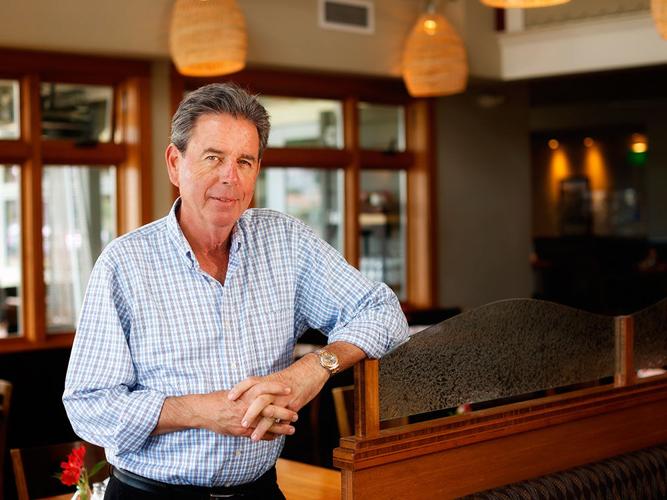
Longtime restaurateur Kevin Phillips at Beach House Restaurant in Pacific Grove. He also owns Monterey destinations Whaling Station Steakhouse, Abalonetti and Rockfish Harbor Grill. “We’ve held the line on pricing,” he observes, despite the soaring costs of food and other items necessary for a restaurant.
“It’s always been the same formula of cost and cash flow,” he explains. “Balancing that has always been a challenge – now more than ever.”
CONSUMERS LIKELY NEED NO REMINDER, but dining out has become a major financial commitment for many people. The check for a couple ordering burgers and fries can easily top $50, even if they settle for water to drink. Prime cuts of steak approach triple digits.
Even fast food prices continue to outrun inflation. A chicken burrito at Chipotle that cost around $6.50 before the pandemic now sets you back almost $11.
Although gross profits are up, rising costs are also putting a tremendous strain on chefs and restaurant owners. While the National Restaurant Association reported nine consecutive months of lower year-over-year wholesale food prices in 2022, turbulent markets returned – with something of a vengeance. More than 80 percent of restaurant operators nationwide reported bumping up menu prices in 2023, a scene reminiscent of the chaotic Covid years of 2020-21, when restaurants stepped up menu prices once, twice, perhaps three or four times to cover skyrocketing costs.
And the situation continues. The federal government’s Producer Price Index for July 2024 saw average wholesale food prices jump by 4.3 percent.
When expenses go up, restaurant owners must respond – although the options are not necessarily palatable. One is to reduce staffing to cut costs, but that comes with the potential negatives of alienating those who remain and less service. A second option is to accept another cut to profit margins, which for successful full-service restaurants hover around 3 to 5 percent.
“Profit margin – that’s what gets cut,” explains Bill Lee, owner of a dozen area restaurants before opening Kona Steak & Seafood in Monterey, which he claims is his last venture. Lee has committed to a menu with value items. Phillips, meanwhile, has avoided menu price increases for the last year-and-a-half.
“Net profit is a very skinny number these days,” Lee says.
The third option for restaurateurs burdened by rising costs is more familiar to diners. According to National Restaurant Association data, menu prices have increased by 4.1 percent across the board over the past 12 months.
“When we have to increase prices, business slows,” observes Maria Maravilla of La Casa del Sazón, with locations in Salinas and Monterey. “But [people] come back, because everyone is raising prices.”
That has been the case. But there are now signs that many Americans are growing weary of menu price gentrification. As Phillips warns, dining out is a luxury, not a necessity: “One thing that has to be kept in mind is that nobody has to go to a restaurant.”
While restaurant sales grew by a modest 0.4 percent over the second quarter of 2024, the National Restaurant Association reports that real sales have been flat. Adjusted for inflation, the figure dropped into the negative range.
People are beginning to stay home.
“The reports look an awful lot like the first quarter, and I stress that word ‘awful,’” Nation’s Restaurant News Executive Editor Alicia Kelso told the video news service NRN In the Mix. Across the quick-service and casual dining sectors, same-store sales dropped in the second quarter. It is evident, Kelso added, that lower-income families can no longer afford a meal out.
“High menu prices have taken their toll,” she added.
WHAT GOES INTO MENU PRICING? In the milieu of a restaurant beset by inflation, plates more than ever become checks written against incoming bills. When projecting his budget before opening Kona, Lee based expected PG&E expenses on the average bill at Sur, his previous restaurant, adjusted for additional square footage.

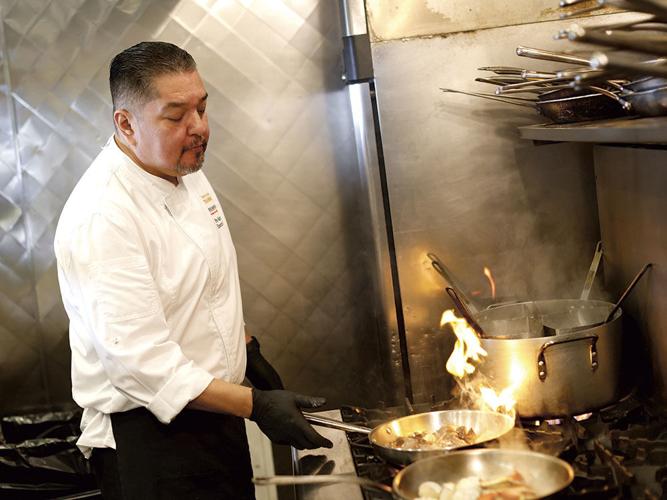
Executive Chef Pete Martinez of Beach House Restaurant in Pacific Grove at work. Restaurant owner Kevin Phillips credits the chef with both keeping food costs in check and preventing costly staff turnover. “He’s not only a great chef, he has a staff that respects him,” Phillips says.
He came to a figure of $10,200 a month. But when Kona opened, the bill came to $10,700 a month.
“It’s not the big numbers,” Lee says. “That’s still $500 more a month. It’s the little numbers that can be a big part of cutting profits.”
Now, 19 months after opening, the monthly PG&E bill at Kona has climbed to $13,500. Rent, water and electric absorb $40,000 each month, before taking other costs into account.
“The first 12 or 13 lunch customers cover just the increase in PG&E costs,” Lee explains. “The next group pays half the rent.”
Ashley Wolff acquired the former Carmel Burger Bar in Carmel Plaza and started transforming the menu with Korean staples earlier this year, renaming the space JeJu Kitchen. She ticks off the list of expenses, including taxes and fees, as well as replacing broken glassware. There’s insurance to cover. The point-of-sale system takes a percentage of each ticket. Rent in pricey Carmel can run up to $20,000 a month.
“A couple comes in and orders short ribs and jajangmyeon,” she offers as one potential example. “Those two items have to cover the cost of ingredients, plus a portion of everything else listed.”
The ribs are currently listed at $38. The plate cost includes marinade, onions and rice. The traditional noodle dish starts at $20 – relatively inexpensive due to its recipe of vegetables and noodles, but adding protein can push the amount over $30. “Everything else” includes not just what’s on the menu but also rent, utilities, staffing, silverware, linens and more, such as soap for the dishwasher.
“None of that is free,” Wolff says.
The formula mentioned by Phillips – the weight of costs and income to hopefully generate profit – is as close to choreography as one can come to when wielding numbers. The generally accepted target is 60, the sum of food costs and labor costs as a percentage of the overall pie. If all other expenses, including rent and utilities, do not exceed 30 percent, the restaurant generates a 10-percent net profit margin.
While all retail operations must absorb costs, restaurants are subject to many variables. Not the least of these is the public’s expectations. Diners may be willing to depart with $30 for fish and chips. Push it to $40, however, and they begin to balk. A 10-ounce cut of prime filet mignon can sell at $80, but $90 is pushing it.
Within this are different margins. That cut of prime steak might push food cost for that menu item to 50 percent or more.
So the goal is to take the items that make up a menu – soup, salads, entrees and so on – amount to no more than 30-percent food cost, without sacrificing quality or driving customers away. And it can get complicated.
Lee explains it in a scenario where a rack of lamb cost the restaurant $18. “OK, I’ll run a 40-percent food cost, so if the total plate costs $20, price it at $50,” he says.
An appetizer with $2 of cost on the plate, that can be set at $10 – a 20-percent food cost.
“You have to average it out,” Lee continues. “How that mix works out is important. That’s the big question.”
For a steakhouse like Whaling Station to remain within food cost bounds, Phillips spreads the menu to include items with better markup value, such as pasta dishes.
None of this is new for long-time owners and chefs. If guests order salads or certain plates where portion size works in the restaurant’s favor, along with wine by the glass (another haven for markups), the percentages begin to settle into an acceptable range.
But food cost has been particularly volatile of late. Within that Producer Price Index 4.3-percent increase figure are some astounding numbers. The wholesale price of beef is 5.2 percent above 2023 levels, and expected to rise further. Coffee is up 9.1 percent, cheese 9.8 percent, butter 26.8 percent and eggs a whopping 90.7 percent above the price from July 2023.
Phillips points out that the PPI figure can be deceptive, as well. Wholesale prices for food items remain above pre-Covid levels. And while a 4.3-percent hike is easier on the budget than the 8-percent or higher spikes experienced during the pandemic, the effect is cumulative.
“It’s 4 percent on top of 8 percent,” Phillips explains. “That’s what people don’t understand.”
He credits his chefs, like Pete Martinez at Beach House Restaurant, for reining in costs without sacrificing quality. There are some tricks to it, such as recognizing when a sauce for one dish can be used as the base of a soup, as well. But the most effective way is time-honored.
“Be smart with your shopping, be smart with your stocking,” Phillips says. “You have to control waste.”
Manage to bring food cost within range, and restaurateurs have a chance at keeping labor cost in check. In California, the state-mandated $16-an-hour minimum wage for tipped workers went into effect in January. That figure was anticipated, staggered up over the past several years from $10 in 2017. The state also layered on a $20-an-hour minimum wage for fast food workers (with certain requirements) and paid sick leave.

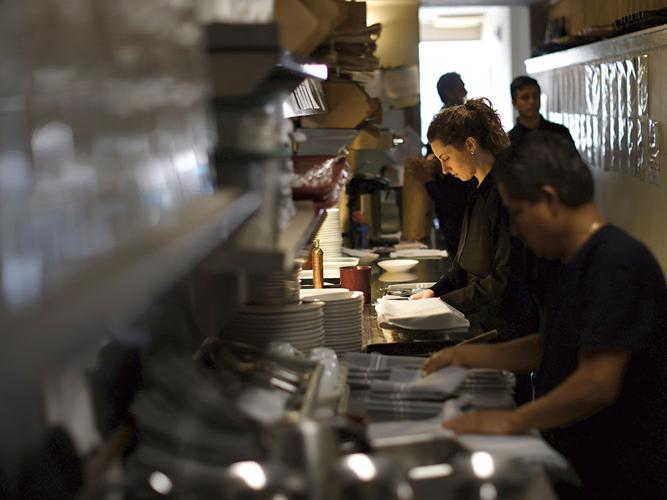
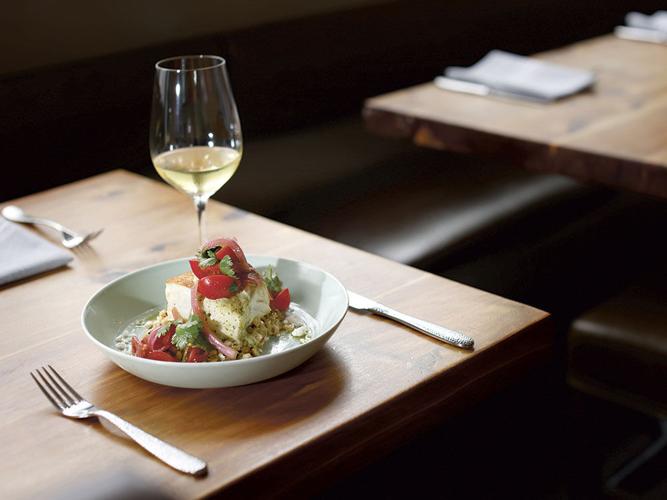
Server Corinne Shohlé and bus staff prepare ingredients at Passionfish (above). A finished dish (below) is priced with food cost, labor cost and other expenses in mind.
Phillips illustrates the impact of this with another scenario. If a restaurant operated on 40,000 minimum wage hours per year, he points out, even a $1 an hour increase pushes labor cost well above the desired percentage.
That more people are beginning to shun meals outside the home may have to do with the quirks of staffing demand. In general, restaurants require more people – cooks, bussers, waiters, hosts – to operate successfully than do convenience or grocery stores. As a result, while menu prices increased by over 4 percent, grocery prices were up by just 0.3 percent in July after holding flat over previous months of 2024.
“That’s what labor cost looks like,” Phillips says. “Overhead has always been an issue.”
Yet higher wages are not insurmountable. They just change the equation. As labor cost creeps toward 40 percent, Lee notes, “something’s got to give.”
Just how quickly all of this mathematical choreography can come crashing to the floor can be seen in a study of profit margins of Darden Restaurants, a group that includes Olive Garden, Longhorn Steakhouse, Ruth’s Chris Steak House and Cheddar’s Scratch Kitchen among its holdings – and, through national leverage, keeps food costs in check. Since 2010, the group’s net profit margin held steady, idling between 5 and 9 percent. During the pandemic, however, that number plummeted to -3.5 percent.
A survey by the industry consulting firm Restaurant365 found that 61 percent of restaurant operators across the U.S. expect to raise prices yet again in 2024. But many local restaurateurs are holding firm, for now.
“Out of 100 guests, there’s another two, three, four you lose,” Lee says of a menu price increase under current circumstances. “It’s a tough dilemma.”
LEE IS QUICK TO CHUCKLE, despite the tenuous situation (“another increase in costs, now profit margin becomes a negative number,” he observes). Phillips describes circumstances with an air of calm.
They have survived similar moments. Insurance rates spiraled upward in the uncertainty after 9/11. Many compare current events to the financial crisis of 2008. After the upheaval of the pandemic, staffing issues have begun to ease.
The industry has escaped the recent oddities, too – the Sriracha shortage, the chicken wing shortage, the worker shortages that slowed packaging of meats.
“I think it has settled down a little bit,” Wolff says. “We’ve had worse.”
According to U.S. Census Bureau numbers, Americans spent $94.7 billion at bars, restaurants and other food establishments in July. Meanwhile core inflation is down.
Setting menu prices has always been a balancing act, a computation of fixed costs such as rent and variable costs, like food and labor. Semi-variable costs are perhaps a new wrinkle, as the price of everything from water to to-go cartons, insurance and even toilet paper edge higher. As Lee pointed out, increments of $500 a month are cause for concern for restaurateurs.
“The fixed costs are squeezing us,” Phillips says. “Sometimes there’s a tipping point.”
IN 2022, A WEEKLY STORY QUESTIONED WHETHER THE MID-RANGE RESTAURANT WAS DOOMED TO EXTINCTION. But restaurants like Kona, Beach House, Whaling Station and others maintain bar menus, value items and perks such as locals’ pricing.

A finished dish is priced with food cost, labor cost and other expenses in mind.
On the other hand, the National Restaurant Association reports that “until wholesale prices start trending lower across a broad range of commodities, food costs will continue to be a headwind for many restaurants.”
While dining out is about an experience, the future of the experience is largely about the numbers. Fewer people are choosing to dine out – 68 percent plan to cut back, according to a survey from the marketing firm Vericast.
So 2024 may indeed be a tipping point. It may also be just another tumultuous year for an industry that tends to weather them.
For now, Wolff chooses to be grateful for those who continue to visit the restaurant.
“They only have X amount to spend and they choose to spend it here,” she says. “That’s flattering.”
(0) comments
Welcome to the discussion.
Log In
Keep it Clean. Please avoid obscene, vulgar, lewd, racist or sexually-oriented language.
PLEASE TURN OFF YOUR CAPS LOCK.
Don't Threaten. Threats of harming another person will not be tolerated.
Be Truthful. Don't knowingly lie about anyone or anything.
Be Nice. No racism, sexism or any sort of -ism that is degrading to another person.
Be Proactive. Use the 'Report' link on each comment to let us know of abusive posts.
Share with Us. We'd love to hear eyewitness accounts, the history behind an article.