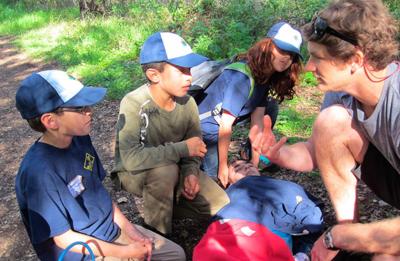
Dave Gruber writhes on the ground, clutching his right forearm. He lifts his fingers momentarily to reveal a massive wound spurting bright red.
A group of five 9 – and 10-year-olds gather around the man. They’re tasked with preventing him from going into shock, but they appear shocked as they freeze, paralyzed with disgust.
Lucky Gruber’s injury is a fake, part of a scenario for teaching these kids the basics of wilderness first aid. The steps they studied just an hour earlier now seem to be an abstract memory, until Gruber’s co-instructor, John Taussig, starts directing them.
“Stop the bleeding!” he says.
Tentatively, two children approach the saturated arm, wrap it with gauze and apply pressure. The more squeamish among them lay Gruber down (step two) and put a backpack under his head.
Then the five kids struggle with a crinkly emergency blanket, trying to cover the bleeding man. The edges keep flapping up. Eventually, Gruber – who’s supposed to be playing a near-dead hiker – tells them, “Wrap me like I’m a burrito.” They comply.
The kids flounder as they try to remember step four: Reassure the victim. Finally, after prompting by the instructors, 10-year-old Anna Iturriaga offers up her version of reassurance: “You’re going to get ice cream!”
Ice cream is indeed part of this two-day class, a weekend workshop at Garland Ranch. It’s one of the Monterey Peninsula Regional Park District’s more rigorous offerings in its Let’s Go Outdoors! program, which is oriented toward education, but also aims to accomplish a simpler goal that might please Thoreau: getting participants aware of, and enthusiastic about, nature.
That comes partly through rigorous training in activities as varied as trail running, first aid, birding and geocaching. But it’s also accomplished by reaching people at their own comfort levels with nature.
“We invite folks out to the outdoors in a way they might not otherwise experience it,” says Joseph Narvaez, environmental education coordinator for the park district. “We might get people started on something – wildflowers, birding or wildlife in our parks. We hope they have a new interest in the park or a particular topic.”
Of about 1,200 participants a year, about a third are seniors and a third are children, each attending programs designed for their age group. Tidepooling classes at the Great Tide Pool in Pacific Grove often draw from multiple generations, with grandparents and grandchildren attending together.
There are introductory courses for toddlers to discover amphibians, birds and plants at the Frog Pond Wetland Preserve in Del Rey Oaks. (The only problem is a frequent cancellation rate, at least during the off-season, so Narvaez recommends double-checking to make sure programs are still on.)
In the first-aid class, it’s not all blood and guts. There’s other practical stuff, like preventing sunburns, poison oak and even drowning (the most common fatal accident among kids of this age group, according to instructors).
There are also the makings of community. Before they venture out to gamely apply first aid to Gruber, the miniature first-responders learn about how to control bleeding. They gather in a “circle of trust,” sitting cross-legged. Each child clutches the tricep of the neighboring child and squeezes.
The boys in the group are Salinas Cub Scouts who need basic first-aid training for a badge.
“This is very extensive compared to what most scouts their age get,” says Karen Moore, troop leader and an ICU nurse at Mee Memorial Hospital in King City.
The programs are also designed to simply turn people on to the rich natural playgrounds located nearby.
“We hear it all the time: ‘I’ve lived on the Peninsula for 30 years, and I’ve never been to Garland Park,’” Narvaez says.
For Anna Iturriaga, a relative newcomer to Monterey with her military family, most “hikes” are walks up her steep Spaghetti Hill block.
Her wilderness skills include offering up her mom’s homemade granola bars – and now also the ability to respond to, and anticipate, backcountry disasters.
Before Gruber and Taussig launch the next scenario, this time a broken leg in need of a splint constructed from a stick, Iturriaga cautions her fellow classmates: “Prepare to be grossed out.”
For complete agendas and pricing for Monterey Peninsula Regional Parks District’s Let’s Go Outdoors! programs, see summer camp listings or call 372-3196 ext. 109 or visit www.mprpd.org
(1) comment
Children love to do new things like playing at Chicago go-kart racing center, taking their swimming lessons, singing and so on. Therefore, you should include new activities in your recreational program and doing so, you will attract new children.
Welcome to the discussion.
Log In
Keep it Clean. Please avoid obscene, vulgar, lewd, racist or sexually-oriented language.
PLEASE TURN OFF YOUR CAPS LOCK.
Don't Threaten. Threats of harming another person will not be tolerated.
Be Truthful. Don't knowingly lie about anyone or anything.
Be Nice. No racism, sexism or any sort of -ism that is degrading to another person.
Be Proactive. Use the 'Report' link on each comment to let us know of abusive posts.
Share with Us. We'd love to hear eyewitness accounts, the history behind an article.