
South of Salinas, where the dark green valley floor gives way to golden slopes of the Gabilan and Santa Lucia mountains, there appears what ranchers call “hill land.” On a bright spring morning, cattle are clustered in the shade of scattered oaks or long-dry creek beds, foraging grass. It’s a windless, still day but for the flicking of cows’ tails and the repetitive pumping of oil rigs, which also dot the landscape, some perched on lonely hilltops or shrouded inconspicuously among oak trees.
This odd pairing of ranching and oil industries has been a feature of the San Ardo landscape for more than half a century, with little conflict and friendly relations between residents and oil companies.
Now the oil industry’s footprint in the region faces scrutiny as the Bureau of Land Management plans to lease out about 2,600 acres between Lockwood and Bradley for oil exploration. The current proposal is significantly scaled back from an earlier, 35,000-acre version, but it’s nevertheless stoking debate over how much oil development – and what type – is good for this rural area.
Document set
Oil on the Range
Ranchers who lease their land to oil companies worry that increasingly vocal South County activists could scare off additional oil exploration – and with it, revenue they say they need to keep this land rural.
Steve Craig, director of Ventana Wilderness and Land Trust, is persistently protesting BLM’s proposal. He argues that the lease sale and subsequent development would permanently change the character of the region, opening up new geologic features and remote areas to drilling. Accessing oil or gas here would most likely require hydraulic fracturing, or “fracking,” which raises serious concerns about water contamination.
But others are viewing the oil leases in a different light: as a tool to save open space that could otherwise be paved over by commercial or residential development.
Elected officials, planning commissioners and county staff are paying attention to the debate.
: : :
“Cow-calf operations are the least profitable of any agricultural activity in California,” says Jay Brown, a South County rancher and Monterey County planning commissioner for Supervisor Simon Salinas’ District 3. Cattle generate about $10 an acre in profits, he says, compared to row crops, which can produce 100 times that much.
Most people in the cattle business supplement their incomes with non-ranching jobs, Brown says. Some lease out land for cell towers, sell hunting rights or lease access to mineral reserves. Brown himself ran a medical equipment manufacturing business in Pasadena until 1996, when he sold the company, retired and bought his ranch. The barely break-even operation is more of a lifestyle for Brown than it is a business. But he sees a need for ranchers who live off their land to expand revenue streams, providing what he calls a “buffer against development.”
“If a ranch cannot sustain itself, it’s going to have exposure to the real estate market as something that could potentially be developed,” he says.
Oil brings not only cash flow, but also a change of scenery that some might find objectionable. “People who see the oil field here are not going to want to come and build houses,” says Mary Orradre, who has lived on her husband’s family’s San Ardo ranch since 1964.
But Orradre and her husband, Mike, aren’t bothered by the oil well in clear view of their house – one of the hundreds of wells on the family land.
Orradre’s in-laws first made agreements with the predecessors of Chevron and Aera, an Exxon-Mobil/Shell partnership, in the early 1950s. Orradre, 71, says the oil and ranching industries not only can harmoniously co-exist, but must, if ranchers are to continue ranching.
She remembers decades ago that calves would sometimes fall into cavities around wells. Chevron and Aera workers would help pull them out, clean them up and send them off to continue grazing, she recalls. Eventually, fencing these drainages became routine protocol to protect wandering calves from accidental falls.
“[The oil companies] didn’t have to be hit over the head by the regulatory agencies to get the issue addressed,” Orradre says.
One of her four sons, Jim, farms in a narrow sliver of valley floor between ranchland and vineyards. “The oil companies accommodate us,” Jim says, standing in a field of Swiss chard over 5 feet tall. “Maybe a fence line is in the way, and we’ll say, ‘Hey, you could move the fence line for us?”
The Orrandres aren’t the only local ranchers who rely on oil income.
Margaret Duflock’s family first started grazing cattle in South County in 1871, when her great-grandfather left San Francisco to avoid encroaching development. The Duflocks first made oil well agreements in the late ‘40s. “There’s been no issue, no problem, since then,” she says.
The royalty income provides a boost, albeit an unreliable one. “There have been years when we’ve gotten more from the cattle than we’ve gotten for the oil,” Orradre says. (No ranchers interviewed for this story would share figures on the privately negotiated royalties.)
Ranchers aren’t alone in looking for ways to boost rangeland revenues. Chris Fischer, The Nature Conservancy’s project director in Monterey, has negotiated development rights on 18,000 acres of private ranchlands throughout the county, with conservation easements that obligate landowners via contract to preserve open space.
But even on land under easement contracts, which expressly prohibit activities like irrigated agriculture and condo developments, ranchers have opportunities to pursue profitable ventures, such as leasing out land for oil leases and cell towers. What’s important is that ranchers can find a way to make the economics work.
“One of the biggest concerns for biodiversity in Monterey County is the economic threat that many ranchers face, particularly if the large ranches shift into a different land use,” Fischer says, “because ranching is no longer economically feasible.”
The Nature Conservancy purchased development rights to the Dorrance Ranch, which extends above Corral de Tierra 10 miles south of Salinas. The peak offers an expansive 200-degree view of the Monterey Peninsula and half of the Salinas Valley. Radio towers make for a visual distraction on the grassy peak, but help proprietor Steve Dorrance strengthen the ranch’s bottom line.
Resourceful collaborations have given ranchers supplemental income vital to their survival, whether through exploiting or protecting natural resources. Agreements with oil companies provide pay-outs to some 80 beneficiaries in South County in what have long been quietly cooperative arrangements. But concern over the serious water contamination risks of fracking are tapping a whole new wellspring of controversy and confrontation.
: : :
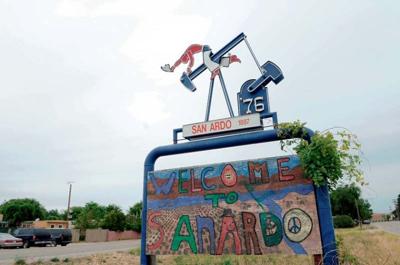
San Ardo has barely enough shops or restaurants to even claim a downtown. Visitors are greeted by a welcome sign featuring an oil pump, and the main drag comprises a non-automated gas station and a greasy spoon that serves burgers, burritos and strong coffee. The claim that this community needs a buffer against development is a little hard to swallow, even for Supervisor Simon Salinas.
“Why would you want to go build around an oilfield?” he says.
Imminent or not, the potential for converting ranchland to more profitable uses has put ranchers on the defensive. They say any threat to any component of their income – which runs the gamut from oil royalties to easements – could jeopardize the rural character of South County and the large tracts of private land that make it a semi-wild oasis.
While South County ranchland may be outside developers’ immediate plans, Fischer has focused The Nature Conservancy’s acquisitions on ranches nearer population centers, like Dorrance Ranch on the Highway 68 corridor.
The 4,300-acre ranch is home to 13 varieties of butterflies and at least that many birds, including a pair of buzzards Dorrance named Harriet and Phil. This inventory of biodiversity came as part of the negotiations for the conservation easement with TNC, through which Dorrance sold the nonprofit development rights for $6 million.
“That’s our retirement,” Dorrance says. He had been considering establishing a vineyard, but gave up that opportunity when he signed the easement.
Fischer says she’s aware of the continued economic pressures on ranches. “There are many ways that a conservation easement can benefit a ranch financially,” she says. “But is it enough to save the ranch generation after generation? Probably not.”
Ag Land Trust Managing Director Sherwood Darington, whose mission is to preserve agricultural lands, agrees: “The income they get from the oil royalties would far exceed any income they would get from a conservation easement, which is a one-time transaction.”
The trust’s priority is preserving irrigated agricultural lands. The group holds development rights to 5,000 acres of rangeland, about a quarter of the total land area it holds rights to; the rest is irrigated fields.
Making the case that ranchland, which accounts for half of the county’s total land area, is on the brink of over-development doesn’t sit well with Darington. He doubts it’s even worth the fight to protect the $30 million cattle industry, which pales in comparison to about $4 billion generated by irrigated agriculture.
“If you’re going to preserve agriculture in Monterey County, you need to concentrate on the farmland,” he says. “What you’re protecting [with ranchland] is open space and not economic use.”
Fischer says The Nature Conservancy would even be willing to consider small-scale oil drilling as part of an easement.
The same can’t be said for solar panels, which shade out and kill grass. And wind turbines pose a threat to protected condors.
Congressman Sam Farr (D-Carmel), however, says it’s just a matter of time until renewable energy technologies really take off. “If you think about cell phones, you don’t need telephone lines, so developing countries can skip through a generation of infrastructure development,” he says.
But for now, oil companies continue to drill new wells and abandon old ones, planting over the depressions so it looks like they were never even there.
: : :
Prospective economic benefit to the 10 landowners affected by the BLM lease is a little more nebulous. They own only the surface rights, and BLM retains rights to oil or natural gas below the surface. BLM will collect 12 percent royalties if an operation gets up and running.
These “split-estate” deals are making some increasingly outspoken South County activists uneasy, including Craig, of Ventana Conservation and Land Trust. Craig doesn’t take issue with existing San Ardo oil fields, but he sees the prospect of opening up federal lands to fracking as an entirely different, and dangerous, direction.
“BLM is acting as the eminent domain arm of the private industries that want to drill,” he says.
Rick Cooper, manager of BLM’s Hollister field office, which manages some 280,000 acres in Monterey and Fresno Counties, dismisses such concerns. “The likelihood of a massive production field going in is low,” he says. “We’ve got 20 years of data that says they’re not going to apply to drill.”
On two existing leases in the county, with oil companies Venoco and Neon, neither operator has applied for a permit to drill. (Simply acquiring the rights to a field doesn’t guarantee an oil company will ever build an exploratory well, much less go into production.)
But in Craig’s estimation, this lease could be a major turning point for the industry in Monterey County. BLM is leasing because an oil company – one the agency refuses to name because such information is considered proprietary – has identified the area as a prospect. It’s most likely Denver-based Venoco, which plans to invest $100 million and drill 13 new wells this year in the region extending south to Ventura County.
“In recent years, the exploration, exploitation and development of the onshore Monterey Shale Formation has taken a fundamental role in our corporate strategy,” a company report reads. Venoco declined to comment for this story.
BLM geologists predict an operator would be able to extract oil or gas from the dense Monterey Shale Formation only through fracking, a technique that injects water and sand, combined with a suite of chemicals like anti-corrosives and antimicrobials, into the ground to create fissures in the rock.
And they would need to go 10,000 feet below the surface, compared to existing San Ardo wells that are about 2,000 feet deep.
BLM considers fracking a “routine drilling” procedure, and therefore doesn’t require operators to disclose whether they plan to frack a well.
Fracking fluids (with the exception of diesel) are exempt from disclosures under the Safe Drinking Water Act, but the Monterey County Water Resources Agency recommends against opening the proposed BLM leasing area to fracking due to lack of data on the impact to drinking water and groundwater. The agency also worries about potential seismic activity.
The County Planning Department has been digging for more information on fracking and the chemicals that may be used, generally considered by industry to be proprietary. County planner Taven Kinison Brown wants more information from Venoco and from BLM when it comes to the details of fracking.
“If fracking is allowed by these leases, then Monterey County believes the [Environmental Analysis] is wholly insufficient,” Kinison Brown wrote in the county’s public comment to BLM.
A state bill, AB 591 (now in Senate committee), would require companies to disclose what chemicals are used in fracking; meanwhile, the U.S. Environmental Protection Agency has undertaken a review of fracking, with a report due out in 2012.
Rep. Farr says, “I err on the side of caution. We’ve got EPA reviewing it, and I don’t think we need to drill holes before we get those results.”
But until then, BLM is charged with mineral exploration, and despite the opposition from county agencies, announced June 16 the parcel will be available for lease in September.
Supervisor Salinas, whose district includes the BLM parcels for potential lease, also takes issue with fracking, but says the county doesn’t have the authority to intervene.
“By raising concern, it tells the BLM there is a need to pause,” he says.
And that might be all the county can do. “We don’t have money to sue the federal government,” Salinas adds.
It’s too soon to say whether Craig and about a half-dozen South County activists will stop the BLM sale from going through, but they do have influence. Ventana Conservation and Land Trust is appealing three of Venoco’s permits, each of which allow up to three exploratory wells on the Monterey Shale Formation. The Planning Commission granted Craig’s application for a waiver of the $4,900 appeal fee.
And though it’s not clear whether Venoco will consider backing out of the county, the company was granted a six-month extension on answering Craig’s appeal in March, and has not cooperated with the Planning Department’s requests for information, according to Kinison Brown.
Orradre believes any opposition to the oil industry could deter expansion/ There are no fracked wells on her property, but she worries about the traction the appeal has gotten.
“The Steve Craigs of the world are not our friends,” she says. “These people could have a horrible economic impact on us if they did what they wanted to do.”
: : :
That oil and grazing can coexist doesn’t foretell what would happen if a new region were to open up for exploration. But BLM’s Rick Cooper insists there’s little reason to worry the Lockwood area will end up looking like San Ardo, where there are more than 500 active oil wells. If an oil company were to bid on the lease (the going rate is $1.50/acre), he says, and then begin applying for drilling permits and ramping up production, his agency would step in: “BLM would at a point stop and say, ‘O.K… we need to reassess.”
Jay Brown, the planning commissioner, sees the BLM lease as potential income for ranchers. Although they wouldn’t collect royalties, they can make agreements on above-ground improvements like roads or fences.
“It could further aid in keeping some of the ranches over on this side [of Highway 101] intact,” he says. “It’s another tool to keep income flowing in a difficult business.”
Craig plans to continue fighting the sale through a 30-day protest period that ends July 16. “We’d rather move to Nevada City or someplace if this is coming,” says Craig, who operates a 50-acre organic nursery and grows olives and pomegranates. “We won’t stay if these leases go through.”
It’s possible the BLM parcels will never be developed as the controversy around fracking comes to a head. Supporters insist continued oil development is key in preserving the rural character of the South County region, where the oilfields feel almost like part of the rangeland ecosystem.
Only the stakes are a little higher now: A cow occasionally falling into a well isn’t much of a hassle. But groundwater contamination would fall into a different category altogether.
(0) comments
Welcome to the discussion.
Log In
Keep it Clean. Please avoid obscene, vulgar, lewd, racist or sexually-oriented language.
PLEASE TURN OFF YOUR CAPS LOCK.
Don't Threaten. Threats of harming another person will not be tolerated.
Be Truthful. Don't knowingly lie about anyone or anything.
Be Nice. No racism, sexism or any sort of -ism that is degrading to another person.
Be Proactive. Use the 'Report' link on each comment to let us know of abusive posts.
Share with Us. We'd love to hear eyewitness accounts, the history behind an article.