TAKING UP A NEW HOBBY OR HOSTING A BIRTHDAY PARTY CAN BE FUN, but it can also be pricey. Maybe you are curious about kitchen supplies like custom cookie cutters or a pasta maker or an ice cream maker, but not sure you will use it again, or don’t have space to store it in the kitchen. It can also be expensive, especially for something that might not make it into the regular rotation for use in the long run.
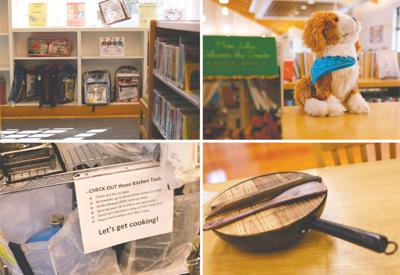
Instead of putting a rain check on cooking aspirations, locals can now go to the library. Pacific Grove Public Library now loans out more than 30 kitchen items, including a rice cooker, a pasta machine, cookie cutters and cake pans in unique shapes. This is in addition to its collection of more traditional library essentials, like books, DVDs and magazines.
Last year, PGPL launched its kitchen tool collection. The idea germinated in 2022, starting with brainstorming on what to do with a surplus budget the library had and the librarians’ intentions to attract more teens to the library. Since Pacific Grove High School has a strong culinary arts program, they thought cooking utensils would be the right call.

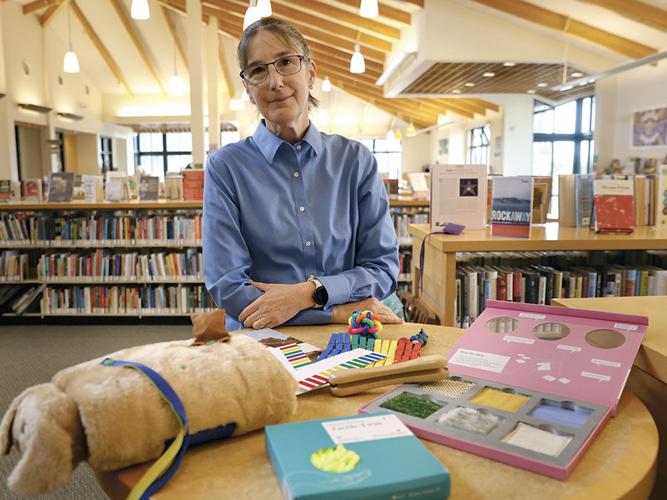
“A public library can be what its community needs it to be, and we can pivot pretty readily. We’re very open to new ideas and experimenting and piloting to meet community needs,” Monterey County Free Libraries Director Hillary Theyer says. Theyer has checked out dementia kits to help her better understand her mother’s illness; the kits include tools for caregivers as well as patients, with activities to boost their learning and soothe them.
Putting together a kitchen tool collection took a lot of trial and error. It started with a list of potential items, followed by a trial period from staff members and volunteers to make sure each item was safe and easy to use. After receiving feedback, they finalized the list. A cotton candy machine didn’t make the cut, but the ice cream maker and pressure cooker did.
“Libraries are always responding to what their community needs,” says Diana Godwin, Pacific Grove Public Library interim director.
Libraries in Pacific Grove and beyond have become a jack of all trades. Through books, readers can learn about other cultures and travel to imaginary worlds. People can also sign out e-books and audiobooks with a library card, no need to show up in person. Libraries also serve as physical community spaces where people meet to study, socialize or attend workshops to learn new topics and skills. Increasingly, they are also a space where people can sign out materials needed for the new skills they are reading about in books – backpacks to enjoy the great outdoors, toys to play with or pans to bake a cake.
“We try to make it as relevant for the immediate community as possible,” says Ernesto Lizaola, community education manager at Salinas Public Library.
Libraries have diversified what they offer on their shelves, and they keep evolving as those community needs change. “People have been calling it the death knell of libraries for decades, and we just continue to rise like a phoenix,” Godwin says. “We just keep re-creating ourselves.”
THE IDEA OF A LIBRARY OF THINGS HAS BEEN AROUND FOR DECADES. In Berkeley, the Berkeley Public Library has offered tools in its catalog since 1979. It started with $30,000 from a federal Community Development Block Grant. That was enough for 500 tools; the collection today has more than 3,500 items for carpentry, plumbing and cooking utensils like air fryers and ice cream makers. It also offers workshops for DIY projects, gardening and home maintenance.
Claire Bresnahan, a Pacific Grove resident who previously lived in Oakland, used to check out tools from the local library for her DIY projects. “I would check out a hammer or a saw, and it was just such a fantastic community resource,” Bresnahan says.
One goal of offering a library of things is to offer patrons a chance to “try it before you buy it;” another is to address community needs and accessibility, helping eliminate cost barriers to certain enrichment activities.
“It’s a good way to get a trial basis,” Lizaola says. “Try it out: Do I like it? Do I enjoy it? It eliminates that barrier of having to buy a tent, which could be up to a couple-hundred dollars.”
Another objective is to help people avoid buying unnecessary stuff that they might only use once or twice, instead creating a shared community resource.
“For those temporary needs, you don’t need to own this forever. You need it once or twice and so you can borrow it from us,” says Hillary Theyer, director of Monterey County Free Libraries. “We’re always looking at the needs, and sometimes the needs walk in the door.”
For example, Lunch at the Library began in Oakland in 2011, when librarians noticed their youngest patrons, some of whom stayed for hours at the library, didn’t have lunch or snacks. A decade ago, MCFL began its own Lunch at the Library program, which expanded during the pandemic. In 2022, MCFL provided 13,702 meals.
Pacific Grove offers framed lithographs, which librarians say is a good way to decide what type of vibe someone wants in their home, with a short (and free) trial period.
Bresnahan has checked two lithographs from the P.G. library, including a large, gold-framed reproduction of “Garden Path at Giverny,” a 1902 piece by impressionist painter Claude Monet. The image features a lively color palette with reds, purples and greens that draws the eye toward the house, semi-hidden by greenery. “It wasn’t the kind of thing that I ordinarily would have gotten, but it turned out that I really like it,” Bresnahan says.
Bresnahan was living in a rental home in 2020 while hers was being remodeled. “I didn’t want to get paintings permanently, because I didn’t know if they would fit,” she remembers. During a visit to the library, Bresnahan and her 11-year-old daughter Zoe saw the painting, signed it out and decided they love it – it’s on their list to purchase their own.

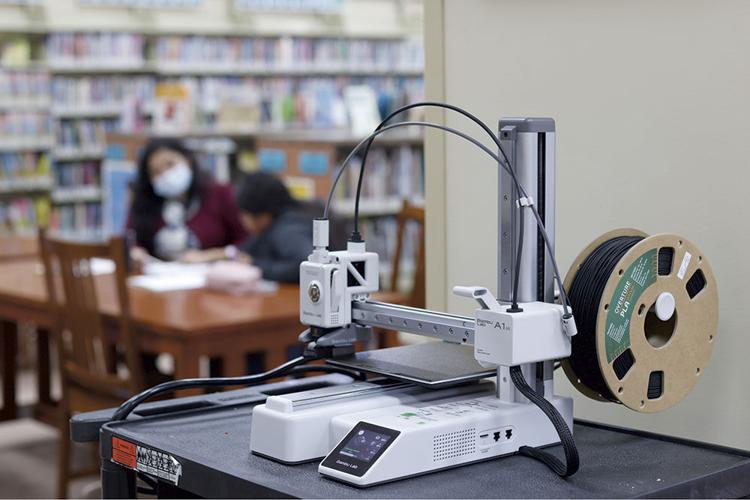
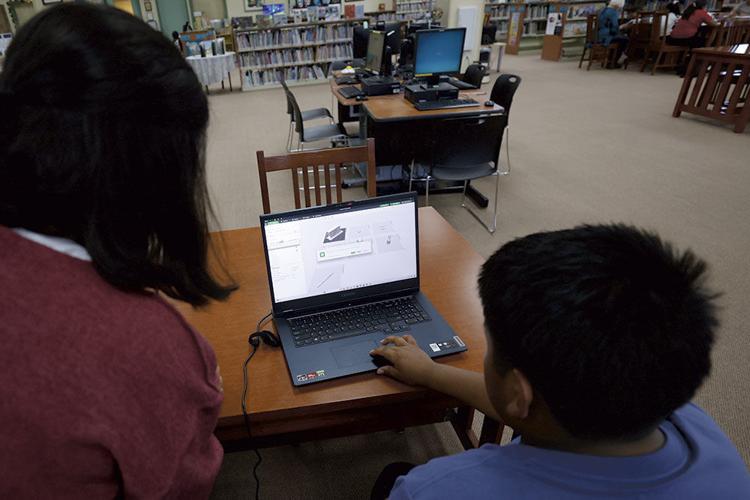
Various local public library systems have 3D printers. Salinas Public Library partners with local organizations, including Alisal High School and Artists Inc., to provide 3D printing workshops. Monterey County Free Libraries offers regular 3D printing workshops.

At the Castroville Library, a 3D printer is available for the community to print 3D objects.
MAYBE YOU THINK OF LIBRARIES AS QUIET PLACES where librarians go around keeping the silence and shushing people; while most libraries have dedicated quiet study areas, this stereotype is far from the truth. Libraries of today have play areas and colorful toys for kids where they can play, run and laugh, or tables with puzzles at different stages of completion that invite people to work collectively to finish them. (Seaside’s Monterey County Free Libraries branch features several completed puzzles framed and hanging on the walls.) People regularly plug devices in at the charging station at Monterey Public Library, and may go doze off in a comfy chair nearby. At the Marina branch, there are regular community gatherings; one of the most popular is Dads Read!
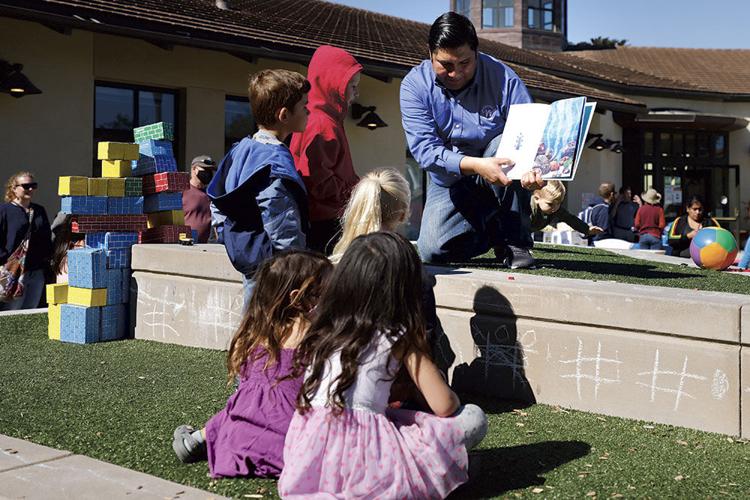
Every month, dozens of kids and their parents gather to listen to a man, mostly fathers, read aloud – another attempt to upend an outdated stereotype. Although it’s not a requirement, most of the reading selections are meant for kids. Parents also have time to socialize and grab groceries from the Food Bank for Monterey County, buy used books or exchange clothing with Buy Nothing Marina. During this event, the play area is full of kids and adults; occasionally, there is also a party with music, lighting and popcorn.
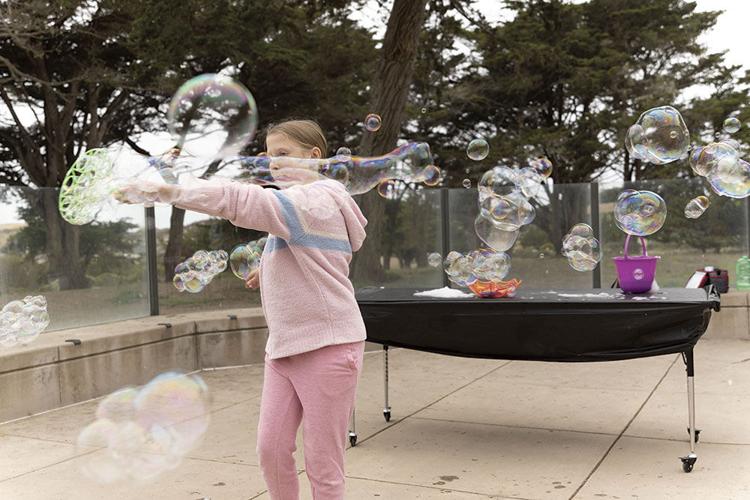
Also at the Marina library, the workshop “Biology with Berta” invites kids to search for bugs or learn how to make bubbles and learn about scientific principles. Nature Journaling invites participants ages 14 and older to draw their surroundings. At Marina and other libraries, local clubs that bring people together for everything from chess to knitting regularly meet in community rooms.
At El Gabilan Library in Salinas, a stationary exercise bike lets people read or write while pedaling. At Monterey Public Library, classes on how to use the 3-D printer give people a chance to make stuff.
All of this has the effect of making libraries louder spaces than they once were, which sometimes impacts the experience for people more accustomed to quiet. Some longtime regulars were having a difficult time enjoying the library and feeling anxious, Theyer says. To fix that, MCFL added artificial pets to its collection for checkout from its 16 branches. These little dogs and cats curl up on people’s lap and many vibrate; people can soothe themselves by caressing them. “This intervention helped people be calm in our space,” Theyer says. “We want to be sure we’re not excluding anybody from our space.”
IT’S NOT JUST THINGS, BUT ALSO GATEWAYS to experiences that are available to check out at local libraries. An array of kits, tools and programs are available based on age, for kids, teens and adults. Systems including MCFL, Monterey, P.G. and Salinas, teamed up with California State Parks and offer free state park parking passes; some also offer adventure backpacks filled with supplies for outdoor recreation.
Francis Hebert, Salinas Public Libraries’ technical services manager, says they focus on acquiring items community members are interested in that might be a cost barrier for them. “We’re trying to be a one-stop shop,” Hebert says.
At Steinbeck Library in Salinas, a prominent display shows different adventure packs available for checkout, like birdwatching, nature walking or camping. The camping pack includes a compass, first aid kit, emergency whistle, lantern and a camping book.
Backpacks available are not just for campers. There are different styles, based on the content they are filled with. For kids, for example, some backpack offerings are in clear bags – looking at the books and dolls inside might get them interested and excited about a science or history kit they want to check out. For those experiencing emotional challenges, checking out material on mental health in an opaque backpack is the way to go, since stigma on mental health still lingers. They include books about different topics such depression or gender identity. Some include heart-shaped pillows users can use to soothe themselves, or “worry monsters” that eat their worries away.
PGPL offers several “hands-on experience” backpack kits. Some focus on science, such as animals, engineering, and the human body; others focus on history and have 18-inch American Girl dolls, inviting little ones to learn about American history through a kid’s lens. On one recent day, there was only one doll in stock out of 14 available for checkout.
For older library-goers, MCFL offers dementia kits. These include books for caregivers, as well as activities for the person whose memory is declining. Theyer checked one out for herself and her 82-year-old mother, and she says it helped her interact with her mom, and make her feel more comfortable. The late-stage kit includes a fidget muff shaped like a dog; it’s a soft, sensory toy people can put their hands in, and it has beads and ribbons. “That became one of my mom’s favorite things,” Theyer says.
“Would I ever have purchased that on my own? No, probably not. I wouldn’t have known about it. Wouldn’t have known if it would work, but the fact that I could borrow it, see it and try it, then I can say, ‘OK, now I’m going to invest in this for her.’”
SOMETIMES, LIBRARY COLLECTIONS MIGHT FEEL TO A PATRON LIKE A MAGICIAN’S HAT – you never know what you might find on hand, from a tiny seed to a giant telescope or a mid-sized cooking utensil.

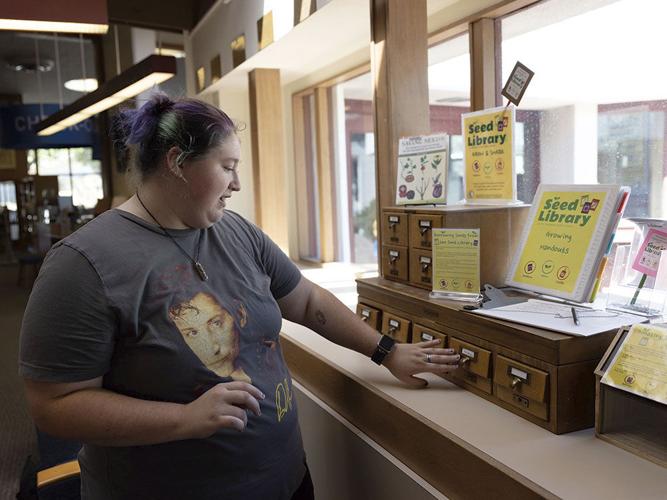
Criteria for inclusion in the seed collection at Monterey Public Library includes a requirement that plants are not invasive in the region. A library card isn’t required to check out seeds, says Sofia Neal.
But for librarians, the process of adding new items is more methodical than reaching into a hat. They deliberate about what to add and how to serve the community. They survey library card holders for ideas; Salinas Public Library includes a survey in every backpack to track what is working or not.
Before adding a new item to the collection, everything is tested, cataloged, and librarians must make a plan for proper storage. If something breaks easily or is difficult to clean, it may not make the cut, even if there is interest from patrons.
Librarians check the product instructions and rewrite them if the existing ones are confusing, and also translate them into Spanish. They also discuss replacement costs and maintenance of items before committing.
Many items in the library of things are funded by grants. When the money runs out, the offerings may end, or evolve into something else.
For people who want to donate, library officials recommend cash donations – they do not want your old ice cream maker that may no longer be under warranty, missing the original instructions or a plan for storage.
They also suggest contacting the local library to ask how you can help or what specific items you can donate. This is how two local organizations, Monterey Stinging Jellies Disc Golf Club and Monterey Institute for Research in Astronomy (MIRA), got frisbees for disc golf and telescopes for stargazing, respectively, accessible to the community in library collections at Monterey County Free Libraries, Salinas Public Library and Monterey Public Library.
MCFL relaunched its back-to-school wish list last month. Their Amazon list (at bit.ly/MCFLWishlist) includes school and craft supplies for student support centers across its branches.
From books to e-books to internet access and to the growing collections of objects, libraries have long been evolving. Smartphones mean that most people have access to a massive volume of knowledge any time, so the concept of the library is changing. But the premise always returns to expanding knowledge and enriching people’s lives.

Local libraries offer an array of events. Offerings at the Marina branch of Monterey County Free Libraries include Dads Read!, which features a different man reading to children each month; at top, Herbert Cortez takes his turn reading aloud.

Hands-on workshops for kids to learn about science include Biology with Berta sessions.
THE SEEDS OF A LIBRARY OF THINGS WERE PLANTED BACK IN 2012 for Francesca Garibaldi, administrative assistant at Monterey Public Library. She found a variety of examples elsewhere – bikes available for loan from UC Santa Cruz’s library, cake pans in Ohio, guitars available in East Palo Alto. In her research, she most connected to the idea of a seed library, and a CSU Monterey Bay environmental studies student made the idea her capstone project.
Monterey’s seed library launched in 2014. Now, a decade later, seeds for tomatoes, sunflowers, peas and lettuce are available in small envelopes that sit inside the drawers of an old-fashioned, wooden card catalog. Some are seeds from library patrons who “borrowed” seeds from the earlier collection, grew successful plants and then harvested the seeds.
“A lot of seed libraries are run solely on the community donations of seeds,” says Sofia Neal, an assistant librarian at Monterey Public Library.
Monterey Public Library’s “library of things” also includes three ukuleles as well as two telescopes.
Some items are tiny like seeds, while others are large. Monterey County Free Libraries also has four telescopes in its collection, great for clear nights and meteor showers. Library staff provide a basic demo on how to use the telescopes, and levers have been marked so users can easily see how to adjust them properly.
The telescope kits include a booklet on how to use them, including guidance not to point them directly at the sun.
The local libraries’ telescopes were donated by MIRA in 2017; each is valued at between $250 and $450, and can be used to view planets, star clusters, nebulae and more.
These are not books about astronomy, but a tool that enables library patrons to experience astronomy for themselves. (There are, of course, books about astronomy – and how to play ukulele, and gardening – that pair well with the objects.)
“Accessibility to the night sky is not something everybody has a chance at,” says Jean Perkins, an astronomer at MIRA. “Putting telescopes in the local library really opens up the chance for people to explore stuff.”
That’s part of the original spirit of democratizing the sharing of knowledge through free books on loan – plus items from cake pans to instruments to telescopes.
(0) comments
Welcome to the discussion.
Log In
Keep it Clean. Please avoid obscene, vulgar, lewd, racist or sexually-oriented language.
PLEASE TURN OFF YOUR CAPS LOCK.
Don't Threaten. Threats of harming another person will not be tolerated.
Be Truthful. Don't knowingly lie about anyone or anything.
Be Nice. No racism, sexism or any sort of -ism that is degrading to another person.
Be Proactive. Use the 'Report' link on each comment to let us know of abusive posts.
Share with Us. We'd love to hear eyewitness accounts, the history behind an article.