


THE AGENDA FOR THE OCT. 21 MEETING OF THE MONTEREY COUNTY BOARD OF SUPERVISORS was relatively standard: a proclamation here, a budget talk there, with some commission appointments sprinkled throughout.
Unremarkable from a news standpoint, as it was mostly routine business that doesn’t generate headlines. Still, news outlets from across Monterey County were invited to attend – the supervisors were scheduled to commemorate Free Speech Week, so the celebration wouldn’t be complete without those in attendance who exercise the First Amendment on a daily basis.
The ceremony was also timely, not only because it fell on the nationally recognized date for Free Speech Week, but just a month earlier, KION TV suddenly shuttered its local news operations, representative of the fickle nature of the industry.
Nick Pasculli, the county’s chief public information officer, thanked the staff of the news outlets for the “vital work” they do.
“They are our partners in democracy,” he said. “Each of these organizations, large and small, enriches public discourse, raises local voices, uncovers stories that might otherwise be overlooked and holds power to account.”
Representatives from only three news outlets attended – Monterey County Weekly, Monterey Herald and KAZU. On the surface, the low turnout was to be expected – news staffers prefer to report on the news, not be the news themselves.
But even if the event drew full participation from all of the outlets in Monterey County, the crowd wouldn’t have been much bigger. Staffing is tight among the county’s print, television and radio media, and sparing a staffer for the Tuesday celebration would have been difficult, if not impossible.
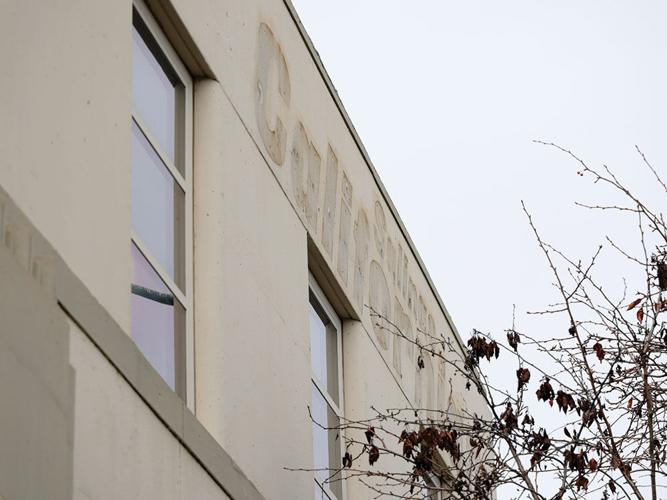
Perhaps the most notable no-show, due to the location of the ceremony, was the Salinas Californian. Just a block over from the supervisors’ chambers stands the newspaper’s once-thriving but now-decaying former headquarters. For nearly a decade, the two-story building with Art Deco-inspired touches has sat boarded up, with weeds growing in the parking lot and the remnants of the newspaper’s sign still etched into its sides.
In mid-2017, the Californian moved into an office complex inside a shopping center’s parking lot on South Main Street. But with cuts over the years from its owner, USA Today Co. (formerly known as Gannett), the Californian is down to one reporter, while most of its other operations have been outsourced to other papers in the company. That office is now vacant, and the Californian lists a Northridge Mall address for mailing purposes.
Meanwhile, the Californian’s former building at 123 W. Alisal St. remains available for lease. A listing posted by Remax Property Experts shows the state of the building in recent photos. A mural showcasing a stagecoach stands in the lobby, but the former newsroom is in disarray – wires hang from the ceiling and the outlines of long-removed cubicles can be seen in the dirty carpet. The cavernous press room wears the decades of hard use.
What appears to be a publisher’s wood-paneled office looks mostly intact, down to the cushy office chairs that remain along with a sturdy wooden desk. Perhaps it was in these chairs where staff learned the paper would be abandoning the building where it had operated since 1949.
These images sum up the state of local journalism in Monterey County and beyond. But even in troubled times, bright spots remain.
IN JULY 2025, Muck Rack and Rebuild Local News released the Local Journalist Index, calculating the number of journalists across the country by state and county.
The index introduced a metric called Local Journalist Equivalent (LJE) that estimates how many journalists are covering local news based on publishing frequency, outlet type and geographic focus. Using Muck Rack’s database of journalists, which tracks more than 3.5 million articles daily, the study found that across the country, there are 8.2 LJEs per 100,000 residents – a 75-percent dip from 2002, when there were about 40 journalists on average for that same number of residents.
More than a third of the counties in the nation have less than one LJE.
“This new data confirms that the local journalist shortage is more severe and far-reaching than we feared,” Steven Waldman, president of Rebuild Local News, said when the index was launched.
Monterey County ranks 1,574th out of 3,141 counties, with 5.1 LJEs. The neighboring counties of Santa Cruz and San Benito stand at 15.4 and 4.6, respectively, but with much lower populations than Monterey County.
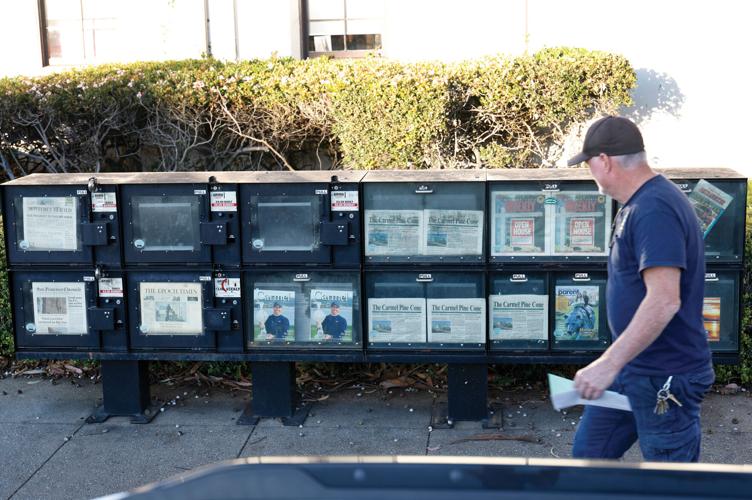
For print media, the Weekly has 10 editorial staffers, while the daily Herald has six and weekly Carmel Pine Cone lists four reporters and one features editor, in addition to freelance writers and photographers.
The Californian, at three days a week, has one reporter who, in addition to covering Salinas, also writes listicles and state news that are distributed across the USA Today Co. network. The paper was even the subject of a lengthy 2023 feature article in the Los Angeles Times titled “The California newspaper that has no reporters left,” chronicling the year the paper had no local staff.
The King City Rustler and Salinas Valley Tribune’s editorial staff comprises an editor and a freelance sports reporter. The weekly papers share the same pages on the inside, with different front and back pages.
The weekly Pajaronian, which is based in Watsonville but covers North Monterey County, has an editor, a photographer/reporter and a sports editor who also write for other newspapers within the San Jose-based Weeklys publication group that includes the above-mentioned South Monterey County papers.
Had recent history not played out the way it did, three local papers would not have lived to see 2026.
WHEN ILLINOIS-BASED NEWS MEDIA CORPORATION abruptly announced it was ceasing operations after 50 years in business in August, it made local news. At the time of its closing, the company operated roughly 30 publications across five states, but had been downsizing in recent years.

The old Salinas Californian building on West Alisal Street in Salinas takes up an entire city block, with 23,610 square feet of office space and 13,603 square feet of warehouse space, according to a real estate listing.
In a letter to staff, CEO J.J. Tompkins wrote that the “decision was not made lightly,” as declining revenue and increased expenses, along with a failed sale of the company, led to the closure.
It’s bad news every time a newspaper announces its closure, no matter where it is. (Studies show that in an area without a newspaper, known as a news desert, government corruption rises as civic engagement sinks.) But Monterey County readers dodged a bullet.
News Media Corporation owned the King City Rustler and its affiliated Salinas Valley papers, along with the Pajaronian from 1995-2019. In 2019, Weeklys purchased those papers, later consolidating the Gonzales Tribune, Soledad Bee and Greenfield News into the Salinas Valley Tribune. (Editor’s note: This reporter worked for News Media Corporation and Weeklys from 2012-2024, including the Pajaronian, Rustler and Tribune.)
Weeklys CEO Dan Pulcrano pointed to the company’s history of buying newspapers in danger of closing, from Sonoma County down to South Monterey County.
“I believe we saved a number of publications from going under, not only News Media’s but the Gilroy, Morgan Hill and Hollister publications were at serious risk of closure,” he says, adding that the company’s acquisition of the East Bay Express, Pacific Sun and Tri-City Voice staved off their closure.
Pulcrano says print media will continue to be in the mix in the future. But operating a newspaper in 2026 is a pricey proposition, with the added expense of printing.
Payroll is the biggest expense, he says. As minimum wage increased to $16.90 an hour on Jan. 1, state law requires certain full-time, salaried employees who make at least double the minimum wage to be paid $70,304 annually, up from $68,640 in 2025.
“Professional journalists are worth that, and a lot more, in terms of their value to society, but the advertising community is price sensitive, and has a lot of options from services that do not pay to create original content,” Pulcrano says.
With traditional sources of revenue such as advertising well below what they used to be (according to a Pew Research Center study, total advertising revenue for newspapers across the country was estimated at $9.8 billion in 2022, down from a peak of $49.4 billion in 2005), publishers must find new ways to bring money in to pay those who report the news.
The Monterey County Weekly, for instance, has historically relied on advertising to fund its operations, being a free publication. But when pandemic lockdowns shut many businesses down, the paper lost a major chunk of its revenue.
It turned to readers for support, which became the Weekly Insiders program, to help close the gap.
“Reader revenue is new to us, but it’s what a subscription is to anyone else,” Weekly Publisher Erik Cushman says.
Carmel Pine Cone Publisher Paul Miller says Big Tech companies such as Google, Meta and Apple “are always trying to monopolize the advertising from even the smallest local businesses, making the competition for revenue ever more difficult.
“At the same time, the people of the Monterey Peninsula have a growing need for reliable local news,” Miller says. “My guiding principle is that, as long as we provide accurate, timely and plentiful local news coverage, they will reward us with their loyalty, which will drive ad dollars – and survival.”
As the owner of the Pine Cone for 29 years, Miller has seen hundreds of local newspapers across the country go out of business. But he says his principle has been proven correct, as the paper “set an all-time record for revenue last year,” with plans to grow its newsroom.
“The Peninsula is lucky to have several news sources that are 100-percent local,” he says. “Let’s hope it stays that way. I know we aren’t going anywhere.”
Recently, local publishers have also had to contend with competitors operating under a relatively new funding model for news, one that Pulcrano says furthers the very problem it claims to solve.
PRE-PANDEMIC STUDIES focused on the rise of foundation-funded journalism. One study from 2018 by Northeastern University found that most funding was concentrated among a few dozen media nonprofits while a “disproportionate number” of partisan outlets were granted money.
Other studies delved into ethics – how do foundations influence what newsrooms cover, and what is the line between journalism and funding?
Pulcrano, though, notes that these deep-pocketed foundations impact well-established news institutions in other ways.
Weeklys, in particular, operates 15 publications from Healdsburg in the north to King City in the south. Across its markets, it faces competition from various news outlets backed by foundations. Santa Cruz-based Lookout Local, for instance, which covers Santa Cruz County and Pajaro, launched in 2020 with funding from the Knight Foundation, the Lenfest Institute for Journalism, Silicon Valley Community Foundation, Google News Initiative and others.
When it began its fundraising efforts, Lookout positioned itself as an alternative to the Alden Global Capital-owned Santa Cruz Sentinel (the same hedge fund that owns the Herald), likening Santa Cruz as a “news desert” since staffing has been decimated at the daily paper over the years (now at seven editorial staff, down from around 40 more than 20 years ago).
In the markets his newspapers are based in, Pulcrano says he’s seen the financial impacts – using data from IRS Form 990s and estimating salaries based on the number of employees, he figures nearly $50.6 million has been spent by the six nonprofit and public benefit corporations operating news outlets in his markets since 2016. “No business can compete against that,” he says, noting that it affects an already limited talent pool.
“It’s tougher to operate in an environment in which big players put their thumb on the scale in local markets,” he says. “When these new competitors, awash in cash, recruit and hire our ad directors, sales reps, most experienced writers and Latino or Black writers, it reduces the talent pool and experience base of established entities.”
Pulcrano notes he believes foundations have good intentions, but they did not receive the full picture beyond the struggles of the daily newspapers.
“Funders didn’t do enough due diligence to investigate whether they were actually filling news voids or simply cannibalizing locally-rooted independents who were already doing some of the state’s best award-winning reporting and played a key role keeping local governments transparent,” he says.
Lookout Local CEO and Founder Ken Doctor says start-up costs were funded by philanthropic efforts, but the news outlet now relies on reader and advertiser support to fund its operations.
“Our model is to make our way forward not on philanthropy but on revenue from the two same sources that most publications have used for over 200 years: reader revenue and advertising,” he says. “Our success here just shows that people want to know more about where they live.”
Local newspapers are much more likely to invest in their communities, not just cover them, Pulcrano notes. He points to the Monterey County Weekly and Good Times in Santa Cruz that have bought and restored older buildings in prominent locations, and spearheaded fundraising efforts for local nonprofits. Monterey County Gives! and Santa Cruz Gives, for example, raised more than $17 million and $2 million in 2025, respectively.
KAREN JERNIGAN WAS HIRED AS A REPORTER for the King City Rustler in 1977. At that time, the Rustler had two reporters, an editor and a publisher. The reporters would be at every city council and school board meeting, and being a small-town community newspaper, would cover car crashes and run a log of arrests.
As the staff dwindled, so did the coverage and the staff’s visibility in the community. Today, the paper is down to one editor and a freelance sports reporter, with the editor also overseeing other publications in the Weeklys group.
“I love the local newspaper, and I only want the best for them,” says Jernigan, who was a member of the King City City Council from 2012-2016. “I was looking at my Rustler today, and it was so thin. You’ve got to look forward and figure out how to live in this digital age.”
Jernigan and her husband John are historians of King City, and are constantly looking at old newspapers – the historic record of the communities they cover.
“I believe really strongly that newspapers are historic preservation,” she says. “If we don’t have them, we don’t have their pictures, we don’t have their words, descriptions, interviews. We are missing an important part of our town.
“That’s why I value and love newspapers, for the life of the city that gets preserved.”

Every Wednesday night, 20,000 freshly printed copies of the Monterey County Weekly are delivered to the paper’s Seaside headquarters from the printing press in San Francisco. The distribution team (led by Aaron Thomas, top, with drivers including Joseph Castello, below) deliver papers.

Every Wednesday night The Monterey County Weekly printed paper is delivered to the Weekly office ready for distribution.
Print readership has declined. According to a “statement of ownership” form published in the Rustler in October 2025 (a document required by the U.S. Postal Service), the paper prints a total of 1,393 copies a week. That’s down from 1,736 in 2017. The Tribune, meanwhile, cites 1,050 copies.
Circulation numbers for the Herald and Californian are not publicly available, and representatives of both publications declined to comment for this article (although a USA Today Co. spokesperson emailed a statement, saying, “Print continues to remain a vital part of our ecosystem, especially for our valued subscribers and advertisers who recognize our reach and impact,” adding that the company is balancing “rising production costs with evolving reader habits,” pointing to its e-newsletter). Recent estimates suggest the Californian has a print circulation of less than 2,500, and the Herald below 10,000.
These papers are far from alone. According to a Pew Research Center study, daily newspaper circulation (both print and digital) was estimated at 20.9 million in 2022, down from a peak of 63.3 million in 1984.
But examining print circulation alone no longer provides an accurate picture of a paper’s full reach. Print is just one aspect of circulation – digital, including websites, newsletters and social media, make up the rest.
“Our audience is bigger than it’s ever been,” Cushman says, when combining both print (Monterey County Weekly) and digital (Monterey County Now) circulation.
According to a 2022 audit by the Circulation Verification Council, the Weekly’s print publication has an average net circulation of 20,323. Data from the platform Mailchimp shows the newsletter has more than 31,643 subscribers, while in 2024-2025, there were 81,719 average monthly unique visitors to montereycountynow.com.
The challenge now is not only sustaining the print publication, but getting the next generation of readers interested in print. Cushman points to the resurrection of vinyl records – statistics show sales continue to rise in recent years as vinyl culture booms – and hard copy book sales that grew during the pandemic and have remained steady.
“We think that’s an opportunity for us. We think we’re going to find success positioning ourselves as a craft, tactile reading material,” Cushman says, adding that good local journalism is the basis.
Still, digital remains a key component in the overall investment in journalism. In the spring, the Weekly plans to launch Salinas Valley Now, a daily online newsletter dedicated to covering Salinas and South Monterey County, a region Cushman characterizes as “radically underserved” in terms of important stories that are “undertold.”
“The stories that are happening in Salinas and the Salinas Valley are California in a microcosm,” he says. “Immigration, land use, affordability, housing, access to health care, education. These are somewhere between incredibly timely and urgent.”
NEXT TO PAYROLL, print costs are the highest expenses for newspapers. Finding a printing press is getting more difficult, and expensive, as the years go on.
In 2013, the Pajaronian pulled the plug on its printing press, selling it for parts and scrap. It was the last printing press in Santa Cruz County, which also printed various other small publications, including the now-defunct Cedar Street Times in Pacific Grove.
The Pajaronian contracted Southwest Offset Printing in San Jose to print its newspaper. But during the Covid-19 pandemic, Southwest closed the San Jose facility and consolidated it with its Gardena printing plant.
As page counts dwindle, compounded by the declining number of publications, it impacts business for printing presses, leading to further consolidations and closings of presses. That, in turn, makes it difficult for newspapers to find a place to actually print their publication.
The Weekly, not having its own printing press, must rely on other companies to print its publications. After a 15-year run at the San Jose Mercury’s now-former printing plant, the Weekly has bounced around to different plants over the years, especially in the past decade or so, mainly because such operations have continued to shutter. It is now printed in San Francisco.
In 2024, the Biden administration enacted a tariff on aluminum lithographic plates imported from China, a key component of the printing process, as well as on other raw materials over the years including aluminum and steel, ratcheting up the costs of printing.
An estimated 80 percent of newsprint used by U.S. newspapers comes from Canada. The on-again, off-again tariffs threatened by the Trump administration earlier in 2025 brought uncertainty. By July, newsprint was exempt from the tariffs, for now.
Whether or not the tariffs come to be, costs will continue to rise regardless. And if recent history is any indication, the number of printing presses will continue to fall in response.
Meanwhile, the ghost of a printing press’ past remains near the heart of downtown Salinas. Long-dried ink stains the concrete floor inside the warehouse of the Californian’s former West Alisal Street building, and anyone who’s spent time inside a running print facility can still hear the roar of the press echoing through the cavernous space, the sound of a more robust time in the local journalism world.
(1) comment
Tompkin's News Media Group purchased the Register-Pajaronian from Scripps-Howard in 1995. Security guards were hired at the office (now the Watsonville Grocery Outlet) while the employees were rounded-up and told the news. Tompkins offered to employ most of us, thus we were unable to receive our earned severance accrued from Scipps-Howard plus we were unable to receive unemployment insurance (because we were offered work.) Tompkins and News Media were a chain of weekly Penny Savers, and the Register-Pajaronian was their first real daily newspaper. They wasted no time trashing the Editorial Department of employees in the first few weeks. The Advertising Department staff were in daily mandatory 8am sales meetings with a list of who and how much revenue they expected to sell each day. At 4:30pm they'd return for the mandatory sales meeting to report on how much they'd sold. The work of ad sales staff usually included writing the advertisement, creating the ad art, submitting the layout to Dispatch, then proofing the ad (often to the customer). Plus Tompkins demanded that ad staff leave the building by 9am, and not return until after 3pm thereby conforming to California Labor standards for "outside sales" which made him immune from paying overtime. And there was plenty of overtime worked because it was necessary to have the twenty sales prospects for the 8am meeting, so ad staff needed to arrive early. The computers, fax machines, telephones, artwork, typewriters were all at the office, but ad staff couldn't access them because the 9am-to-3pm ban from the office. So that work would have to be done after 3pm, but then there was the 4:30pm sales staff meeting to prepare for and attend. It would often run past 5pm. So then ad sales staff would need to continue working to create the ad copy and ad artwork and submit their layout to make deadline by working late into the night. Without overtime pay. Management was abusive to ad staff. I can personally recall the Ad Sales manager screaming at us that he "could hire monkeys to do our jobs." We organized our labor and affiliated with the San Jose Newspaper Guild. Tompkins and management became increasingly antagonistic toward the workforce. They'd have "meetings" with workers to convince them that a union would be bad for them. It was during that time that the Detroit Free Press was on strike, so Tompkins took photos of the workers and police fighting off the wire services and blew them up into posters and added the text: Where There's Unions There's Trouble then posted them on the workroom floor. The union won the election, yet Tompkins would recognize the union and the NLRB had to issue them orders to bargain with us. Even then, Tompkins required that we meet for negotiating the contract at a out-of-the-way hotel conference room in Morgan Hill rather than in our hometown of Watsonville. And all the while, Tompkins invented spurious reasons to fire workers that were pro-union. Then Tompkins hired the Advertising Sales Manager from the 50,000 circulation vehemently anti-union Ganett owned Salinas Californian to manage/union bust the 10,000 circulation Register-Pajaronian. What monetary compensation that required paid-off. Tompkins succeeded in firing enough workers and busting the union. The writer may look fondly back at his tenure with Tompkins and the Register-Pajaronian. But many former workers recall a very different scenario.
Welcome to the discussion.
Log In
Keep it Clean. Please avoid obscene, vulgar, lewd, racist or sexually-oriented language.
PLEASE TURN OFF YOUR CAPS LOCK.
Don't Threaten. Threats of harming another person will not be tolerated.
Be Truthful. Don't knowingly lie about anyone or anything.
Be Nice. No racism, sexism or any sort of -ism that is degrading to another person.
Be Proactive. Use the 'Report' link on each comment to let us know of abusive posts.
Share with Us. We'd love to hear eyewitness accounts, the history behind an article.