



ONE CAN CONSUME THE WORK OF DAVID WHYTE IN MANY DIFFERENT WAYS, from reading – his books of poetry (11 of them to date), essays (he is working on his second volume) or prose – or by tuning into online events to watch and listen, including to his frequent guest appearances on podcasts or his TED Talk, or attending in-person events (such as an upcoming March 29-31 workshop at Asilomar in Pacific Grove).
Let’s start with poems. They are simple and sometimes abstract, if occasionally as readers we find ourselves transported somewhere more literal – on a transatlantic flight or pondering the nature of a soap dish.

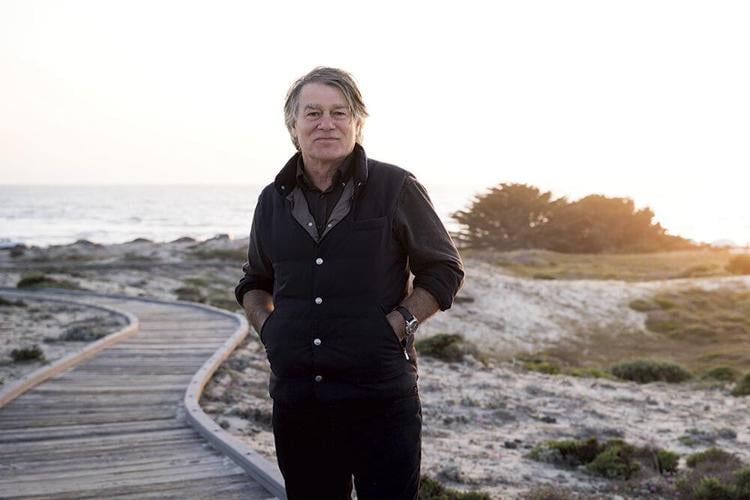
David Whyte walking in the Asilomar dunes. He loves all coastal regions, from the Irish and English coast to Whidbey Island, Washington, where he lives.
There are seasons in this poetry, also of life, and big universals such as failure, regret, hope, love. The poems are addressed to a universal “you,” also the you in the mirror. Occasionally appearing as “we,” the poet is somehow removed from the first plan. Instead, he is a voice trying to reaffirm itself and others, to meditate, to bless himself and others, to give the world a sermon. His words seem like prophecies of the kind the ancients used to travel to the Oracle of Delphi to heal, where a high priestess closes her eyes and starts speaking in the language of a god, and not just any god but the master of poetry, Apollo.
The poet’s “signature move” is the use of sparse but effective repetition for emphasis – in the beginning, the end of the culmination of a poem. It works miracles.
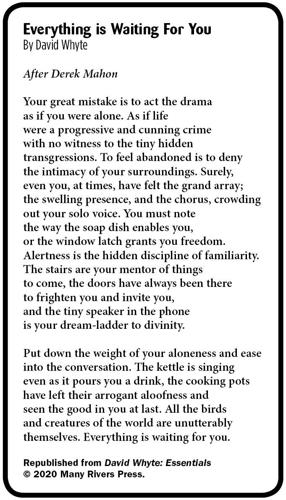
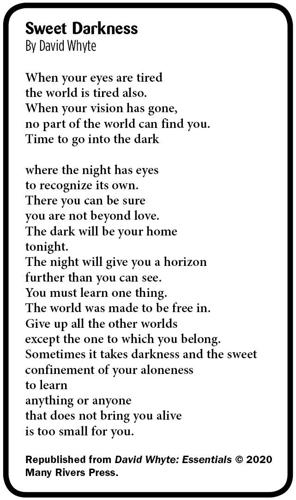
If you haven’t encountered any of Whyte’s poems, start with “Everything is Waiting for You” from the volume of the same title (2023), or perhaps “Sweet Darkness” from The House of Belonging (1996). Intelligent more than intellectual, this poetry doesn’t compete in the eternal competition of poets. It is philosophical, and indeed some refer to Whyte also as a philosopher, one who is not afraid to speak of phenomenology – not in the sense of the known trajectory from Edmund Husserl to Martin Heidegger, but as a general study of consciousness and the objects of direct experience that his readers can relate to.
Whyte’s philosophy is about “the conversational nature of reality,” a definition he repeats often in interviews about his work. That means realizing that our desires are thrown into the real world, which will do with them whatever it wants – and, at the end of your life, it will kill you.
This is not a dark framing, but a wakeup call. Basically, Whyte is using poetry as a practice. “Poetry is about paying attention to something other than yourself,” he says.
WHYTE IS AS INTROVERTED AS POETS TEND TO BE, AND AS EXTROVERTED AS ANY GOOD PUBLIC SPEAKER. In practice, he is both, but prefers to see himself as a poet, not a guru, and definitely not a “spiritual guru.” He doesn’t like the word “spiritual.” One is allowed to be more of a sinner as a poet, Whyte adds. “But if you are a serious poet you will have to do the writing. Everything else is just an addition,” he says.
Sharing his words with people was a natural consequence of a longtime habit – Whyte’s need to memorize poetry and recite it, hear it out loud, during solitary walks. Before memorizing his own poems, he had done the same with traditional Irish and English poetry.
He started to write seriously at age 13 or 14, inspired by a good English teacher. He was “abducted” by poetry as a boy, he says, by voices of poets such as Ted Hughes. He came to see poets as adults who preserve access to their original imagery of childhood.
But then, he learned about French explorer and oceanographer Jacques Cousteau, and life as a literal adventure became all he wished for.
Whyte got his degree in marine zoology and took a break from writing throughout his 20s to work as a guide on the Galápagos Islands. That experience was a face-to-face meeting with the poetry of the ocean and wildlife. Looking at animals for hours, ironically, brought him back to writing, forcing him back to poetry. That’s because the language of science was not enough to contain all this poetry.
So he returned. Only then, in 1984, he published his first volume of poetry, The Songs for Coming Home.

HOME HAS LONG BEEN WHIDBEY ISLAND, NORTH OF SEATTLE, but Whyte was raised in West Yorkshire, England, the region of the moors and Emily Bronte, and also the cradle of the world’s industrialization.
“Oh, I’m afraid there was a woman involved,” he says about his current homeland in the Pacific Northwest. “My first wife, the children. But Whidbey Island is very good for me. It’s my base.”
A frequent passenger on the direct flight Seattle-London, Whyte gets to spend a lot of time in England and Ireland, in addition to working all around the world. A rock climber and lifelong explorer (the Himalayas, the Amazon, the Andes), a father of two, now on his third marriage, he holds American, British and Irish citizenship. His third book of prose, published in 2010, is titled Three Marriages, Reimagining Work, Self & Relationship, but contrary to expectations, Whyte means one’s marriage to your work, your spouse and oneself.
When Whyte started doing poetry readings, it was to a room of six people. Then he started to get invited here and there. He noticed the enormous effects his poetry had on people, that his voice was getting poetry across.
“It happened very naturally, even though that was never my plan,” he says about his readings growing bigger and bigger. “It’s larger than me.”
Whyte kept publishing volumes of poetry – Where Many Rivers Meet (1990), Fire in the Earth (1992), The House of Belonging (1996). With time, he got invited by corporations, not only to provide poetry to corporate employees, who needed it badly, but also to learn that they are humans and have a human response to poetry like everybody else. It put him on a track to reach larger audiences.
“I was a very serious young poet so I didn’t want to be compromised by the corporate world,” he says. “When I actually responded to many invitations, I found out that I didn’t have to compromise my work at all.”
The result of that experience was Whyte’s first book of prose, The Heart Aroused: Poetry & the Preservation of the Soul in Corporate America (1997). “I was invited against my will to the corporate world,” he says with laughter. “Then I got bullied into writing a book about the corporate world. Bribed and bullied by publishers.”
The basic point is that people in all walks of life get overwhelmed within the system they exist in. It can be a corporation or it can be a small village in Northern Ireland. “Sometimes an English Department can be more Machiavellian than any corporation,” Whyte adds.
According to Whyte, hierarchy is not inherently bad. It can be pernicious or it can be good, but it is pervasive. “If I met Seamus Heaney [an acclaimed Irish poet who won the 1995 Nobel Prize for Literature], it would be natural that I would look up to him. It’s a healthy hierarchy,” Whyte says. “But if we went sailing, maybe he would look up to me as a better sailor. Hierarchy changes, the nature of conversation between the two changes.”
When it comes to peers, his partner in poetry and best friend was another Irish poet and Hegelian philosopher, John O’Donohue, who died in 2008. “Part of me died,” Whyte said in a 2022 interview with Krista Tippett of The On Being Project podcast: “We were like two bookends.”

SINCE THE DAWN OF SOCIAL MEDIA, WHYTE WENT VIRAL, becoming a celebrity poet, but still – Asilomar is the place of his annual pilgrimage. That’s because his breakthrough, as Whyte says, took place exactly there.
Monterey Bay shares a lot of the qualities of North Ireland, according to Whyte, even if it’s very different culturally. “The ancient conversation between the sea and Earth and the sky,” he says.
Whyte loves the wooden buildings of the Asilomar Conference Grounds, the Monterey pine forests, Asilomar State Beach. He loves that the Arts & Crafts style conference center was designed by a pioneer female architect, Julia Morgan, the same person who conceived of Hearst Castle in San Simeon.
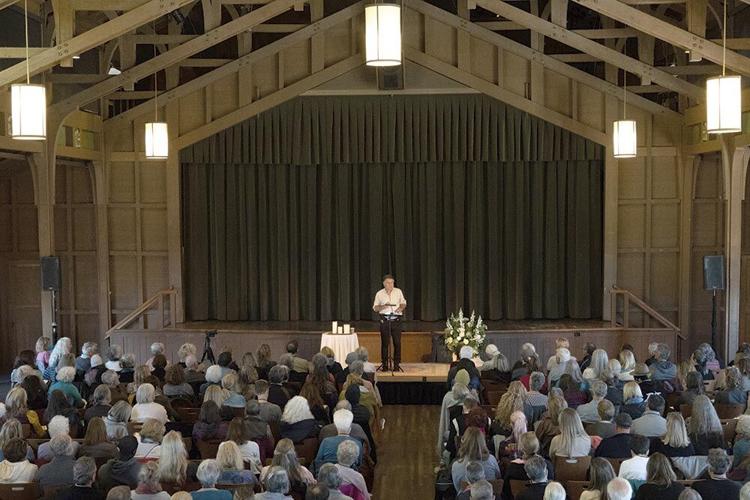
It was 1988, between the publication of his first and second volumes of poetry. A conference took place in Asilomar. The organizers invited Whyte as a speaker. “I was so incredibly nervous, afraid that I would fail as a poet on stage,” he says. “Six-hundred people. When I got on the stage, my memory was flawless. It was a traumatic experience, I was ill for days. But I also knew that this is what I was supposed to do in life.”
Now, he gives dozens of public talks a year, from weekend in-person meetings to regular online events. His 2017 TED Talk, titled “A lyrical bridge between past, present and future,” has been viewed over a million times.
Whyte is a more experienced public speaker now. Is he a better poet too? Whyte says it’s easier and easier to quickly write something decent. There’s also his inner cycle. When he starts on a new book, he at first takes 10-minute, 20-minute-long stabs that day after day get longer and longer. “Now I’m in the middle of a book [a second volume of Consolations, not yet published], and I’m starting to write longer and longer. In the end, I will write all day.”
It took time to accept that there’s a cyclical year in between books, when Whyte is not writing. It used to frighten him, but not anymore, he says, this feeling of exile from poetry.
“The difference between writer and non-writer is that the writer just writes,” he says. “When you are not writing, you know you are not a writer. You stop asking yourself if you are a writer the moment you start to write again.”
And then there are those poems and those volumes that couldn’t have been written any other time than they were written, such as The House of Belonging (1996), forever associated with a certain threshold in Whyte’s life. Sometimes they contain closeness to the ocean or the mountains, or the cliffs, maybe a particular place in North Wales. Geology of their place of origin matters, too.
Whyte emphasizes that not all of his work is equally important to him. He makes a big distinction between prose (storytelling as a tool, he says) and his poetry and essays. Essays are important, he admits, because to him they are close to poetry.
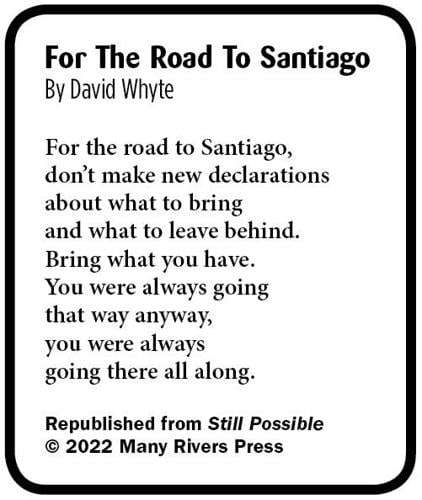
(You can find three of Whyte’s poems republished in this issue of the Weekly, including “Everything is Waiting For You,” one of the most iconic among his fans. It brings an almost meditative sense of awareness to the mundane – the soap dish, the window latch.)
Another function of writing and reading poetry is keeping innocence and youthfulness.
“We tend to think about innocence as a commodity that we will exchange for experience,” Whyte says. “But innocence is important for the world to find you.”
According to Whyte, there’s youthfulness that is available to a person in their 20s or 30s. But there’s also youthfulness of the 70s or 80s. Whyte’s memory is better now, he says, than it was in his 20s.
“You have to be careful that things fall from your repertoire,” he says, since he doesn’t read but recites his poems from memory. “When I recite, I find a different kind of emphasis each time. It’s like whispering, but I’m being whispered to at the same time. It’s the voice of something other than yourself speaking back to you.”

Whyte had his breakthrough as a public speaker at the Asilomar Conference Grounds in Pacific Grove. Since then, he has spoken and recited poetry many times, including on return trips to Asilomar, and many larger stages, including a TED Talk.
WHYTE’S PRESENCE BEYOND SMALL POETRY READINGS AND IN PRINTED BOOKS means he finds readers from all over. Tyler Scheid of Carmel saw Whyte’s name popping up online, and developed an interest in his writing about five years ago.
“He just struck the chord, woke me up to a larger reality we live in,” Scheid says.
He attended an online event with Whyte, and is thinking about in-person participation at a workshop in Ireland, due to Scheid’s Irish roots.
Upcoming events include one for leaders and coaches focused on the “false choices we often make between our personal gifts and the sacrifices we make for others”; one focused on shame (“nothing to be shameful about”); and his event at Asilomar, titled “A Deeper Form of Rest.”
What to expect? A celebration, lots of laughter, tears and poetry, Whyte says. “We all know how difficult it is to really rest,” he adds.
In the event description, he wrote: “I will look at ways of working from a deeper, a priori, rested core that already exists inside us, but which can only be approached through various forms of undoing rather than doing.”
Some might think about poetry magnifying feelings as a form of therapy, or a session focused on practical wisdom.
Charlotte Whyte – Whyte’s daughter, who has been coming with him to Asilomar since she was a child – will sing Irish music along with brothers Owen and Mícheál Ó Súilleabháin, who perform everything from Latin Gregorian chant to Irish language pre-Christian spiritual music and traditional song.

Whyte describes the weekend event, which is expected to draw 200-300 people, as an opportunity to “practice the art of simplification and the art of resting at a deeper level.”
The goal is to do some poetry healing. But it is also celebratory, an opportunity to soak up beauty of a place, of words, of our own minds.
“We will create our own Easter,” Whyte adds, noting the event wraps up on Easter Sunday. (Even though Whyte is more soaked in philosophy than in religion, he would know because his first culture, the culture of his mother, was Irish Catholic.)
“Poetry is not about something, poetry is something,” Whyte says. “You create this physical experience in the room – gravitation, eye contact with the audience. I’m following the silence in the room. Where the silence is deepest, I’m going.”
A DEEPER FORM OF REST: A WEEKEND OF RENEWAL WITH DAVID WHYTE takes place Friday-Sunday, March 29-31. Asilomar Conference Center, 800 Asilomar Ave., Pacific Grove. $695; $925/including meals; onsite lodging booked separately. (888) 635-5310, davidwhyte.com
(0) comments
Welcome to the discussion.
Log In
Keep it Clean. Please avoid obscene, vulgar, lewd, racist or sexually-oriented language.
PLEASE TURN OFF YOUR CAPS LOCK.
Don't Threaten. Threats of harming another person will not be tolerated.
Be Truthful. Don't knowingly lie about anyone or anything.
Be Nice. No racism, sexism or any sort of -ism that is degrading to another person.
Be Proactive. Use the 'Report' link on each comment to let us know of abusive posts.
Share with Us. We'd love to hear eyewitness accounts, the history behind an article.