


As a coyote trots across a meadow in the western foothills of the Gabilan Range, it stops and turns toward the road to see a single car approaching Pinnacles National Park.
As the car passes, the coyote keeps its eyes on the road, waiting for another car it can hear – but not yet see – before trotting on its way.
It’s a crisp and clear afternoon in December, and further east down the road, the lot at the park’s western trailhead has partially emptied out on account of hikers who got earlier starts.
The plan for the day’s hike is a classic: a four-mile partial loop that climbs up the Juniper Canyon Trail, and just over a mile in, hits a junction at the Tunnel Trail, the exit of the loop.
From there, continue up Juniper Canyon another half-mile to the High Peaks Trail, the crown jewel of the trails at Pinnacles.
Climbing up Juniper Canyon Trail from a creek and into switchbacks, the Pinnacles’ spires glow in the sunshine, with hues colored by the approximately 350 species of lichens endemic to the park.
At the end of that trail, atop the ridge, a sign pointing north toward High Peaks notes: “STEEP-NARROW.”
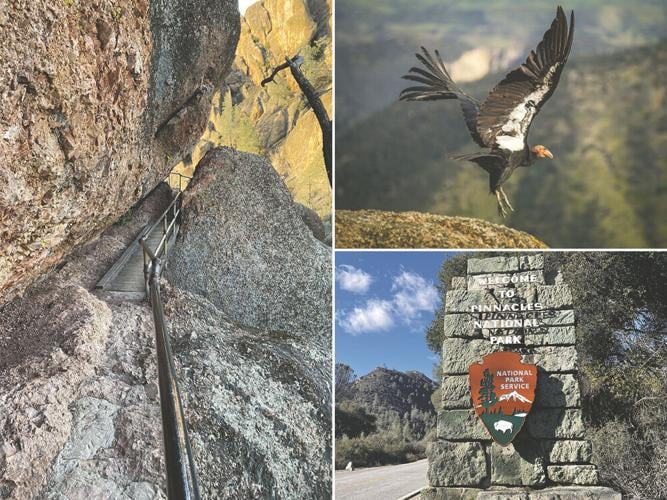
Built in the 1920s and ’30s, a trail like High Peaks could never be built today: It traverses the park’s spires, and in several places, stairs have been hammered out of rock, some of which have room for only a left or right foot. Aside these stairs are metal railings, sunk into stone, as the climbs are steep, and falls dangerous.
On a level part of the ridge, looking up, a California condor, a critically endangered species which calls the Pinnacles home, is perched atop a spire. It’s a stunning sight – it’s one of the largest birds on Earth – and it inspires communication, and recognition.
“Hello, beautiful.”
Climbing on a narrow trail that winds east around that spire, with only a metal railing to protect a hiker from falling down a cliff, the condor soars by on the level, about 50 feet to the east.
With a wingspan of nearly 10 feet, it’s a jaw-dropping spectacle as the bird effortlessly circles over the canyon a few times, and then soars north to perch on another spire, out of sight.
There are a few parties of other hikers on the trail traveling south, and they speak in various languages, including English. They don’t get to experience how quiet this place can be – at least not on this day.
At the Tunnel Trail junction, a hiker hooks left and back down south, toward Juniper Canyon. The sun is soon to set over the spires to the west, which lie in shade.
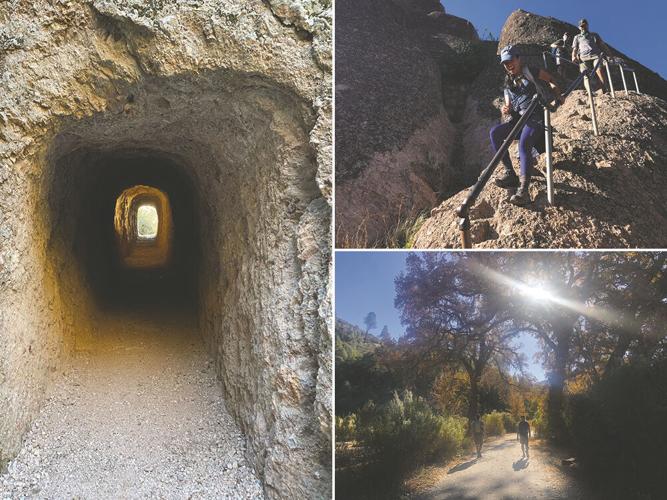
After about a half-mile, approaching the trail’s namesake feature – a 120-foot tunnel, built in 1932, that bores through a spire – the late afternoon sun is hitting it just right, and the latter end of the tunnel is golden, aglow.
It looks like a portal, or perhaps a giant keyhole, but which door it unlocks is up to whoever is passing through.

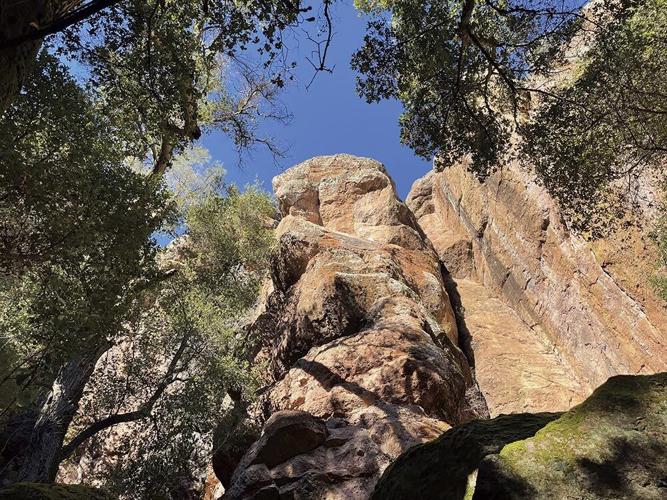
Top: Looking up at the cliffs along the trail approaching Bear Gulch Cave, from the east. Below: The Tunnel Trail’s namesake feature – a 120-foot tunnel built in 1932 – lights up in the late afternoon sun.
WHEN FORMER PRESIDENT BARACK OBAMA signed the legislation to make Pinnacles a national park on Jan. 10, 2013, there was no fanfare, no press conference, just a stroke of a pen.
And with it, California eclipsed Alaska as the state with the most national parks – nine.
The inspiration, and much of the work to get that legislation to Obama’s desk, was led by former longtime Central Coast congressman Sam Farr, D-Carmel.
The idea to form a national park in the region was planted in Farr’s mind by former California Senator Alan Cranston, who once told Farr, “When you create a national park, it’s forever.”
At a rotary club meeting in San Juan Bautista in the late ’90s, a suggestion was made to Farr to advocate for making Pinnacles, then a national monument, into a national park. “At the time, I didn’t think it was worthy of that,” Farr says.
That changed when filmmaker and documentarian Ken Burns made a documentary series for PBS titled The National Parks: America’s Best Idea, which was released in 2009. One of the biggest criticisms of the park system in that documentary, in Farr’s estimation, was that the parks were primarily only used by white people.
So after an evening reception for Burns in Washington, D.C. celebrating the launch of the series, Farr introduced himself, noting that he was a longtime friend of Ansel Adams, who had lived in Carmel Highlands, and whose photographs were instrumental in convincing Congress to create Kings Canyon National Park in 1940.
Farr told Burns he had come around to think that Pinnacles should indeed be a national park. Burns, who Farr says visited Pinnacles in his youth, wholeheartedly endorsed the idea, and so Farr got to work – Ken Burns is a weighty endorsement.
Though the bill didn’t get through Congress until 2012, Burns wrote a letter in 2009 with screenwriter Dayton Duncan in support of it.
“In studying the history of the evolution of the national park idea, we learned that many of today’s national parks were at one time national monuments,” they wrote, noting that the Grand Canyon and Death Valley are among them. “While changing an area’s designation from ‘monument’ to ‘park’ does not necessarily change its crucial attributes, it nonetheless alters its place in the American imagination.”
The letter also makes the case not just for the geological record the park protects, but the cultural one. “It would preserve a place that, over the centuries, Native Americans, early Spanish settlers, homesteaders from the East, and Basque sheepherders have considered home, offering an important series of perspectives on the larger sweep of American history.”

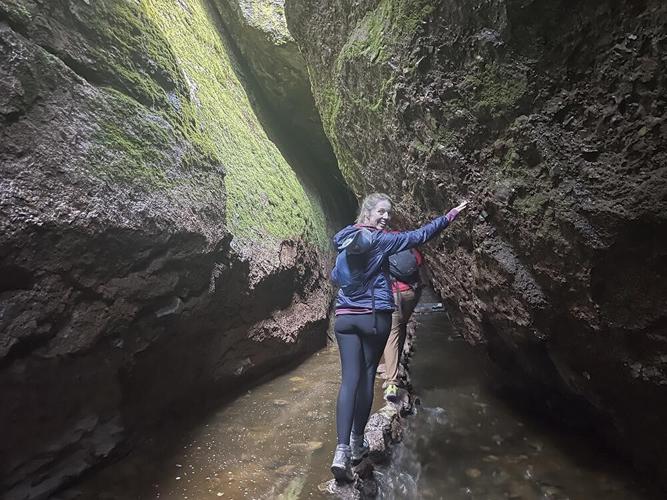
Hikers enter the Bear Gulch Cave, which is pitch dark in many sections and requires a flashlight or headlamp, especially if one wants to avoid stepping into the creek that runs through it.
PINNACLES, DUE TO STRIDENT ADVOCACY BY LOCALS, became a national monument under then-president Teddy Roosevelt on Jan. 16, 1908, making it the 13th national monument in the nation. Two monuments that preceded Pinnacles for national monument designation in that same week were Muir Woods and the Grand Canyon.
National monuments became possible under the Antiquities Act of 1906, which allows a president, with a stroke of a pen and no act of Congress, to preserve historic landmarks, structures, “and other objects of historic or scientific significance.” It’s language with latitude.
But the history of the landscape goes back some 23 million years, when the signature spires at Pinnacles were formed by volcanic activity in what are now the Tehachapi Mountains southeast of Bakersfield – Pinnacles is just west of the San Andreas Fault, and every year the formation shifts north about 1.5 inches, which adds up in geologic time.
But for as much is known about the geology of the park, the history of its first human inhabitants has mostly been lost, as the histories were passed down orally, and the Spanish prohibited Indigenous people from speaking in their native languages.
That said, the archaeological record shows the Chalon people, who occupied the Salinas Valley for millennia, never settled in the western Gabilan Range – though they traversed it – as the climate was dry, and the soil shallow.
But the Chalon and Amah Mutsun tribes both had settlements around the eastern part of the park, where the soil is deeper and holds more water.
The founder of Pinnacles as a park was a rancher in Bear Valley – on the eastern side of the park, along the San Benito River – named Schuyler Hain, who would later be called “Father of the Pinnacles.”
Starting in the 1890s, he led an effort to make Pinnacles a national park on account of its spectacular rock formations. Part of how that happened was that in 1893, a Stanford professor of Hain’s cousin, who was attending the university, spent the Easter holiday in Pinnacles and reportedly said, “I have traveled in South America and Alaska, visited Yosemite and climbed the Matterhorn. But for the variety of the scenery and beauty of coloring I have never seen the equal to this on the same area.”
That’s when Hain realized it could be more than a local attraction – it could be a national one.

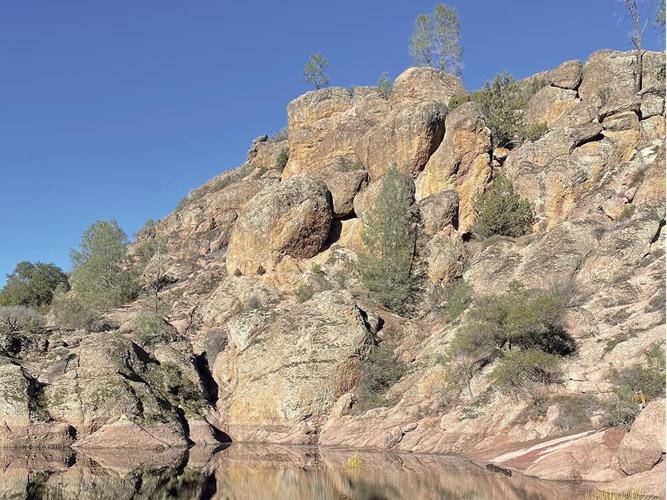
The Bear Gulch Reservoir, just above the cave, is a popular spot for lunch or snack.
In terms of biodiversity and geology, Pinnacles is a singular place.
It’s an ecosystem where endangered California condors nest – two condor chicks fledged at Pinnacles in 2022 – and which is home to more than 500 species of native bees, the highest known density of bee species of any place on Earth.
It’s also home to nine prairie falcon nests and four peregrine falcon nests, and several other species in the animal kingdom, including butterflies, California red-legged frogs, tarantulas, snakes and more than 500 species of moths.
But aside from the condors, for which the park became a release site for in 2003, and the world-class bee diversity, Pinnacles is home to several talus caves – boulders piled up on mountain slopes – that along with cliffs and trees, shelter at least 14 species of bats. Among them are Townsend’s big-eared bats, and in Bear Gulch Cave, they’ve formed the largest colony of their kind between San Francisco and Mexico.
Perhaps, though, the most unsung natural feature at Pinnacles are the 350 or so types of lichens, which paint the rock formations, the oaks, and anywhere else they can latch on to.
Without lichens, Pinnacles would be like a silent movie – lichens make it sing.

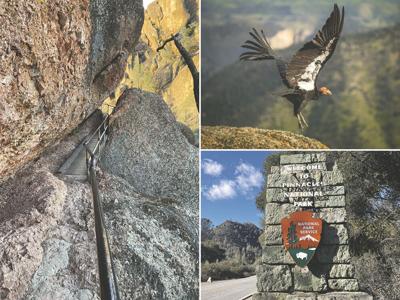
(clockwise from right): The northern part of the High Peaks Trail features a steep descent – or climb – with steps cut out for only one of two feet; visitors walking along a road in the campground on the park’s eastern side; the Tunnel Trail’s namesake feature – a 120-foot tunnel built in 1932 – lights up in the late afternoon sun.
As spectacular as the flora, fauna and geology at Pinnacles are, so too are the trails.
Starting in 1921, a group of five World War I veterans settled near the monument – which was essentially unmanaged at that point, despite its protected status – and they became its de facto stewards.
They were called the “Pinnacles Boys,” and chief among them was Herman Hermansen, who became the park’s first custodian – a title that later transitioned to superintendent. Together they built a road the leads up to Bear Gulch Cave and a trail that runs through it, and another one that traverses the High Peaks. They remain the two most distinctive trails in the park: the former climbs through and up a cave in darkness and water, including a waterfall, flows through it.
Hermansen only lasted a few years on the job – he was fired for his lack of connections to rich and powerful people who could promote the park – but reinforcements quickly followed: Men who enrolled in the New Deal’s Civilian Conservation Corps were stationed in the park for years, and they helped build out much of the trail network that exists today.
A federal inspector, observing the camp in its first year, noted that it was “an exceedingly well kept camp, not from a sanitary point but morals etc.”
That same inspector also called the morale and spirit of the enrollees, and the meals at the camp, “excellent.”

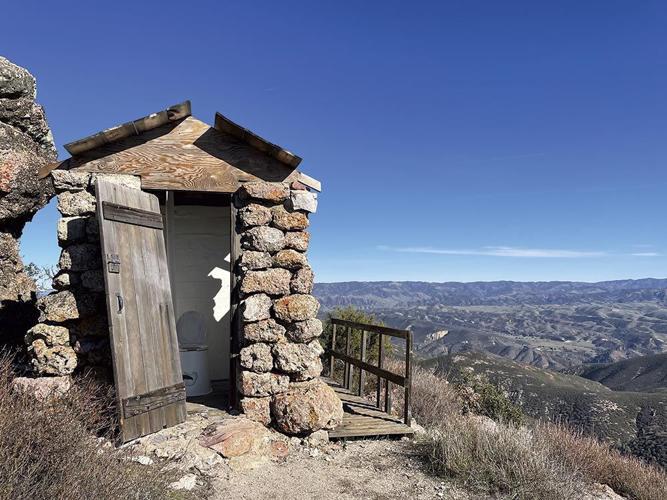
Left: The outhouse on North Chalone Peak offers the most scenic throne of anywhere in the area code. Right: The view east from North Chalone Peak offers sweeping views of the rolling, arid hills to the east.
AFTER PINNACLES BECAME A NATIONAL PARK, the city of Soledad rebranded its tagline from “It’s happening in Soledad” to “Gateway to the Pinnacles.”
The hope was to harness the name change to boost the local economy, but given that the limited parking spaces in the park – particularly on the western side – cannot meet demand on busier days, the park’s ability to attract more visitors is likewise limited.
So 10 years in, does it even matter that Pinnacles became a national park?
Arguably, yes. But also, maybe not.
There are two entrances to the park – the most popular being the east side, south of Paicines in San Benito County, in part because that side has more parking and a campground. It’s also much closer to Bear Gulch Cave, one of the most popular places in the park, for adults and kids alike. Aside from being pitch black (bring a flashlight), it feels like it was created by Walt Disney (a cave, with a waterfall, in Central California?). Lights are also a necessity in the pitch-dark Balconies Cave on the east side of the park.
Parking spots on the western side, accessible from Soledad, are fewer. They total about 100, with 75 near the trailheads, despite being closer to where more people live, at least locals (for those traveling from the Bay Area, it’s about the same distance to each park entrance; there is no through-road, but hikers can go from one county to the next).
The park is already at carrying capacity on busy weekends, and the parking lots on the west side are prone to fill up. When they do, prospective visitors are forced to turn back. The same is true on the east side, where there are about 240 parking spaces.
Rich Moorer, a Pinnacles spokesperson, says overcrowding has become less of an issue since they installed a roadside sign on the western approach, which can be programmed from afar, to inform drivers heading to the park of the wait time. He says it’s drastically reduced the number of visitors who have to turn back.
Oddly, and perhaps inaccurately, the National Park Service’s data on visitation to the park shows its record year was 2011, with 393,219. That’s before Pinnacles became a national park.
The only other year that’s sniffed that number is in 2021 – 348,857. But what could explain why, in 2019, visitors only numbered 177,224?
Moorer says he thinks there was a problem with the data in 2011, but he can’t confirm that, or speak to what that means if it’s true. He also adds that bad weather on prime weekends – for Pinnacles, that’s spring – can drive down visitation numbers in a big way.
There have been substantive improvements to park infrastructure recently, most notably to the western side’s visitor center, which had been in the works for 10 years and opened in 2012, just before Pinnacles was elevated to park status.
There have also been a few new trails on the western side, one of which travels from the visitor’s center to the trailhead, and another that’s ADA-accessible that climbs from the western visitor center to an overlook that offers a sweeping view of the park’s rock formations. The admission price has also increased, from $5 per vehicle to $30, in part to support shuttles on the eastern side to take visitors to the trailheads – but those shuttles haven’t resumed since the pandemic hit.
And while admission revenues help boost the park’s budget incrementally – the park’s budget went from $3.4 million in 2012 to $3.6 million in 2017 to $3.8 million in 2022 – that’s about it as far as changes. Pinnacles was already being managed by the National Park Service when it was a national monument, and many of the improvements made over the last decade were already years in the planning, before the park designation.
Brent Slama, the city manager of Soledad – which is located directly west of the park – says he believes the uptick in city tax revenue since Pinnacles was granted national park status can at least be partially attributed to the name change.
But Slama also hedges, saying that he can’t be sure what is driving that increase. That said, he adds there are some folks – Americans and foreigners alike – who put visiting every national park on their bucket list.
Pinnacles is now on their map.
When Farr’s bill came to Obama’s desk a decade ago, Farr says that Obama’s staffers pressed him on how many jobs it would create. Perhaps that’s why, when describing it, Farr loves to say, “It’s not just pretty scenery. It’s jobs.”
How true that is remains to be seen, but unless the park can add more parking spaces, it’s hard to see how it can increase its visitor numbers and therefore, its impact on the local economy.
And as for what Alan Cranston told Farr with respect to national parks, they’re not forever. They will only last as long as the United States.
The spires at Pinnacles are on a different clock.
They move in geologic time.
(2) comments
Thank you for the informative article about our local National Park, Pinnacles, but I’m concerned that readers may be left with an impression that it’s too hard to visit because of parking lot capacities. In 2000-2002, I was one of five Alternative Transportation Planners hired in the National Park Service (NPS), a program of President Clinton’s administration. NPS has gained a lot of experience in shuttles and reservation systems since then, e.g. Yosemite, Muir Woods. I’ve heard that expanded transportation and access improvements are high on the list of Pinnacles Superintendent Blanca Alvarez Stransky’s priorities, and the Weekly would be a great place to publicize those new opportunities to access and enjoy the Park.
Wonderful article. I first visited circa 1957, and have been there many times since. It deserved National Park status.
Welcome to the discussion.
Log In
Keep it Clean. Please avoid obscene, vulgar, lewd, racist or sexually-oriented language.
PLEASE TURN OFF YOUR CAPS LOCK.
Don't Threaten. Threats of harming another person will not be tolerated.
Be Truthful. Don't knowingly lie about anyone or anything.
Be Nice. No racism, sexism or any sort of -ism that is degrading to another person.
Be Proactive. Use the 'Report' link on each comment to let us know of abusive posts.
Share with Us. We'd love to hear eyewitness accounts, the history behind an article.