


TODD BRAMMER GRABS A TOOLBOX FROM HIS TRUCK PARKED OUTSIDE HIS SALINAS HOME AND TAKES IT INSIDE TO THE KITCHEN. He sets it on the table, beside various mechanisms that have been pulled from a machine, its guts spread out in an orderly fashion that only Brammer can make sense of.
“I’m mechanically inquisitive,” he says. “I like to see how things work and what makes them tick.”
These parts in particular are for a coin drawer for two bright, colorful and loud pieces of equipment that tower over the adjacent kitchen table: pinball machines.
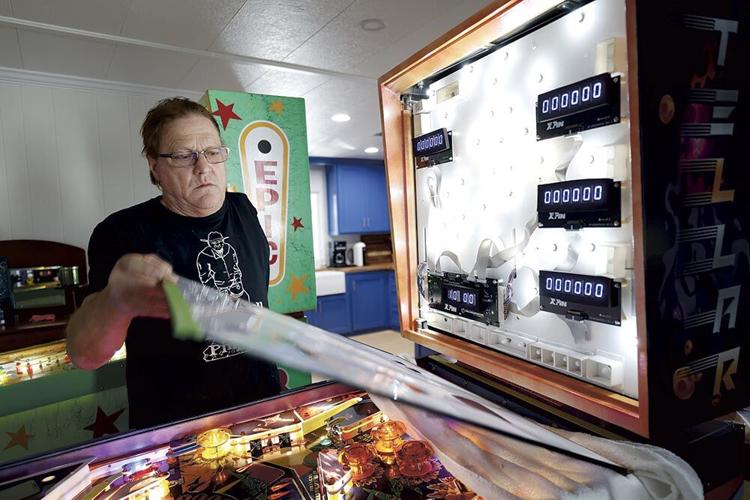
Brammer is currently renovating old pinball machines to gift to his three grandsons: Epic, Ace and Stellar. With the help of a local powder coating company and others, Brammer is customizing the pinball machines in honor of his grandsons; a 1970 Big Flipper, for example, has been transformed to Epic Flipper, complete with its own unique graphics including a flipper emblazoned with his grandson’s name and many red and gold stars.
Brammer is a lifelong pinball player who is drawn to the sights, sounds and adrenaline rush that some people get from playing the games. He and his wife, Kim Brammer, live in a mobile home park in Salinas, where the front entryway of their home is filled wall-to-wall with pinball machines; each playable, all in some stage of renovation due to age.
He says he owns 12 machines currently. About a year ago he had two, but before that he had 14, probably the most he’s ever had at one time. Machines in his inventory include “Indiana Jones: The Pinball Adventure,” “Radical!” and “Defender,” most of which were manufactured in the 1980s and 1990s.
He paid $600 for his first pinball machine, “Road Kings,” manufactured in 1986.
“It was like Lay’s potato chips, you can’t just have one,” Brammer says with a laugh. “I haven’t found one that I haven’t liked.”
He admires the designs and technical aspects of pinball machines. But all of them were designed assuming their users have two arms.
Brammer does not. For someone without a left arm who can only activate the right flipper on the machine, it presents a dilemma.

Todd Brammer works on a pair of custom-designed pinball machines named after his grandsons at his Salinas home.
BRAMMER RECALLS BEING A CHILD AND SNEAKING OFF TO THE BOWLING ALLEY TO PLAY PINBALL. “Back then there were no video games, per se,” he says. “I liked the lights, the sounds and mechanical aspects. I was like a kid in a candy store.”
After graduating from college, Brammer began a career working on airplanes in Texas. Years later, he broke his left arm in a workplace accident.
It was then doctors discovered that he had bone cancer in his arm. Following surgeries and chemotherapy, his arm continued to get worse.
Fifteen years ago, he had enough.
“I told them to snip it off, I’m done,” Brammer says.
Now living in California with his wife, Brammer says he was faced with two options: either sit on the couch, watching TV and feeling sorry for himself, or do something.
He chose the latter, and ended up running a successful landscaping irrigation business which he is now retired from.
But through this time, Brammer says he was frustrated because he couldn’t play pinball.
The light bulb moment happened when he came across a machine that had an extra button on one side to activate a magnet. The solution had been staring him in the face: just add another button on the right to activate the left flipper.
Brammer grabbed a drill and took it to his beloved “Road Kings” machine, creating a hole so he could wire a button for the right flipper. Despite the confusion at first from his brain (the right flipper is activated by the top button using the index finger, the left on the bottom with the right middle finger), he eventually mastered it. He was now back in the pinball game, literally and figuratively.
It was a perfect solution for his home games. But what about heading out to the arcade to play with friends? Brammer couldn’t exactly bring his drill and start ripping up someone else’s machines.
A decade ago, Monterey resident Cary Carmichael put out a call on social media, looking for local pinball players to form a new league. The group was small, meeting frequently at Angelina’s Pizza in Salinas for a few rounds.
Carmichael says he first met Brammer when he and Kim were hovering over a machine, with Kim playing the left flipper while Brammer took the right.
League members chatted with the Brammers about a mechanical solution for Todd, something that he could take with him to any machine he wished to play. Carmichael posted about it on the online Pinside forums, seeking suggestions.
The discussion eventually caught the attention of Ben Heckendorn, an engineer who, among other things, modifies video game controllers to adapt to those with disabilities.
Heckendorn came up with 3D printed clamps that connect to the sides of the machine. By pressing a button on one side, it activates a servo – a motor-driven mechanism – that taps the flipper button on the other side.
It worked, but had its limitations. Mainly, it had a bit of a lag, making it difficult to catch a ball with a flipper in a split-second. It also attached to the machine with suction cups, which were hard to put on and frequently fell off.
More possibilities were discussed and prototypes were created. Now, Brammer plays with an updated version of Heckendorn’s creation designed by Fred Hamilton, which does away with the suction cups and instead clamps on by the weight of the batteries.
This kind of troubleshooting is not atypical for the pinball community. People are here to play a game and have fun, many of them intensely – but even among competitors, there is a desire to help each other and solve problems.
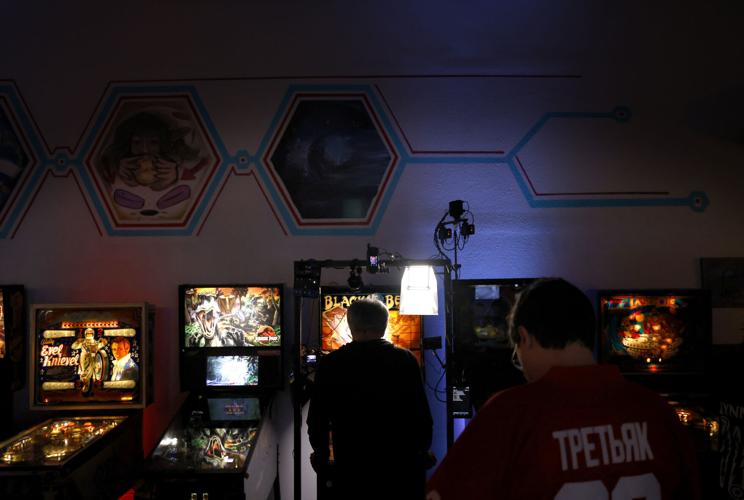
That is true at Lynn’s Arcade in Seaside, where Brammer is a regular. The place quickly became the hub for all things pinball in Monterey County.

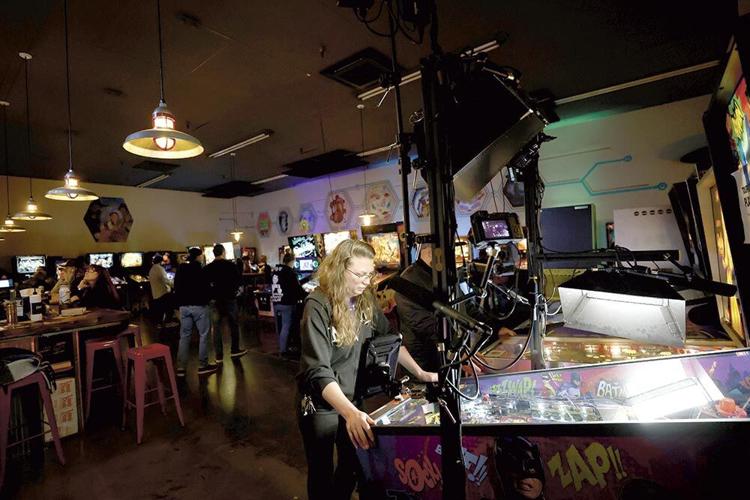
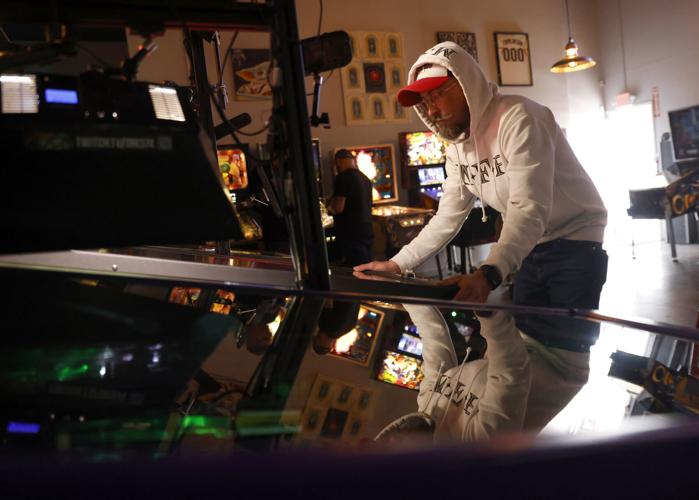
Nikki Carmichael, one of the owners of Lynn’s Arcade, tries for the high score during the women’s league championship night. She is playing underneath a rig outfitted with lights and cameras that is streaming the event online.
IN THE EARLY 2010S, CARY AND NIKKI CARMICHAEL MOVED TO MONTEREY, AND IMMEDIATELY SET UP A 2002 PLAYBOY PINBALL MACHINE IN THEIR KITCHEN. By lucky chance, they learned that their fellow husband-and-wife neighbors Matthew Talley and Meredith Sherwin were also pinball fanatics. Talley says he and Cary would travel to the Santa Cruz Beach Boardwalk on their lunch breaks from work, just to play the Tron pinball machine.
The four decided to start their own local pinball league, after Cary found himself traveling north to the Bay Area every Thursday night to compete with the Bay Area Pinball Association, not returning home until 2am.
The Monterey Flipper Pinball league started off small at Angelina’s Pizza with six games, but the buzz was growing, going from three players in the summer of 2014 to 15 players by the end of the year.
“It steadily started to grow from there,” Cary says. “We got interesting folks from all different walks of life.”
They eventually outgrew the pizzeria and moved to a warehouse in Salinas owned by Cary’s father, Lynn, where more than 40 people consistently showed up, many unknown to the original league founders. Attendees were encouraged to bring their own beer when inspiration struck.
“There were a lot of empties,” Talley says. “If we sold that… ”
After crunching the numbers, forming a business plan and securing a location in the University Plaza Shopping Center in Seaside, the group headed to the Seaside Planning Commission in April 2019, needing approval not only to operate a pinball arcade, but also to request a variance to operate to midnight on school nights. Seaside’s municipal code specifically prohibited arcades from being open past 10pm on nights preceding school days.
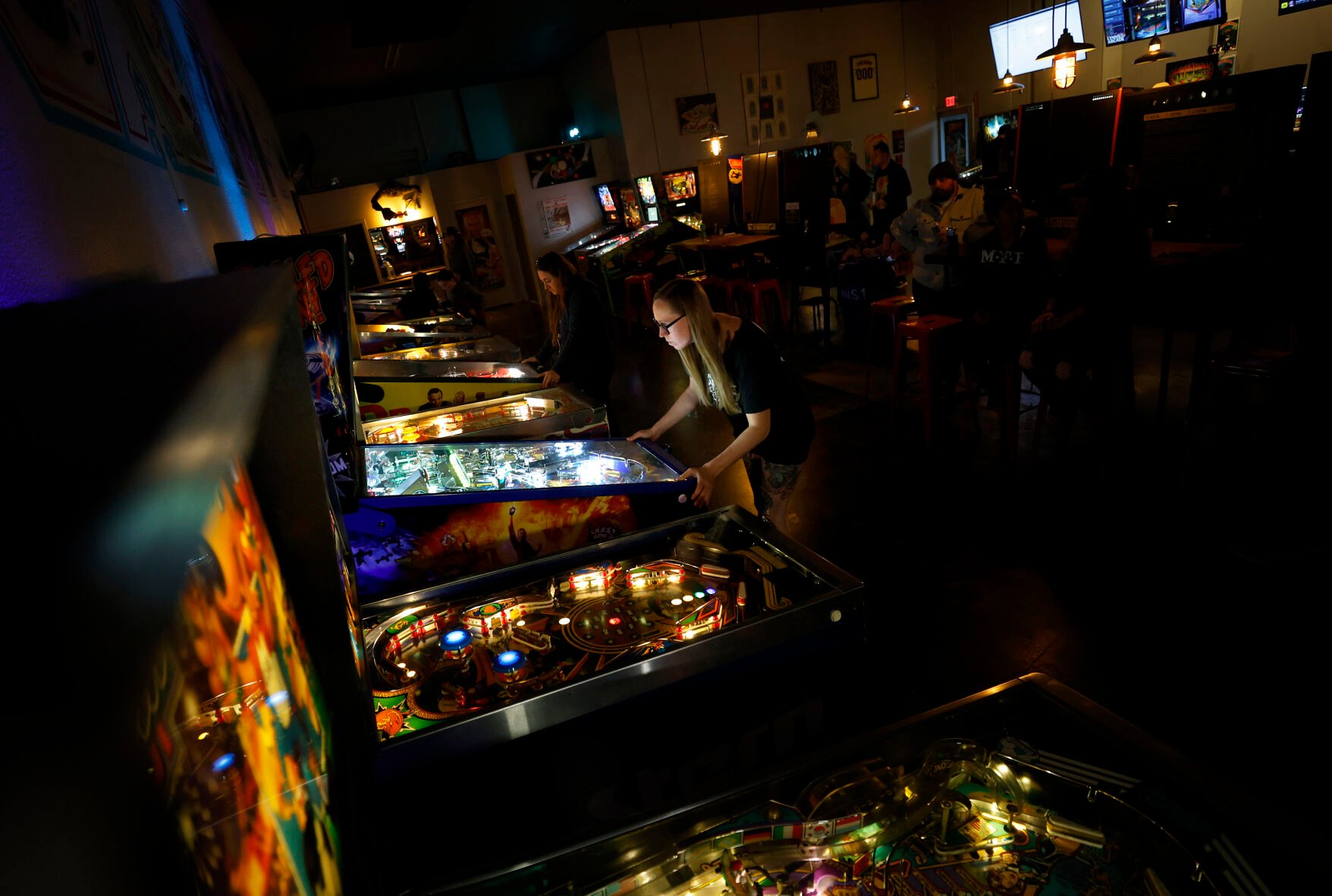
Sam Stanko is a member of the women’s league at Lynn's Arcade.
Nikki Carmichael notes they were nervous going in front of the commission to make their case. Turns out it was for naught, as the plan passed unanimously with little discussion and plenty of excitement from some of the commissioners.
It was representative of shifting attitudes toward pinball. Once considered as a sleazy gambling device that contributed to the delinquency of children, forbidden in city code, it’s now viewed as a legitimate form of competition that builds community and camaraderie. But it took decades for the general public to realize it.

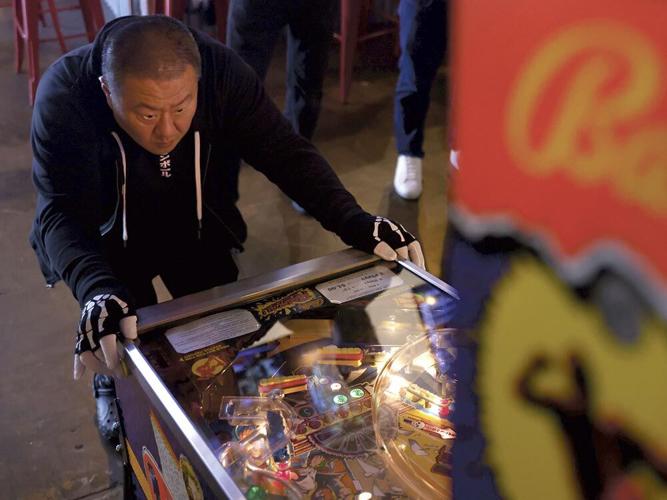
Kwang Chong plays an intense game as he tries to make it to the championship round at Lynn’s Arcade.
HISTORIANS GENERALLY AGREE THAT PINBALL’S ROOTS TRACE BACK TO TABLETOP GAMES IN LATE-19TH-CENTURY EUROPE CALLED “BAGATELLE.” Players would use a stick to push a ball up an incline, where it would roll down and bounce off pins to rack up scores.
Electronic, coin-operated machines burst onto the scene in the 1930s, eventually adding sounds, flippers and bumpers.
But in 1942, the game, now referred to as pinball, was banned in New York City, with other major cities following, due to the rise of gambling centered around the machines, according to history compiled by Princeton University. It wasn’t until 1976 when magazine writer Roger Sharpe proved in a city council meeting that pinball was a game of skill, not chance, which led to the overturning of the ban in New York City.
At the same time, pinball was competing with the rise of arcade machines and home video game consoles, which were easier to operate and took up less space. Pinball manufacturers came and went.
The arcade craze hit the Monterey Peninsula, and cities scrambled to come up with plans to regulate it.
In September 1982, the Seaside City Council passed an ordinance which prohibited arcades from being within 1,000 feet of schools, and prevented them from being open during the daytime on school days. It also set a 10pm closing time on nights preceding school days, and required potential arcades to be considered during a public hearing.
“Based on an increasing number of applications in Seaside to establish electronic game centers… the need was identified to establish regulations for the operation of electronic games and game centers,” the ordinance reads. “The Seaside City Council finds that it is both appropriate and necessary to establish regulations for the operation of mechanical and electronic games and game centers to preserve the public health, safety and welfare of the City of Seaside.”
That ordinance remained in effect until 2020, when the Seaside City Council determined that such an ordinance was now out of date, given that children can have arcades in their pockets at any time of the day thanks to smartphones, and the fact that police reported that it has received no complaints regarding Lynn’s Arcade, which opened the previous year.
A new ordinance instead allows arcades to be located in commercial zones and be approved administratively, without special hours of operation.
Pinball machines, however, are banned from service stations in Seaside.
A review of other municipal codes among cities in Monterey County shows a mixed response to pinball and arcades in general.
The City of Monterey prohibits minors from playing at an arcade after 9pm on nights before school days, or after 10pm on any other night. Arcades are also banned within 300 feet of a school.
The “purpose” of the ordinance, as laid out in the code, reads like a scolding parent: “The intent of these regulations is to control the location and hours of operation of game centers so as not to allow school children to play the games during school hours.”
In the City of Salinas, anyone who operates a business with coin-operated machines must pay an annual license tax of $100. In addition, businesses must pay $50 per pinball machine per year, except for arcades.
There is no mention of arcades or pinball in the municipal code for the City of Carmel. The City of Pacific Grove, meanwhile, had once banned arcades for a brief spell, but repealed that ordinance in 1982, the same year that saw the city codify a ban on dog excrement in public places. Arcades are subject to approval from the planning commission.
In Greenfield, businesses with pinball machines must pay a tax of $3 per quarter-year for each game.
Across the state, Oakland and San Francisco had little-enforced pinball bans on the books up until 2014.
“Pinball went through a dark period of time,” Cary Carmichael says. “Now you’re finding them in more places. We are definitely part of the comeback.”

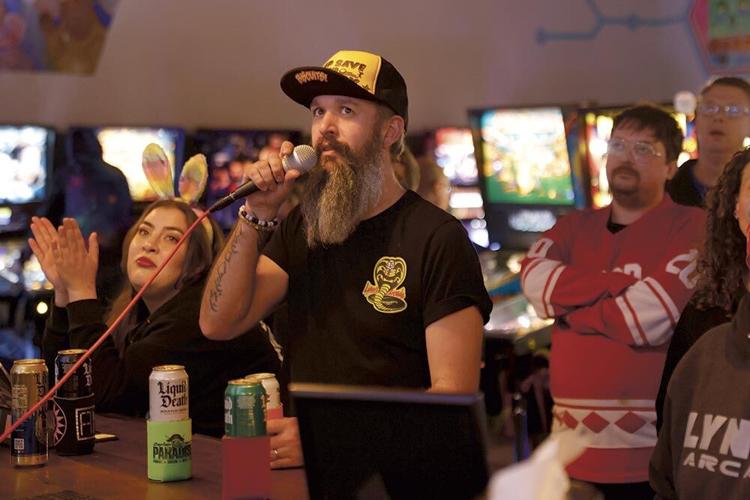
Matthew Talley updates the crowd of the leaders during a Lynn’s Arcade pinball tournament.
JUST AS THE COMEBACK WAS GAINING STEAM, IT GOT SQUASHED, ADDING ANOTHER CHAPTER TO PINBALL’S ROCKY HISTORY. A little more than six months after Lynn’s Arcade opened, it – along with countless other businesses – was forced to shut down in March 2020 after being deemed a “non-essential” business in the early days of the Covid-19 pandemic.
Nikki Carmichael says the arcade was “on a really good trajectory” before it abruptly closed. And so it had to pivot. They rented out pinball games on a monthly basis for a fee, where Talley and Cary Carmichael would show up to a customer’s house wearing masks and gloves and install games in a living room. At its peak, 22 games were rented out at one point.
“That’s what got us through Covid: the community,” Talley says.
When restrictions were lifted in 2021, Lynn’s Arcade was packed with roughly 80 people clamoring to socialize in-person once again.
“The day we reopened was the busiest we’ve ever been,” he says.
The trajectory is back on track.
The arcade currently has 38 machines available to play, with more than 60 in storage in various locations, in addition to a wide selection of beer. The games span from vintage machines spared from the junkyard (“Abra Ca Dabra” from 1975) to the ’90s-era (“NBA Fastbreak”), to prototypes (“Dirty Harry”) and modern-day machines from small manufacturers (“Rick and Morty”).
The machines are not cheap, ranging from $7,000 to $13,000 for the premium games, in addition to maintenance. Parts are generally easy to come by thanks to suppliers such as South Carolina-based Marco Specialties, which even created its own custom kit of flippers and materials in the name of Lynn’s, encouraging players to “Lynns-ify your games.”
Each day at Lynn’s offers something different, such as Strikes Night on Thursdays, which is a “three-strikes-and-you’re-out”-style tournament, and the Monterey Flipper and Flipper Ladies pinball leagues on Mondays and Wednesdays, respectively. Both leagues are endorsed by the International Flipper Pinball Association, and the arcade’s annual main tournament, Seaside Champ, brings participants from far and wide looking to move up in the worldwide rankings.
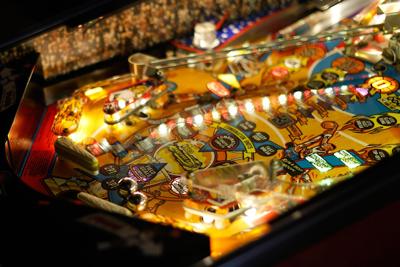
Such league nights are all about the fun, but with a tinge of serious competition. Amid the flashing lights, clunks of flippers and beeps, boops and chimes as the steel pinballs make their way down the ramp, there is the occasional cursing, but plenty of laughter. And don’t stand too close to some of the players, or you may be inadvertently kicked during a celebratory dance.
“We really do cheer all of us on,” Cary Carmichael says. “You are playing against the machine, so you’re never really playing against a person. It’s an interesting activity where you cheer on your competitor.”
The arcade’s owners say they don’t really have a favorite machine. They are drawn to those that offer a challenge through tricky shots and unique mechanical obstacles.

A weekend tournament at Lynn’s Arcade brings players from all over California to compete.
They love the social aspect of pinball, having met players from all around the world through various events, Nikki Carmichael says.
For Talley, standing over a machine, hands grasped to the sides with fingers hovering over the flipper buttons, it is almost a Zen-like experience.
“When you’re playing, you’re not thinking about anything else,” he says. “You’re focusing on keeping that pinball alive. There’s nothing else penetrating your mind at that point.”
Tutorial Tuesdays are important for the future of the game. Every week, pinball experts share their skills in-person and online via Twitch.tv, standing inside a rig outfitted with cameras that point not only at the player, but at different angles of the machine.
There are fewer and fewer people who understand the inner complexities of the older games, Talley says. Many others walk into the arcade having never touched a pinball machine before, but the staff are more than happy to help them along.
“We need to keep it going, keep teaching everybody so we can keep it alive,” he says.
As pinball regulations loosen, Cary Carmichael says many of the players are those who were impacted by the turbulent time for arcades in the 1980s, getting a chance to relive a part of their childhood that was taken from them.
“They bring their families along as well,” he says. “They get to share that experience with their children who have never seen it before.”
At any given night, Brammer can be found among the crowd, playing for fun and competing in leagues. They are not mutually exclusive.
“Pinball has picked up steam here and in the grander scope of things,” he says.
(0) comments
Welcome to the discussion.
Log In
Keep it Clean. Please avoid obscene, vulgar, lewd, racist or sexually-oriented language.
PLEASE TURN OFF YOUR CAPS LOCK.
Don't Threaten. Threats of harming another person will not be tolerated.
Be Truthful. Don't knowingly lie about anyone or anything.
Be Nice. No racism, sexism or any sort of -ism that is degrading to another person.
Be Proactive. Use the 'Report' link on each comment to let us know of abusive posts.
Share with Us. We'd love to hear eyewitness accounts, the history behind an article.