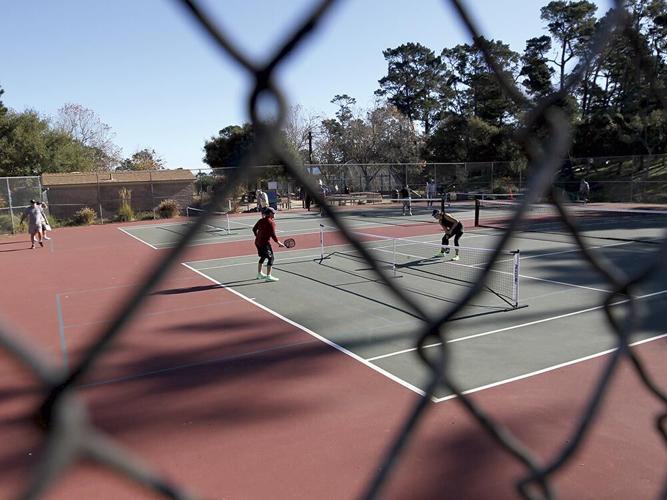


Pickleballers enjoying the fine weather on the recent Wednesday morning at Monterey’s Via Paraiso park.
Pop. Pop. Pop. Plunk! “Nice! Good shot!”
It’s a sun-splashed morning on the first day of winter, and about a dozen people are gathered on the courts at Via Paraiso Park in Monterey to play pickleball.
It’s a sport that’s been around for decades but that, over the last nine years, has quietly exploded in popularity on the Monterey Peninsula – but not quietly in a literal sense.
The weather is gorgeous and everyone seems to be having a great time, and the staccato sound of pop, pop, thwack, plunk reverberates in the air.
Watching the games and waiting for his turn is Monterey Bay Pickleball Club co-founder Jay Zwagerman, who lives in the neighborhood. “On Memorial Day, we had 60 people,” Zwagerman says. “It was crazy. You had to wait 30 minutes to play.”
And for at least some neighbors, therein lies the problem: Google “pickleball noise,” and countless articles pop up in the results from media outlets across the country, highlighting neighborhood disputes about pickleball noise over the past decade.
Last year, one resident in Berkeley reportedly described the noise of pickleball play as sounding like “gunshots”; this past September, in Ocean City, New Jersey, one pickleball player reportedly told the City Council that if they didn’t agree to add pickleball courts to a certain location, they should expect to suffer at the ballot box next spring: “If the mayor and the administration wants to battle pickleball, we want [it known] that we intend to be a huge factor in May of 2022 and there will be consequences.”
And while the pickleball enthusiasts seem to far outnumber the critics in the vast majority of those stories, the critics are every bit as impassioned.
Paul O’Leary lives just across the street from Via Paraiso Park, and the sound of pickleball play has been driving him mad for the last few years, ever since the park became a local pickleball hotspot in 2016.
The crowd on this day, O’Leary says, is small. It’s at least twice the size when the club comes to play.
“There have been days where it’s 50-plus [people],” O’Leary says. “It’s a social party – you can hear people talking about what they had for dinner last night.”
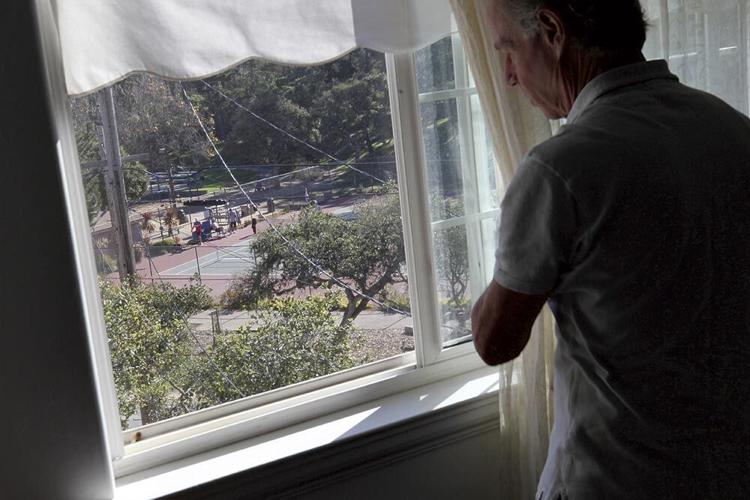
The pop-pop sound – which he aptly describes as “asynchronous” – is clearly audible in one of his bedrooms when the window is open, but what gets him most is when he’s in his backyard, which he considers his “sanctuary” now that he’s retired.
“I have no angst with pickleball per se,” O’Leary says. “It just doesn’t have to ruin my quality of life. I was here first.”
O’Leary is a veteran of the Vietnam War, and says that until the pickleball club started playing across the street, he never had a sense for what PTSD symptoms felt like. But he says he does now – it’s triggered something in him.
“It gets my blood pressure going,” he says.
While the details of every story are different, from a broader perspective, it’s a common one across the nation, and cities and towns, including those on the Monterey Peninsula, have been wrestling with the same question: What should we do about pickleball?
Another common feature of those stories has been: What the hell is pickleball?

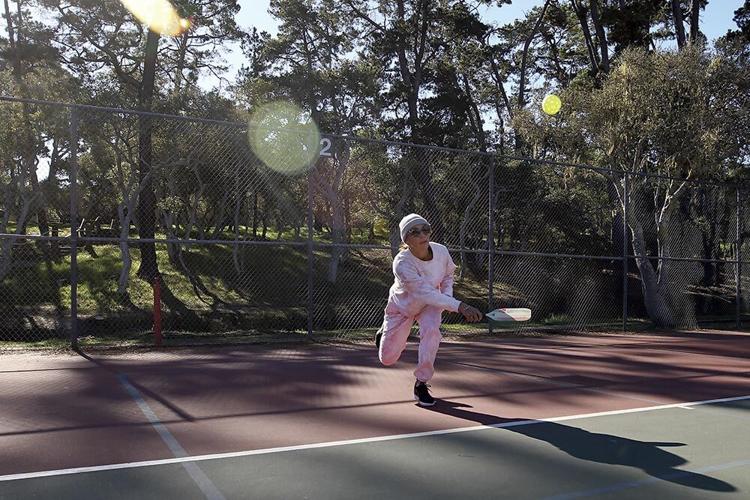
Maria Merzon Eldridge returns the ball during a game at Via Paraiso Park on Wednesday, Dec. 1.
PICKLEBALL’S ORIGIN STORY IS ONE OF IMPROVISATION.
According to a history from the USA Pickleball Association, in 1965, two friends, Bill Bell and Joel Pritchard, who was a congressman from Washington state, were looking for a game to keep their families entertained one afternoon at Pritchard’s home on Bainbridge Island.
There was an old badminton court on the property, but not enough badminton rackets to go around. So Bell and Pritchard grabbed ping-pong paddles and a wiffle ball to volley over the net, which they originally set at a 60-inch height. As the weekend progressed, they lowered it to 38 inches because the ball bounced well on the asphalt surface – it made for better sport.
Two years later, the first-ever dedicated pickleball court was constructed in the backyard of Pritchard’s neighbor, a friend of his.
The minimum recommended size of a pickleball court is one-quarter the size of a tennis court, and it’s played with a slightly lower net and has different striping. (Because there are no dedicated public pickleball courts yet in Monterey County, blue stripes have been added onto a handful of public tennis courts.)
The popularity of pickleball, which is essentially a hybrid of tennis, ping-pong and badminton, grew slowly at first, but as the years went on, the growth became exponential – when you start with only a few people on an island, even exponential growth takes a while to get noticed.
The USAPA was formed in 1984, and by 1990, the association claims, the sport was being played in all 50 states. And in 2008, pickleball got its first major media exposure with a live feature on ABC’s Good Morning America, which included a brief demonstration of the sport.
Locally, the genesis of pickleball’s popularity is rooted in Carmel, where in 2011, Larry Chazen advocated that the city stripe one of the tennis courts at Forest Hill Park for pickleball, which city officials did in 2012.
In 2014, Chazen’s friend Jerry Holden, along with Zwagerman, founded the Monterey Bay Pickleball Club, and Holden, who died earlier this year, became its first president.
In 2016, Zwagerman approached officials at the city of Monterey about striping a tennis court at Via Paraiso Park in the Monte Vista neighborhood, where he lives, for two pickleball courts (four pickleball courts could fit inside one tennis court, though local public pickleball courts are only striped for two on each tennis court). The city, through its Neighborhood Improvement Program, agreed.
The first sign of pickleball controversy at that park surfaced in March 2017, when a handful of tennis players showed up to a Monterey City Council meeting and complained, during public comment, about “pickleball people” crowding out the tennis players at the park and marring the courts with chalk lines.
“I had to Google it,” Monterey City Manager Hans Uslar says, recalling the meeting. “I didn’t even know what [pickleball] was.”
That controversy ultimately died down after the city striped the courts for pickleball in October 2017 – so they could be used for both tennis and pickleball – and priority days and times for each sport were established for the park. And according to Zwagerman, it also died down because a lot of the tennis players eventually picked up pickleball themselves.
But that coincided with a different controversy just starting to simmer in the neighborhood: pickleball noise. Sometime in 2019 or 2020, Uslar recalls, “Somebody told me, ‘If you don’t take care of pickleball, this will be World War III.’”

Monterey resident Paul O’Leary’s house looks right down onto the courts at Via Paraiso Park. “I’ve got no problem with small groups,” O’Leary says, “but I do have a problem with clubs.”
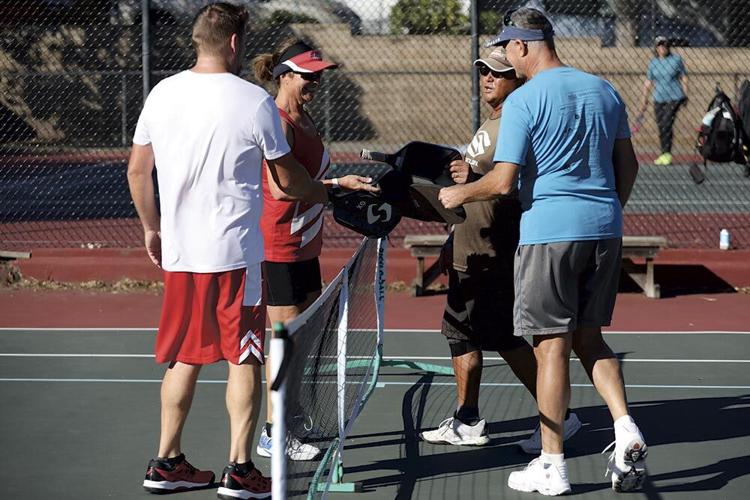
IF YOU SHOW UP ON ANY GIVEN MORNING AT A LOCAL COURT WHERE PICKLEBALL IS ALLOWED – the most popular time is 9am to noon – you’re likely to see a wide range of ages and body types on the court, and everyone’s breaking a sweat and everyone’s having fun. You might see some people playing singles, but most players seem to prefer doubles – it adds a teamwork element.
And it’s not just happening on the public courts: On Saturday, Nov. 27, Chamisal Tennis & Fitness Club hosted a round-robin tournament and social. According to Chamisal’s tennis director Mike Zury, 146 players attended, and 116 of them were playing at any given time on 29 different courts.
“Pickleball has boomed,” Zury says, adding that the pickleball classes he teaches at Chamisal and another private club, Quail Lodge, always fill up. By the end of an hour-long intro class, he says, everybody is playing. “It’s hard to find a sport where people of all ages and athletic abilities can be that active that fast.”
Zury played tennis at Carmel High, and later became the school’s tennis coach for 13 years after playing Division I tennis at University of Montana. But because of a hip injury, Zury, 47, started playing pickleball in 2018, and now says he enjoys it more than tennis. When healthy, he plays six days a week.
“I can play pickleball for hours and feel great and exercised, and I’m not in pain,” Zury says.
And there are other reasons why it’s become so popular: It’s not just accessible fitness, it’s community.
Mark Thomas, who’s been president of the Monterey Bay Pickleball Club for the last five years, lives in Del Rey Oaks and is a firefighter in San Jose. He started playing in 2015 at his fire station as a team-building and physical fitness exercise, and got hooked.
“It’s a social game,” Thomas says. “There’s a lot of interaction between players during and after the play.”
That’s a good thing – it makes the sport way more fun – but there’s no question it creates additional noise to the pop, pop, pop, especially if there are players waiting on the sidelines, likewise being social.
That’s why Thomas, and many of his fellow club members, are among the legion of pickleball players nationwide advocating for more pickleball courts to spread the impact as the number of players grow.
Thomas has worked with Del Rey Oaks Mayor Alison Kerr to that end, and on Dec. 8, after the Weekly’s deadline, the city’s Parks and Recreation Committee was set to consider, among other improvements to the city’s parks, resurfacing the city’s two tennis courts in Work Memorial Park and adding pickleball stripes. (See more about the city of Del Rey Oaks’ park updates on p. 12.)
“I had [Kerr’s] husband out to play, and he was athletic enough to learn right away,” Thomas says. “It’s a testament to how much fun it can be.”

Pickleball can be as social as it is physical, which is part of why many palyers prefer to play doubles.
SO FAR, WORLD WAR III HAS NOT HAPPENED. And what most local cities with pickleball courts have done – Monterey, Pacific Grove and Seaside – is more or less the same: establish three days a week where pickleball is either allowed on existing tennis courts, or in Monterey’s case, where it has priority.
Carmel is an exception, for now at least: There is no restriction on pickleball play and there are no priority times – it’s first-come, first-serve. In September, Carmel’s Forest and Beach Commission voted unanimously to stripe the second tennis court at Forest Hill Park for pickleball.
And there’s been a recent breakthrough in Monterey: Jean Rasch, president of the Monte Vista Neighborhood Association, has been working with the city to resolve the concerns of residents who live near Via Paraiso Park – residents like Paul O’Leary.
“I think the city feels a bit besieged by all the complaints, but what they don’t understand is the neighborhood was never [provided with notice] in 2017 and 2016,” Rasch says. “There is a sense in the community that this happened without community advice or consent.”
Rasch was among those who voted to approve the striping of the Via Paraiso courts in 2017, but “what we didn’t understand was that pickleball is unique. It involves a lot of people.
“We aren’t against pickleballers,” Rasch continues. “We are against the city having in effect a de facto reservation system that’s allowed the pickleball club to overwhelm the community.”
But with Monterey’s fiscal situation so impacted by the pandemic – the city laid off 71 employees in 2020, and less than half of those positions have been refilled – Uslar has made clear he cannot prioritize dedicating staff resources to mediating a recreation dispute in a city park.
So the city agreed to pay for third-party mediation at the Mandell Gisnet Center at the Monterey College of Law between the pickleball club and Rasch’s neighborhood association, MVNA, which would like to remove the pickleball striping on one of Via Paraiso’s two tennis courts.
After a months-long dispute about the level of the city’s involvement in that mediation – MVNA’s board unanimously insisted someone from the city be involved – Uslar informed Rasch in a Nov. 30 email that the city would have a Parks and Rec staff member present to answer questions, and the city would carry the costs of the mediation.
“I am hopeful,” Rasch says.
Some residents near the Morris Dill Courts in Pacific Grove are less hopeful. Fred Jealous and his neighbor Dan Miller, a former city councilmember, have been vocal critics of the sport’s noise impact on the neighborhood, and would like the city to make an agreement to have pickleball play in the city limited to Pacific Grove High School.
Pacific Grove Public Works Director Daniel Gho says that’s not happening – the school is outside of the city’s jurisdiction, and that furthermore, there are strict rules about who’s allowed on school property, and the courts are being used by students.
Gho says there are no plans to change the city’s current policy of allowing pickleball on two tennis courts from 9am to dusk every Tuesday, Thursday and Saturday.
“We went through the policy in 2019, really not that long ago, and that was about a one-year effort,” Gho says, “and it came to a conclusion that satisfies the needs of the neighborhood and the pickleball community.”
Meanwhile, in Seaside, Councilmember Jason Campbell received rage-filled voicemails from one resident, Sung Choi, who lives near the Wheeler Street Tennis Courts. Choi has also sent several emails to Seaside Acting Police Chief Nick Borges in recent months, complaining about the parking issues that have started on his street since the city started allowing pickleball on a trial use – the City Council will consider whether to continue allowing pickleball on the courts next spring.
But with the sport’s growing popularity, there does seem to be a consensus the community needs to be adding more courts, not taking more away.
And more courts are coming: In July, Marina City Council approved four dedicated pickleball courts – not striped for tennis – at the soon-to-be-built Sea Haven Park. And a handful of other pickleball courts are being planned in Marina in the coming years.
Monterey is also looking to expand its pickleball options, but an approved feasibility study for a dedicated pickleball facility at Ryan Ranch was defunded in April 2020 due to Covid.
It remains to be seen whether an expansion of playing locations will lessen the impact on neighborhoods, especially if the sport continues to grow in popularity.
But what does seem clear is that pickleball has arrived.
“It’s addictive and it’s a family-friendly sport,” says Thomas, the Monterey Bay Pickleball Club president, who encourages everyone to give it a try. “The biggest thing is how much fun pickleball is, and how easy it is to pick it up.”
(0) comments
Welcome to the discussion.
Log In
Keep it Clean. Please avoid obscene, vulgar, lewd, racist or sexually-oriented language.
PLEASE TURN OFF YOUR CAPS LOCK.
Don't Threaten. Threats of harming another person will not be tolerated.
Be Truthful. Don't knowingly lie about anyone or anything.
Be Nice. No racism, sexism or any sort of -ism that is degrading to another person.
Be Proactive. Use the 'Report' link on each comment to let us know of abusive posts.
Share with Us. We'd love to hear eyewitness accounts, the history behind an article.