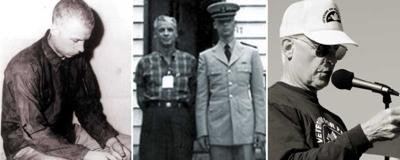

There is little about Phillip Butler’s appearance to suggest a man who has lived by what he calls the “warrior spirit.” Dressed in a sweatshirt, jeans and sneakers, Butler wears his snowy white hair closely cut and sometimes walks with a cane. He speaks softly and enjoys a mostly quiet life in Monterey.
But a warrior is what he was, and what he continues to be.
As a child, he faced down abuse that would ruin others. As a teen, he found the resolve to be a father figure for an essentially orphaned little sister – and still ace his studies. As a soldier, he survived his plane’s crash and 2,855 dark days and often solitary nights as a prisoner of war. Now a senior citizen, he regularly takes on one of his fiercest challenges yet: United States military policy.
“Hell, I’m 70 years old and was a POW,” he said in 2008, “and I’m going to tell it like it is.”
That he did with the recent publication of his memoir Three Lives of a Warrior – a 500-page chronicle that traverses his parents’ emotional illness and substance abuse, his decorated military career, his eight-year North Vietnamese nightmare, and a life that today has him reflective and resolute.
As president of Veterans for Peace Monterey Chapter 46, and chair of the Peace Coalition of Monterey County, a collection of 20 local peace and social justice organizations, Butler now fights for peace. He supports his government when he thinks it deserves it, and impugns it – and one of its most revered veterans and fellow POW, Sen. John McCain – when it does not.
UNREST IN PEACE
On Nov. 13, 2010, two days after Veterans Day, some 180 people chose to spend the bright blue peak of a Saturday afternoon not beachcombing or day tripping, but protesting. Mobilized by the Peace Coalition of Monterey County and the Peace Resource Center, they lined nearly the entire length of Window-on-the-Bay, waving signs and beckoning motorists to honk in support of ending the wars in Iraq and Afghanistan.
Across traffic from the peace protesters, nearly a dozen counter-protesters held their own signs denouncing the “war” on churches, families and homeowners; one yelled that the peace activists are a “bunch of fruits and idiots.”
Undeterred, the peace activists listened to speeches by Assemblyman Bill Monning, PRC president Joyce Vandevere and others, interspersed with songs like “Vietnam Rag” from singer-songwriter Steve Mortensen. At the end, Butler asked Mortensen, a friend and fellow Vietnam War veteran, to play a song he specifically reserved for the end because it can make him cry – Buffy Saint-Marie’s “Universal Soldier.”
As Mortensen’s voice and guitar hushed the crowd, Butler, in a Veterans for Peace baseball hat and tinted transition glasses, seemed to stand alone, as if he were revisiting another place and time in his life.
LIFE AS AN OKIE
“I had to learn to be a warrior.” That’s how Butler begins his book. The point quickly becomes clear: Before he could navigate the seismic obstacles that awaited him, he had to conquer others.
Born in Tulsa, Oklahoma, at the end of the Great Depression, Butler saw the U.S. claim victory at the conclusion of World War II and, he says, “blossom.”
“We used to walk the railroad tracks and go down to the Delman Theater on Saturdays,” says his friend Leonard Krisman. “For 25 cents you could see five cartoons, two serials, two features, and get popcorn and a Coke for 5 cents. We saw the Nazi stormtroopers, the Japanese, on the news reels.”
For years, Butler had a paper route, which taught him responsibility (and, he laments, the streetwise paper boys taught him how to smoke). He attended Will Rogers High School, where he met his future wife, Karen Olsen. After beginning flight training with his father, he earned his student pilot’s license the same day he earned his driver’s license – his 16th birthday. His proud father rewarded him on the drive home.
“‘Oh hell, I know you smoke,’” he told his son. “‘So here have one of mine. I guess you are about grown up now.’”
While still in high school, he took people, illegally, on plane rides for $5. For fun he would “buzz”(fly especially low) over his school.
But turbulence awaited. His father, for reasons Butler describes as “very complex,” became depressed and drank excessively. His mother, Effie Mae, once “loving and doting,” experienced her own depression, which led to volatility and addiction to medication. She abused Butler physically and mentally. In a rage, she once tried to push him off the top of a four-story grandstand at a Triple-A baseball game. Later she also turned the abuse on Butler’s sister, Linda.
“It seemed that dad’s alcoholism and her abusive personality fed off each other,” he writes, “each making the other more acute.”
He became the parent that wasn’t present. On several occasions he took his father to a hospital to dry out. He stood up to his mother when he grew older, and protected his sister, 10 1/2 years his junior. By the time his parents divorced, Butler, 14, was the anchor of the family.
“Our parents were not the greatest. [Phil] took care of me and continues to do so even today,” his sister Linda Jones says. “He was brother, father, best friend, consultant.”
Despite the strife at home, he excelled in school, winning a presidential appointment to the U.S. Naval Academy, a feat that pushed his father to tears of pride. But before Butler would graduate, his father, at age 44, drank himself to death. He was discovered by a nurse sent to deliver the news that his sister, Butler’s aunt, had drunk herself to death earlier that day.
Butler was forced to summon the resolve that would serve him throughout his life. After burying his father and aunt, Butler became the executor of his father’s estate, set aside the majority of the money for his sister, went back to the academy and flourished. He received his officer’s commission and married Karen Olsen the day after graduation. The next few years, they criss-crossed the country for flight training, including an assignment in Texas, where Butler flew the Grumman F-11F-1 Tiger during the Cuban Missile Crisis.
On March 2, 1965, his only child, Diane, was born.
“I felt an instantaneous and powerful connection with my daughter,” he writes. It would be a brief one. Two days later he was deployed to Vietnam.
“I didn’t know it then,” he writes, “but I was not to return until… this little infant girl was 8 years old.”
LIFE IN CAPTIVITY
The hefty “second warrior life” section of Butler’s book is taken from debriefing interviews conducted in the weeks following his release. It is an angry, raw, immediate, honest account.
Butler had flown an A4C in four or five bombing missions in South Vietnam before his carrier moved north. There, he flew about nine missions – mostly at night – in North Vietnam. His last mission came on April 20, 1965, when his plane exploded in the dark sky.
He thinks it was the result of a malfunction with an experimental fuse on the 250-pound bombs he had just released. He ejected and came down in a canopy of trees, deep in North Vietnam, where he was able to elude capture – and at least one native cobra – for four days and nights before he was caught.
At the start he was kept in solitary confinement. His very first night in a North Vietnamese cell, he was woken up by rats and giant roaches crawling all over him. For long stretches, they were his only company.
Isolation, he writes, reveals a person’s true nature to himself. He tapped the will that steeled him through past traumas, finding devices, however silly, to help him cope. He planned family vacations in his mind, down to packing the suitcases. He retraced his life. He slept 20 hours a day. He peeked out of the cell door’s food hatch to watch rats scampering or, as he writes, “screwing.”
He was transferred to 10 different camps – from the famous “Hanoi Hilton” to “The Zoo,” so named for the animal treatment they received – to join other POWs over the course of his captivity. During his first transport, to Hanoi by barge, a boy about 12 years old loaded a round into a rifle and pointed it at his head.
“At this point I was physically and emotionally exhausted. I think I didn’t give a damn whether he shot me or not. I just sat there and stared at him,” he writes. An old man who ran the barge came and snatched the rifle away.
Butler and his fellow POWs devised simple but critical ways to ward off that exhaustion and keep up their morale. They communicated with each other despite guards’ efforts to squash it, hiding notes in common areas written by burned out matchsticks and teaching each other the “Tap Code,” an alphabet that they could hear through walls or along support beams – or with chucks of a hoe on work detail. They also used hand signs approximating letters.
“I can’t overstate how much our communications, as limited as they were, meant to us. It really and truly meant our sanity,” he writes.
Humor was another lifesaver.
Butler taught one of his guards some English, which that guard promptly showed off to his buddies, announcing: “I’m queer.” They assigned their captors nicknames like “Rabbit” and “Squirt.” Inside jokes verged on gallows humor – they called the peace talks between the U.S. and North Vietnamese “peace scares.” They staged “movie nights” in which a person acted out, to the best of his recollection, a movie he had seen.
“It’s a survival technique,” says Butler today. “Put a bunch of American guys together, under a lot of stress, and that’s what you’ll get.”
One thing Butler didn’t do, unlike so many prisoners before him: turn to God. His discipline held there, too – he had sworn off the church as a teenager after hearing his minister announce that black people “wore the Mark of Cain.”
In interviews and the book, he characterizes himself as no more brave or exemplary than his fellow troops.
Fred Cherry, a black POW, is one of many he honors. “Once they they were beating the hell out of him. They told him, ‘You’re oppressed in your country. You’re not like these white guys.’ Fred said, ‘I’m an American fighter pilot. I am just like these guys.’”
His roommate of several years, Hayden Lockhart, had been cuffed to Butler during the infamous Hanoi March. A picture of them published in Time magazine shows Lockhart holding up Butler after one of many objects thrown at them by a rabid North Vietnamese mob almost knocked him out. Moments later, Lockhart was struck and Butler kept him on his feet. The mutual support was everpresent, and meant everything.
LESSONS IN PAIN
The POWs were slapped, punched, kicked, yelled at and beaten with rifle butts. To inspire submission, they were deprived of sleep, light, medical care, food and water. Chronic malnutrition opened the floodgates to disease and ailments, including malaria, colds, flu, jungle rot, boils, fatigue and a case of dysentary so severe, Butler writes, that at the end of its course he was shitting out parts of his intestinal lining. At one point Butler resorted to eating out of a garbage can to supplement his diet after he slyly volunteered for trash detail to get to discarded food.
At the camp called Briar Patch, guards decided to smash the first prisoner who came out of his cell to use the latrine with the butt of their rifles. Butler and Lockhart agreed to take turns, sharing the pain of crossing the threshold daily.
The North Vietnamese were famously eager to use the prisoners as tools of propaganda, coercing them to sign confessions that the prisoners, most of them pilots, had purposely “bombed innocent women, children, hospitals, churches and schools.”
If interrogations didn’t work, the POWs were tortured. That included “Hell Cuffs,” in which their arms were tied to constriction and torqued behind their backs to a gruesome degree, a technique as simple as it was vicious.
“The pain went into the unreal,” he writes. “After a while I started screaming, kicking and crying. Then I was vomiting, urinating and defecating in my pants. I was just running around the room like a wild man!… After about three or four hours of this I decided I was going to try to commit suicide.”
He ran across the room and bashed his head into the wall. Unsuccessful, he was now in even more pain. After hour six, he called out to the guards that he would sign whatever they wanted. His interrogators left him tied, however, for two more hours, as a lesson. All 54 men of that camp, Briar Patch, were tortured for the same confession.
But they turned even that torture technique into a source of camaraderie. They competed to see how long they could last. The winner was an Air Force First Lieutenant named Jerry.
“If a gook would scream at him he’d get unnerved as hell,” Butler writes. “But they stuck Jerry in those damn hell cuffs and that son of a bitch stayed in them for a week.”
Their resistance served a double purpose: The more they could endure, the more time they bought the next man.
Other smaller victories took on larger meaning. When their captors insisted they say “Thank you” when receiving food, the POWs said, “Fuck you.”
“We took a lot of licks after they figured out what we were saying,” Butler says, allowing a chuckle.
Through it all he and his fellow POWs survived on the mantra – the mandate – “Return with honor.”
“You have to be able to look at yourself when you’re shaving,” Butler says.
The cycle of interrogation and torture happened “off and on” for years, ending when Ho Chi Minh died and a new administration took over. When the signing of the Paris Peace Accords ended Butler’s captivity in 1973, his relief and joy were so intense he doesn’t remember the face of the Air Force nurse who looked after him and his fellow POWs in the C-141 that would carry them home.
“But I can still remember what she smelled like,” he writes. “It was heaven. She was the first good thing I had smelled in over eight years.”
On the flight from the Gia Lam airport, he continues, “Nobody moved or said a thing. But when the [C-141] wheels broke the ground everybody in that airplane let out a spontaneous roar. It was deafening. We were screaming and yelling and everybody was crying.”
DESTROY AND REBUILD
But the world to which he was flying back to was completely unlike the one he had left behind. There is a wide-eyed sense of wonder in the beginning chapters of Butler’s return to the States and the beginning of his “third life.”
Music. Fashion. Protest. Drugs. Cars. Television. Sex. Between 1965 and 1973, it had all changed.
“I can empathize with Rip Van Winkle,” he writes.
Another change that rocked Butler: His wife had a boyfriend and wanted a divorce. That proved to be a protracted and painful ordeal. But the reception from friends, his other family and even strangers – the POWs’ plight had been well covered in the media – was jubilant.
“When Phil first came back… incredible,” his sister Linda says. “[Our hug] was on TV. It was amazing.”
He and his fellow POWs received the hero’s welcome that eluded earlier returning Vietnam War veterans – a ticker-tape parade, letters from well-wishers (they trickle in to this day), a visit to the White House, a lifetime Major League Baseball pass that is still honored today.
Butler says he went to libraries and “absorbed” books, magazines and newspapers – catching up on nearly a decade’s worth of news and “finding out the truth,” during which, he writes, “I became more liberal, humanistic and caring.”
Plotting this third phase of his life, he earned a doctorate in sociology in 1981, performing field work at the University of California at San Diego and writing his dissertation at the Naval Postgraduate School (after which he became a professor, finally retiring from the Navy with the rank of commander). He describes the educational process as “mind opening” and a “reorientation of my warrior spirit.”
“I made a transition from being a person who just accepted the orders… to becoming an intellectual, a person who questions things,” he writes.
He also became a husband again. He met his wife, Barbara, at a POW reunion in San Diego in 1978; she had been a guest of her brother, a Vietnam War POW named Chuck, and his wife, Terry. The four have been tight ever since, visiting each other every year after Butler and Barbara moved to Monterey.
In 1991, Butler joined Veterans for Peace. In 1999, he and several others obstructed the path of a tank rolling down Alvarado Street in a Fourth of July parade. As part of what has become something of a local legend, they were all arrested, but the tank hasn’t appeared in subsequent parades. Butler says he found out later that the driver of the tank was a friend, Ret. Gen. Bill Morely, and told him, “Thanks for stopping, Bill.”
Although he describes himself as a peace activist and not a pacifist, Butler arrived at a view of war, as waged by the United States, as “an instrument of foreign and economic policy” wherein “it hasn’t been the combatants, but civilians who have become the primary victims.”
He’s become a vet in this battle for peace, too – he’s spent 30 years speaking to thousands across the country, including 25 engagements in two years at CSUMB, MIIS and NPS and 15 torture teach-ins at the foot of the Defense Language Institute, and providing financial guidance to bolster the Peace Resource Center.
“He has special respect within the activist community,” says local United Nations Association chief Larry Levine. “He embodies the fact that people very critical of war-oriented policies can be very supportive of the troops and veterans.”
Butler’s been awarded more than a dozen medals, including two each of the Silver Star, Legion of Merit, Bronze Star, and Purple Heart. This year he accepted the 27th Assembly District’s Veteran of the Year from Rep. Bill Monning (D – Carmel).
“Phil maintains an unbelievable level of equilibrium amidst life’s challenges,” Monning says. “His contributions and work to convert a war culture to a peace culture are rooted in unassailable credibility. I can think of no other person with whom I would entrust greater confidence and trust.”
The level-headed credibility is clear in a steady pre-2008 election video shot in his home office, which has received more than 600,000 views on YouTube. It came as a response to a swell of inquiries from fellow vets, friends and family.
“They’d say, ‘You knew John McCain,’” he says, “‘What do you think?’”
Butler took issue with McCain’s shifts in principle, particularly religion, and his willingness to let the media make him out to be “the POW, the hero, when there were 600 more just like him.” But it was temperament that troubled him most:
“He was a volatile guy who could blow up, go off like a Roman candle…
“The world is such a dangerous place, and he has shown himself to be bellicose… he’s not someone I would like to see with his finger near the red button.”
Butler believes all wars since WW II have been largely unnecessary, aggressive and imperialistic. And while he reiterates he’s no pacifist – “I believe in defending yourself,” he says – self-defense has turned into occupation throughout the Middle East.
“Certainly we went to Afghanistan in the beginning because we were after Al Qaeda, but that was over in a hurry,” he says. “Iraq was totally unnecessary. It’s become a war of gathering territory.”
He says that’s manifested in the fact that soon the U.S. will have more than 250 bases in Iraq, and will be unwilling to give them up. “The military-industrial complex and the government are rooted in power,” Butler adds. “Whether it’s the military, the CIA, or civilians, we won’t walk away from those positions.”
He goes on from there: The U.S. also should step back from engagement in North and South Korea until carefully considering how other countries can help manage relations. “It’s very unwise for us to get involved,” he says.
“North Korea is in the process of switching from one despot leader to his despot son, and they don’t have a lot to lose – they are in terrible shape,” Butler says. “Half the population is starving.”
Differences in POW politics are as inescapable as civilian descrepancies, albeit more dramatic since, as Butler writes, returning POWs who successfully navigated the tricky transition back to freedom did so only through the mutual support that carried them through confinement. “We did what we had done in prison,” he writes.
Moreover, those sides are rarely as clearly separated as the the two groups of protesters were by Del Monte Avenue on Nov. 13. Take Sherman Ball, of the smaller counter-protest group, who said he is a Vietnam War-era veteran.
“I think we should win the war [in Afghanistan] and then get out,” he said. “The rest of the world, too. Germany, Japan, Spain, Greece. We pay for their protection. It’s ridiculous. I don’t think we should be nation-building.”
Maybe he didn’t hear Assemblyman Monning on the podium, who, at one point, directed his comments across the street: “I agree with a lot of what you’re saying. You should be over here with us.”
Maybe it’s not that simple. Ball, holding up a sign that read “Remember 911 Attack by Islamic Terrorist Pigs,” said he didn’t know about the Veterans for Peace. And one of his fellow counter-protesters said, “the two sides are never going to come together.”
Butler writes that he has been subjected to a lot of vitriol from former POWs, fellow USNA grads and veteran comrades: “They came home but never changed. I did change. So I have had to experience many friendship casualties over my convictions and activities. But I am a warrior. And warriors have to accept casualties.”
THE WEIGHT OF MEMORIES
Butler spent Veterans Day playing golf at Monterey Pines with alums from the Naval Academy and West Point. Although he’s traveled to other countries, he hasn’t been back to Vietnam.
“POW-MIA Day always surprises me when it comes around,” he says in his home office. He points to screensaver pictures of family and friends hovering on his computer’s monitor: “That’s where I focus my time.”
His home office near Del Monte Golf Course is neatly lined with books, press clippings, photos of his service, commendations and, atop a bookshelf, models of the light attack jets he once flew.
There is another space in his house, though, that is anything but dusty and distant. That is the garage, home to a spectrum of bumper stickers, placards and signage of his peace, environmental and social justice activities.
It doubles as a vibrant and evolving reminder of who Butler is today, as opposed to the military memorabilia, which seems to have served its time.
“I don’t know what I’m going to do with all this junk when I’m gone,” he says. “Maybe donate it to some institution.”
A suggestion comes: Perhaps the Naval Postgraduate School might be interested. Butler replies, half-seriously, “You want it?”
(1) comment
I am familiar with Dr. Butler only in the sense that I read his story on Alternet which spotlighted Sen. John McCain and his confinement with Dr. Butler and others at the Hanoi Hilton. His story did not flatter Sen McCain, but neither did it lie about the Senator's record as a prisoner of war. I found his story believable. I am a USMC veteran serving from 1961 to 1965. I was fortunate in that I did not experience combat. Dr. Butler is speaking out on an issue close to my heart - our envolvement in unnecessary wars. It is my guess that most present and former military vets favor these wars. So I am happy to learn that Dr. Butler is giving us an alternative view of these wars that have cost us, most importantly, the lives of young men and women who should never been put in harm's way. I have been speaking out on my facebook page, much to the chagrin of some members of my family and friends from childhood. The purpose of my comments here is to encourage Dr. Butler to carry on with the good fight. I will continue to do the same. And if Dr. Butler thinks there is a way I can help him, please get in touch with me. I am a very willing volunteer. Tel: 1985=264=5622. It is important that we as human beings find a way to live in peace.
Welcome to the discussion.
Log In
Keep it Clean. Please avoid obscene, vulgar, lewd, racist or sexually-oriented language.
PLEASE TURN OFF YOUR CAPS LOCK.
Don't Threaten. Threats of harming another person will not be tolerated.
Be Truthful. Don't knowingly lie about anyone or anything.
Be Nice. No racism, sexism or any sort of -ism that is degrading to another person.
Be Proactive. Use the 'Report' link on each comment to let us know of abusive posts.
Share with Us. We'd love to hear eyewitness accounts, the history behind an article.