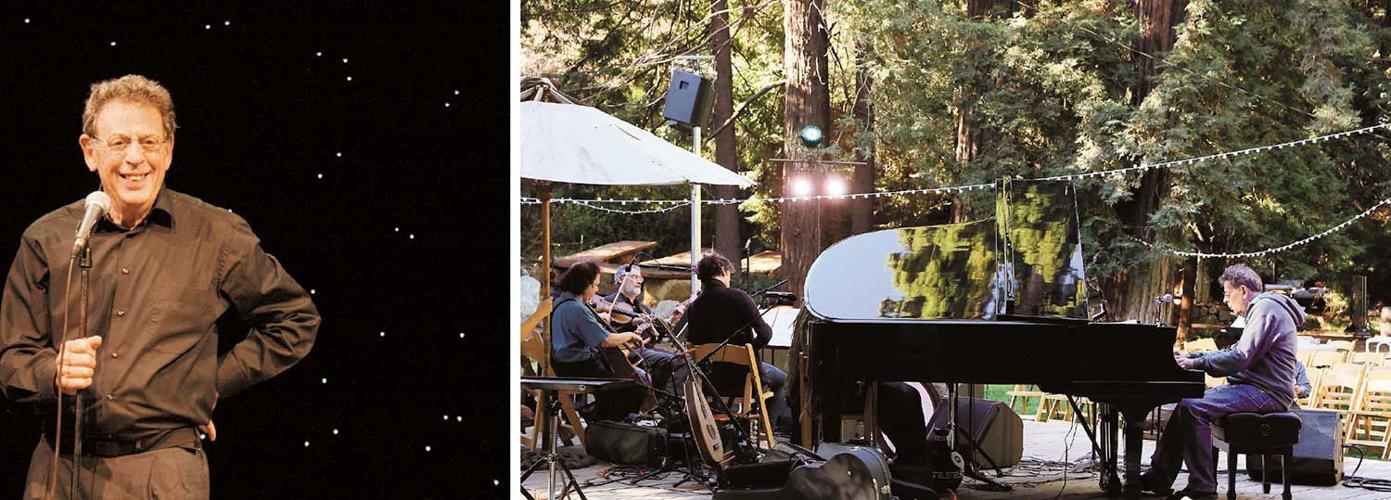


(L) Philip Glass recalls two similar scenes of visionary artists from different eras: Allen Ginsberg standing atop a table in a bar reading his urgent poetry, and Lin-Manuel Miranda as Hamilton, who stood atop a table on a theater stage delivering raps about liberty. (R) Although he cherishes the setting of Henry Miller Library (above, 2014), Glass says, “The Golden Bough is a real theater. Having [the festival] in town is going to make it easier for people who want to come to multiple events.”
Philip Glass scores a lot of films, operas, theater pieces, dances; his music makes an excellent partner, enhancing and propelling whatever it accompanies. A few weeks ago online theater magazine Playbill called his music “deceptively simple repetitive structures that evolve slowly and flower subtly.” You can put on a Philip Glass composition and just listen.
You can also add it as a soundtrack to life: to run, to drive, to cook, to paint, to sit and talk or watch things, to go faster, or feel grander, or get quieter. Sometimes it works best skirting the periphery of an event. Put it on in the outdoors and it spreads out and settles right into the atmosphere. Commit it to your memory and you’ll have beautiful energy coursing through your brain.
It’s rhythmic music with sweet, melancholy or robust harmonies, so easy to like that some people distrust it. But Glass is sowing his music all over the world, and it’s blooming.
One of his formative experiences was in theater, an inherently collaborative art form. So he’s collaborated with David Byrne, Allen Ginsberg, Ravi Shankar, Godfrey Reggio, Martin Scorsese, Robert Wilson, Patti Smith, Chuck Close, Stephen Colbert and tons of others. He’s been a mentor, a benefactor, a fan and a friend to many of them.
His Days and Nights Festival, now in its seventh year, grows out of that ethic: him and his artist friends getting together and putting on a show of contemporary culture. For Glass’ 80th birthday year, he was hoping to go big and do it in Big Sur. The landslide that took out the Pfeiffer Canyon Bridge also swept away hopes of a Big Sur communion. The festival has since relocated to Golden Bough Theater in Carmel. But it’s still going to be big.
* * *
Weekly: First of all, happy [belated] birthday.
Glass: Thank you. This birthday year is almost over. I tell you it’s a lot of work. Getting to be 80 is not easy.
How has this birthday year been treating you?
A lot of people want to have celebrations. I had a very big one at Carnegie Hall. [My birthday] is not the significant [event] to me, in a way. I’m still working, writing music, and I’m very happy about that. The music is getting played as well. I’m very fortunate to have survived and be well enough to come out and play. I don’t have arthritis – I should be knocking on wood. Physical problems can come up, but they haven’t in my case.
There’s so much going on in the festival this year. What were you trying to do with it?
If you think about it, it’s really a reflection of the first year. The idea of the festival was always music, film, theater, dance. Besides that, I was hoping to bring in some people who work on what they call [human] development. That has to do with the way you see the world. This time I have Sat Hon, a tai chi and qi gong teacher, coming to give a workshop. [Guru] Victor Sanchez from Mexico is giving a workshop. It gets us into the soul.
Do you know what [This American Life host/producer] Ira Glass and [multimedia artist] Laurie Anderson are going to do?
I’ve talked with Ira. He was trying to make up his mind. Laurie, lately she’s been doing [what] she calls stand-up. Just herself talking. She’s a very good talker, a very good storyteller. It might be what she’s doing. I’ve been out touring with her. We read poetry together, do music together. But this is really her show. It’s a very broad based festival. It’s all the stuff that I like. It involves movement, speaking poetically, singing, dance. We’re going back to the beginning of the cycle.
What will you and the ensemble play in your highlights concert?
I’m going back to early pieces like “Music in Similar Motion,” “Music in 12 Parts.” A short kind of retrospective. The ensemble’s been almost continuously playing all these years – we’re not getting together especially for this event – we’ve been on tour as an ensemble all year. What I’m finding out is the early pieces, from the ’70s and early ’80s, young audiences are discovering that music. It’s become popular – not in the sense of a huge audience – but there’s a lot of interest in that music. When we play these concerts in Europe, thousands of people come to hear us. That moment is very strong. And then, of course, there’s [groundbreaking 1982 film] Koyaanisqatsi.
You said in your Carnegie Hall Composer’s Chair interview, “I’ve probably written too much music.” Do you believe that?
In one way that’s true. Now, after 50 years of writing music, I’m trying to get everything in order. Pages are missing. From that point of view, it can be a problem. I’ve written 13 concertos, 11 symphonies, a massive amount of work. Keeping all the materials correct is a huge amount of work. It’s not a bad problem. But it’s urgent.
What would be your dream Big Sur performance?
I really like the outdoors and history of Henry Miller Library. It’s not a [big] place. We’re not interested in quantity. Ideally we’ll expand, using [it] as our base. Hopefully we’ll be back at the Library, use that as a stage where the elements can come together, and take it globally. That’s the big picture. This is our fourth year that [Days and Nights] has been in Amsterdam. The work would originate in Big Sur and we would take it abroad. We’ll be hosting it for annual visits in New York City, too. We’re also interested in environmental study, things a lot of people are interested in, especially in California – integrating the arts to science and other cultural elements.
In 2013 you wrote in the Weekly that “… when society seems on the verge of coming unhinged, and as the inevitable fear and unease become simply the texture of our lives, then it is that the arts and science find a new voice that’s original, vital and compelling.”
That’s absolutely true. I saw it in the ’60s. It’s a cycle. If you live long enough, you get to see it twice. And that’s what’s happening to me. In the ’60s I would see Allen Ginsberg standing on a table in a bar, reading poetry with a gas can. That was during the time of Vietnam. It almost seems like Mother Nature gives us a little [push] into something terrible, and the artist comes along, and tries to rebalance things. It’s unmistakable, the connection.
Are you less distressed over today’s political climate?
What I find is a lot of the work I do is more politically oriented. I did a piece a few years ago called Appomattox, which is about voting rights. It’s an opera. We did it in Washington, D.C. at the Kennedy Center. I just finished a piece last year called The Trial, based on the Franz Kafka story, completely about government corruption and society. My voice has become more political. Working with [filmmaker] Godfrey Reggio, when he talks about the implanting of technology on this whole society, that’s whatKoyaanisqatsi is about. It’s always been there. We’re a small part – I hope an important part – of that cultural response to problems of gender, race, society.
How do you feel about the New York Philharmonic finally performing one of your pieces?
I’ve lived in New York since my 20s. I’ve been there maybe 60 years? This is my first performance at the Philharmonic. They almost missed… [laughing] I could have died before that happened. And it happened because of [Music Director] Jaap van Zweden. Times are changing.
Let’s say you got to the point where you don’t want to travel or perform so much…
I see no exit from this. Becoming a performer had a tremendous, powerful effect on my life as a composer. It put me in touch with an audience which I see constantly. I’m in touch with the audience I’m writing for. That’s just the way my life has been. I was just in Brazil. Today, Boston. Tomorrow, New York. It seems to be an essential part of the way artists are working these days.
What are some hopeful things you’ve encountered out there in your travels?
What I’ve seen is rejuvenation. It’s extremely rewarding. My children get worried about what’s happening in the world. I say “Look, democracy is very expensive. We haven’t been paying for it. We’re paying for it now.” Things like freedom of speech, voting rights – some of those things have been challenged. There are young people very interested in politics now instead of playing video games. A turnaround is happening. Something’s bubbling. We went to see Hamilton in New York. There’s a lot of badness going on. A lot positive things too. This is not an easy time for anybody.
If you were to make a film…
No, no. I’ve done enough films. Some of the most interesting ones were in the documentary film world. [Independent] filmmakers are like the poets of the performance world. It’s not a big audience, they don’t have big careers or big exposure. But it’s a very important voice. And I do what I can to be part of it.
THE PHILIP GLASS DAYS and NIGHTS FESTIVAL takes place Sept. 29 to Oct. 8 at Golden Bough Theater, Monte Verde between Eighth and Ninth, Carmel. $85/show; free/talks and films; $500-$1,000/packages. philipglasscenter.org

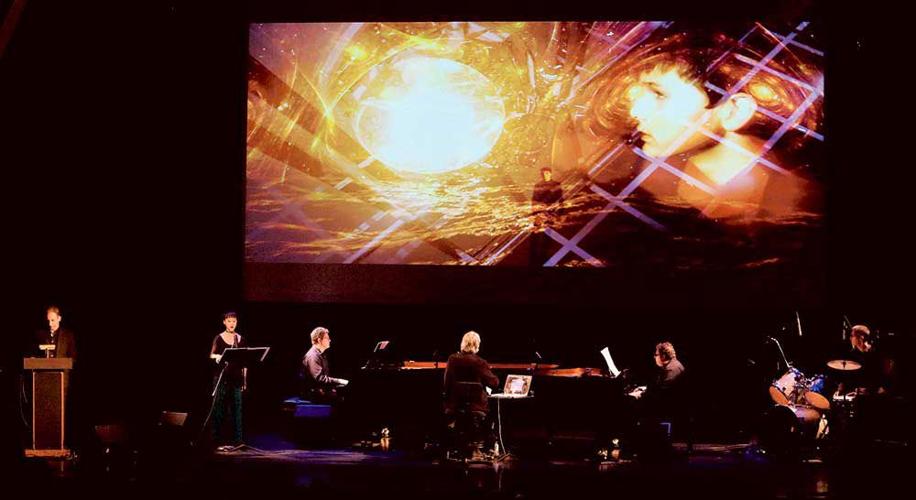
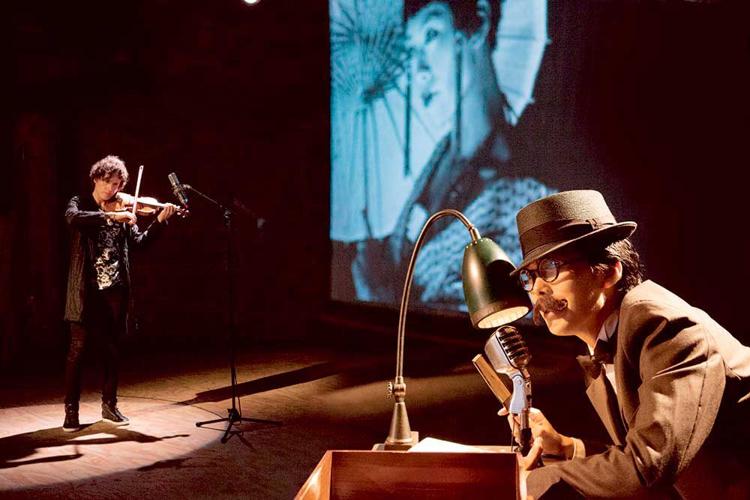
The opening night’s performance combines theater, music, film and dance.
(0) comments
Welcome to the discussion.
Log In
Keep it Clean. Please avoid obscene, vulgar, lewd, racist or sexually-oriented language.
PLEASE TURN OFF YOUR CAPS LOCK.
Don't Threaten. Threats of harming another person will not be tolerated.
Be Truthful. Don't knowingly lie about anyone or anything.
Be Nice. No racism, sexism or any sort of -ism that is degrading to another person.
Be Proactive. Use the 'Report' link on each comment to let us know of abusive posts.
Share with Us. We'd love to hear eyewitness accounts, the history behind an article.