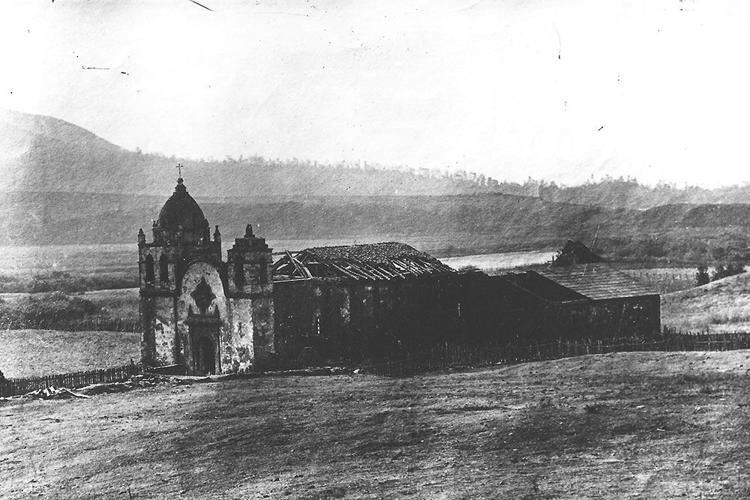

Looking south at the Carmel Mission, 1875. It, along with the photo of the interior, are believed to be the earliest known photos of the mission.
Monterey~ May 17.
We arrived here on Wednesday. On Monday, May 13, we left Guadalupe Ranch and came about 14 or 15 miles and camped in a valley that turns off from the Salinas on the road to Monterey. We had hardly camped, and were eating dinner, when the stage came along.
I went to the driver to get him to carry a letter to the next post office. He had to stop there to water his horses. A familiar face appeared in the stage, not at first recognized, but a mutual recognition soon took place – it was a good friend I had known on shipboard, a friend of Averill’s, a lawyer from New York, a Mr. Tompkins, one of the finest gentlemen and most entertaining that I have met for a long while. We were much together on shipboard.
He had traded eastern property for a ranch near Monterey, on the coast, and had just been to it and was returning to San Francisco. He was the first acquaintance met since Los Angeles, or I should say, since we left San Francisco.
The meeting was mutually pleasant. He tendered us the hospitality of his ranch, although he could not be with us there, but gave us a letter to his majordomo (head ranchero) to give us all attention, feed, board, horses to ride, etc. We shall go there next week.
He had so improved that we did not at first know him – he was in ill health last fall, but hearty enough now. We, tanned by the sun, bronzed by exposure, without coats or vests, in buckskin pants, bowie and Colt at our belts – he said at first sight we fulfilled his beau ideal of buccaneers stopping the stage. We stopped there over Tuesday and the driver gave us a Monday’s paper from San Francisco, with the latest news. That was the 14th, and we had news up to May 3, by Pony Express, that is, only 11 days from New York to camp.
We have been quite lucky thus far for news, and it has been a great item in these times. I cannot write how heavily the national troubles bear upon my mind, they are in my mind by night and by day. God grant that we may yet save the United States, but I fear for the worst. Newspapers from home are always acceptable, but we get the great news by earlier means.
On arriving here, by a “judicious” distribution of patronage to two leading stores, we got lots of papers for reading, a dozen or more.
This sheet finishes my letter paper of thin kind – the last scrap is here – and I must use such as I can get hereafter until I get to “Frisco.” Trusting that the mails will not be “seized” by pirates, it must go by next steamer. The last steamer went out fully armed, for it was currently believed that a party was going abroad as passengers to take her for the Southern Confederacy. The Union sentiment here is overwhelming.
Monterey~ Sunday, May 19.
It is a lovely evening – the moon shines brightly, the old pines and thick oaks by our camp cast dark shadows, and the quiet bay sparkles in the moonlight.
I have been to church today – attended Protestant service for the first time since last November, nearly six months ago. There is a Methodist mission station here. I heard there was to be service at 11am in the courthouse, so was on hand. The rest of the party went to Mass.
I found two or three fellows loafing on the porch, and as the door was locked, a man started to find somebody who had the key. Meanwhile, a dozen collected on the porch. After much delay the key was found, and, half an hour after time, services opened.
How unlike a Roman missionary – he would have had all ready and shown himself “diligent in business” as well as “fervent in spirit.” The congregation at last numbered some 20 or 25 persons, not counting the few children. The clergyman was a very doleful looking man, with very dull style and manner, who spoke as if he did it because he thought it his duty to preach and not because he had any special object in convincing or moving his audience.
His nose was very pug, his person very lean, his collar very high and stiff, and his whole appearance denoted a man entirely lacking energy, surely not the man for a California missionary. Yet how good it seemed to meet again with a few for divine service – it was indeed a pleasure. We have now been over a country twice as large as Massachusetts, and this is the second Protestant congregation we have seen, and both of these feeble and small. But there are Catholic churches in every considerable town.
As I came out of church and met Averill in the street, we were accosted by a man who wanted us to ride a few miles and look at a supposed silver “lead” he had discovered. We declined, but were soon beset by others, with ore and “indications” from another mine. I must take the specimens, which I did, and returned to camp and “blowpiped” them to get rid of them – found a little silver.
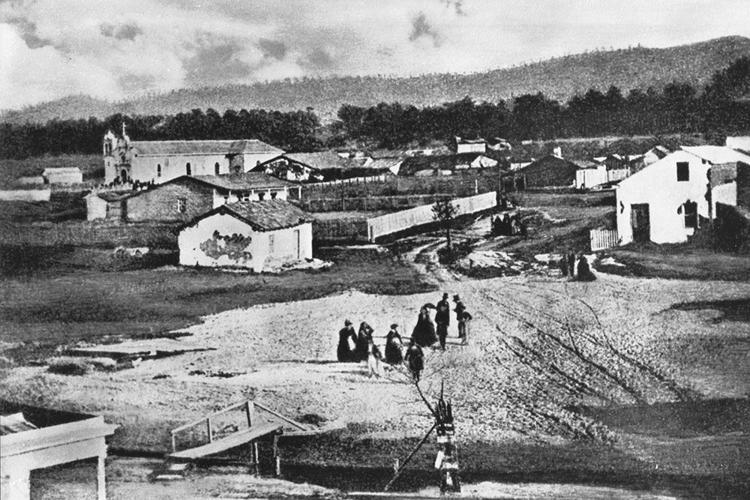
Monterey has about 1,600 inhabitants and is more Mexican than I expected. It is the old capital of California. There are two Catholic churches, and Spanish is still the prevailing language. Like all other places yet seen, more than half of the “places of business” are liquor shops, billiard saloons, etc. – all the stores sell cigars, cigarritos and liquor. Stores are open on Sunday as well as other days, and that is the day for saloons and barrooms to reap a rich harvest.
Billiard tables go from morning till midnight – cards and monte are no secrets.
Thus it has been in all the towns. Liquor and gambling are the curse of this state. Lots of drunken Indians are in the outskirts of the town tonight.

Downtown Monterey, 1868. Near the top left, San Carlos Cathedral is visible. This is thought to be the earliest known photo of Monterey’s downtown.
Pescadero Ranch~ Monday, May 27.
After examining things about Monterey for three days, we came here to Mr. Tompkins’ ranch, where the feed is good. It is a ranch of 4,000 or 5,000 acres, on the coast about five miles from Monterey. We pitched our tent in the yard, but a larger log house is our headquarters.
Last Monday, while in Monterey, a dull day with showers, we got an “artist” to bring his camera out to camp and take a few pictures of camp on leather. He took four – not good in an artistic sense, but good as showing our camp. We divided our pictures by cutting cards for the choice, and I got the best picture.
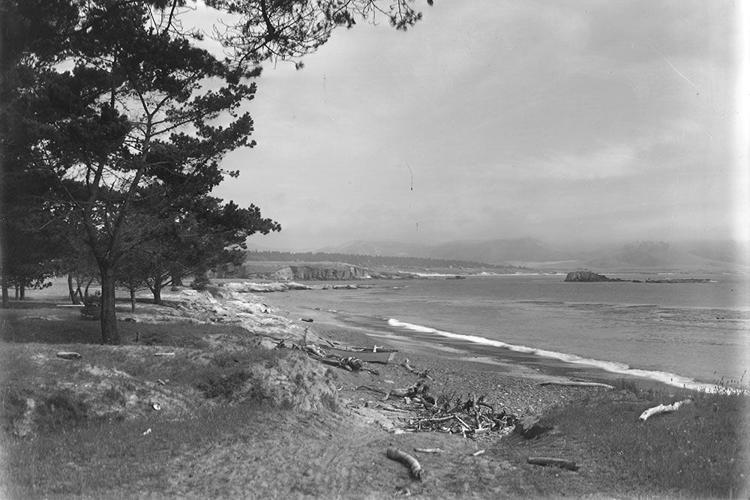
Pescadero Ranch was formerly owned by an eccentric, misanthropic, curious man, who lived in solitude and tried to educate two boys, keeping aloof from the world and the rest of mankind. He built a large and very secure log house, for fear of robbers, just on the shore of the Pacific, by a lovely little bay. Behind rise hills covered with tall dark pines, and near the house is a field of about 100 or more acres, fenced in, where we have fine feed for our mules.
His books are still here – a strange collection on science, art, astrology, romance, infidelity, religion, mysteries, etc. Old harness, spades, implements, harpoons, etc., are stored in large numbers. I know not why he had them. He had invented a new harpoon which no one would use.
By the way, Monterey Bay is a great place for whaling. Two companies are at work, and already over half a dozen whales have been taken here. On Wednesday we saw them towing one in, and on Thursday morning went down to see them cut him up. He was a huge fellow, 50 feet long. Last year they caught one 93 feet long which made over a hundred barrels of oil. After stripping off the blubber, the carcasses are towed out into the bay, and generally drift up on the southeast side.
The number of whale bones on the sandy beach is astonishing – the beach is white with them. Hundreds of carcasses have there decayed, fattening clouds of buzzards and vultures. The whales are covered with thick black skin. The tail is horizontal. They have no fins, but a pair of huge “paddles,” one on each side – oars, as it were – like great flat arms covered with skin, 3 or four 4 wide and 12 or 15 feet long. The ball-and-socket joint which attaches the paddle to the body is wonderful – the ball is as large as the end of a half-barrel. Barnacles grow on the skin in great numbers; I will try to collect some if they do not stink too badly.

Pebble Beach, 1880. It was formerly known as Pescadero Ranch.
TO RETURN TO PESCADERO. We came on Thursday. I had letters to several persons. Wednesday evening I had called on a prominent Monterey citizen, and spent an evening in female society, and heard a piano for the first time in many months.
On Friday we rode a few miles to Judge Haight’s. He is a wealthy San Francisco gentleman and has a fine ranch here, where he spends a part of the year with the whole or a part of his family. We presented our letters, but did not find him at home.
We visited the old Mission of Carmelo, in the Carmelo Valley, near his ranch. It is now a complete ruin, entirely desolate, not a house is now inhabited. The principal buildings were built around a square, enclosing a court. We rode over a broken adobe wall into this court. Hundreds (literally) of squirrels scampered around to their holes in the old walls. We rode through an archway into and through several rooms, then rode into the church.
The main entrance was quite fine, the stone doorway finely cut. The doors, of cedar, lay nearby on the ground. The church is of stone, about 150 feet long on the inside, has two towers, and was built with more architectural taste than any we have seen before. About half of the roof had fallen in, the rest was good. The paintings and inscriptions on the walls were mostly obliterated.
Cattle had free access to all parts; the broken font, finely carved in stone, lay in a corner; broken columns were strewn around where the altar was; and a very large owl flew frightened from its nest over the high altar. I dismounted, tied my mule to a broken pillar, climbed over the rubbish to the altar, and passed into the sacristy.
There were the remains of an old shrine and niches for images. A dead pig lay beneath the finely carved font for holy water. I went into the next room, which had very thick walls – four-and a-half feet thick – and a single small window, barred with stout iron bars.
Heavy stone steps led from here, through a passage in the thick wall, to the pulpit. As I started to ascend, a very large owl flew out of a nook. Thousands of birds, apparently, lived in nooks of the old deserted walls of the ruins, and the number of ground squirrels burrowing in the old mounds made by the crumbling adobe walls and the deserted adobe houses was incredible – we must have seen thousands in the aggregate.
This seems a big story, but hundreds were in sight at once. The old garden was now a barley field, but there were many fine pear trees left, now full of young fruit. Roses bloomed luxuriantly in the deserted places, and geraniums flourished as rank weeds. So have passed away former wealth and power even in this new country.
Our road to the Mission was a mere trail through the thick chaparral, crossing some deep ravines. We came on the tracks of numerous grizzlies – or, rather, numerous tracks. There are three grizzlies living in the brush near here, particularly bold and savage. One has nearly killed several people. They came here to eat a whale stranded on the beach. As we had two good Sharp’s rifles, besides other guns, we concluded to watch for them that night. An Indian, an old bear hunter, entered into the project, but on examination of the ground, it was found that there was no good place – no trees to get into and watch from – for no one is so mad as to engage in a bear fight unless he has all the odds on his side. So we had to give it up.
Judge Haight came over and invited Averill and me to dinner yesterday. We rode to Point Cypress in the morning – a granite, rocky point, covered with a kind of cedar called “cypress,” more like the cedar of Lebanon than any other tree I have seen. Some of the trees were beautiful – and often three or four feet in diameter. I measured one that was 18 feet 8 inches in circumference as high as I could reach. Another, 23 feet at two feet from the ground.
Returning to camp, we took other mules and rode to Mr. Haight’s, about five miles. We rode through the old Mission again – and paused a short time among the ruins. We were on hand at two o’clock, the appointed time. Judge Haight is a fine old man, a man of much intellect, lives in a comfortable house, has with him two daughters, most lovely young women, of perhaps 18 and 22 years – pretty, agreeable, cultivated and sensible. I don’t know when I have spent an afternoon so pleasantly. The dinner was good, not brilliant – champagne was partaken of moderately.
His library was well stocked with choice works. It was indeed a luxury to meet with ladies – the first time we had sat at a table with them since New Year’s at Mr. Wilson’s. We were decidedly pleased, and we think they were, for they are much isolated here. They had a fine piano, and one of the girls played well.
We climbed a hill just above the valley, and had a pretty view of the Carmelo Valley, the sea beyond, and the mountains in the south. He has a fine ranch, keeps about 1,200 sheep, much better animals than one generally sees here. We were so urged to stay to tea that we did, and rode home by twilight. One dared not wait later for fear of grizzlies.
Where our trail ran through dense chaparral we came on fresh tracks made but a few minutes before – after a man had passed an hour before – but we were spared a sight of any animals.
(0) comments
Welcome to the discussion.
Log In
Keep it Clean. Please avoid obscene, vulgar, lewd, racist or sexually-oriented language.
PLEASE TURN OFF YOUR CAPS LOCK.
Don't Threaten. Threats of harming another person will not be tolerated.
Be Truthful. Don't knowingly lie about anyone or anything.
Be Nice. No racism, sexism or any sort of -ism that is degrading to another person.
Be Proactive. Use the 'Report' link on each comment to let us know of abusive posts.
Share with Us. We'd love to hear eyewitness accounts, the history behind an article.