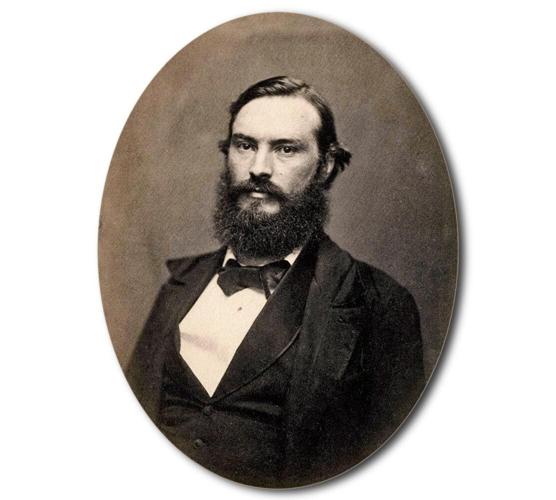

Camp 31, Guadalupe Ranch. May 12, 1861 ~
We left San Antonio Thursday morning May 9, and followed up the valley a few miles, then crossed a high steep ridge over 1,000 feet high, which separates the San Antonio from the Salinas, and then descended and struck down the great Salinas plain. Dry as had been the region for the last 60 or 70 miles, it was nothing to this plain.
The Salinas Valley for a hundred or more miles from the sea, up to the San Antonio hills, is a great plain 10 to 30 miles wide. Great stretches are almost perfectly level, or have a very slight slope from the mountains to the river which winds through it. The ground was dry and parched and the very scanty grass was entirely dry. One saw no signs of vegetation at the first glance – that is, no green thing on the plain – so a belt of timber by the stream, from 20 to a hundred rods wide, stood out as a band of the liveliest green in this waste.
The mouth of this valley opens into Monterey Bay, like a funnel, and the northwest wind from the Pacific draws up through this heated flue with terrible force. Wherever we have found a valley opening to the northwest, we have found these winds, fierce in the afternoon. For over 50 miles we must face it on this plain. Sometimes it would nearly sweep us from our mules – it seemed as if nothing could stand its force.
The air was filled with dry dust and sand, so that we could not see the hills at the sides, the fine sand stinging our faces like shot, the air as dry as if it had come from a furnace, but not so very hot – it is wonderfully parching. The poor feed and this parching wind reduced our mules in a few days as much as two weeks’ hard work would. Our lips cracked and bled, our eyes were bloodshot, and skins smarting.
We stopped for lunch at a point where the mules could descend to the river. A high terrace, or bluff, skirts the present river – that is, the plain lies from 75 to 150 feet above the present river. The mules picked some scanty herbage at the base of the bluff; we took our lunch in the hot sun and piercing wind, then drove on.
We pulled off from the road a mile or so at night, and stopped beneath a bluff near the river. We had slept in the open air the previous night and did so again. It turns very cold during the clear nights, yet so dry was it that no dew fell those two nights, cold as it was! The mules found some picking where you would think that a sheep or a goat would starve.

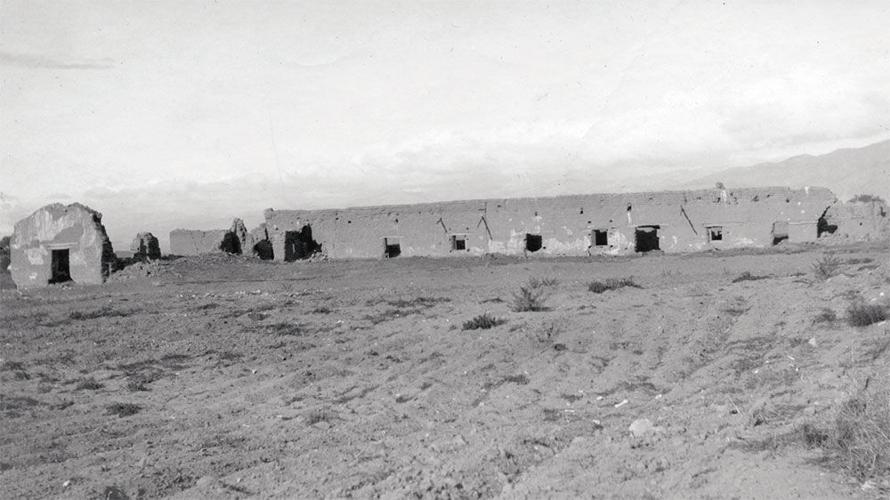
The Soledad Mission, seen here circa 1890, was in complete disrepair by that time, and for good reason: California’s mission system, established by Spain starting in 1776, was never self-sustaining – the missions required continual subsidies from the Spanish crown for upkeep and sustenance, not to mention what was essentially slave labor from ostensibly “converted” indigenous peoples who – once “converted” – became prisoners not allowed to leave, even if they wanted. When Spain ceded Alta California to Mexico in 1821, the mission’s physical structures began a slow, steady decline.
FRIDAY WE PUSHED ON ALL DAY, FACING THE WIND. We met a train of seven wagons, with tents and beds – a party of 25 or 30 persons from San Jose going to the hot springs, some on horseback. Two-thirds were ladies. A curious way for a “fashionable trip to the springs,” you say, but the style here. They will camp there, and have a grand time, I will warrant. [Note: Brewer appears to be describing what is now known as Paraiso Hot Springs west of Soledad.]
We kept [to] the left bank of the river, through the Mission Soledad. Before reaching it we crossed the sandy bed of a dry creek, where the sand drifted like snow and piled up behind and among the bushes like snow banks. The Mission Soledad is a sorry looking place, all ruins – a single house, or at most two, are inhabited. We saw the sign up, “Soledad Store,” and went in, got some crackers at 25 cents a pound, and went on. Quite extensive ruins surround the place, empty buildings, roofless walls of adobe and piles of clay, once adobe walls. It looked very desolate. I do not know where they got their water in former times, but it is dry enough now.
We came on 17 miles farther. Here we find tolerable feed and a spring of poor water, so here is a ranch. Sorry as has been this picture, it is not overdrawn, yet all this land is occupied as “ranches” under Spanish grants. Cattle are watered at the river and feed on the plains, and scanty as is the feed, thousands are kept on this space, which must be at least 4,000 to 6,000 square miles, counting way back to the Santa Lucia Mountains. The ranches do not cover all this, but cover the water, which is the same thing. We could see a house by the river every 15 to 18 miles, and saw frequent herds of cattle.
THE SEASON IS UNUSUALLY DRY, and the plain seems much poorer than it really is. In the spring, two months ago, it was all green, and must have been of exceeding beauty. With water this would be finer than the Rhine Valley itself; as it is, it is half-desert. As to the actual capability of the plain, with water, the Pacific Railroad Reports state that “At Mr. Hill’s farm near the town of Salinas, 16 miles east of Monterey, 60 bushels of wheat have been raised off the acre, and occasionally 85 bushels. Barley, 100 bushels, running up to 149 bushels, and vegetables in proportion” (VII, Pt. II, 39).
We passed through a flock of sheep, the largest I have ever seen, even in this country of big flocks. It was attended by shepherds, and must have contained not less than 6,000 sheep, judging from the flocks of 2,000 and 1,500 we have seen often before. Some of our party thought there must have been 8,000. Sheep are generally kept in flocks of not over 1,800 head. High mountains rise on the opposite side, in the northeast, and still nearer us on the left. These latter were very rugged – from 3,000 to 4,500 feet high, black, or very dark green, with chaparral – yet not abounding in streams as one would imagine, although now only early in May.
The Nacimiento and San Antonio rivers are the only tributaries of the Santa Margarita and Salinas valleys on the west side, this side of Atascadero Ranch – that is, only these two streams for a distance of 120 miles. And, from leaving the San Antonio, 61 miles back, we have not crossed a single brook or seen a single spring until reaching this ranch, where there is a spring.
Yesterday I climbed the ridge southwest of camp. I ascended about 3,000 or 3,500 feet, a hard climb, and had a good view of over a hundred miles of the Salinas Valley from the Bay of Monterey to above where we last struck it, or over the extreme limits of about 130 to 150 miles, with the successive ridges beyond. Four-thousand to 7,000 square miles must have been spread out before me. I have never been in a land before with so many extensive views – the wide valley, brown and dry, the green belt of timber winding through it, like a green ribbon, the mountains beyond, dried and gray at the base, and deep green with chaparral on their sides and summits, with ridge after ridge stretching away beyond in the blue distance. Then to the north, a landscape I had not seen before, with the whole Bay of Monterey in the northwest. To the west and south of me was the very rugged and forbidding chain of mountains that extends from Monterey along the coast to San Luis Obispo and there trends more easterly – the Sierra Santa Lucia.
I have found much of intense geological interest during the last two weeks. I had intended to spend at least two weeks more in this valley had we found water or feed as we expected. Not finding it, and having four weeks on our hands before the rendezvous with Professor Whitney at San Juan, I decided to push on to Monterey, which I had not intended to visit. We are now within eight or 10 leagues of there – will be there in a few days. I feel now that we are indeed working north and I long to be in San Francisco again. It is now over five months since I have attended church (Protestant) and have only had that privilege three times since I left New York.
Sunday Evening ~
Today has been a windier day on the plain than any other day we were on it. I am glad enough we are sheltered here in camp. Clouds of gray dust, rising to the height of 5,000 or 6,000 feet have shut out the view in the north all the afternoon, and even the hills opposite could not be seen at times, and all day they have been obscurely seen through this veil. If it is thus in May, what must it be here in July or August, as no rain will fall for at least four months yet!
It was interesting yesterday, while on the peaks above, to watch the great current of air up the valley, increasing with the day until at last the valley seemed filled with gray smoke. While speaking of the plain, I forgot to mention the mirage that we had. The sun on the hot waste produced precisely the effect of water in the distance; we would see a clear lake ahead, in which would be reflected the objects on the plain. This was most marked on the dry sands near Soledad – we could see the trees at the Mission mirrored in the clear surface – but it kept retreating as we advanced. The illusion was perfect. At times the atmospheric aberration would only cause objects to be distorted – wagons and cattle would appear much higher than they really were, as if seen through poor glass.
The Weekly will continue to publish Brewer’s letters from Monterey County. The next installment of Brewer’s letters will take us into Monterey, circa 1861, and then on to Pebble Beach – at the time, called Pescadero Ranch – where Brewer marvels at the marine life he sees in the tidal zone. One piece of that section that haunts the reader, and reflects the cyclical nature of history, is when Brewer gets his hands on a newspaper from New York, which had arrived to Monterey from New York in just 11 days via the Pony Express: “I cannot write how heavily the national troubles bear upon my mind, they are in my mind by night and by day,” he writes. “God grant that we may yet save the United States.”
(0) comments
Welcome to the discussion.
Log In
Keep it Clean. Please avoid obscene, vulgar, lewd, racist or sexually-oriented language.
PLEASE TURN OFF YOUR CAPS LOCK.
Don't Threaten. Threats of harming another person will not be tolerated.
Be Truthful. Don't knowingly lie about anyone or anything.
Be Nice. No racism, sexism or any sort of -ism that is degrading to another person.
Be Proactive. Use the 'Report' link on each comment to let us know of abusive posts.
Share with Us. We'd love to hear eyewitness accounts, the history behind an article.