

They called it The Jesus Pot.
Virginia Ruth Jackson would boil up so much spaghetti in the towering metal cylinder that to her young grandson Orlando Johnson and his aunts, uncles, brothers and cousins, it seemed to have everlasting life.
Even with 17 people (four generations all told) living in Jackson’s Seaside home at one point – with Orlando and two cousins using the living room as their bedroom – the pasta persisted.
Every time it seemed like it should be finished, there was more. When everyone thought it was done, it would dish out another serving.
One would think Johnson, the youngest surviving member of Jackson’s house up there at 1484 Sonoma in Seaside, would’ve been done. Long ago.
He never met his dad. His mom, whose three boys were born to three different fathers, was murdered 25 years ago, when he was 1. It happened at the bottom of a downward spiral into crack cocaine, in Seaside’s Darwin Park. The killer left her strangled and partially burned. No one was ever charged in the crime.
When Orlando Johnson was 7, he lost his great grandma, aunt and two closest cousins – each of whom he lived with – to a house fire at the home they shared, after a bad space heater sparked Christmas decorations.
To make it all the more painful, his best friend and constant companion, cousin Angel, was among them. Little Orlando would’ve likely been dead along with them if his brother Robbie hadn’t sent his girlfriend to pick him up for a visit before the blaze. In fact, his other brother Jamell Damon thought he was gone until Damon had to identify the bodies.
Angel begged Orlando to let her join him on the trip. There was no room in the car, so he’s left with the memory of her on the other side of the gate, pleading, crying. The bars on the house’s doors and windows, there to discourage break-ins, helped seal her fate.
• • •
Virginia Ruth Jackson helped bring hundreds of Peninsula natives into the world as a nurse in the maternity ward of Community Hospital of the Monterey Peninsula, so it makes sense she was the type of person who was the first to welcome new staff members, neighbors and churchgoers to her world.
She helped lead the local chapter of the NAACP, earning a regional award for community-building along the way. She was appointed church mother at Friendship Baptist Church in Seaside. She was a frequent presence at City Council meetings. She met with the police chief on occasion. To this day her offspring marvel at the generosity she showed others: Damon remembers seeing her slip money to neighbors on hard times so they could buy something to eat.
She was a giver. Maybe the most important thing she gave Orlando and his brothers, cousins, aunts and uncles: sports.
They were a prerequisite at 1484 Sonoma. She and her husband Tommy Jackson Sr. both served as presidents of Seaside’s youth baseball organization. She ran the snack bar, among myriad other duties. Everyone in her house played some sport.
One of them is Orlando’s uncle, Chris Jackson, now varsity baseball coach at Alisal High, JV basketball coach and an assistant for varsity football.
“We had a big family and that’s all we did,” he says. “If we didn’t have sports, living in a tough neighborhood, it would’ve been brutal. It was our outlet.”
“They raised us on sports,” Damon adds. “That’s what we grew up on.”
Intelligent human beings can disagree on whether our society should dedicate so much attention and treasure to sports. But for a family like this one, how and why sports matter is self-evident.
• • •
Orlando Johnson’s story is one of family, community, violence and tragedy, wherein nightmares lead into unlikely pro basketball dreams. But it’s also a story about understated toughness, passed down across generations.
It was a daily discipline for Virginia.
“Seeing her work every day all those years and then come home and cook for so many had an impact on me,” says Damon, 39. “It had an impact on all of us.”
Robbie, now 44, elaborates. “That’s how it was,” he says. “She never complained, she just did it. She made it happen. So we did too. That’s all we knew.”
Her resolve grew more apparent when tragedy struck.
“She was strength,” Damon says. “Just strong, man. To this day I’m amazed.”
From 1989-1995 she lost seven close family members. That included her mother, sister, son, daughter, grandkids and husband Tommy, an ex-Army staff sergeant who helped instill accountability, self-determination and a love for sports.
“To not see her break, it made it easier to move on,” Damon says. “Seeing her work every day all those years, taking care of all those kids in her house… ”
He lets the thought hang there, then adds: “If she ever took a vacation it was to do something with us.”
After she retired, she volunteered at the hospital two more years. One day she sat on the couch talking to a neighbor by phone when a blood clot found its way to an artery in her heart.
Orlando was 11, in middle school, when he got a note from the office sending him home.
Today, like his brothers, he carries her close.
“She took on the challenge of raising my aunties, uncles, brothers, cousins, and never let none of the trials and tribulations get in the way of providing for us,” Orlando says. “Watching her hustle – watching her work – makes me push to be as good as her. If I can do that, I’ll be pretty happy with my life.”
• • •
American men are far more likely to get hit by lightning than to make the National Basketball Association. Millions and millions play the sport worldwide, but the 30 NBA teams carry only 15 players each.
No one from Monterey County had ever done it, in fact, before Orlando Johnson.
There were no shortage of people telling him he couldn’t. But when life throws unexpected things at you, you start to worry less about what is or isn’t likely.
The first one to tell him he should try something else, ironically enough, was one of his biggest supporters.
His older brother Jamell Damon helped raise Orlando after their mother’s murder. After Virginia Jackson’s heart stopped, he ultimately took over primary caretaking duties, though he was in his early 20s and figuring things out himself.
Damon was convinced that Johnson’s best shot at pro sports was football, and he had a point. Johnson starred at quarterback at North Monterey High School as early as his sophomore year, with speed, strength and an arm capable of 68-yard throws. After a transfer to Palma High he grew to 6 feet 5 inches and 220 pounds and evolved into a dominant wide receiver. He started fielding a range of Division I scholarship offers after just one season at the position.
Johnson’s football coach saw the offers, and how much Johnson loved basketball. He told him to abandon the distracting second sport. Damon insisted – and does to this day – that football would’ve been a far more manageable path to the pros. The odds are certainly better. Dozens of locals have done it.
Only Johnson didn’t listen. Instead, he rejected the offers and his coach. He quit football to focus on basketball.
• • •
El Dorado Park. Closter Park. Laurelwood Park. Central Park. Wherever there was a pickup game in Salinas, Johnson was there. If there was a traveling basketball team, he was on it. Every open gym, he was in.
“We went to some tough neighborhoods,” Damon says. “As long as there was a game there.”
Every free moment, Orlando gravitated toward the court. That was the thing: He enjoys playing that much. As a quiet, steady type, Johnson doesn’t gush. The closest he comes to it happens when he talks about family or hoops.
“I just love to be out there,” he says. “Basketball would bring me peace.”
That ultimately softened Damon’s football stance, which is why he carted Orlando to so many courts for so many years: “I saw he loved it. Football was the easiest route. Now that I look back at it, I see to become a professional athlete you have to have your heart in the game, to do it every day, with excellence. Basketball was that. Nothing was going to stop him.”
• • •
Palma’s basketball Head Coach Paul Alioto doesn’t remember Orlando missing a practice, ever. He remembers him adding practices, motivating teammates to join him for predawn workouts while the rest of the school slept. Orlando would report to the gym at 5am to put up some 500 shots.
“His work ethic was off the charts for a kid his age,” Alioto says. “He had a great focus and desire to maximize his talents.”
When he settled at UC Santa Barbara after a stint at Loyola Marymount, his drive again differentiated him. Even during his post-transfer redshirt year, before he was allowed to play, he was first to arrive and last to leave.
His sophomore season at UCSB he earned league most valuable player honors. Across three years he averaged around 20 points and made all conference each season. When he graduated with a degree in sociology, he was the school’s all-time leading scorer and earned a spot on the roster for the World University Games’ U.S. squad. His teammates, a collection of the best college players in the country, voted him flagbearer for opening ceremonies.
“It’s a moment I won’t forget,” he says. “There are a lot of people who could’ve been chosen. For them to choose me and represent the country, it’s a real honor.”
• • •

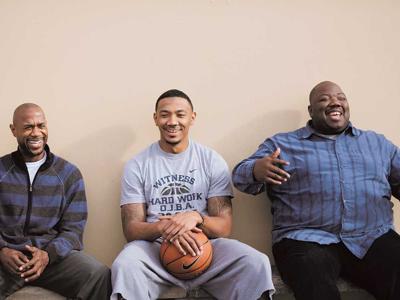
From left, brothers Robbie Johnson, Orlando Johnson and Jamell Damon. “They shaped me into the man I am today,” Orlando says.
Orlando Johnson idolizes NBA greats Shaquille O’Neal, Paul Pierce and Gilbert Arenas. But his favorite player never made the NBA – and happens to be the one most responsible for Orlando making the NBA himself: His oldest brother, Robbie.
“I started falling in love with the game watching my brother play,” Orlando says. “I wanted to be like him.”
While Damon – a decent basketball player and an all-county football player – filled a fatherly role, bringing Orlando to live with his young family while he worked at Pepsi Co., Robbie took on a coach-like capacity.
Few in the area could be better suited. He remains one of the best pro basketball prospects to hail from Monterey County, a long, fast point guard and suffocating defender who went on to make all-conference at Weber State and play professionally in Croatia.
He has trained players for a decade, and currently runs the Orlando Johnson Basketball Academy. It’s based out of various gyms around Monterey County, and includes a traveling team and summer camps for student athlete ages 10-18 from Salinas to Carmel.
Robbie preaches defense and humility, to Orlando more than anyone else.
“It was, ‘You were good but here’s where you can do better,’” Robbie says. “I wasn’t doing it to put him down. I just wanted him to be the best. I didn’t want him to get complacent.”
When asked about his relentless work ethic, Orlando doesn’t hesitate. “That’s Robbie,” he says. “He instilled it in me. He was always in my ear. When it came to the game, he always said, ‘The more time you put in, the better you’ll become.’”
“We were definitely demanding,” Robbie says. “Coming that close myself allowed me to remind him there’s more work you can do to prepare yourself.”
The only time they haven’t communicated constantly – they still talk just about every day – was when Robbie saw Orlando getting “a little big for his britches” after Palma won the Central Coast Section championship and Orlando took player-of-the-year honors. Robbie challenged him to 1-on-1 and dealt him a sound defeat. Orlando didn’t talk to Robbie for three days.
“It was ‘You’re good, but you’re not that good,’” Orlando says now, laughing. “I was mad. After that, I got back to work. And I took it to him a year later.”
As it would turn out, something more humbling lay in wait.
• • •
Longtime Boston Celtic and NBA Hall of Famer Larry Joe Bird ranks comfortably among the best – and most popular – players to lace up sneakers. He happens to be one of Robbie’s favorite players, and by inheritance, Orlando’s. He also delivered the most joyful effect on Orlando’s NBA career.
Bird, then president for the Indiana Pacers, selected Johnson in the second round of the 2012 NBA Draft, paying $2.5 million to trade up to the 36th slot. He inked Johnson to a guaranteed two-year contract, an unrequired rarity among non-first round picks. Bird liked how Orlando worked.
Pacers President Donnie Walsh, who succeeded Bird, said Johnson improved more quickly than any rookie he could remember, telling Pacers staff writer Mark Montieth: “It’s all through work. He’s an extremely mature kid. He doesn’t get up or down. He never reacts. He just plays.”
Johnson savored the time spent with veterans like his latest big brother figure, David West, working long hours with All-Star Paul George and playing in front of dozens of relatives in L.A.
After two seasons with the team – and on the eve of a playoff push with a group of guys who had become family – Johnson was among those stunned he was cut, to clear a roster spot in a trade.
Basketball had been a place he could escape life’s cruel twists, where he could exact his will. Now his sanctuary dealt him a reminder nothing’s guaranteed.
As Robbie says, “He couldn’t control everything: He could be here one minute, gone the next.”
But he wasn’t without perspective.
“A lot of the events in Orlando’s life go beyond disappointment,” Robbie says. “It gives him patience. He’s never been handed anything. He had to work for all of it. Nothing came easy. He had to fight for all of it.”
• • •
Orlando soars over the hardwood floor, swooping in from behind a driving player and pinning his shot against the glass backboard. He drifts beyond the three-point line, catches a pass and flicks a flawless jump shot into the hoop. He head-fakes his man in the air and blows by, finishing artfully with his left hand at the rim.
Polished YouTube highlights from his NBA and college career present a portrait of a complete player.
Like his NBA scouting sheet read before the 2012 draft: “Scores in a variety of ways. Great 3-point shooter. Rebounds his position well. Competes. Good passer. 7-foot wingspan. Good leaper. Work ethic.”
But it’s a rougher clip from a fan that bodes best for the upcoming NBA season, which tips off at the end of the month.
He dodges traffic on a fast break, pivots away from a defender with a nifty bit of footwork, rises and thunders down a dunk.
The crowd booms – and does again and again with each replay on the stadium jumbotron – screaming in… Filipino.
This is how Orlando faced down the news he was cut. Like he always has. He went to work. And kept playing.
He played in the NBA’s developmental league. He played in Spain. Most significantly, after participating in the 2015 NBA D-League Playoffs, he played the rest of the summer in the Philippines for Barangay Ginebra San Miguel, amassing 33 points and 11 rebounds a game.
The opportunities abounded, and confidence that had been contained by limited minutes in the NBA started to flourish again.
“I want to be part of something special, I want to be useful,” he says. “In the Phillipines I got back to being me. It was exactly what I needed.”
• • •
The NBA preseason opened this week. Johnson has been training most recently with the one of the most dominant dynasties in professional sports, the San Antonio Spurs, who carry his contract.
He will most likely start the season in the NBA’s developmental league as a member of the Austin Spurs. That means he would travel to Santa Cruz to play the D-League defending champion Santa Cruz Warriors Nov. 27.
In the meantime he’s completing two workouts a day with Santa Barbara’s Peak Performance Project, starting at 7am with skill work, ball-handling and offensive sets, followed by weightlifting and conditioning, then yoga and another gym session heavy on jump shots. It’s a lot of work, but quality work, as laser-focused as his nutritionist-directed diet.
Meanwhile, doubters still chase like a press defense, pushing him to pursue surer odds and higher salaries overseas.
“They ask me why I don’t stop focusing on the NBA and go play in Europe and make money while I can,” he says. “They tell me to give it up.
“Some people say I’m crazy or stupid. But it’s my life. I wouldn’t be doing myself justice if I gave up now.”
• • •
Up on the top of Seaside, near 1484 Sonoma, on Highland Elementary playground, time is running out.
Not so much on 26-year-old Orlando Johnson’s window of opportunity, though that’s not infinite either. Nothing is. Even the Jesus Pot eventually ran out.
The clock is dropping toward zero.
10… 9…
His brother and surrogate father Jamell Damon calls out the numbers.
8… 7…
His brother and surrogate coach Robbie Johnson looks on, smiling.
6… 5…
Earlier they laughed at old stories of all the boys in the house – the games of sock basketball, tin-can baseball, Donkey Kong video game tournaments at Nations corner store, dance contests in the living room.
4… 3…
Somehow their story contains so many smiles it makes your cheeks hurt as much as your heart.
2…
They have gathered for a photo shoot, but Orlando can’t resist taking a few shots. He wants the ball in his hands. He wants the pressure of disappearing time.
1…
He lets the ball go. It arcs high into a big sky and rushes through the net.
Swish.
Orlando Johnson wants to redeem his grandma’s, his brothers’, his own hard work. He wants to get better. He wants to play. As much as anything, he wants to prove he’s far from done – that there’s plenty more pasta in the pot.
(0) comments
Welcome to the discussion.
Log In
Keep it Clean. Please avoid obscene, vulgar, lewd, racist or sexually-oriented language.
PLEASE TURN OFF YOUR CAPS LOCK.
Don't Threaten. Threats of harming another person will not be tolerated.
Be Truthful. Don't knowingly lie about anyone or anything.
Be Nice. No racism, sexism or any sort of -ism that is degrading to another person.
Be Proactive. Use the 'Report' link on each comment to let us know of abusive posts.
Share with Us. We'd love to hear eyewitness accounts, the history behind an article.