



MRS. CHERRY OF THE CARL CHERRY CENTER FOR THE ARTS IN CARMEL is poets Lena Yates, Lena Burton, Emma Yates, Lena Dalkeith and poet/painter Jeanne D’Orge, a mercurial heroine of this story, an unstoppable force whose life story embodies a bohemian idyll. She was a woman who had a great role in shaping Carmel as a city of arts. In her later years, Mrs. Carl Cherry became an important arts benefactor, whose legacy, now commonly known as The Cherry, still lasts.
Despite a troubled private life, Mrs. Cherry is a great example of artistic integrity; she was committed to be herself and reserved her energy not to play a certain societal role, but to practice arts.
This red-haired poet, painter, feminist and harpist still surprises as she always did, walking around Carmel in the 1920s in one of her Chinese robes, splattered in paint.
Abandoned by her father in early childhood, she always lived as if she had nothing to lose. Her personality was shifty, her urges immense, her interest in arts, poetry, music, visual arts and theater boundless.
Did she love arts as much as she loved Carl Cherry, for whom she left her husband and her teenage children? Would she have risked a social scandal and leaving a bohemian life in England’s North Midlands, where she was born and grew up?
It is important for Monterey County today to keep Mrs. Cherry in mind, 100 years after she started her life here. She was a staple in the history of bohemian Carmel. Jeanne D’Orge – as we will call her from now on, since that was her ultimate preference – left many treasures behind. The pearl is The Cherry, formerly the Carl Cherry Foundation, a multidisciplinary art venue, where poetry is still read, art is exhibited and music and theater thrive.
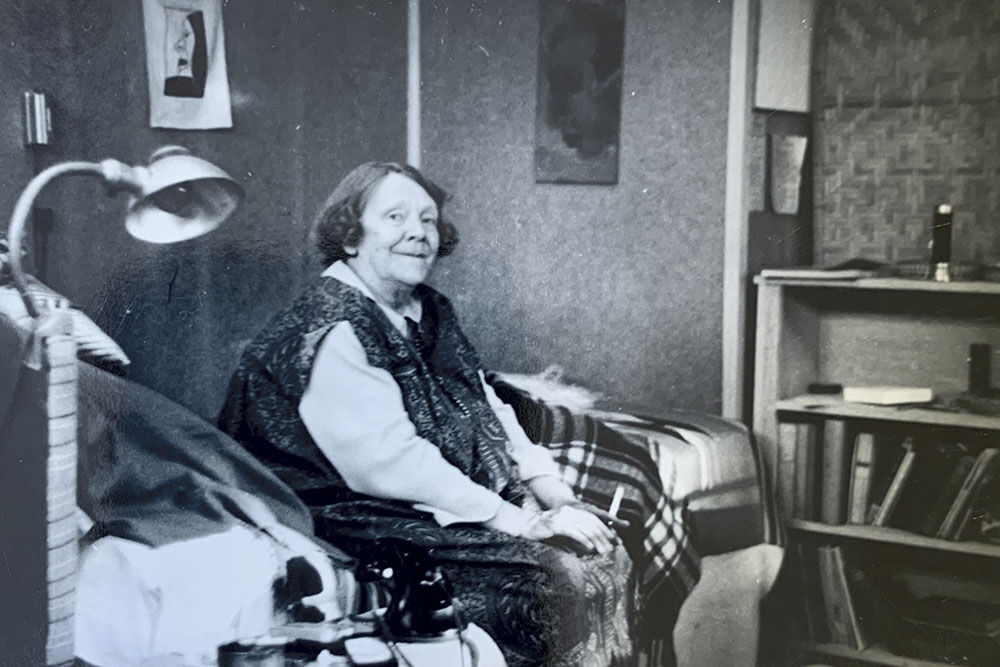
Mrs. Carl Cherry – more widely known as Jeanne D’Orge throughout her adult life – photographed in her later years.
LENA YATES DIDN’T LIKE HER GIVEN NAME. She had been experimenting with nicknames since childhood in the UK in the 1880s and ’90s when, in letters to her beloved mother, she called herself “Chicken” and “Speckles.”
D’Orge’s father was a seed merchant named Walter Yates who disappeared from the picture immediately after she was born. On the contrary, she remained close to her mother and brother all her life. When she got married for the first time, she took her mother along to the U.S. from Europe.
According to her friend, puppeteer François Martin, who in 1960 built and owned the Tantamount Theater in Carmel Valley, she eventually chose Jeanne D’Orge as her default artistic pseudonym because she greatly admired Joan d’Arc, another groundbreaking feminist who feared nothing and followed her instinct, the patron Saint of France. Her lover and second husband, inventor Carl Cherry, would always call her “Jan.”
D’Orge grew up in Edinburgh, later in nearby Dalkeith – from where one of her nicknames comes from – and had traveled a lot in her youth, including to Paris. In the poems in her volume Voice in the Circle, one can trace her childhood experiences, including visiting a world where, unlike her, other children had a father.
In 1900, D’Orge gave birth to a child who was given up for adoption, undoubtedly leaving another trauma that later certainly influenced future decisions in life, also regarding children and maternity. In 1906, while on a walking tour of France, she met Alfred Burton, an American topographer and at some point a dean of the Massachusetts Institute of Technology – and a man 20 years older. They married the same year. While it’s hard to speculate if Alfred Burton filled the void and served as a fatherly figure in her early womanhood (she was 27), at some point, D’Orge told one of her friends that she married Burton because she thought he was a kind man.
D’Orge came to the U.S. with her husband and mother. She first arrived in Boston, but D’Orge lived also in New York for a brief time, eventually settling in Carmel in 1920. Children were born, years passed, the marriage ended and somehow a new world of possibility opened: By abandoning her husband and teenage children, D’Orge finally found time to become her full self. It cost her close relationships with her adult children who moved on, picking up studies or living with relatives from Burton’s side of the family.
She left for love and it certainly helped that both partners were committed to the same lifestyle. She left to pursue not only love, but also a bohemian lifestyle.
While D’Orge had been a writer since she was a child and at the moment she arrived in Carmel, she was already a published poet, but not yet a painter. Only then, after leaving her family, she gained time to become a full-time artist. That was the beginning of the bohemian life of Jeanne D’Orge, now becoming her full self – with all the consequences, pain, hard work and poverty that comes with choosing that kind of path.
EVEN THOUGH D’ORGE IS KNOWN FOR HER MANY PAINTINGS, she was a writer first. She became a playwright by the age of 20 and published poems in London before she moved to California.
She first revealed herself as a poet in 1913 when she participated in New York’s Armory Show, also known as the International Exhibition of Modern Art, where she read some of her poetry.
In 1916, D’Orge released a collection of verse titled Prose Chants, published under the pen name Lena Dalkeith Burton. In 1916, she made her debut as Jeanne D’Orge in the literary magazine The Little Review, publishing literature and art. In 1918, she published in Others: Magazine of the New Verse in New York, associated with modernist poets such as Pulitzer Prize-winner Wallace Stevens and Ezra Pound.
From that early period came “The Little Tailor Meditates,” published in 1917:
… My idea would be to do away with the star- / manufactured / ready made garments / they never fit / like a suit cut to measure… / then there’s too much putting on and off / too much running in and out /like a dog at a fair / in this business of birth and death…
As the poem shows, Jeanne D’Orge was a modernist too; she dropped rhyme and logic and let herself practice with her own stream of consciousness.
During her Carmel years she wrote two more volumes of poetry: Lobos, published in 1928 and recently reprinted by The Cherry, and in 1955, Voice in the Circle. The first was later proclaimed as a milestone in the literary life of Carmel where it was, and still is, hard to find an artist who is not in awe of the energy of Point Lobos.
After the publication of Lobos, D’Orge received kind letters from Robinson Jeffers and Edward Weston, who shared her feelings toward the Central Coast’s nature.
“She was also writing about a spiritual connection with the land,” says Anne Mitchell, a board member of The Cherry and a poet who writes about Point Lobos. “Her poems also speak about her life as a woman.”
D’Orge’s poetry is expressive, autobiographical, practical; she writes about her family, friends, even doctors. As we read in Voice in the Circle:
The third circle is my old Scotch nurse / Who scolds me because she loves me.
Sometimes the lyrical subject seems like the voice of a child, bombarded by everyday experiences. The poet’s subject matter can be anything, from the experience of waking up to a railway train. Hers is an “I poetry,” honest and not ashamed of itself, even simple.
In the poems from Lobos, D’Orge speaks in a different, mature and spiritual tone, just like her own human voice. It’s a voice with traces of Scottish accent.
The most dominant word in Lobos is the word “rock,” proof that the poet’s existence is experienced through a connection to land. D’Orge never stopped looking at Point Lobos as a surprise, a caprice of nature, a miracle that astonishes whenever one takes a look.
Over her long life, D’Orge wrote quite a lot. In addition to poetry, there are reviews, plays and even opera, all contained in The Cherry’s archives.
THE WORD “BOHEMIAN” comes from the Latin name for the largest historic region of what now is the Czech Republic. Later, the term was used in reference to the Roma people. Transplanted to the U.S., bohemians practiced an unconventional lifestyle, movement, music, dances, devotion to arts – and perhaps sexual promiscuity.
There is an iconic photo often used to illustrate Carmel bohemians. On a hill we see poet Robinson Jeffers and his sons, future Mrs. Cherry, her then-husband Alfred Burton and painter William Silva. They are resting on the slope of a hill. The grass is combed by the wind. Their faces are serious, their Victorian clothes striking compared to the landscape around them, a bit like “A Sunday on La Grande Jatte” by post-impressionist painter Georges Seurat or “The Picnic” by Édouard Manet, except no one is naked. There is another, perhaps more famous photo of Carmel bohemians: that of George Sterling, Jack London, Mary Austin and James “Jimmy” Hopper on the beach at Carmel (taken by photographer Arnold Genthe) that reflect almost identical ideals: camaraderie, physical contact with nature and simplicity.
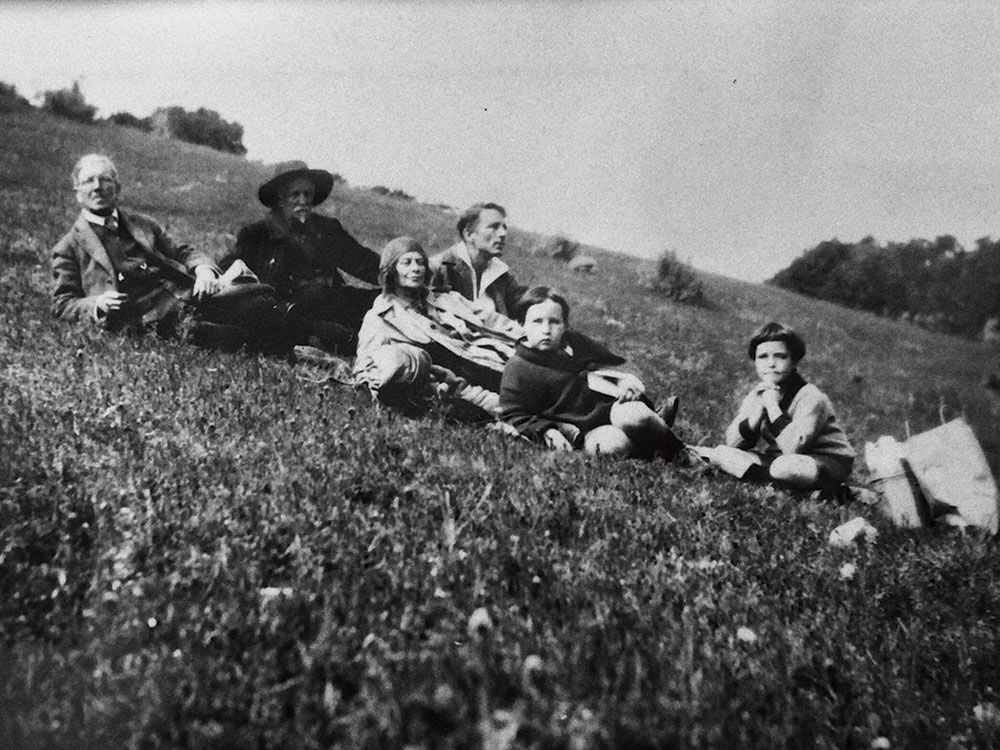
Picnic, circa 1923. From left to right: Alfred Burton, painter William Silva, Jeanne D’Orge, Robinson Jeffers and his twins, Donnan and Garth Jeffers.
D’Orge’s development as a poet was shaped by her Scottish education and exposure to the Scottish Renaissance, but also by English and Irish authors, such as William Butler Yeats, Thomas Hardy and Oscar Wilde. On the contrary, D’Orge’s development as a painter took place only after she moved to Carmel.
Alfred Burton and Mrs. Burton took a house on San Carlos Street and lived merrily. That is, until this 46-year-old mother and wife left them for a man in his 20s.
Life on San Carlos Street was far from dull. Burton shared his wife’s passion for theater; commedia dell’arte performances were a regular occurrence in the house. Alfred Burton was at some point the vice president of the Forest Theater (both Cherries served on the board); he was also involved with the Carmel arts.
All three – Burton, D’Orge and Carl Cherry – got close through the Forest Theater, after Burton had been Cherry’s mentor at MIT. In 1921, Burton and Cherry worked together on Countess Cathleen for the Forest Theater; Cherry was good with lights.
It was already untoward when D’Orge, before she was Mrs. Cherry, became a Carmel’s newspaper carrier, but when, in 1925, she just walked out on her husband and teenage children for Carl Cherry in the middle of the night, the city was in shock.
The affair quickly became quite serious. The couple discovered they were soulmates, to the point that they communicated in silence.
“They were in love all the time,” Rosalind Sharpe Wall wrote in her 1978 book, About Jeanne D’Orge and Carl Cherry. They had their own existence.
Carl Cherry was not your average Joe. Small, kind and quiet, he was a talented inventor who in 1936 created the blind rivet, a breakthrough in the aircraft and shipbuilding industries. Patented as the Cherry Rivet in 1939, it was widely used during World War II.
They loved working in the same house too, happy to drink strong coffee and eat a diet that consisted of boiled eggs and sardines. D’Orge would smoke a lot of cigarettes; they did not drink alcohol.
“It’s amazing to me that she lived out of the norm for a woman her age who broke a lot of rules,” Mitchell says about D’Orge’s “bad behavior.” In fact, Mrs. Cherry remained mischievous her whole life, eager to take action, such as take a trip to Lompoc to see a solar eclipse, and to learn about Zen, Kabbalah or theosophy. Children liked her and she loved to participate in the entertainment of her era: singing alone, reading out loud and acting in plays. D’Orge also had a special fondness for puppet theater. There were also rumors that there were spiritual seances at the Cherries’ home. In fact, D’Orge developed another, less documented, bohemian group around those mysterious gatherings. We don’t know the names of the members.
The “Wild Cherries,” as they were called, lived in the fifth-oldest house in Carmel, formerly the Augusta Robertson cottage that then belonged to the Cherry family and now houses the Carl Cherry Center for the Arts. It was a two-story Victorian building, remodeled by the couple who removed the top story and had a ceiling skylight installed.
With time, especially after Carl Cherry’s death, D’Orge came to be treated by the artistic community as a guru.
D’ORGE’S DESCRIPTION OF WRITING as if being touched by outside invisible force likely applies to her paintings too. She left about 1,200 works behind; some speculate that large works are missing from The Cherry archives.
She took up painting in 1927, when she and Carl settled in the house on Guadalupe Street. D’Orge never studied painting and claimed she didn’t have a “technique” as a painter. She didn’t even consider her work as fine art, agreeing with some of her future critics.
“Artists should be anonymous,” she was quoted as saying in Better Than Beauty: The Life and Work of Jeanne D’Orge by Jane Wilgress, who later became the director and curator of The Cherry. “People should know their work but not the artist.”
Her art was never for sale: “How can I sell my ecstasies?” she once said.
A few pieces were likely sold during her second exhibit at the Pat Wall Gallery in 1946; the first exhibit of 20 pieces took place in 1939 at Sibyl Anikeyev’s photography studio in Monterey. She was willing to show her works in smaller local venues, but decided her works would stay with The Cherry to never enter the marketspace.
Her visual art was modernist too, perhaps too experimental for its time. She never belonged to any art organization. It is said that Salvador Dali visited D’Orge and was surprised and delighted with her work.
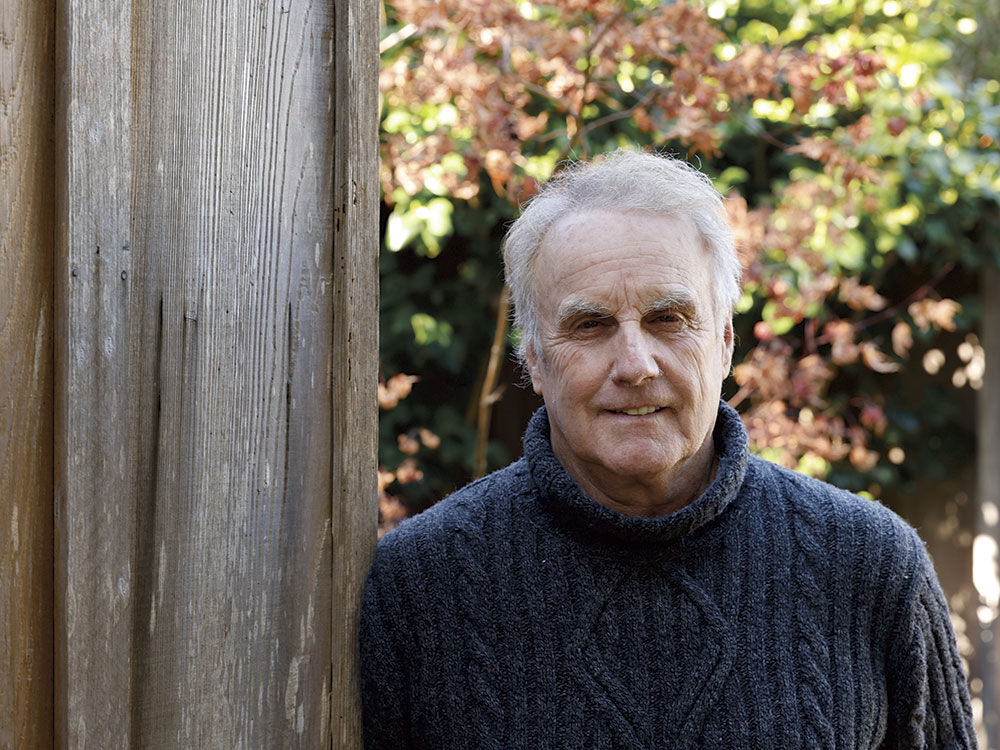
Robert Reese has served as The Cherry’s executive director since 1987.
Oscillating between abstract and landscape painting, her muted palette pieces (some on wood) become more dramatic the more a viewer analyzes them up close. In the 1960s, she had an exhibit at The Cherry, where her works rest now, waiting for another opportunity to shine.
IN THE 1940S, before Carl Cherry died of spine cancer, the Cherries became rich due to his 1936 invention of the Cherry Rivet. Being a rich widow can instantly repair one’s reputation. From a talked-about hussy, D’Orge became a wealthy art benefactor.
In 1949, two years after Carl Cherry died, Virginia Lee Burton came to visit her prodigal mother. That did not fix their complicated relationship. Nonetheless, D’Orge had enough energy to sketch her vision for the Carl Cherry Foundation, which she had created a year earlier. She wanted a gallery and a space for experimental arts and science and a place for serious lectures with speakers, such as American sexologist Alfred Kinsey. After her death, a theater was built deep inside the house, in a space that had previously been Carl Cherry’s workshop.
In 1949, The Cherry went through a renovation. A few years later, Mrs. Cherry moved to Carmel Valley, becoming more and more interested in the Tantamount Theater, a puppet theater. D’Orge returned to Carmel to live the last year of her life. After she died of a heart attack in 1964, her ashes, just like Ansel Adams’ and Ed Weston’s ashes, were scattered at Point Lobos.
Still, her mission lives on in the The Carl Cherry Center. Located in what had been Augusta Robertson’s old cottage, it is often beaming with lights and sounds of music today.
THE FRIENDS AND RELATIVES OF MRS. CARL CHERRY were left with 1,200 of her artworks, as well as papers, correspondence and finally, the foundation. For a while, Virginia Lee Demetrios née Burton was on the board, by then a published writer and illustrator of children’s books, including the 1939 classic Mike Mulligan and His Steam Shovel.
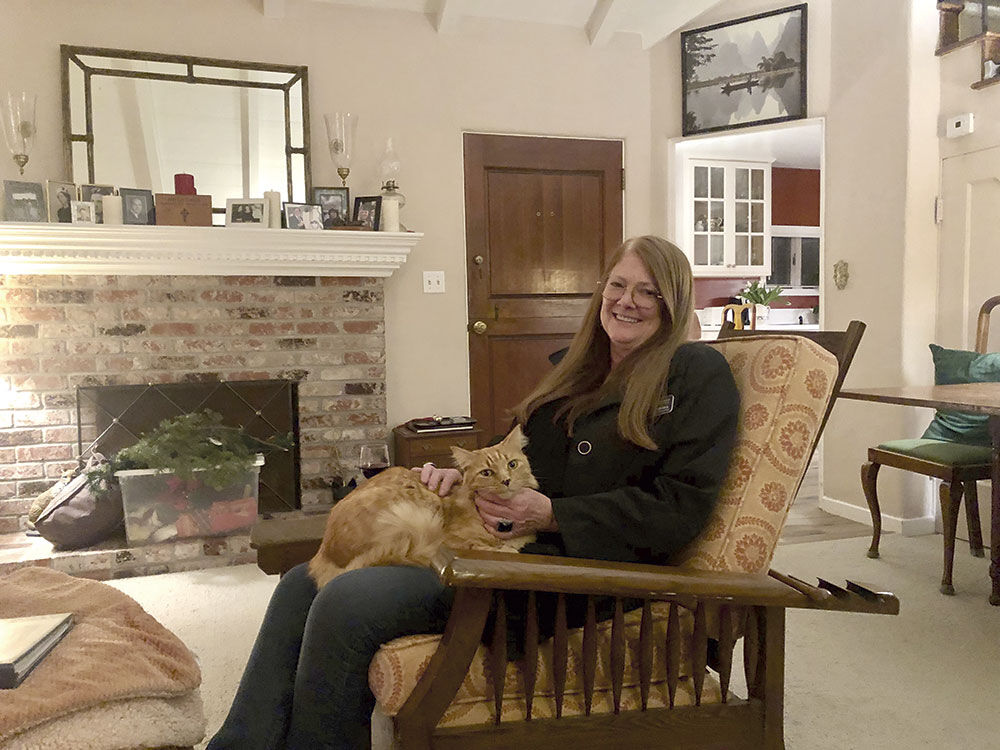
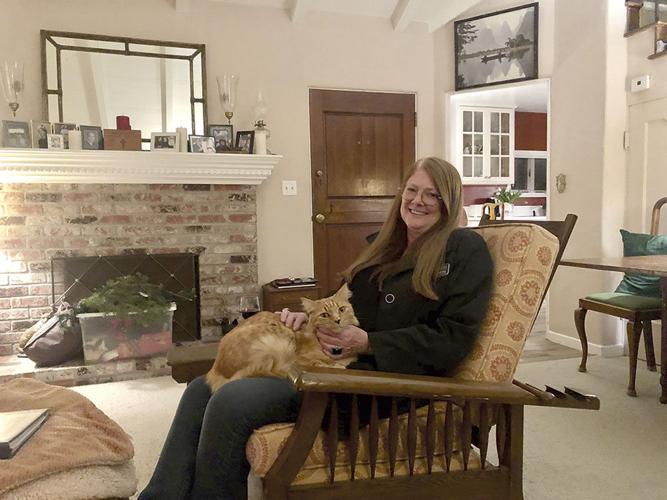
Poet Anne Mitchell, also a board member of The Cherry, accompanied by her cat, Ziggy. MItchell has been interested in Jeanne D’Orge’s poetry for a long time.
Virginia and her son, sculptor Artistides Burton Demetrios, may be proof that D’Orge’s artistic genes were passed down; Artistides’ father was also a sculptor. Demetrios’ works have been shown in the Boston Museum of Fine Arts and the Metropolitan Museum in New York City. Artistides “Aris” Demetrios died in 2021 in Santa Barbara, after winning the “Santa Barbara Beautiful Award” for the most beautiful work of public art.
The first protectors of the Carl Cherry Foundation were D’Orge’s good friends George and Angie White. Conceived by the Cherries together before Carl died, the foundation was established in 1948 to help support experimental fine artists and projects in the sciences.
The original director of the Carl Cherry Center for the Arts was Jane Wilgress who, in 2004, wrote the book Better Than Beauty: The Life and Work of Jeanne D’Orge. English-born Wilgress tracked D’Orge’s roots in England, Scotland and California. Much of this reporting comes from that book, the most extensive publication devoted to Mrs. Cherry.
The Carl Cherry Center for the Arts remains active, each year bringing diverse art exhibits, working with local schools, hosting art contests, presenting jazz, theater, animated films and pretty much every form of art the little space can handle. A space for art, that’s what it is. D’Orge’s version of Virginia Woolf’s “room of one’s own,” something she felt strongly about.
“Sometimes it’s no more than to give a writer a place to stay, keeping their stomach filled so he can write what he wants to write,” D’Orge once said in an interview. “There are no strings attached to the help we give.”
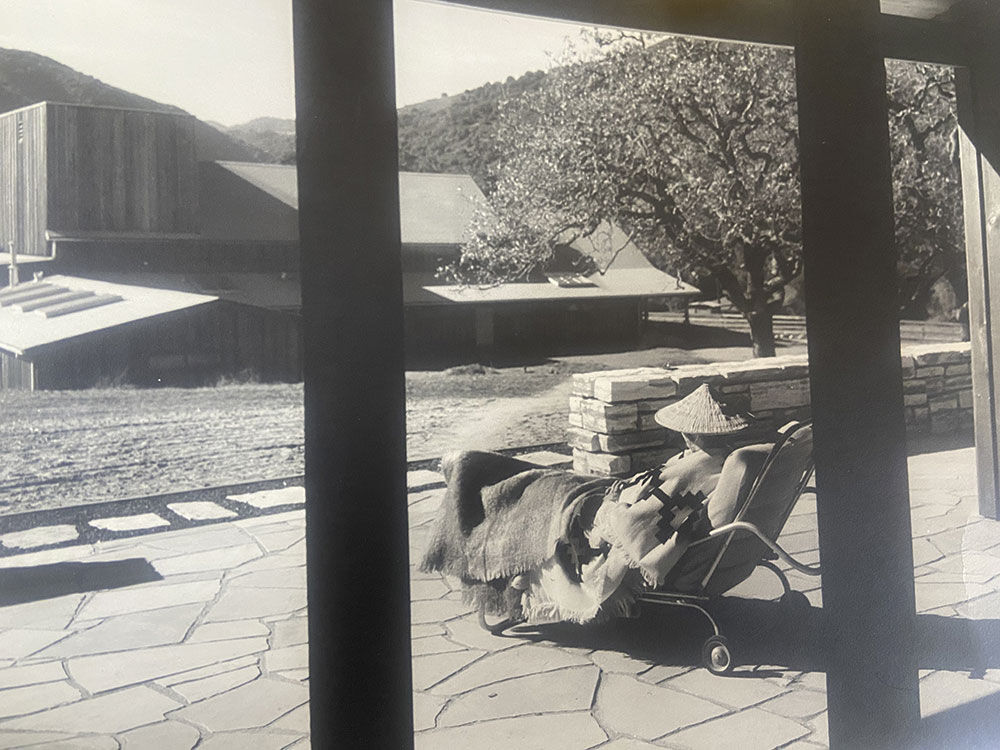
Jeanne D’Orge at her Carmel Valley home (on Middle Canyon Road) in front of Tantamount Theater.
The life and times of Jeanne D’Orge, a timeline:
1879 Lena Yates is born in an English village, Donisthorpe
1900 Her first child is born, then adopted out
1906 She marries, becoming Lena Burton, and moves to the U.S.
1907-11 Her three children are born
1916 First poetry publication, under the name Lena Dalkeith Burton; this year she debuts as Jeanne D’Orge
1920 She moves to Carmel
1925 Romance with Carl Cherry; they marry in 1931
1927 She and Carl move to the house now housing the Carl Cherry Center for the Arts
1928 Publication of Lobos
1939 The Cherry Rivet is invented; with time, Carl Cherry gets rich
1946 First exhibits of her paintings
1947 Carl Cherry dies at the age of 46
1948 Carl Cherry Foundation is created
1955 Voice in the Circle is published
1957 D’Orge moves to Carmel Valley
1964 She dies at age 85
1992 The foundation changes its name to Carl Cherry Center for the Arts
This article was modified on Jan.7, 2025 for accuracy.
(1) comment
This article claims Joan of Arc was a "groundbreaking feminist who feared nothing and followed her instinct", but even the feminist historian Helen Castor rejected the idea that she was a feminist, and her stated views were often the opposite. Her goal, as she said, was to place her king on his throne (the most "patriarchal" in Europe since France blocked women from the line of succession), and she told one of the soldiers, Jehan de Metz, "I would prefer to stay home with my poor mother and spin wool" rather than take part in a military campaign. She also said bluntly that she didn't personally fight in combat and didn't call herself a commander since there was always a nobleman in direct command. She was a religious visionary in an era when many women and girls had been accepted in that role (e.g. St. Catherine of Siena, St. Birgitta Birgirsdottir, St. Colette de Corbie, etc, etc).
Welcome to the discussion.
Log In
Keep it Clean. Please avoid obscene, vulgar, lewd, racist or sexually-oriented language.
PLEASE TURN OFF YOUR CAPS LOCK.
Don't Threaten. Threats of harming another person will not be tolerated.
Be Truthful. Don't knowingly lie about anyone or anything.
Be Nice. No racism, sexism or any sort of -ism that is degrading to another person.
Be Proactive. Use the 'Report' link on each comment to let us know of abusive posts.
Share with Us. We'd love to hear eyewitness accounts, the history behind an article.