The song arrives like a lullaby, soft and lilting. Behind it, the Pacific pummels the shore, providing background to the cadence of “Dona Nobis pacem,” Latin for “give us peace.”
Swiss-American Sabina Loetscher, a 17-year veteran of Esalen massage who first lived here as a work-study apprentice, sings like this to close each massage, cooing with a gliding grace just as her 70-minute massage – deep, rolling Esalen-style strokes blended with Thai and Pakistani techniques that further pretzel and stretch the body – slides from scalp to shoulder to spine.
Preceded by an hour in the adjacent hot springs, this treatment is essential Esalen: relaxation and renewal.
But bliss like this can lead to mistaken assumptions that Esalen is purely about pampering. When visitors hear of conflict at the institute – which seems to be peaking as Esalen celebrates 50 years – they can’t miss the irony: The land of hippie harmony is itself in need of healing?
Esalen has always been, and continues to be, about therapy. But it’s also about soul-searching, friction and the hard, personal work driven by dialogue. The best massage, in other words, has to dig deeply to be effective.
A protected V-shaped cove next to a cool, clear stream and warm, stinky springs on the south Big Sur coast drew the Esselen Indians in pre-colonial days like it draws some 15,000 annual Esalen visitors today.
There the Esselen danced, conducted ceremonies and planted prayer sticks. They re-enacted creation times, balanced the good and malicious spirits of the universe and commemorated the dead. The springs were where the divine powers of land and water, normally divided, came together.
“To them it was magical,” says Esselen ethno-historian Alan Leventhal.
Centuries later, Salinas doctor Henry Murphy may not have ascribed mystical powers to the waters, but he saw a special healing potential in them. According to Walter Truett Anderson’s The Upstart Spring, Murphy bought what was then called Slate’s Hot Springs in 1910, thinking the waters could bring health to patients and business to the family.
He and his wife Vinnie couldn’t make much progress with that vision until well after the Big Sur Coastal Highway was completed in 1937, so the property was mostly useful as a country respite for the Murphy clan – including Henry’s grandson and eventual Esalen co-founder, Michael.
By the time a 30-year-old Michael brought his pal and co-founder Richard Price to the Murphy family’s “Big House” in 1961, Henry had passed away and Vinnie had built Slate’s Hot Springs into a tourist stop with a restaurant, bar and cabins. It was a gathering place for Big Sur’s growing bohemian community, including a banned writer named Henry Miller, a young singer named Joan Baez and an aspiring scribe named Hunter S. Thompson, whom Vinnie had hired to caretake the property. True to character, it had its friction: While the lodge became a church of the fire-and-brimstone variety on Saturday nights, just down the hill, gay men from San Francisco cavorted in the baths.
Today those baths are gone, torn away by El Niño and replaced by a $5 million monsoon-proof bathhouse with indoor-outdoor baths, wide cement showers, graceful locker rooms and two levels of padded massage tables right on the cusp of the ocean.
Some suggest the investment required to retool the baths triggered a fundamental shift in the nonprofit’s business approach, from fly-by-the-seat-of-the-sarong to corporate-inspired. And even in an inherently skeptical Esalen community that grapples with an identity crisis every decade or so, some elders say it’s never been this bad.
Take some of the deepest rifts of society: The Cold War, creation versus evolution, Western-Arab animosity. Look into some of the most fundamental challenges of human existence: inequality, psychosis, stress, death. Navigate the most complex and extreme edges of science: transpersonal psychology, paranormal activity, quantum entanglement.
At each point Esalen is there, gathering relevant visionaries to pioneer progress, often long before it even registers on any mainstream radar. So if any place is suited to work through an identity crisis, it should be Esalen.
After all, the institute built connections between the U.S. and U.S.S.R. where government had failed, arranging for Boris Yeltsin to visit the U.S. in 1989 before Yeltsin helped dissolve the Soviet Union. “The visit changed his mind about the Communist system,” Murphy says.
The institute went on to host leader-studded conferences on religious fundamentalism, and sponsored a Dubai summit of cross-cultural filmmakers to explore the role of documentaries in cultural diplomacy. “This is the largely untold story of Esalen,” Murphy says.
A summary of Esalen-led initiatives is one of the most humbling lists you’ll see. Esalen was where Ida Rolf, creator of Structural Integration (aka Rolfing, a physical therapy that’s helped redefine deep-tissue work), first set up. This is where Gestalt therapy (which includes the understanding that our perceptions actively shape our experience) gained its first prominent platform. When Esalen was founded, massage was still marginalized, as was talk of mind-body connection and personal growth.
“This happened with us with dozens of practices,” Murphy says. “We mushroomed.”
The inner-space travelers at Esalen have peered deeply not just into the powers of meditation and yoga, but also into the empirical evidence for afterlife. Timothy Leary and Richard Alpert were part of unprecedented “consciousness” research involving LSD, which was legal at the time.
It was a consistent pattern of pioneering. Long before TED conferences met in Monterey, Esalen gathered cutting-edge thinkers 45 miles south.
“We look for a conversation that should be happening, but isn’t,” Esalen President Gordon Wheeler says. “That’s an Esalen signature – whether it’s astronauts and cosmonauts, people studying mind-spirit-body, or people doing community politics. We want to bring those people together.”
Collaboration is a pillar for both lofty intellectual frontiering and on-the-ground interactions. Each pod of the 200-person staff meets regularly to “check-in” and acknowledge what they’re bringing to the workplace, professionally and personally. Leaders broker non-violent communication around those issues, whether it’s the death of a loved one distracting a line cook or the death-looks one staffer has been giving another. Language like, “Your stupid bragging is really pissing me off” is swapped for, “When I observe you talking about your technique, I feel frustration.”
Ambitious stuff, surely. But also basic and human. Just like the dynamic between Murphy and Price.
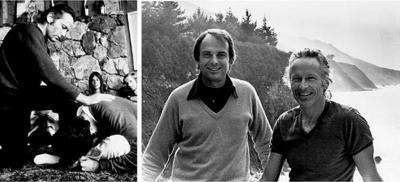
They didn’t know one another at Stanford, where they both graduated with psychology degrees in 1952. But for several years after graduation, Dick Price and Mike Murphy followed relatively parallel paths.
They were independently drawn to the ideas of Stanford comparative religion professor Frederic Speigelberg. They both had non-combat stints in the military and dropped out of grad school (Price at Harvard, Murphy at Stanford) when they became disillusioned with education that didn’t mesh with their interests in mind-bending new schools of thought.
By the time the two met at an urban ashram in 1960, they were both living in San Francisco, studying Eastern philosophy and looking for purpose. But Murphy had touched transcendence in a meditative year-and-a-half at Sri Aurobindo Ashram in India, and Price had suffered through almost as much time in mental hospitals.
In 1961, the pair visited Murphy’s family property in Big Sur and hatched the idea that became Esalen. Price was still carrying ideas from a lecture he’d heard by Brave New World novelist Aldous Huxley, who’d spoken about the idea that extraordinary abilities are latent in all of us.
“We both had been inspired by a vision that the human potential is far greater than people had realized,” Murphy says. “We did not want to start a religious cult, a new church. We wanted it to be a center where we could explore conceptually the ideas that we were interested in. Namely that the cosmos, the universe itself, the whole evolutionary unfoldment is what a lot of philosophers call slumbering spirit. The divine is incarnate in the world and is present in us and is trying to manifest.”
Murphy had the family land, and Price – whose father had scaled the ranks at Sears and helped start the Whirlpool Corporation – had the seed money.
With the support of friends like Speigelberg, Huxley and philosopher Alan Watts, they envisioned a hotel that would attract interesting people. Murphy brought a focus on Eastern mysticism and philosophy; Price had a mission to reform American psychology through communal living.
Brita Ostrom remembers her first impression of Esalen: a place populated by old vans, waitresses in long skirts and bearded men in handcrafted Mexican clothes eating with snappily dressed Hollywood types.
Ostrom and a friend had hitchhiked from Haight Street, aiming for a commune in Gorda. But they missed that stop and snuck into Esalen instead, sleeping that night in a flower field. It was 1967, and 23-year-old Ostrom was focused on the idea of intentional community. Within a year or so, in the midst of the psychedelic explosion, she joined the Esalen staff as a waitress.
She reminisces about the parties: Drummers and dancers would come down from the Big Sur hillsides, and they would drop acid and create rhythms interpreting themes like the beginning of the world. “It was ego-dissolving work,” Ostrom says. “We were dancing every night in the lodge to Janis Joplin and The Beatles.”
Over the next 45 years Ostrom would become a visionary in the Esalen school of massage, which incorporates both body and mind. She describes Esalen’s early years as an unusual melding of high-powered psychologists and psychotherapists – like Abraham Maslow (who created the “hierarchy of needs” method of self-actualization), Alexander Lowen (father of bioenergetic analysis), Virginia Satir (mother of family therapy) and Fritz Perls (who developed Gestalt therapy) – and free spirits in the emerging hippie movement. In the thick of the Vietnam War, it was also a sanctuary for conscientious objectors.
Counter-balancing the elite intellectuals streaming in were the workers. Esalen established its “seekers serving seekers” work-study program in the 1970s, bridging the lower-level staff with the high-brow seminarians. “The place became less top-and-bottom heavy and much more in the core,” Ostrom says.
Today, that middle class is revolting.
By 1970, Murphy had left Big Sur to start an Esalen center in San Francisco. It was Price who stayed – but in 1985, he was killed by a falling boulder while hiking alone in the wilderness. That depth of that loss to the Esalen community is hard to overstate.
In 2003 Dick’s son, David Price, ended an eight-year tenure as Esalen’s general manager. Around that time, the board set about creating a more professionally polished institute. They inflated the mid-level management and created higher-priced accommodation options. David says that’s roughly when the practice of “karma yoga,” in which seminarians were expected to contribute labor to dissolve the barriers between server and served, faded.
David thinks that was a mistake, creating expectations of a resort experience instead of a personal-growth environment. “The place was never meant to compete with Post Ranch and Ventana,” he says.
In his view, when the administration became more hierarchical, staff began demanding things like minimum wage and overtime. “The truth is, a lot of this stuff was fuzzy before,” he says, “but people didn’t make an issue of it because we were all in it together.”
Wheeler, who has been Esalen president since 2003 and served as CEO from 2004-2010, says Esalen was more than $7 million in the hole eight years ago, “running deficit budgets, and lacking some of the key management expertise needed to deal with today’s world of technology and finance and regulation. The challenge was how to right the ship while increasing, not decreasing, our commitment to our ‘seekers serving seekers’ model of community staffing.”
The board came to two conclusions: The world needs Esalen in the long term. And in order to keep thriving, the institute had to put its house in order.
In 2006 the board hired Tricia McEntee, who had business and accounting experience, as their chief financial officer; in 2010 they promoted her to CEO. McEntee has brought the institute into compliance with labor laws, built up its reserves, overseen major capital improvements, boosted staff salaries and benefits, and helped attract record numbers of seminarians.
She’s also one of the most resented people at Esalen.
Nine “disembodied” beings launched Esaleaks.org in November 2011 as a protest against the current administration.
It was a clear summoning of Dick Price, who in the late ’70s used a psychic to channel opinionated extraterrestrial beings. The Nine, as he called them, helped Price make administrative decisions including a spate of sudden firings.
That the anonymous website administers chose to call themselves The Nine – they later revised it to The Eight and a Half – reflects a widely held feeling that the current Esalen administration is no longer honoring Price’s legacy. So The Eight and a Half presume to be speaking for him.
“I think Dick Price would be thrashing in his ashes if he knew what was happening here at Esalen,” reads one entry. “His precious healing Community being devalued, and its profundity being sold as a boutique spa experience.”
Similar gripes dominate other channels of Esalen communication. For almost a year now, members of the amorphous Esalen “community” – from the present staff to the untold hundreds of thousands of former workers and seminarians worldwide – have been raising a stink through Facebook, email and other forms of social media that didn’t exist in Esalen’s earlier decades.
“We used to fill management positions with people who had been through our self-development programs,” says Seymour Carter, who first dropped in on Esalen in 1962 to pursue Price’s vision of community as a psychiatric healing process. “We have a cadre now of business-oriented people, obedient to principles of hierarchies and of pyramid power structure. They are technocrats with pencil-pusher kinds of ideas.”
The rebellion intensified last April, when administrators reorganized three managers out of their jobs. One of them, a longtime Esalen resident, had been particularly close with Price. The firings heightened a growing concern that Esalen’s current board and administrators are straying from Price’s vision.
Among those who have criticized the direction is Dick’s former wife, Christine Stewart Price, who was an Esalen resident through most of the ’70s and ’80s and has remained a workshop leader in Gestalt awareness practice.
She says that will end in January: “Esalen is making changes that have not made me feel that what I’ve been doing for 40 years has as strong a place there.”
An anonymous group of critics hired a lawyer to outline their grievances for the Esalen board. More recently, somebody sent the county building services department a list of 27 Esalen projects allegedly done without a permit. (Wheeler says the projects are legit; the county is investigating.)
Murphy says this kind of dust-up has been a part of Esalen’s identity since its earliest days.
“Along the way we’ve had these intermittent crises that would just convulse the staff,” he says. “Our staff is so spirited and independent minded. The problem is when you have diversity of opinion over the smallest details.”
In his view, the recent events have been comparatively mild.
There may be a deeper, even preternatural current beneath the current conflict: a dynamic tension between Price and Murphy that helped birth the institute and still hasn’t faded.
The Esalen co-founders had what some describe as overlapping but distinct visions, like circles in a Venn diagram of the human potential movement. Murphy is more known for his social-change ambitions, while Price emphasized personal growth.
Murphy says they always, ultimately, stood up for one another. “Dick and I, we did have differences. But whenever it came to the crunch, we were together. He did not like boards of trustees, let’s put it that way. He was not a corporate guy, and neither have I been. But if you’re a nonprofit, who is going to run this thing? Nature abhors a vacuum.”
Carter says he’s witnessed some of those conversations. “I’ve been in the room with Dick Price when he’s arguing very fiercely with Michael Murphy over the direction of Esalen and been very opposed to Michael’s messianic, millennial, we’re-gonna-change-the-world stuff,” he says. “Dick was very focused on healing one person at a time.”
Chris Price says both men were interested in mysticism and logic, experiential teaching and theory. “But the way Dick sat with people has not been a practice of anyone who’s been in power since then. What Dick held that was different than Mike isn’t held anymore. It’s not the result of a conflict; it’s a loss.”
Carter worries Esalen is squeezing out the last of Price’s allies. “They marginalized us and put us out of the catalog for a number of years until it just became impossible to hold on to Dick Price’s legacy,” he says. “And that’s what I think is being contended, I think: The humane vision of Dick Price is faced now with this corporate management.”
But McEntee, a target of much of the vitriol, takes a stab at explaining it. “Transformation is really hard,” she says. “Many of our staff and our students live here. It’s their social life, it’s their family. At the core of the upset and the uncertainty that comes with it – the organization is just really committed to surviving in the long term.”
She says she often has to remind herself of Esalen’s mission. Even meetings at which staff are throwing barbs at her yield a lesson. “We promote that freedom of speech and diverse opinions,” she says. “How amazing that I can sit here as CEO, and people can tell me exactly what they like and don’t like.”
Down in the Esalen meditation room, under the bridge that splits Esalen’s property, a Zen leader takes five students through a breathing and awareness exercise. He could be speaking to the whole global community that is Esalen – 1 million-plus alumni the world over – as he quotes a master. “There is no stability in the world,” he says. “It is like a house on fire.”
Someone who doesn’t know Esalen might think it’s an oasis on a burning planet, a place of peace and love and sweet oblivion. But those who know it intimately describe it more like the very heart of the fire: a surreally beautiful place where people confront the most terrifying elements of themselves. When they come out, they feel devoted.
“The absolute love affair people have for the place – I’ve been getting that feedback for 50 years,” Murphy says.
Some of the most vocal critics of current leadership are also the most committed to Esalen’s mission. “The world needs to get past the very aggressive stance we find ourselves in today,” Ostrom says. “Esalen has real potential to be a service.”
One of the ongoing debates focuses on how Esalen can best serve the world. McEntee says Esalen inspires transformations on two levels – the personal and the social – that feed each other. Historically, the institute’s emphasis has been on the personal work; recently, that’s shifting toward the social.
“In the ’60s and ’70s we didn’t realize the vulnerability of our planet. Now, I feel like the evolution of human consciousness is the most promising, most hopeful thing human beings have,” she says. “We want to keep pushing the edge and taking risks and booking workshops of leaders who aren’t very well known, who are doing something different. This is what gives Esalen its uniqueness and flavor: New things are born here.”
That goes for constantly evolving construction, too. Murphy says the near term will bring new projects to the Big Sur campus, like the reconstruction of the South Coast housing center that was destroyed by fire last year.
Esalen’s first 23 years were guided by its two original co-founders. Its next 27 were shaped by the leadership of just one. Now Murphy, at 82, is preparing the institute for a future without him.
“Esalen’s always moving into the undiscovered country, and we’re going to keep exploring,” he says. “We’re going to build it so it lasts another 50 years, or another 100 years, because our work is not done.”
Party Time
Esalen’s 50th started as this issue reached the streets, with Joan Baez playing a sold-out show on the lawn Oct. 3. Weekend guests pay $2,070 for a shared room and a chance to commune with a diverse range of world-changers. For more on the celebration, visit www.esalen.org. For more Weekly reporting on Esalen, including a look at its finances, visit www.mcweekly.com/esalen.
(0) comments
Welcome to the discussion.
Log In
Keep it Clean. Please avoid obscene, vulgar, lewd, racist or sexually-oriented language.
PLEASE TURN OFF YOUR CAPS LOCK.
Don't Threaten. Threats of harming another person will not be tolerated.
Be Truthful. Don't knowingly lie about anyone or anything.
Be Nice. No racism, sexism or any sort of -ism that is degrading to another person.
Be Proactive. Use the 'Report' link on each comment to let us know of abusive posts.
Share with Us. We'd love to hear eyewitness accounts, the history behind an article.