
THERE WAS A TIME, 20-ODD YEARS AGO, THAT DIANA HAD A GOOD JOB, A PROFESSIONAL WARDROBE AND MONEY IN THE BANK. She was living in Carmel, and remembers at the time occasionally seeing people living in their cars. “I said, ‘how does somebody live in their car, my god?’ I felt sorry for them.”
Diana went on with her career, working in real estate and administrative jobs, and relocated to Southern California. (The Weekly is not using her last name because she fears it will negatively affect her job search.) She lived in the same building for 18 years, until it was sold, and the date she had to turn in her keys sticks out in her memory: March 15, 2018.
She had $25,000 in the bank, put her stuff in a storage unit, then loaded herself and her cat into her Nissan Xterra and drove north. “I said, ‘I don’t give a shit if the rent’s $10,000 a month, I’m out of here. I’m going back to Carmel,’” she says. “The weather down south is so horribly hot.”
She started spending down her savings, staying at a hotel in Monterey. As that $25,000 depleted, eventually Diana found herself sleeping in her car – luckily an SUV, which has always been her preference. (“I have always driven a pickup truck – a nice one – or an SUV, not some old jalopy,” she says.) She kept looking for work, but only half-time, because “I couldn’t take a job and leave a cat in the car for eight hours.”
“How the hell do you dress up, step out of a car, and act like you just stepped out of a house?”
And then there’s the challenge of landing a job offer when you live in your car. “How the hell do you dress up, step out of a car, and act like you just stepped out of a house?” Diana says. “Where are you going to hang a wardrobe?”
(Using Social Security, she says she still pays the monthly bill for a storage unit in Southern California that houses all of her old clothes.)
These days, she parks and sleeps overnight in a church parking lot, alongside five other similarly situated women as a clients of the nonprofit One Starfish. Diana, a 76-year-old with a professional history, is a classic One Starfish client – someone who finds themselves sleeping in a vehicle, and is planning to get back into housing.
THE ONE STARFISH SAFE PARKING & SUPPORTIVE SERVICES PROGRAM STARTED AS AN IDEA IN 2013, at a time when Monterey City Council was looking for ways to address a growing homeless population as the 2008 recession lingered. It came as a 14-page proposal from Tia Fechter, who found her life’s passion in helping the homeless community.
Fechter and her husband, Michael, had developed something of a reputation for being people who cared and were prepared to help where needed. One day, former Monterey Police chief Phil Penko called her with a situation: Frank Maiorana, an unwell, 75-year-old man had been cited for illegally parking and sleeping in his RV many times over 20 years, and the city was preparing to tow his home.
It was the type of scenario the Fechters had been hearing about again and again: people living in their cars, parking illegally, getting citations they couldn’t afford and, eventually, impound fees they couldn’t pay. (The Fechters found a nursing home in Gilroy that could house Maiorana, but he refused help. His RV was eventually impounded, and he died in 2015 at 76.)
By 2015, there was enough momentum – and funding – to get One Starfish off the ground. The premise: Give people living in their vehicles a safe, clean place to park and sleep overnight, assign them a case manager and get clients on track to have health care, a source of income and housing.
One Starfish currently runs five women-only parking lots and two co-ed sites, which One Starfish operates on contract for Monterey County. (Each program costs about $100,000 a year.)
To qualify, clients must live on the Monterey Peninsula, have a valid California driver’s license and registration and be willing to work with a case manager on a plan for future housing. The program doesn’t accept clients with severe mental illness, instead referring them elsewhere. Participation is reassessed on a monthly basis, and some end up staying for just a week, while others stay much longer. “Some people have been in One Starfish for a couple of years, just because the cost of housing keeps going up,” says Case Manager Dorian Manuel, who is set to take over as executive director in January. (Michael Fechter is outgoing, and he succeeded his wife, who volunteered as the first executive director; she is still board president.)
The Fechters estimate that to date, One Starfish has served 1,200 to 1,500 clients, about 200 a year.
Part of what makes One Starfish successful is that it’s unobtrusive, something that neighbors demanded from the outset. Back in 2013, when it was just a concept, Monterey City officials circulated a survey seeking feedback. One resident, on behalf of the Alta Vista Neighborhood Association, wrote in: “The effect of allocating space for bums and vagrants will be two-fold. First there will be more bums and vagrants, and second, the problem will move from downtown to the neighborhoods. Using private parking lots for overnight parking will turn them into permanent ghettos.”
"This won’t get that much better unless we all want it to.”
Manuel rejects that premise. “There are people who don’t want this sort of program because they think it will be a magnet for crime or poverty, when in reality all these things are happening in their community anyway,” he says. “We just try to help. This won’t get that much better unless we all want it to.”
When Michael Williams decided to get out of his family home in Seaside, where he and his brother were in constant conflict while their mother was dying, he thought it would be maybe a few weeks, 90 days tops.
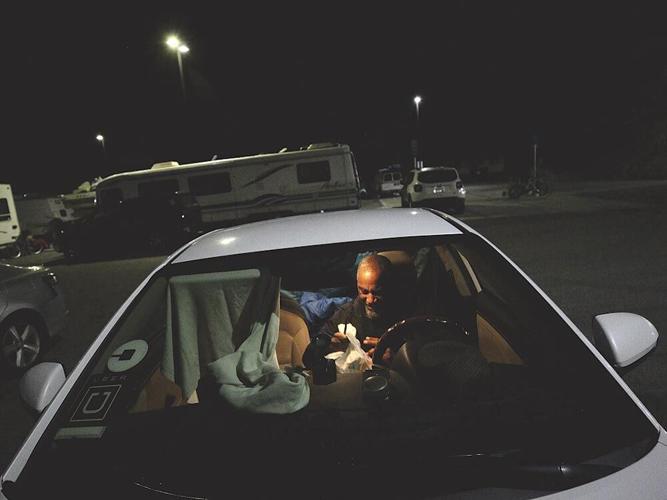
That was 2017. He still lives in his Hyundai Elantra, and stuffs towels in the windshield at night to keep it warm. This car has been everything for Williams in recent years – he drove for Uber until Covid-19, and even though his unemployment benefits have stopped, he’s reluctant to start driving again because of an underlying illness and risk of the virus.
For years, he worked as a bartender, bass player and AV technician for bands in Ireland, then moved back home to help care for his ailing mom. He’s starting to play music again, but for now gets by on $582 a month from Social Security. “I just have been doing the best I can with what I’m getting,” Williams says. “I’m keeping the bills paid, I don’t know how.”
He is now parking and sleeping at a friend’s place, after the Monterey County lot he was in became over-crowded with people living in their vehicles and looking for someplace to park who are not enrolled in One Starfish. “We kept our area clean,” Williams says. “The RV people set up shop like they’re at home. I know they have to have a place to go, but they shit on my program that’s helping me.”

Michael Williams lives in his car, which he also drives for Uber. He insulates it with towels at night. “The front is like a cocoon,” he says. “It really is not too bad. Plus, I’m kind of used to it now.”
ON THE PARKING LOT IN FRONT OF THE MONTEREY COUNTY DISTRICT 4 SUPERVISOR’S OFFICE IN MARINA IS A DENSELY PACKED SEA of dozens of RVs, trucks, an occasional tent and one portable toilet. This is one of two sites for the Monterey County Safe Parking Program, but during the pandemic, when the county offices were empty, it got flooded with people looking for a place to park.
It’s hard to turn anyone away, Manuel says: “There really is nowhere for people to go because of ordinances preventing folks from staying in their vehicles.”
He remembers a time about two years ago when the county program was much smaller, with maybe 20 people there, and it felt like a community. If someone got a housing lead that someone else might qualify for, they’d pass it along. “Everyone was very close, always rooting for each other,” Manuel says. “If someone got housing, everyone would celebrate and break bread. The feeling of community among people who had so few possessions was huge, it just warmed my heart. It felt like lightning in a bottle.”
“A single woman should not be out in a tent by herself – she’s vulnerable.”
These days it looks more chaotic, but there is still a spirit of community. A woman who goes by Wildfire Daystarr acts as something of a self-appointed mayor for the group; she is looking for donated cars for some young women living in tents. “We don’t want to leave anybody behind,” she says. “A single woman should not be out in a tent by herself – she’s vulnerable.”
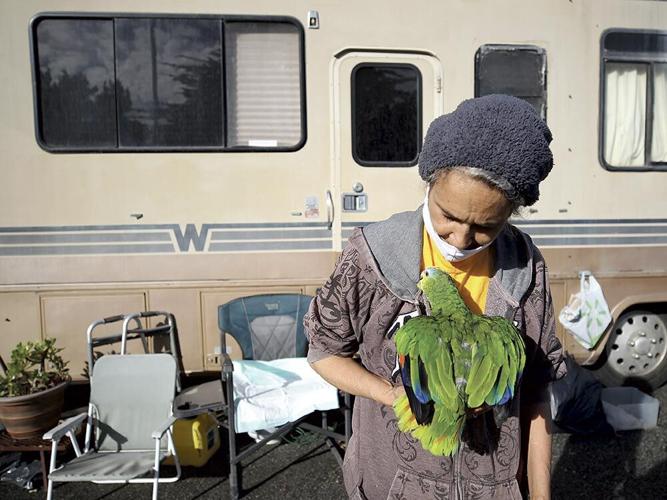
Daystarr’s story has taken a series of tragic turns – a sexual assault, a small settlement that she used to stay at the Motel 6 in Marina for a time after she fled an abusive household where she was working as a caregiver – and then a 1988 Winnebago she bought for $5,900. She lives in it now with her Maine coon, Lucky, and yellow-headed Amazon parrot, Bella, who has radiant, almost iridescent plumage with shocks of yellow and red. Out front, Daystarr keeps a sitting area with potted plants.
Daystarr has a few health issues she struggles to manage. She’s not supposed to be smoking due to a lung ailment, she says, “but I’m so stressed that I need to smoke.” And she’s supposed to take a psychiatric medication, but she’s worried that in case of an emergency, she might have to drive her Winnebago. “I’ve got to have a clear head to move this vehicle,” she says. “I can’t be doped up.”
“Where are we going to push everyone to, the ocean?”
Meanwhile, Daystarr has been worrying about what would happen when the county inevitably cracked down on the lot. That day came on Monday, Nov. 8, when sheriff’s deputies served eviction notices, directing occupants to leave by Friday, Nov. 12 (see story, p. 14). Daystarr was similarly evicted from Lapis Road north of Marina in 2017, and until there’s a more permanent solution, she wonders what’s next: “Where are we going to push everyone to, the ocean?”
IT’S UNKNOWN HOW MANY PEOPLE LIVE IN THEIR VEHICLES FULL-TIME, but there is evidence that the number is growing. Some of it is people who are homeless. But a growing segment is people who are leading Instagram-worthy lives from the road, #vanlife style, publicizing their nomadic lives as they journey to scenic spots. Dyana Kelley is president and CEO of CampCalNOW, a trade association representing about 350 of California’s RV parks and campgrounds.
And RV parks have been busy, even during the pandemic, when long-term stays for people who live in their vehicles were allowed, even while tourism was on pause. “The change we’ve seen is a significant number of younger people, not retirees, who want to go work at a campground for a few months then go somewhere else,” Kelley says. “And families with young kids who have decided to homeschool, and decided to see the world while they’re doing it.”
She cites an estimate that 1 million people in the U.S. live in an RV, some in a stationary setting, others on the road. Some are traveling, others traveling while working, like a remote tech job. “Many people are choosing this as a lifestyle,” Kelley says.
One group for whom RV living is particularly popular is traveling nurses, Kelley says, who don’t have to pack up every few months as they are reassigned, but take their home on wheels.
The 1 million figure excludes people who are homeless, and instead is a reference to those who are living in vehicles by choice. It’s a number Kelley cited while working with the governor’s office during shelter-in-place to carve out specifications for keeping RV parks and campgrounds open.
“It’s an entire world, from someone who is completely destitute all the way up to people who are spending $150,000 on a van.”
It’s harder to estimate how many people live in their vehicles out of necessity, but Kelley and CampCalNOW members know they are there: “It’s an entire world,” she says, “from someone who is completely destitute all the way up to people who are spending $150,000 on a van.”
WHILE SHELTER-IN-PLACE MIGHT HAVE LED TO A SURGE IN PEOPLE LIVING VOLUNTARILY IN VEHICLES, temporary Covid safety net measures likely shrank the population living in vehicles out of necessity. Diana spent the better part of 2020 in a Marina motel as part of the state’s Project Roomkey, a temporary program to lodge homeless people and to get people into under-utilized hotels and motels while tourism was halted.
Now that the eviction moratorium has ended, Manuel says more calls are coming in: “I have seen an increase in people reaching out for help. It’s overwhelming. A lot of people are in this situation who were never in this situation.”
One Starfish can serve up to about 50 clients at a time, depending on the size of their vehicles. The biggest limitation is not enough partner organizations offering up available spots.
County Supervisor Wendy Root Askew, who represents District 4, with an office behind that fully occupied parking lot, notes the fundamental challenge of dispersing the existing camp: nowhere else to go. “The county has resources to commit, the county is ready to be a partner,” she says. “We simply need the location where five to 10 vehicles can be securely parked overnight.”
How to shelter people living in their vehicles, of course, is only a piece of the work – the goal is housing.
Like the parking lots, affordable housing is space-constrained. Nonprofit Interim, Inc. houses up to 302 people, in permanent and transitional settings. All of those units are full, and some of the waiting lists have been closed because demand is so high.
Interim’s clients are homeless and also have a diagnosis of a severe mental illness. Andy Ortiz, outreach coordinator for MCHOME, a program of Interim, estimates that 30 of the clients he works with, roughly half, are living in vehicles. Many of them cannot afford a license or registration and do not qualify for other programs, but cars are a necessity for many homeless people in Monterey County because services are so spread out. “The only Social Security office is in Salinas,” Ortiz notes.
Meanwhile, the overarching problem that is the housing crisis persists. More and more One Starfish clients are working full time, but can’t afford to rent a place. While the success of the nonprofit has far exceeded the Fechters’ expectations, the need keeps rising: “The problem has definitely gotten significantly worse in our 10 years of work,” Michael says.
As the search continues for a system-wide solution, individuals continue to search for their own solution. Williams is renting land for $200/month from a friend in Prunedale, and he’s nearly done building a trailer he’ll live in. He’s waiting for the price of plywood to drop – it’s gone from roughly $25 a sheet to $100 a sheet – and then he’ll be ready to start sleeping in there. Until then, it’s too cold overnight.
He used his Covid-era unemployment checks to pay his son and daughter-in-law to help with the building, a process he enjoyed. “The blessings are always there, no matter what the hardship is.”
Diana is on every housing waiting list she can find, and persists in looking for work. “I will make my way back,” she says. Back to what, exactly? “To who I was. I lived my life behind a desk, that’s where I thrive. I have to make my way back to that.”
(1) comment
Dear Sara Rubin,
Thank you for writing about the lucky ones who have a safe place to park. Between the lines of your story dwell the people who do not have a safe place. This article is heartbreaking for me, because nothing has changed since at age 18 I fled a stalker and took up temporary residence in Ventura, California on the advice of the police, who "couldn't protect me" against this crazy person unless I was hurt first. (There is much more to this story, but for brevity and to stay on topic, I’m leaving out the details.)
At the time I was a waitress and community college student who got a job at a golf course restaurant in Ventura on the first day in town and figured I'd camp out for a few weeks until I found a place to live, so I booked into McGrath State Park with my trusty tent and sleeping bag. As an avid backpacker, I enjoyed camping out and figured a few weeks in a tent would be fine.
After a few months, I was invited to move into a really cool converted school bus with another working couple, Sean and Bobbie McCoy. I took a second job, and pooling our resources, all three of us could never save enough money for first, last and deposit on anything after paying for the basics: food, gas and park fees. By the end of one and a half years I was done living like a gypsy in an "RV" and moving every 2-3 weeks from park to park. I moved back to Phoenix, where in less than a week I had a job and a place to live.
My point is this: three young, strong, resilient, hard-working people all between 18-22 years of age and not on drugs or alcohol - Sean was a groundskeeper for the State Parks, Bobbie and I both waiting table – pooling our resources, could not afford a place to live in the greater Ventura area (Oxnard to Ojai) for almost 20 months. We bought food at discount grocery stores and cooked all our meals to save money – no junk or fast food. Plus ate at work if they offered an on-the-job meal.
I don't know what became of Sean and Bobbie; after I left, we lost touch. After all, they didn't have an address. They were kind souls, who took me in when I needed a friend and provided me with a very fun and safe place - if not a brick & mortar home - to live during a forced exile from my hometown. I have very fond memories of singing songs, playing cards, reading out loud and even chopping wood. A big bonus: I can cook anything (and I mean anything) over a campfire. Would I want to live like that now? No way!
Yet a real fear for many women over 50 is becoming homeless, and it’s not as easy as one imagines to get into a home again once one has become homeless. When that was my situation in 1980-81, one could get mail delivered to “General Delivery” and didn’t need a permanent address to get an ID card or driver’s license; my California ID listed Space #8 at Emma Wood State Beach as my address. I was lucky that there were parks with bathrooms and showers to camp in.
Those days are gone – since 9/11 one can’t get an ID, a place to live or a job without a place to live first. It’s a cruel catch 22 that the average person does not quite grasp. No way to cook, leads to a poor diet and lower immune system, making illness more likely. Each rental wants a recent rental history and requires an application fee - these can add up to a lot of money. The homeless services are over-burdened, and a housing voucher is only good if there’s actual housing to apply it to.
And god forbid a person was evicted! No one will rent to folks with an eviction on record. I know a woman who was homeless with her daughter and living in her truck for over two years. She fled an abusive relationship where her partner caused the family to be evicted. This single mom was working two jobs and stayed in a motel once a week for wi-fi and showers. No one would rent to her despite proof of income due to the eviction on her record. She finally found a private party who gave her a chance and has been housed now for close to two years.
Low wage workers are the people who support our economy, they are the foundation of our communities and provide the backbone that supports agriculture, hospitality, retail, restaurants, entertainment, and education. Back in ’80 when I realized that we weren’t the only ones who were working, ‘mobile homeless’ I was shocked and dismayed. The mobile-homeless living in the State and County parks in Ventura consisted of young professionals, retirees, minimum wage workers, and even families – the school bus actually stopped at the park gates! These people I met in 1980 neither wanted nor desired that nomadic lifestyle.
Fast forward to 2021 and I continue to be shocked and dismayed that nothing has changed in California, that our communities do not seem to grasp that we are not just having a brain drain, we are having a workforce drain. I hear some complaining that people are just lazy and don't want to work, my experience has been people without jobs or a place to live have mostly moved away.
Those who are able to relocate when they can’t afford to live here, move. Some went to live with family elsewhere. Those who can’t afford to move elsewhere – for a myriad of reasons – become homeless. With rents so high – a room in a house is going for $1500, studios $1800, 1B-1B $2200 and a small 2B, 1B $2800 – even college professors are living in their cars and showering at the “Y”.
Frankly, I see zero thought in our communities being given to workforce housing – housing that is affordable for blue collar workers, students, educators, and even some professionals. The big Ag companies are understanding that people living and 20-50 people in a house is neither acceptable nor sustainable. They are building workforce housing for their employees. Perhaps the answer is for hospitality/restaurants to build workforce housing, too.
There are solutions that would require public-private partnerships and some temporary measures until we can find and build more permanent solutions. How about we ‘Gather In’ our un-homed community members instead of ‘Sweeping’ them out? What if we built an RV park and campground charging on a sliding scale that is safe and clean? It could also host tourists (Salinas does not currently have an RV park/campground for paying guests) – it could actually pay for itself!
We could all consider investing in our community human infrastructure. What if we could buy or lease land and construct several tiny home villages or neighborhoods that rent or rent-to-own and are walk-able to work. It’s a high-density infill project that works in the short term and could be completed in record time with community volunteers, donations, partnerships with school construction programs, and sweat equity from potential residents. Especially if city and county government waived permitting fees and facilitated such projects. Zoned as mobile home parks, they could be placeholders for more dense housing projects in the years to come. Private investment means it could be completed in record time.
We don’t have time to wait for 2-20 years for workforce housing – it’s urgently needed now to support our economy and stop our workers all moving away or becoming homeless. We have other major problems causing homelessness, too: beds in mental health facilities, beds in drug and alcohol treatment facilities – these issues need urgent attention, as well. I invite our community members to join me in creating some non-traditional solutions. Let’s become a model for other communities around the country!
Welcome to the discussion.
Log In
Keep it Clean. Please avoid obscene, vulgar, lewd, racist or sexually-oriented language.
PLEASE TURN OFF YOUR CAPS LOCK.
Don't Threaten. Threats of harming another person will not be tolerated.
Be Truthful. Don't knowingly lie about anyone or anything.
Be Nice. No racism, sexism or any sort of -ism that is degrading to another person.
Be Proactive. Use the 'Report' link on each comment to let us know of abusive posts.
Share with Us. We'd love to hear eyewitness accounts, the history behind an article.