

I am standing on Steinbeck Plaza on Cannery Row looking at a big fake rock – just a giant piece of fake rock, 15 feet high, 17 feet wide – on which nine life-sized bronze figurative sculptures created by artist Steven Whyte have been artfully arranged. There’s Ed Ricketts, the famed marine biologist (better known as “Doc”) of John Steinbeck’s life and work. There’s Steinbeck himself, of course, who brought the row back to life with his writing. There’s Flora Woods, who delivered babies to laboring mothers and, uh, happiness to the countless customers who visited her Cannery Row brothel. There’s one of Flora’s girls up there too, leaning back with legs extended, basking in the sun. There’s a Chinese fisherman, representative of just one of the myriad ethnic groups who fished Monterey Bay and worked the long-gone canneries that made the row famous, the long-gone canneries that drove Monterey’s economic engine for decades until there were no sardines left to fish.
Then there are four guys huddled together, frozen forever in time, cigars and playing cards fanned out in hand. They’re repping a good timing group of bums – all of the figures are archetypes that inhabited Cannery Row when it was in its heydey.
Surreally, I’m there listening to a man explain how it came to pass that a much younger version of himself was first sculpted in clay and then cast in bronze, before the bronze was hauled to the top of that fake rock and cemented in place – and how the same happened along with his three close friends and business partners.
As he talks, I’m watching a guy loaded down with camera equipment moving around the Cannery Row monument, trying to get the best angles on the figures. He zooms in on the charming bronze frog at Ricketts’ feet, and as I watch him work, I poke Cannery Row Co. President and CEO Ted Balestreri on the lapel (“Wow, nice fabric!” I think. “Silk? Italian wool?”) and direct his attention to the cameraman. Balestreri strikes up a conversation.
“You with anyone? You from a magazine?” he asks the guy. The guy explains he’s a photo hobbyist, that he and his wife come to Monterey every year and stay for their anniversary because they love Cannery Row so much. Balestreri smiles and nods. This pleases him. This, in fact, is the point of everything he’s done.
Then I jump in.
“You see that guy up there with the cards?” I ask the photographer, gesturing to the bronze and then back to Balestreri. “That’s him. That’s the guy you’re talking to.”
The photographer is animatedly amazed. He asks Balestreri to move closer to the bronze rendering. Way closer – he asks for the besuited Balestreri to climb on top of the lower rock wall (the one that surrounds the fountain that surrounds the larger sculpture) and pose for a few shots with his inanimate self.
Balestreri raises his fist at me in mock anger. “Mary. Mary. Do you see what you’ve done here? To the moon, Mary.”
I cringe. Because while Balestreri stays pretty active with regular golf games and walking Cannery Row, let’s face it: Climbing anything – especially in nice leather shoes with slick bottoms – when you’re in your 70s is a dicey proposition. I don’t want to be known as that damn reporter who caused Balestreri to fall down and crack his skull.
But Balestreri clambers up the side and stands there. From up on that wall, he raises his fist again at me, then gestures at the Monterey Bay behind him. “Hey Mary,” he yells down. “How long you think you can hold your breath?”
I cock my head to the side and think about it for a few seconds.
“Actually, Ted,” I say with a shrug, “probably not long enough.”
• • •
“You’re writing about Ted Balestreri?” a friend asks me. “What can you say about him that hasn’t been said before?”
It’s a good point. So here are some quick facts just to set the scene.
Balestreri was born in Brooklyn and still has the accent to prove it. His dad died, terribly and swiftly of cancer, and Balestreri, his mom and his sister moved here when he was 16 because an uncle was in the produce business in Salinas. The corned beef was so bad here – “I ordered a corned-beef sandwich when I first got here and they put mayo on it, Mary. Mayo!” – it made him cry. He was drafted into the Army in 1961 and spent his time keeping Monterey Bay safe. “That’s why you’re sitting here today,” he says with a grin, “because I had guard duty over Monterey.”
He met two of his late partners, Harry Davidian and George Zarounian (“Albanians?” I ask him. “Armenians! Armenians, please!” he says), when he was 21, a hotel-management school grad doing a two-week stretch trying to prop up a struggling hotel in Visalia. He was still there, 18 months later, and by then found himself under the wings of the two older businessmen (both were partners in a tomato-growing business that Harry managed, and George owned auto dealerships as well). They hung out at the restaurant of the hotel, and he became a regular in the Armenians’ poker game
They’re up there, too, frozen in bronze.
“I didn’t have any money, you know. I was just a broke kid. I made $750-something a month, but they liked me and they staked me into their games,” he says. “We ended up being the best of friends, and cards were the common thread.”
They liked him so much, in fact, that about 20 years after they first met the two called him, told him to put on a pair of overalls and drive to a field in Dinuba. They gave him directions but didn’t give him a reason, he says. I ask him what he thought was going to happen.
“You ever see Goodfellas?” he asks. “I didn’t know what was going to happen.” When he arrived, he found they were wearing the exact type of overalls they had told him to put on.
They took him out into the field – then handed him the deed to 80 acres of farmland.
He and his partners also own the famed Sardine Factory restaurant, the first thing he and his original partner, Burt Cutino (the fourth bronze figure on that monument), ever did together. They spent less than $1,000 to lease the original building, with the help of a local dentist they bought out a year later. Cutino and Balestreri were in their late twenties, flat broke, and Cannery Row itself had fallen into one giant pit of industrial rot and despair. People thought they were stupid for even trying it – Zarounian and Davidian took a pass on an offer to go in on it.
But a year later, when Cutino and Balestreri were opening The Butcher Shop in Carmel, the tomato farmers wanted in.
“I asked them, ‘Don’t you need to check me out? Don’t you need your lawyers to take a look at me?’” he says. “And they said, ‘Kid. we checked you out years ago.’”
Then, piece by piece, they parlayed those one or two things into a local real estate empire. They also own the buildings that house Bubba Gumps, the Whaling Station, the Chart House, El Torito and a trio of pubs (Blue Fin, Sly McFly’s and Cooper’s). Hell, they even owned (at one time) the franchise rights to develop nearly 30 Wendy’s fast-food restaurants in Silicon Valley, although they only ever built five and they’re down to owning the land on only two.
“If your kids don’t want to end up owning it, what’s the point of doing it?” Balestreri says.
In short, he and those partners – the late, great Armenians and Cutino, the ones rendered in bronze up on that fake rock – are responsible for taking the dying, decrepit Cannery Row of the 1960s and, over the course of 45 years, Disney-fying it. They own about 70 percent of the row’s eight blocks alone. It’s phenomenally clean and phenomenally safe. And thanks to the Monterey Bay Aquarium at the end of the row, it’s also one of the biggest tourist draws in the state – all of those sealife lovers flocking in from out of town need places to eat, places to buy Monterey-themed baubles and places to stay.
Thanks to the tourists, Cannery Row Co. is also the largest taxpaying entity to the city of Monterey, paying $5.4 million in Transit Occupance Tax (TOT) on the hotel rooms in 2013, and more than $7 million in sales tax. The City of Monterey lists Cannery Row Co. as a “principal property tax payer,” with a secured taxable value of nearly $107 million.
Google Balestreri’s name: almost 13,000 results come up. He got nationally famous in the mainstream press for that bet he made with one of his besties – then CIA Director Leon Panetta – in which Balestreri promised to crack open a $10,000 bottle of 1870 Chateau Lafite-Rosthchild if Panetta “got” Osama bin Laden. He donates massive amounts of money to charity, his favorite being Rancho Cielo Youth Campus, along with Catholic Charities and a few other people-centric organizations.
So what can I say about him that hasn’t been said? Probably not much. But I can ask questions and listen to him talk.
That, it turns out, is a hell of a lot of fun.
• • •
Cannery Row almost killed Balestreri twice on the same day. The first time, the Sardine Factory had been open for a few years, and Balestreri was driving down Prescott Street toward what would become Steinbeck Plaza. He had the music turned up, he didn’t notice the overhead lights flashing at him and by the time he realized the freight train making its run through Cannery Row was bearing down on him (it was the era before gated crossings), it was too late for his car to clear the tracks. The train slammed into the back end of his car, lifted it up, spun it around and it landed down the street.
Balestreri walked away without a scratch.
He walked, in fact, all the way down to the walkway next to a project he had under construction, what is now the Chart House restaurant. He walked down the wooden planking overlooking the ocean, stepped on a loose board and went headfirst over edge, landing 14 feet below.
He landed in the only sandy spot on that rocky patch of shore.
Metaphorically speaking, the Hotel Intercontinental-The Clement almost killed him too. It took 28 years, about $80 million and sensitivity training for the construction crew on how not to stress out the sea life before the place finally opened in 2008. And it only opened because Balestreri managed to keep the entitlements alive long enough for Bay Area hotelier Clement Chen to come in, (after two developers had already failed at the mind-numbingly difficult project) and bring the hotel to completion.
“When they were building that hotel and putting the pilings in the water, every employee had to take the training,” Balestreri says. “When they were pouring the pilings, there was an environmentalist in a kayak out on the water and if an otter got rattled, they had to stop.”
It’s not that Balestreri doesn’t appreciate nature. Not even close – he knows the ocean, in the end, is why people come to Cannery Row.
It’s just that… seriously, sensitivity training for construction workers?
“The [Monterey Bay Marine] Sanctuary said if we put in a walkway, we’re going to change the marine environment,” Balestreri says. “So we put in cutouts in the walkway so the sun could keep hitting the water.
“I think I’m a hero for it,” he says. “And I think Clement’s a hero too.”
• • •
Balestreri pauses in the oceanside doorway of The Intercontinental and leans over to pick up a stray leaf that had blown inside. I keep track. During an hour-long walk along Cannery Row, it’s not the first or the last time Balestreri has leaned over to pick something up and throw it away. There’s a stray piece of paper in an elevator, a candy wrapper on the sidewalk and another stray piece of paper on the deck of Schooners, the Monterey Plaza restaurant where he takes me to lunch.
He orders the chilled seafood platter for the table, and from it he makes me a plate. “I’m giving you a little bit of everything,” he tells me. Then he orders the salad with salmon filet. I go for the grilled cheese and tomato soup.
“Are you sure? A grilled cheese sandwich?” he says. “That’s all you want? A grilled cheese sandwich?” he says. I tell him it’s a pretty damn good grilled cheese sandwich, and the tomato soup is killer.
We talk about manners. Manners are important to him, and his are impeccable. Only he doesn’t call them manners, he calls it civility.
“Civility is what made that restaurant so great,” Balestreri says. “When Sardine Factory opened, it was white-glove service. I was out there in a tux and white gloves every night. A server whose name was Joe became Joseph. A server named Mel became, I don’t know, Meliere. We did everything to glamorize the human experience.”
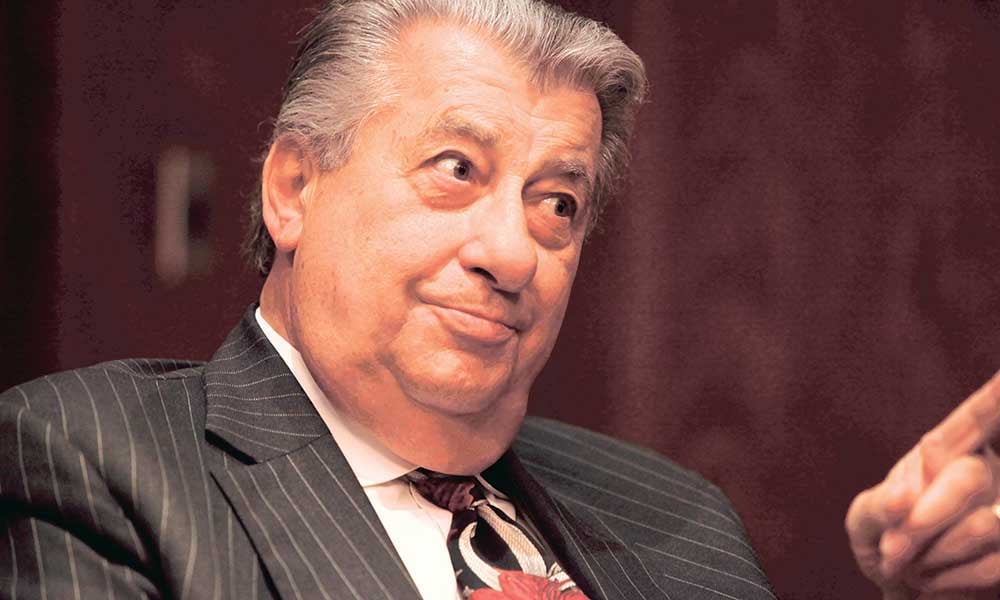
Ted Balestreri, consummate storyteller and president and CEO of the Cannery Row Co., says his company runs by the edict “Work hard, play hard, have fun together.”
Balestreri worked the front and did the books while Cutino was in the kitchen. One night a pair of school teachers came in for a special occasion, and Balestreri could tell they when they left they weren’t happy. The restaurant found their address and sent a pair of prime steaks to their home.
Now, he says, people don’t necessarily want their experience glamorized. They just want something more casual. (Like a grilled cheese sandwich, I think.) He accepts that – witness the success of Bubba Gumps, the first in that chain, on property owned by Cannery Row Co. – the ultimate in casual. But the loss of the glamor, the loss of civility, makes him wistful.
As we eat, a number of luminaries drop by to pay homage. It seems a Rancho Cielo board meeting has just ended. Hotel manager John Narigi comes by to say hello. Construction magnate/political shotcaller Don Chapin drops by to greet him. And Rancho Cielo founder John Phillips, currently running for Monterey County Supervisor, joins the table for a cup of coffee.
We talk about health care. Balestreri, a Republican, thinks everyone should have health care. Education, too – everyone should have access to good education.
“So really,” I say, dunking a grilled cheese crust into the soup, “you’re kind of a socialist.”
The waiter almost drops the water pitcher. Cannery Row Co. Chief Operating Officer Mike Zimmerman can’t stop laughing. Even Phillips smiles wider than I’ve ever seen him smile.
“Mary, no. No. You can’t say that. Mary, really, how long can you hold your breath?” Balestreri asks me.
I’m keeping count. That’s five pieces of litter he’s picked up – and two half-hearted threats of drowning me.
• • •
Why, at almost 74 (his birthday is in June), does Balestreri still show up for work every day? He has a crack management team in place that could run things. His sons, Teddy II and Vince, are both involved in the company – Teddy on the community relations side, and Vince on the construction side. And Balestreri says there’s a succession plan already in place that will keep the company thriving long after he’s gone.
“I’m not a spectator,” he says. “I’m a player. I’m trying to slow down and take a day off. I am trying.”
He thinks about it, you know. He thinks about being gone. It doesn’t bother him much, but there are a few things left he’d like to accomplish.
He wants to get his sons married off. He and his wife would like grandchildren. He got married at 30 and has stayed married to that same woman – Velma – for 44 years this May. But people don’t seem to get married anymore, and they definitely don’t seem to get married young.
“My Aunt Dorothy told me, ‘There are a lot of women you can marry, so marry the one you can’t live without,’” he says. “I married the one I can’t live without. I’d like to see that happen for my sons too.”
Our talk turns back to the monument. Maybe the 45,000 pounds of bronze at Steinbeck Plaza is something of a succession plan in its own right. Maybe it’s a way Balestreri and his boys will be remembered after he’s gone.
Or maybe I’m overthinking it.
Maybe it all goes back to counting. The litter count matters to him as much as the TOT count. The charitable dollars count more than the 45,000 pounds of bronze. The nearly 300 people who work for him matter more than he does, and the diners who eat at the restaurants on the row and the visitors who stay in the hotel rooms matter more than anything.
(1) comment
Sounds like an interesting gentleman who has done much to enhance Monterey and its economy. Thank you
Welcome to the discussion.
Log In
Keep it Clean. Please avoid obscene, vulgar, lewd, racist or sexually-oriented language.
PLEASE TURN OFF YOUR CAPS LOCK.
Don't Threaten. Threats of harming another person will not be tolerated.
Be Truthful. Don't knowingly lie about anyone or anything.
Be Nice. No racism, sexism or any sort of -ism that is degrading to another person.
Be Proactive. Use the 'Report' link on each comment to let us know of abusive posts.
Share with Us. We'd love to hear eyewitness accounts, the history behind an article.