


Ron Glazier had just injected some crystal meth in his arm.
“That’s a really intense high,” he says.
A cold, clear February night settles around him. He’s feeling good, even relaxed.
He and a friend are camped out in a tent near Highway 1, not too far from Lightfighter Drive on the former Fort Ord.
Glazier is high for about 15 minutes, when around 9am, suddenly flashlights shine, then comes the sound of voices.
Marina police are on him, “out of the blue.”
They arrest Glazier and book him into Monterey County Jail on charges of possession of a controlled substance and drug paraphernalia. It was his second arrest in a month, after Monterey police had pulled him over when he was driving a friend’s car to retrieve a bicycle and portable generator from a campsite.
Then he was driving without a license or current registration and was booked in jail and released. This time, he can’t make bail and spends three months locked up awaiting trial.
With three prior prison terms for drug possession (and one for possession with intent to sell) under his belt, Glazier was looking at a sentence of four years or longer.
“‘I turned 44, and I’ve had my fun,’” he remembers thinking. “‘Now it’s time to grow up.’”
A year has passed since those back-to-back arrests.
Glazier sits outside a coffee shop in Sand City, sipping coffee and smoking Turkish Camels. He is a little guarded at first, but once he opens up, he’s articulate and warm and self-aware. He describes how he served in the U.S. Marines in Desert Storm, then returned home to Seaside and struggled to find a job. He started selling meth as a way to make money, even good money.
Now he attends five Narcotics Anonymous meetings a week, checks in at court twice a month, and goes to counseling three times a week. He talks about looking for a job in retail, maybe at Target, or going to school to learn computer repair.
From here it’s hard to imagine him camped along the highway, “slamming” crank – Glazier’s word for injecting – and getting way too high to focus.
He cultivates good habits in treatment he hopes to transfer to the rest of his life – taking out frustration by riding his motorcycle to Big Sur, and just keeping busy.
“When you’re busy doing something constructive, the feeling goes away of just wanting to get high,” Glazier says.
He says he has otherwise sworn off drugs, but hasn’t passed all his drug tests either. He willingly shows a reporter his upper gumline where his teeth used to be. They’re all gone, a byproduct of a condition known as “meth mouth.” The drug dries out salivary glands, allowing naturally occurring acids to eat away at tooth enamel. Glazier says his dentist isn’t sure whether his lower teeth can be saved.
He sits here in Sand City and not in jail because a judge gave Glazier two options when he appeared in court in February 2014.
One: Face a years-long prison sentence for the felony meth possession and driving without a license, emerging with another felony on his record.
Two: Enter a rigorous diversion program through what’s called drug treatment court, a collaborative process incorporating Behavioral Health Department social workers, attorneys, probation officers, defendants and judges.
It’s a choice designed around treatment of addiction, not incarceration.
There are 226 drug courts in California, and hundreds more nationwide. It’s a model many feel makes all the criminal, social and financial sense in the world.
But some of those advocates worry that in approving Proposition 47 – which changes drug possession from a felony to a misdemeanor in California – voters might have totally undermined drug treatment court, giving offenders the chance to keep using drugs indefinitely, until their habit kills them.
• • •
When Carmelo Colon first showed up at drug treatment court in 2013, no one thought he stood a chance at recovery, including Monterey County Superior Court Judge Sam Lavorato.

Judge Sam Lavorato has presided over drug treatment court for seven years. “The effectiveness of drug courts is not a matter of conjecture at this point,” he says. “They’ve been proven to work.”
“Not to bring up the past, but you’ve just done a 180,” Lavorato told Colon in court. “I’ve never seen anybody so sick in my life.”
Prosecutor Jim Martin added: “I thought he was going to be dead.”
Today Colon, 38, has a slightly round belly and bright eyes. He drinks a lot of Red Bull, but has been clean for more than a year.
Colon grew up in Puerto Rico where he served in the Army for two years, then got a job at a supermarket for a year. That’s the last job he held: He found he could make quick cash selling drugs.
In those days, Colon just smoked pot. It wasn’t until he was locked up at age 26 that he first tried heroin, which led to a decade of more crime and jail time.
That hits on a key aim of Proposition 47: to keep small-time drug users like Colon out of prison. Steering low-level offenders like away from hard drugs and hardened criminals – booked for murder, assault or armed robbery – lowers the chance of them developing similar habits.
Also: Prisons cost $9 billion a year in California. Even intensive collaborative courts like drug treatment, which are costly to staff, save money due to lower prison costs, higher citizen productivity and reduced crime. According to the National Association of Drug Court Professionals, every $1 spent on drug court translates to more than $3 in taxpayer savings.
And California prisons, and the Monterey County Jail, are notoriously overcrowded. Without enough cells at the county jail, some inmates are kept in large, dormitory-style rooms with 40 or more beds. At Salinas Valley State Prison, suicidal inmates are sometimes kept in phonebooth-sized cages without bathrooms while they wait for treatment beds.
Things got so bad for state prisons that the U.S. Supreme Court weighed in, saying the existing conditions amounted to cruel and unusual punishment, a crime in itself.
“Crowding creates unsafe and unsanitary conditions that hamper effective delivery of medical and mental health care,” Justice Anthony Kennedy wrote in the 2011 opinion. “It also promotes unrest and violence and can cause prisoners with latent mental illnesses to worsen… A prison that deprives prisoners of basic sustenance, including adequate medical care, is incompatible with the concept of human dignity and has no place in civilized society.”
A broad coalition of reformers brought Prop. 47 to the voters. Backed financially by George Soros, a billionaire financial adviser and progressive philanthropist, the group included San Francisco District Attorney George Gascón, former San Jose Police Chief William Lansdowne, and the organization Crime Survivors for Safety and Justice, a project of the nonprofit Tides Center.
The goal was simple: Keep non-violent criminals – including those facing time for drug possession – out of prison and jail. Petty theft, check forgery and burglary crimes for amounts under $950, once felonies, are now misdemeanors.
It was a good pitch in voters’ eyes: The proposition passed with 60 percent of the vote and fared even better in Monterey County, where it earned 65 percent.
The proposition, also called the Safe Neighborhoods and Schools Act, will save hundreds of millions of dollars a year, according to the state Legislative Analyst’s Office.
The savings will be deposited into a new fund, named the Safe Neighborhoods and Schools Fund. That money gets divvied up for mental health and drug abuse treatment, victim services and truancy reduction programs.
The changes came into effect Nov. 5. Anyone who’s been previously convicted under one of 10 drug and theft statutes like burglary of a business can petition the court to designate those felonies on their record as misdemeanors, barring any major threats to public safety. That means hundreds of thousands of Californians previously convicted can file.
Some of them are currently doing prison time. Statewide, 5,350 inmates are eligible to file petitions for Prop. 47 relief, asking the court to change their records, and the sentences they’re serving.
That’s why hundreds of yellow folders are stacked up on the floor at the Monterey County District Attorney’s office, overflowing from a half dozen file boxes. These are just a handful of the 640 (and counting) Prop. 47 petitions that have flowed into court since the proposition took effect, many from former inmates or parolees already out hoping to clear a felony from their record, so they can vote in elections and improve their chances for employment.
The petitions started arriving Nov. 5, the day after the election, even before Monterey County Superior Court had created its own forms.
“Most of them are granted,” says Nona Medina, public information liaison for Monterey County Superior Court. “It would be a rare thing for somebody to go through the petition process and not qualify.”
The problem with all this, say proposition critics, is that the new law isn’t so much a thoughtful solution to overcrowding as it is a dangerous overreach.
• • •
In 1994, California voters approved the state’s three-strikes law, meaning non-violent felons with two previous offenses could be sentenced to 25 years to life in prison. The law meant that any felony, even a non-violent crime like stealing clothes from a department store, could land offenders with two prior felonies on their record in prison for life.
In 1996, Charles Ramirez, a homeless addict, was convicted and sentenced to life in prison under the three-strikes law for stealing a car radio.
In 2000, voters gave prosecutors the power to charge juveniles directly as adults in some cases, without first seeking permission from the court.
One result of all this: the overcrowded prisons that drew the ruling from the U.S. Supreme Court.
The voters responded through the initiative process. In 2012, they passed a ballot measure, Prop. 36, unwinding parts of the three-strikes rule approved 18 years earlier; after doing 12 years, Ramirez was released, and is now sober and working full time in Los Angeles.
Now Prop. 47 follows a similar path.
And that’s a major problem, says one vocal critic, Monterey County Chief Assistant District Attorney Berkley Brannon.
Voters are managing by crisis, swinging from fears over one thing to another without being pragmatic or thinking big picture, Brannon says.
“It’s a pendulum,” he says. “We’re overreacting, and it’s going to be time to bring it back. And it will come back.”
Reacting can have other consequences. Brannon doubts lawmakers and the public will know whether these major reforms are working since they come as other major shifts are in motion. After all, public safety officials are still wrestling with serious implications and outcomes of un-crowding state prisons via a different process called realignment, placing many would-be inmates at state prisons in the custody of county probation departments, or in county jails.
“In the middle of this realignment experiment, we changed the rules of the experiment,” Brannon says. “We didn’t even have the results of the first experiment.”
Voices like those of Gilbert Otero, president of the California District Attorneys Association, Harriet Salarno, president of Crime Victims United, and Christopher Boyd, president of the California Police Chiefs Association, who wrote the rebuttal that appeared on the ballot, insist Prop. 47 is an attack on the teeth of the justice system.
“Proposition 47 is a dangerous and radical package of ill-conceived policies,” they wrote.
The proposition, they reasoned, would provide “Get Out of Prison Free” cards.
“The question is whether this system has sufficient incentives to cause people to change their conduct,” Brannon says. “We’re going to find out.”

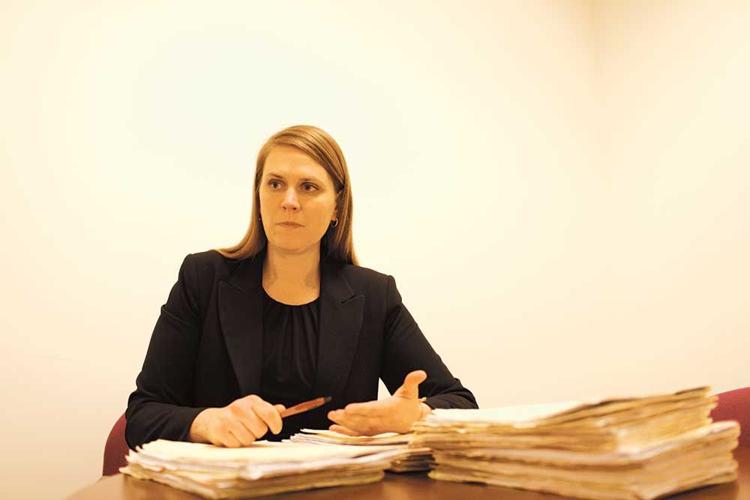
Deputy Public Defender Michelle Wouden braced for lots of drug court drop-outs with Prop. 47, but it hasn’t happened. “We thought we’d see a lot of people who said, ‘Forget treatment.’ We didn’t.”
They get even more ominous when it comes to what the proposition will mean to drug courts: their doom.
• • •
It started as a Saturday-only thing for Cecelia Whitney. She first started drinking and using meth at 15 while at parties. It crept into Sundays too, then the entire week.
“I didn’t really care anymore. I didn’t care about my appearance, my family. All I wanted to do was get high, feel that rush,” Whitney told Judge Lavorato in court Feb. 20.
Her mom stood beside her, silently crying. “I’m grateful to you, your honor,” she said. “I haven’t had a daughter since 14 years old.”
After 18 months in drug court, Whitney is clean, and stood before the judge for her graduation ceremony.
A social worker held up a bowl of dark, round pebbles, and asked Whitney to select two rocks from it. She then placed one in a tall vase, like all drug court graduates.
Eventually, this vessel will be full.
The second stone, Whitney kept for herself. It’s to serve as a reminder of “a solid recovery,” the social worker said.
If the proceedings feel a little bit like a spiritual ceremony, that’s probably appropriate, as there is a ritual-like feeling to Alcoholics Anonymous and Narcotics Anonymous meetings, with traditional roles, graduation traditions, sayings, turns talking and often-circular seating arrangements.
Defendants in drug treatment court often start out in residential treatment programs, then proceed to earn points over a period of about 18 months. They get credit for things like showing up at court-ordered counseling sessions, attending AA meetings and passing drug tests. They lose points when they test positive or miss a court date, and the judge can order them back to jail if they’re not sticking with the requirements of the program.
It doesn’t work for everyone – at least half flunk out – but for those who are working successfully toward recovery, even months from graduation, life is markedly better.
Carmelo Colon, the Puerto Rican Army vet, fell in and out of unsuccessful treatment programs back home, then followed his mom and siblings to Salinas about two years ago. In February, he advanced from phase two of drug court to the third and final phase, and Judge Lavorato cheered him on: “You were skinny, scrawny. You were bones, and you were sick. When people ask me, ‘Does drug treatment court work?’ I think of you. I am proud of you.”
Colon is about six months shy of graduation, and he’s enrolled in computer classes at the Employment Training Center in hopes of getting a job and moving out of his mom’s place.
With treatment, sobriety has gotten easier over time: “It’s not that hard now, but at first it was very difficult,” he says in Spanish. “Mentally and physically, I feel good. And spiritually.”
Here’s what at first scared defense attorneys, prosecutors and public defenders who work in drug court, when Prop. 47 first passed: that without the greater consequences no one like Colon will enroll.
Those skeptics include Salinas defense attorney Geoffrey Buckles, who represents clients in drug cases privately and as an alternate public defender, and Deputy Public Defender Michelle Wouden, who represents drug court clients.
Colon, Wouden’s client, was granted Prop. 47 relief on Jan. 16. He can now change his felony record. With time he’s already served, plus good-conduct credits at the jail, the maximum sentence he would receive with Prop. 47 is just 17 days in jail.
Suddenly the tough choice guys like Colon and Glazier made – to engage in treatment and actually battle addiction rather than time with convicted murderers – doesn’t seem so clear.
“Now they only have three months over their head of actual [jail] time,” Brannon says. “The question is: Does that create the kind of incentives that people need at times to correct their behavior?”
• • •
Glazier hadn’t heard of Prop. 47 by name before this interview, but he had heard word on the street is that you can get off easy now on drug charges that would’ve once required extended prison time – and you can do it without going through drug court, and the treatment opportunities it offers, because of Prop. 47.
“An old girlfriend of mine got caught with a quarter ounce of crystal and a pipe,” he says. “She just got cited to go to court. Before, she would’ve been put in jail, at least 18 months in county jail, right there.”
But Glazier says that hasn’t changed how he feels about drug court. He has advanced from phase one to phase two and hopes to complete the third and final phase within a year.
“When you’re fermenting in jail, you have nothing but your own thoughts in your head,” he says. “That’s when it dawned on me: I am so sick of doing this. I can’t do this anymore.”
Drug courts across the state, like local attorneys, were also abuzz with fears that clients like Glazier would drop out, fatally wounding the program and its sizeable benefits: Why stick with a rigorous program when you can just do a month in county jail for a misdemeanor, then feed the addiction again?
But the much-anticipated flood of addicts leaving treatment programs following Prop. 47 has been more of a trickle.
“Even after 47, people are still saying, ‘I want to participate,’” Wouden says. “It’s not about whether the charge is a felony or misdemeanor. It’s where do you see yourself in a year, two years from now?”
Buckles says he’s lost only one client from drug treatment court since Prop. 47 passed.
“I was expecting a lot more to say, ‘It’s a misdemeanor, I’m out of here,’” he says.
The numbers tell a more nuanced story. From Nov. 5 to Dec. 31, there were no new referrals to drug treatment court, which looked ominous. (The current caseload is 53.) But then in January and February, referrals started to tick up – 14 and counting since Jan. 1.
“I think the premise of Prop. 47 is good,” Buckles says. “The original intent was to not put recreational [users] or people who really need programs in prison with hardened criminals, and second, to reduce overcrowding.”
But in Buckles’ view, people charged with drug crimes aren’t in the best position to think long-term and weigh the benefits of a challenging 18-month program, especially when the maximum sentence they might receive isn’t all that long.
“When people just meet an attorney cursorily at an arraignment, all they hear is, [jail] is the offer to resolve the case right now.’”
• • •
Prop. 47 is an experiment that hasn’t happened before now.
In the absence of results that will come with time, the best way to evaluate its effects is to go to the heart of drug court. Locally, that is Department 10 of Monterey County Superior Court in Salinas.
There, Lavorato doesn’t seem like the typical judge – he comes across as more conversational than official.
He tells addicts repeatedly, “Thumbs up” and “I’m proud of you,” and gives them a chance to tell their stories and explain their dirty piss tests.
But old-timers know not to equate this compassion with leniency.
“He’s tough, but he’s fair,” Glazier says. “He will give you the opportunity to straighten up – if you don’t confuse his kindness with weakness, because he will drop the hammer on you.”
Lavorato says it can be challenging to serve as a judge in this court, where you are praising a defendant one week, and sanctioning them the next. But it has its moments.
“When they finally get to the point where they’re clean, they’re sober, they’ve gotten their family back and they’ve gotten their kids back – they’re being productive members of society – they come in smiling, and you never saw that before,” Lavorato says. “That’s what makes my job as a drug treatment court judge satisfying.
“It’s a win-win situation for everybody: the person, law enforcement, employers. When you finally see someone fly, it makes you feel good.”
Lavorato is optimistic about the future of drug court programs despite Prop. 47.
“The outlook is positive,” Lavorato says. “Prop. 47 may have redesignated crimes, but it sure didn’t take away addiction.”
Same goes for the need or desire for support and education: “It didn’t take away alcohol and drug problems,” he continues. “The landscape may have changed a little bit, but that is still there. We’ve seen in the last month and a half, people still want [treatment].”
He believes there is a future for collaborative courts like these, even if Prop. 47 gutted part of the motivator – felony records and corresponding sentences – that made the prospect of drug court more attractive.
“I think the stick is still there,” Lavorato says. “A misdemeanor is still a crime.”
He believes that with Prop. 47, the voters have weighed in favorably toward alternatives to jail.
“There’s a lot to say about how jail doesn’t work, and rehab does,” he says. “I think that’s the thing of the future: rehab. The voters agree with that.
“Obviously we have individuals that are dangerous to society, and we need to look at them, respectfully, in a different light. But individuals who are eligible and suitable for a drug or mental health court, I’ve seen it work firsthand.”
Even Brannon, who donated $200 of his money to the No on Prop. 47 committee, concedes that the unprecedented law – despite its risks – reflects the will of the public.
“I think most people would rather spend money on education than prisons,” he says.
(5) comments
Just as I was about to commend The Weekly for opening its very nice juice bar/cafe/art gallery/music venue, you publish this weeks issue using a racist , stereotyped, photo of a black man on your cover to support your story on Proposition 47. You are fully aware that whites account for the most arrests for drug related offenses.
Shame on you for your insensitivity and poor judgement.
Seaside is on its way to becoming the historic home to a World Class University and a National Monument with opportunities to develop a healthy and vibrant economy. As the " Gateway to the Monterey Peninsula", Seaside will have an appealing "Brand" with destination points to complement tourist attractions elsewhere on the Peninsula.
The headline is misleading. Oxford defines "radical" as: "relating to or affecting the fundamental nature of something; far-reaching or thorough." There is nothing radical about Prop 47. It is a minor reform which will make no more than a slight dent in the number of people incarcerated in the nation with the highest incarceration rate in the world. Also, one has to read to almost the end of the article to find that the fears of a flood of addicts leaving treatment programs following Prop. 47 have proved groundless. But I guess a headline along the lines of "Right-wing Fear-mongering about Prop 47 Refuted by Actual Facts" would lack the desired sensationalism.
It's rare that the Weekly features a black man on its cover. Unfortunately, despite the fact that only 3% of people in Monterey County are black, and despite the well-established fact that whites are significantly more likely than blacks to buy, sell and use illegal drugs, the Weekly chose to use the image of black man on its story about local drug addicts. This reinforces the negative, inaccurate and racist stereotypes.
I would also like to point out that a letter on the issue of bigotry against Muslims and Arabs was recently sent to the Weekly. The letter was signed by a variety of local human rights activists, including the President of the local NAACP chapter and a person who had just recently been recognized by the Weekly as a "local hero." The Weekly declined to publish the letter or even to acknowledge that it had been received.
These editorial decisions show a disappointing insensitivity that is unfortunately quite common among those who have never experienced the pain of discrimination based on ethnicity or religious identity.
The National Coalition Building Institute offers workshops on welcoming diversity and prejudice reduction. The people at Weekly might consider contacting NCBI before they alienate more members of the community.
http://ncbi.org/contact-us/
A) The photo of a man featured in the story, who in all likelihood probably volunteered to have his photo taken. This isn't an issue of color, it's an issue of drug abuse, regardless of ethnicity.
B) How do you know they DIDN'T receive the letter? You can't acknowledge getting something you never actually got, after all.
Don't go around making wild assumptions, sir.
If you aren’t willing to follow the law yourself, then you can’t demand a role in making the law for everyone else, which is what you do when you vote. The right to vote can be restored to felons, but it should be done carefully, on a case-by-case basis after a person has shown that he or she has really turned over a new leaf, not automatically on the day someone walks out of prison. After all, the unfortunate truth is that most people who walk out of prison will be walking back in. Read more about this issue on our website here [ http://www.ceousa.org/voting/voting-news/felon-voting/538-answering-the-challenges-to-felon-disenfranchisement ] and our congressional testimony here: [ http://judiciary.house.gov/_files/hearings/pdf/Clegg100316.pdf ].
Welcome to the discussion.
Log In
Keep it Clean. Please avoid obscene, vulgar, lewd, racist or sexually-oriented language.
PLEASE TURN OFF YOUR CAPS LOCK.
Don't Threaten. Threats of harming another person will not be tolerated.
Be Truthful. Don't knowingly lie about anyone or anything.
Be Nice. No racism, sexism or any sort of -ism that is degrading to another person.
Be Proactive. Use the 'Report' link on each comment to let us know of abusive posts.
Share with Us. We'd love to hear eyewitness accounts, the history behind an article.