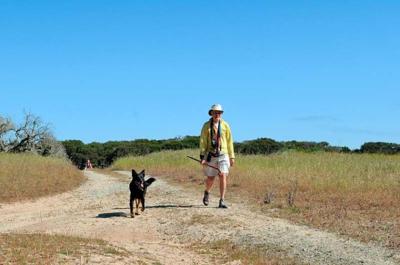
There’s a heaviness to Bill Weigle as he walks a slow loop through the former Fort Ord on a sunny April morning, past wildflower-smattered maritime chaparral, lichen-draped oak woodlands and gentle khaki-colored slopes cut through by a power line.
He usually clocks 7 miles a day here as he trains for a 24-hour, 48-mile Grand Canyon hike this fall. And he once qualified for the Olympics as a long-distance runner. So it’s not fatigue that bothers the 71-year-old meteorology professor during a 3.5-mile stroll.
The occasional industrial debris – a pile of plywood at the edge of a meadow, a pipe fragment at a fork in the trail – serves as a reminder that much of this 28,000-acre expanse spent 77 years as a practice battleground.
Weigle, a veteran himself, is at peace with that past. It’s Fort Ord’s future that haunts him.
As he walks, he describes the view as if the County of Monterey has already executed its planned projects. The trailhead on Marina’s Gigling Road and Eighth Street will look onto a sprawling parking lot, he says. The chaparral to the northwest will be horse stables; the huddle of oaks to the south, houses.
Where there are now quiet trails, trees and butterflies, Weigle projects a parkway, a chi-chi arts district, an events arena.
“The thought of losing this place just drives me crazy,” he says. “But I’m not alone.”
At least 213 people can back him up on that. That’s the latest count in his month-old Google group, Fort Ord Rec Users (forU), with a mission “to preserve and enhance recreational use and the native habitat of the former Fort Ord for the benefit of all.”
Since the base’s closure, a wide spectrum of recreationalists has embraced Fort Ord as a de facto public park, including mountain bikers, horse lovers, hikers, dog trainers, birders and youth educators. Fort Ord Recreation Trails Friends (FORT Friends) brings those groups together in an effort to preserve connectivity between the historic Army trails on the west side of Fort Ord and the BLM trails to the east.
As the newest Fort Ord user group, forU takes a more aggressive position, challenging the very foundation of the base’s post-military identity: the 14-year-old Fort Ord Base Reuse Plan.
Fort Ord is a memory for the 2 million soldiers who trained here from 1917 to 1994, spanning World War I to Operation Desert Storm.
In 1991, the federal Base Realignment and Closure Commission decided to shutter Fort Ord and send the 7th Infantry Division to Fort Lewis, Wash. Three local politicos – then-Congressman Leon Panetta (now President Obama’s pick for Defense Secretary); then-Assemblyman Sam Farr (now a congressman) and then-State Senator Henry Mello (now deceased) – convened a community-wide task force to brainstorm what could be done with the base.
At the time, Monterey County’s three-legged economic stool was tourism, agriculture and the military. The shuttering of Fort Ord meant a steep drop in revenue for bordering cities, especially Seaside and Marina. The task force recommended using the land to build up education and research to make up for the lost military economy.
Over the next two years, representatives from the affected cities and the county, working with the Army, honed that vision during weekly meetings of the Fort Ord Reuse Group. By the base’s official closure in 1994, they had a brand-new agency to shepherd it forward: the Fort Ord Reuse Authority (FORA), with a voting board comprised of local elected officials, and non-voting members including state and federal politicians and representatives from local agencies and institutions.
In 1997 FORA adopted the Base Reuse Plan, which set a goal of building the former Army base back up to its historic population of about 36,000, with civilian uses.
The plan slated 2,300 acres for education and research, with parcels eventually transferring to CSU-Monterey Bay, Monterey Peninsula College, University of California, Monterey College of Law and other schools. Another 3,500 acres were dedicated to residential and commercial uses, and 4,000 more for parks and visitor-serving facilities.
A legal challenge from the Sierra Club led to a 1998 settlement restricting Fort Ord development to the potable water available, imposing higher developer fees to mitigate environmental impacts, and limiting new private housing units to 6,160. It also sets more than two-thirds of the base aside as public open space and habitat.
“What we adopted was comprehensive and balanced. We felt it was important for the Monterey region to have protected open space,” FORA Executive Officer Michael Houlemard says. “Development on the remaining parcels is essential to providing the financial support for the recreational uses, the habitat protection and environmental mitigation measures.”
The building up of Fort Ord is slow going, what with land to be burned, munitions to be cleared, contaminated groundwater plumes to contain, developers to woo and the crappiest economy in decades.
But it’s going: In Seaside and Marina, more than a dozen projects are either completed (the Bayonet and Black Horse golf courses, the Seaside Highlands condos, the Dunes big-box retail center) or in the pipeline (the Main Gate mall, the Cypress Knolls senior community, the Marina Heights housing project).
It probably won’t be long before Fort Ord gets a new name on Google Maps. The state law that created FORA requires it to dissolve by June 30, 2014 – but first, it has to reassess the Base Reuse Plan.
The forU activists see a window.
About a mile into the hike, Bill Weigle runs into the same five creatures he sights almost every day: John and Cindy Hutcherson, a fit couple in their 70s, and their three mutts, Chula, Murphy and Roxie.
John figures he and Cindy know the Fort Ord trails as well as anyone. Former marathon runners, they’ve now scaled back to hearty 6-to-10-mile walks, which John says they’ve done daily for the past 15 years, excepting the occasional out-of-town vacation.
“We love going along the paths with old trees and moss and shade,” John says. “We actually enjoy it more because we know it is very possible this will all be gone. It’s hard to believe we will be denied access to these trails, because we feel they belong to us as much as anybody.”
In his view, the county should stick to developing the traditional blight along Highway 1: “That is where they need to put their effort to clear the blighted barracks and put in useful housing for young and low-income people. There are hundreds of acres in there to be improved. We don’t need to destroy habitat or green land or forest when there’s all this blight out there.”
The county’s first project didn’t improve the the Hutchersons’ confidence. “I tell ya, the most devastating thing was to see that East Garrison,” Cindy says. “Horrible, just horrible.”
That 244-acre, 1,400-home subdivision promised high-density, affordable housing in line with New Urbanist principles. But the original developers, East Garrison Partners, defaulted on their loan and lost title to the land – after cutting down thousands of ancient oaks.
Three years later a new developer, Union Community Partners, bought the parcel, landed a $10 million Neighborhood Stabilization Program grant and expects to break ground within the next few months. But the delay has branded East Garrison a “stillborn” among critics, a habitat unnecessarily mowed down and then squandered.
And it’s just one of four Fort Ord projects that has kept County Redevelopment and Housing Director Jim Cook on the defense.
Almost 80 years as a playground for war toys has left Fort Ord a contaminated Superfund site; state law considers all 45 square miles of it “blight.” But less than half of that, about 13,000 acres by a FORA staffer’s estimate, looks like what the term evokes: lonely paved lots, rows of boarded-up barracks, dilapidated warehouses.
This is the sort of traditional blight forU members support developing; a 120-room youth hostel under construction and a proposed “eco-village” in Marina are poster projects. But while the cities of Seaside and Marina have gone to work on the eyesores, the county is making plans for the open spaces.
Near the Parker Flats area, developers in negotiation with the county are proposing to build a 450-acre horse park, including a 1-mile horse track, public and private stables, a visitor center, vet clinic, apartments, hotel and a 6,500-seat arena.
Cook says the Monterey Downs project would bridge the Peninsula’s urban centers with the Fort Ord backcountry, enhancing recreation opportunities and boosting ecotourism. As an added bonus, he says, the developers have agreed to buy an endowment property that will help Seaside fund its planned veterans cemetary.
But Cindy Hutcherson has a hard time imagining the trail she’s standing on as the edge of a horse track. “This is just gorgeous!” she says, gazing at the quiet, oak-studded meadow. “It’s going to be leveled. There’ll be a grandstand and horses racing, and all these trees will be gone.”
The Board of Supervisors is expected to consider the Monterey Downs development agreement next month; forU is mobilizing to oppose it.
The group – which includes Weigle’s wife, Sustainable Seaside leader Kay Cline – is also in battle mode against Whispering Oaks, a 58-acre business park next to the old Army landfill. County planners proposed to anchor the site with a 24-acre, $100 million headquarters for Monterey-Salinas Transit, but on March 9 the county Planning Commission unanimously rejected the proposal because it would involve cutting down 4,400 trees.
Two months later, about 70 forU members attended an MST board meeting and submitted a petition that now exceeds 700 signatures, asking the agency to build its headquarters on an alternate site – preferably on traditional blight, like the Marina Airport. The authorities, however, weren’t persuaded. The appeal is headed to the Board of Supervisors, possibly in mid-June.
Cook says the MST/Whispering Oaks siting is strategic: In exchange for putting its new hub next to the planned multi-modal corridor, MST agreed to give the county a backcountry parcel. It’s a win-win that will help the county offset the future costs of taking on the landfill, he says, while boosting MST ridership, cutting vehicle emissions and creating jobs. Moving the location now, he adds, would threaten $30 million in grants and put the entire project in jeopardy.
That doesn’t impress Margaret Davis, a forU member and leader of Friends of the Fort Ord Warhorse, who rides the trails after work most days on her pigeon-toed quarter horse, Jack.
“You get that pleasant fatigue, that sense of seeing horizons. It’s very restorative,” she says. “The bikers and the hikers experience the same thing. It’s like a magical place: Once you get 100 yards away from the parking lot, you feel like you’re in the wilderness.”
Davis is bent on preserving those paths, particularly the Sgt. Allan MacDonald Cavalry Trail, which connects the Marina Equestrian Center to the Jerry Smith Corridor and the open expanse of BLM land – more than 80 trail miles that include the grave of the famous war horse, Comanche.
“As many trails as possible should be maintained for horses and bikers,” she says. “This is an incredible resource. It was a windfall that has developed into a favorite place for people to go. It needs to be respected for that.”
ForU is also opposing the Eastside Parkway, FORA’s planned 3-mile route through Fort Ord from Parker Flats to Inter-Garrison Road. A related project is the 1-mile extension of Eucalyptus Road, which will connect the parkway with General Jim Moore Boulevard in Seaside. Construction on the Eucalyptus extension begins next month.

Houlemard says the Eastside Parkway (planners are toying with changing the name to Panetta Parkway, in honor of Leon) is critical for mitigating the traffic impacts of development. But forU members see it as yet another boondoggle that will destroy ancient oaks and rare maritime chaparral habitat.
“I’m sure that any developer would be thrilled to get their hands on this,” Weigle says, stretching out his arms to frame the wild landscape. “If that were my mentality, I would be salivating.”
Jim Cook doesn’t like being cast as the environmentalist’s nemesis. He’s an avid cyclist himself, he says, and often spends Thursdays biking in the Fort Ord backcountry, which he calls a “jewel.”
But as the county’s head of redevelopment, it’s his job to follow the Board of Supervisors’ direction. He says the county’s proposed Fort Ord projects are in line with both the Base Reuse Plan and the 2010 General Plan – though forU and other public critics are testing that claim.
Cook emphasizes the sheer area of protected open space on Fort Ord: The Army is about halfway done clearing almost 17,000 acres of munitions and transferring it to the Bureau of Land Management, to be preserved as a habitat reserve. The county is setting aside another 1,300 acres for recreation.
But the county needs revenue-generating projects to fund the necessary trail maintenance, law enforcement and emergency medical services for those open spaces, Cook says. And the weak economy is all the more reason to move forward with them.
“The county is in layoff mode. The General Fund has a $30 million financing gap. What we’re trying to do on Fort Ord is be self-sustaining,” he says. “You can argue it’s a down time, so we should be doing nothing. But one person in 10 is sitting on a curb somewhere. We need to be out there working for people.”
Most of the elected officials who make the decisions around these parts, including the suits in Sacramento and Washington, are on the same page.
U.S. Congressman Sam Farr, who’s been involved in the FORA process since its inception, has a long record of support for public open space – including Fort Ord Dunes State Park, a nearly 1,000-acre parcel he fought to protect from development.
“But there needs to be a balance,” he writes by email. “And I believe we have worked to do that at Fort Ord, with a plan that does not allow development to outweigh the value of open, recreational spaces.”
State Assemblyman Bill Monning (D-Carmel) has similar sentiments. He’s one of the founders of LandWatch, the local nonprofit that advocates for the redevelopment of traditional blight and the preservation of natural open spaces. But last year he pushed a bill through the Legislature that would have allowed cities to use redevelopment funds for Fort Ord projects, even on wildlands.
Then-Gov. Arnold Schwarzenegger vetoed AB 1791 with a message that could have been scripted by LandWatch: “Redevelopment funds should be used solely for the purpose of eliminating blight in California’s urban neighborhoods.”
But Monning continues to back the Base Reuse Plan, which he says was the product of a long process involving a broad spectrum of community stakeholders. He adds, though, that a reassessment would be healthy.
“It’s not unethical to seek development that creates jobs in our community. It’s not unethical to want to preserve habitat and the environment,” he says. “The purpose of the Fort Ord Reuse Plan was to strike a balance. As we move forward, it’s fully appropriate to check in with those principles.”
County Supervisor Dave Potter, who’s been on the FORA board since its formation, says those who want the Base Reuse Plan revised to reduce commercial and residential development aren’t considering the hit neighboring cities took when the base closed.
“I think there’s a lack of understanding of all the hard work that went into the plan and the community consensus that was around it,” he says. “To say we should have the overwhelming majority of [Fort Ord] for recreation or habitat – where’s the social and economic equity for the cities of Seaside and Marina?”
Much of the former Army base may look wild, he adds, but it’s still blight: “While trees may have grown up in areas where people were throwing grenades and launching mortars, those areas still need to be cleaned up.”
The county is open to public input, he emphasizes, and is working with FORT Friends to plan amenities such as road crossings, restrooms, public parking and signage. He says he supports the goals of keeping the trails accessible and preserving connectivity from the beach to the backwoods.
But forU members want deeper concessions to protect Fort Ord’s natural spaces.
“They seem to have a real alternate vision for some of the Fort Ord land,” says Supervisor Jane Parker, who sits on the county’s Fort Ord Subcommittee with Potter.
“Their ideas are very timely because the Fort Ord Reuse Plan was put together, gosh, 15 years ago. The assumptions on which we built the plan may need to change,” she says. “We’ve always accepted that economic development by necessity involves putting in paved roads. This group is saying there is huge economic value in looking at the really unique land on the former Fort Ord in terms of its quality and quantity.”
The latest county general plan, GPU2010, is strong on clustering developments in or adjacent to cities, she adds. “Accepted planning wisdom is that growth and development should happen in the populated areas. What that means from a practical standpoint: The unincorporated county should be the last place where growth and development would happen.”
The BLM is charged with protecting the rare and endangered plants and animals of Fort Ord: California tiger salamanders, California red-legged frogs (one was recently found on Fort Ord near the Salinas River), and Contra Costa goldfields, sunflowers that depend on easily disturbed vernal pools.
So as a BLM botanist, Bruce Delgado keeps his views on Fort Ord narrowed to enthusiasm for the area’s 800 wildflower species, including the Monterey manzanita, a wild flowering shrub that exists only on Fort Ord and Toro Mountain.
But as the mayor of Marina, his political take on the base’s redevelopment is more complex.
Perhaps more than any other city, Marina depends on revenue from land vacated by Fort Ord’s closure. The city has taken traditionally blighted parcels and turned them into Marina High School, The Dunes shopping center, Peninsula Wellness Center and, most significantly, CSU-Monterey Bay. Officials are banking on the Marina Heights project to put more than 1,000 new homes between Imjin and California Avenue, and Cypress Knolls to create 775 residences for seniors.
“The overall vision of Ford Ord development is a great balance that actually favors the environment,” Delgado says. “The problem is that half of what can be redeveloped already is developed. Nobody has a problem building on blight. The other half: beautiful wildland that’s just as beautiful as the set-aside wildlands. It’s very sad and frustrating for many people, including me, to see wildlands bulldozed, but that’s part of the deal.”
He sees the upcoming reassessment of the Base Reuse Plan as a way to buy the natural space some time. To that end, he’s pushing for the Whispering Oaks/MST project to move to the Marina Airport Business Park, a traditionally blighted Fort Ord parcel three miles away.
“The question is not whether we should develop, but how and in what order we should develop these properties,” he says. “What’s the appropriate pace of bulldozing wildlands?”
With Monterey Downs and Whispering Oaks decisions heading for the Board of Supervisors, Delgado proposes a peace accord between forU and the county.
“Maybe we should try to prioritize redeveloping the blight,” he says. “You’ve got an oak woodland next to a parking lot: which one should be developed first?”
(0) comments
Welcome to the discussion.
Log In
Keep it Clean. Please avoid obscene, vulgar, lewd, racist or sexually-oriented language.
PLEASE TURN OFF YOUR CAPS LOCK.
Don't Threaten. Threats of harming another person will not be tolerated.
Be Truthful. Don't knowingly lie about anyone or anything.
Be Nice. No racism, sexism or any sort of -ism that is degrading to another person.
Be Proactive. Use the 'Report' link on each comment to let us know of abusive posts.
Share with Us. We'd love to hear eyewitness accounts, the history behind an article.