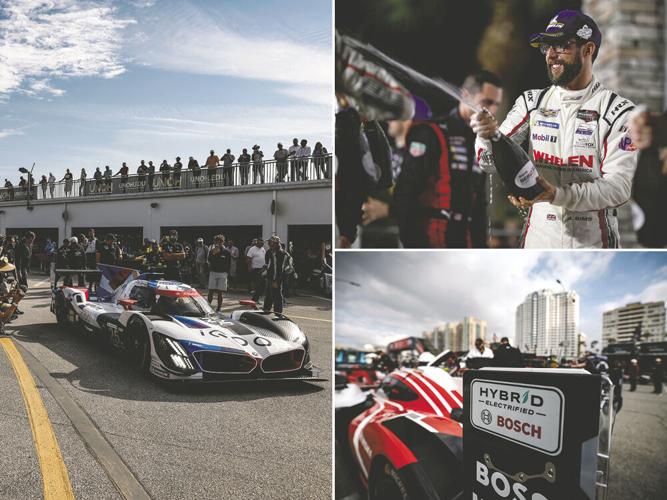




“Exciting” is a word tossed around quite a lot in the racing world these days. Drivers use it. So do engineers. Even executives are prone to condense the sport and its current state into the encompassing adjective.
In this case, however, they are not referring to action on the track. Instead, there is growing anticipation surrounding the sport’s future – alternative fuels or battery power, for example – as climate change raises questions about racing’s very existence.
“We’re at the start of a long journey and a really exciting one,” says Alexander Sims, driver of the IMSA GTP class Action Express Racing Whelen Cadillac, set to compete this weekend, May 12-14, at WeatherTech Raceway Laguna Seca. “We’re starting a new era.”
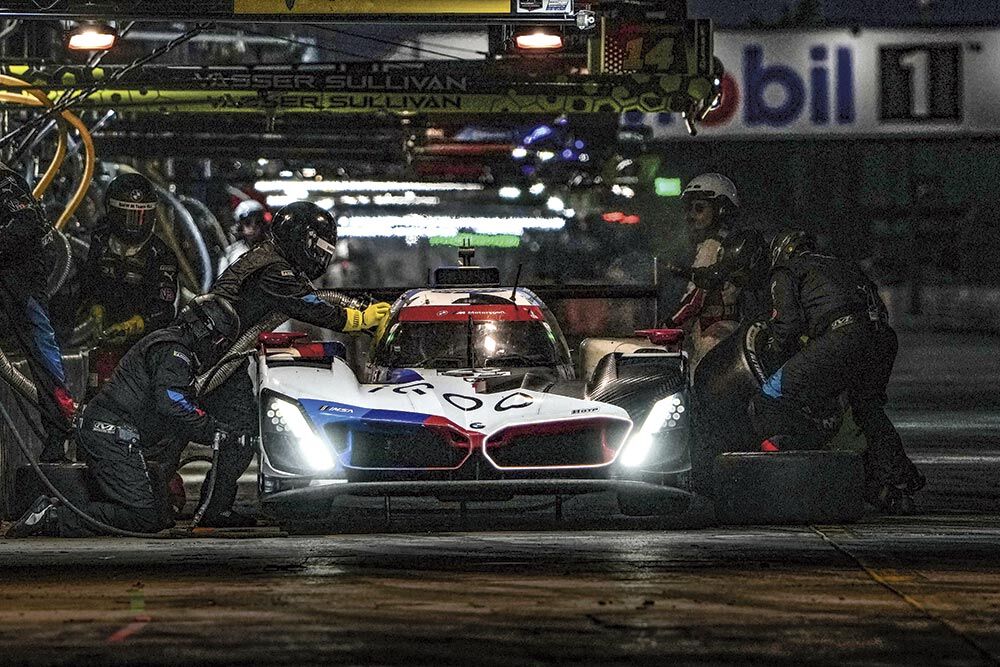
A pit stop during the 12 Hours of Sebring. Race sanctioning bodies like IMSA (above) and IndyCar are using biofuels and tires made with more environmentally friendly materials.
IN A WORLD BEING SMOTHERED by greenhouse gas emissions and non-recyclable waste, auto racing has a serious image problem.
While exhaust spewed into the atmosphere by the 20 cars on a Formula 1 grid, the 28 or more that take the green flag at IMSA and IndyCar events, the 36 fielded by NASCAR and other series account for a mere fraction compared to the billions of vehicles commuting daily, motorsports are a highly visible reminder of carbon excess.
The sport has been in a similar position before. During the oil crisis of the early 1970s, racing continued through gas rationing, reducing fuel consumption by shaving race distances (NASCAR’s Daytona 500 was shortened to 450 miles). As Bob Kelly, who operated the road course at Watkins Glen, New York, told the New York Times in 1973, “Some guy who has to sit home on the weekend because of rationing turns on his television set or reads a newspaper and sees auto racing. How is he going to feel?”
That was a response to a temporary crisis. Climate change spurred by greenhouse gases has devastating potential for the long term. Governments and manufacturers tend to accept battery-powered electric road vehicles are a logical response. Although mining and battery production is by no means clean, the cars themselves produce zero emissions.
For racing, however, battery-powered cars have limits – particularly when it comes to range. The Indianapolis 500 demands vehicles lap for 500 miles, something no current or foreseeable electric car can achieve without serious downtime for recharging. Formula E, which features advanced-technology electric cars, caps races at 45 minutes – on street courses with few high-speed sectors. By incorporating more slower turns into the layout, organizers avoid sapping the stored power too quickly.
“Electric offers a lot of benefits as the technology improves – for the general industry,” explains Sims, who has driven in the Formula E series and is a proponent of sustainability. “But it’s putting motorsports in a different situation than it has faced in the past. The new [battery] technology for road cars has drawbacks for race cars.”
So the excitement reverberating through racing communities might seem misplaced. However, the situation has created a challenge – one that has brought race teams and the automobile industry together with a purpose.
“How do we continue with the sport we love and contribute to environmental protection?” says racing legend Bobby Rahal, co-owner of two cars competing in IMSA’s GTP class and three in the IndyCar series – and a 24-time winner on the IndyCar circuit as a driver. “This is probably one of the most advanced times in the auto industry. There’s a lot going on.”
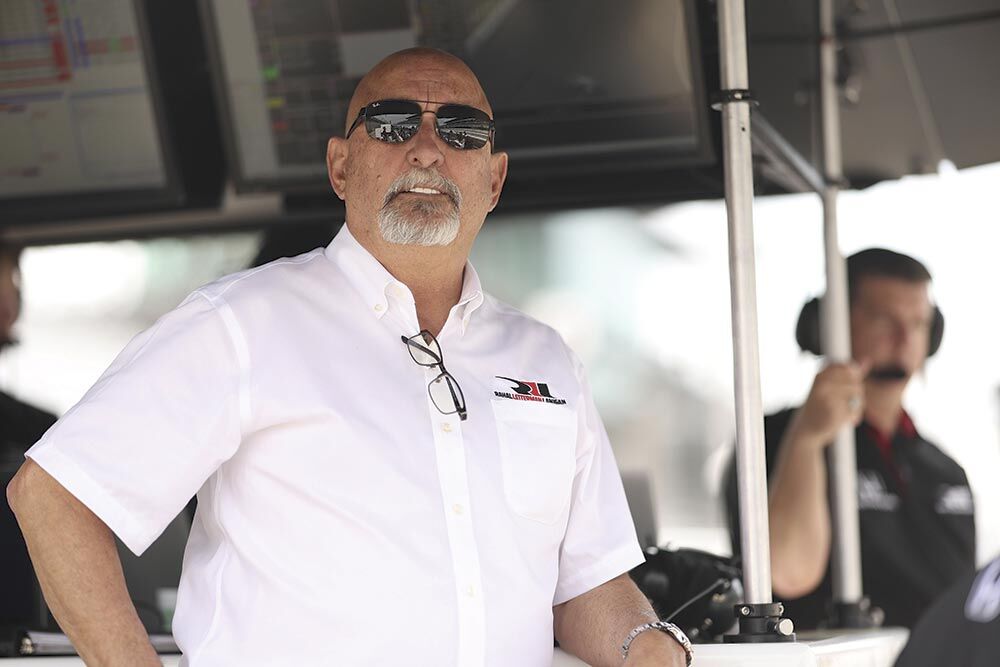
Team co-owner and racing icon Bobby Rahal watches an IndyCar test session earlier this year. The series is moving to hybrid engines next season, but IndyCar switched from fossil fuels to ethanol more than a decade ago. Now, Rahal says, the quest is to find substitutes for everything carbon-based in racing.
WHILE RAHAL ADMITS “WE’RE A LONG WAY FROM THE FINISH LINE,” there may never have been a time in the sport’s history with so much development toward a goal of dramatic change away from the foundation of rubber, fossil fuels, internal combustion and planet-be-damned. Shell supplies a 100-percent renewable fuel to IndyCar prepared from waste material left by the processing of sugar cane, resulting in a 60-percent reduction in greenhouse gas emissions. Porsche lent its support to a plant in Chile pursuing a nearly zero-carbon fuel. Formula 1 set a goal of reaching carbon neutrality by 2030 and Michelin Group is aiming for 100-percent sustainability by 2050.
Firestone, which supplies tires for the IndyCar series, recently rolled out racing tires with sidewalls created from guayule, a southwestern desert shrub that doesn’t require much water to grow and reduces demands on the shipment of rubber from Southeast Asia. They tested the tires during last year’s race on the streets of Nashville.
“The drivers didn’t notice a difference,” observes Mark Sibla, IndyCar’s chief of staff. “That’s success.”
However, the future of motorsports on the track remains a series of question marks. Biofuels are available now and development of cleaner versions are ongoing. Hydrogen has potential – attractive because water vapor is its only emission – but the technology to deliver it is still young.
“It’s interesting to look into the crystal ball,” says John Doonan, president of IMSA. “If I was able to predict, there will be different fuel options.” For the moment, he adds, “I think hybrid is a tremendous solution.”
Much of the immediate excitement for the future of racing stems from the new generation of hybrid power units combining internal combustion and electric power as an initial step toward sustainability goals. IMSA’s hybrid GTP class debuted at this year’s 24 Hours of Daytona with great success. IndyCar will introduce hybrid power for 2024.
The technology goes beyond switching between the two components. In the GTP cars, an electric motor-generator unit harvests energy created by the rear axle – not in itself an extraordinary process; Formula 1 brought out its first iteration of power regeneration units with its Kinetic Energy Recovery System in 2009 and such systems currently exist on passenger EVs. But IMSA caps GTP horsepower at around 670, meaning when the MTU contributes its 50 or so horses to the drivetrain, the internal combustion engine dials back by the same amount, cutting fuel consumption while maintaining power.
The racing between the hybrid cars has been riveting. When the checkered flag waved at Daytona after 24 hours, only five seconds separated the top two finishers, and the fourth-place car crossed the line just 12 seconds back. Sims, teaming with Pipo Derani and Jack Aitken, won the 12 Hours of Sebring by a narrow 2.9 seconds. And in the first sprint race of the season, at Long Beach, the Porsche of Nick Tandy and Mathieu Jaminet edged the BMW driven by Connor De Phillippi and Nick Yelloly by less than a second.
“The GTP cars – it’s fascinating being on track with them,” observes driver Thomas Merrill of Salinas, who won Daytona in the LMP3 class. “They have good straight-line speed, but in the middle of a corner they are no faster than a GT car.”
The weight added by the hybrid unit and its components accounts for the compromise. Yet from the start, lap times were comparable to GTP’s predecessor class.
“We were a little surprised,” admits Kelvin Fu, vice president of Honda Performance Development. “The more we use the cars, the more we understand. The goal is technological development that will roll into the street car.”
ALMOST FROM THE BEGINNING, motorsports became a testing and proving ground for advancements for passenger vehicles. Seatbelts and rearview mirrors, hydraulic disc brakes, traction control, aerodynamic efficiency and better tires are among the many racing innovations that later became the norm in commercial cars.
GTP is an abbreviation of Grand Touring Prototype. In automotive terms, Grand Touring is essentially a sports car, designed for both performance and distance. As the word prototype suggests, these are vehicles meant to shape the future. But there is more implied in the GTP stamp.
During the 1980s and early ’90s, the original GTP class was a collaboration between the race series and automobile manufacturers that produced great racing on track, as well as now-familiar technologies such as antilock braking.
“In the old days, racing was the test arena,” Rahal recalls. “But with computerization and simulators, much of the development started happening in that world.”
The new iteration of GTP has spurred a collaborative effort. Porsche, Cadillac, Acura and BMW committed to the class, sculpting high-tech, aerodynamic beasts. Components from Bosch, Williams and Xtrac are cutting edge. The Michelin tires contain materials that are less environmentally costly. The fuel blend offers a 60-percent reduction in carbon emissions.
“Manufacturers – they are our voice to tell what’s needed,” Doonan explains. “That’s how you get to hybrid, to 80-percent sustainable fuel, to a double-stint tire.”
By requiring teams to run the same tires for two stints – a stint being the 40 to 50 minutes on track before refueling is necessary – IMSA cars chewed up one-third fewer sets of rubber at this year’s Daytona 24-hour race.
But it’s the collaborative flurry between race teams and manufacturers that has engineers excited. “We have more influence than we did 10 years ago,” says Fu, whose team is now preparing IndyCar hybrid engines. Innovation in race technology has perhaps never been more relevant or important to advances in passenger vehicles, and Fu notes that their work in the performance department is drawing interest from other manufacturers. “That’s what racing should be,” he adds. “We can be riskier in terms of what we try.”
With so much underway and with new, more sustainable technologies proving both reliable and successful on track, those in the racing industry – drivers, engineers, executives – see possibilities in the sport’s image problem.
“That’s why we are so keen on telling the story – because we’re visible,” Doonan says. “We can tell a competitive, entertaining story, but also be a friend of the environment.”
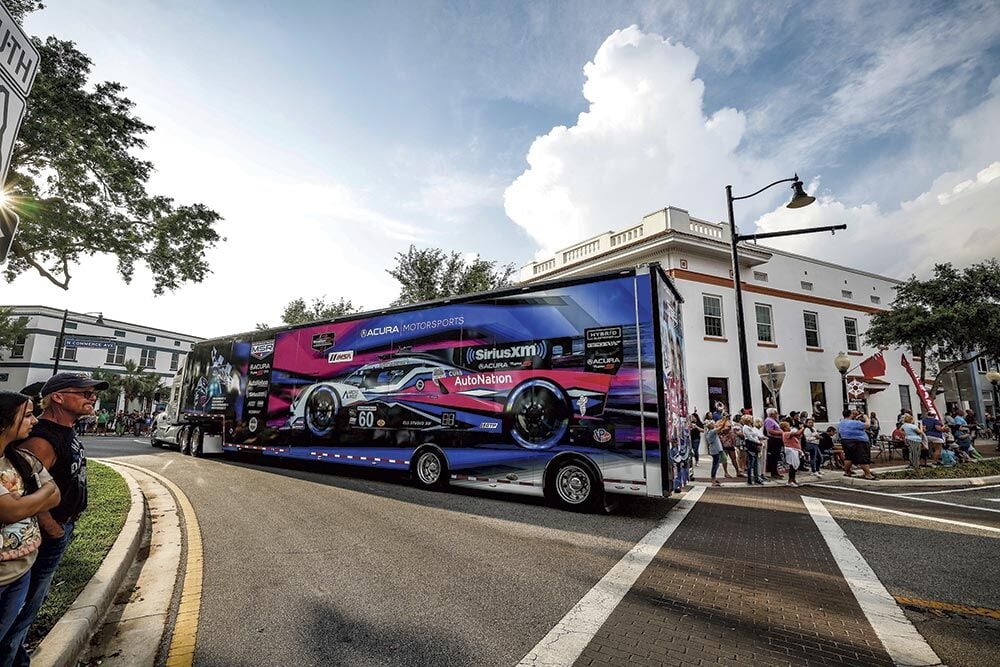
In studies on the carbon footprint of racing, it has been found that transportation to and from events by both teams and fans account for most of the emissions. Race teams are introducing biodiesel fuel and, in some cases, electric trucks for transport.
TO FULLY UNDERSTAND THE IMPACT OF ANY ACTIVITY ON THE ENVIRONMENT, it is necessary to know not only the pollutants created directly, but also those from sources associated with the activity – fans traveling to a race, for instance, the potential harm from the creation of carbon fiber components, the use of electricity by racetrack ticket offices, even missed opportunities such as lack of composting by facilities. Researchers refer to these as zones 1 (direct), 2 and 3 (indirect).
IndyCar recently partnered with the waste disposal firm WM for a study of pollutants created by the race series. “We are looking at all three zones so we understand the totality of our footprint,” Sibla explains. “We’re focused on what our baseline is and how we go about negating it. It’s very much measurable.”
In establishing a goal of net zero by 2030, Formula 1 completed a study of their zones 1, 2 and 3 carbon footprint in 2018. It found that emissions from their race cars during all 21 grand prix weekends, as well as on-track test sessions, accounted for just 0.7 percent of the total.
The biggest culprits were less visible aspects of the sport. Logistics – the freighting of cars and equipment to circuits around the world – made up 45 percent of all Formula 1 emissions, business travel was 27.7 percent and factories producing the parts and tires 19.3 percent. The remainder – 7.3 percent – came from event operations. Included in this were anything from VIP clubs at various tracks to the use of generators. In all, the 2018 Formula 1 schedule contributed 256,551 tons of CO2 to the atmosphere. By comparison, the burning of fossil fuels in the U.S. alone added 4.6 billion tons, according to the Congressional Budget Office citing 2021 data.
When members of the Department of Energy, Environmental Protection Agency and Society of Automotive Engineers International met in 2006 to discuss criteria for what would become the Green Racing Protocols laid out in 2008 – IMSA became an early adopter and has partnered with the EPA and SAE for the past 15 years – focus was directed toward the development of renewable fuels that could also be used in road vehicles, where the contribution to CO2 and particulate reduction would be enormous. That remains the goal of the Green Racing Initiative, and the program has seen successful. According to EPA data, for example, cellulosic E85 – composed of 85-percent ethanol and 15-percent gasoline, and in use for more than a decade – reduces both greenhouse gas output (by 65 percent) and petroleum use (by 62 percent) for teams using the fuel.
As these continue to develop, attention is turning toward savings to be found in zones 2 and 3. IMSA’s racing command center – where series officials monitor track incidents and radio traffic – is completely solar powered. Doonan foresees a time in the near future when the series’ entire fleet of trailers draws power from the sun. At the Indianapolis 500, IndyCar deployed eCascadia trucks – all electric – to bring race tires to the track.
“Those are little things,” Sibla notes. “But all those little things add up.”
In 2020, the Mercedes Formula 1 team performed a trial of biofuel, running its 16 transporters on hydrotreated vegetable oil on a swing through three European races. According to the team, use of the biofuel cut CO2 emissions for the trips by 89 percent.
Race sanctioning bodies are turning to companies with expertise in waste reduction, such as WM and Safety Kleen. The latter recycles fluids used in vehicles. The McLaren Formula 1 team developed a racing seat – which must meet impact standards – from a renewable plant-based composite. The team reports an 85-percent reduction in CO2 compared to carbon fiber.
“I think the expectation is that something needs to be done,” Sims says. “We just need more renewables, more carbon-neutral solutions.”
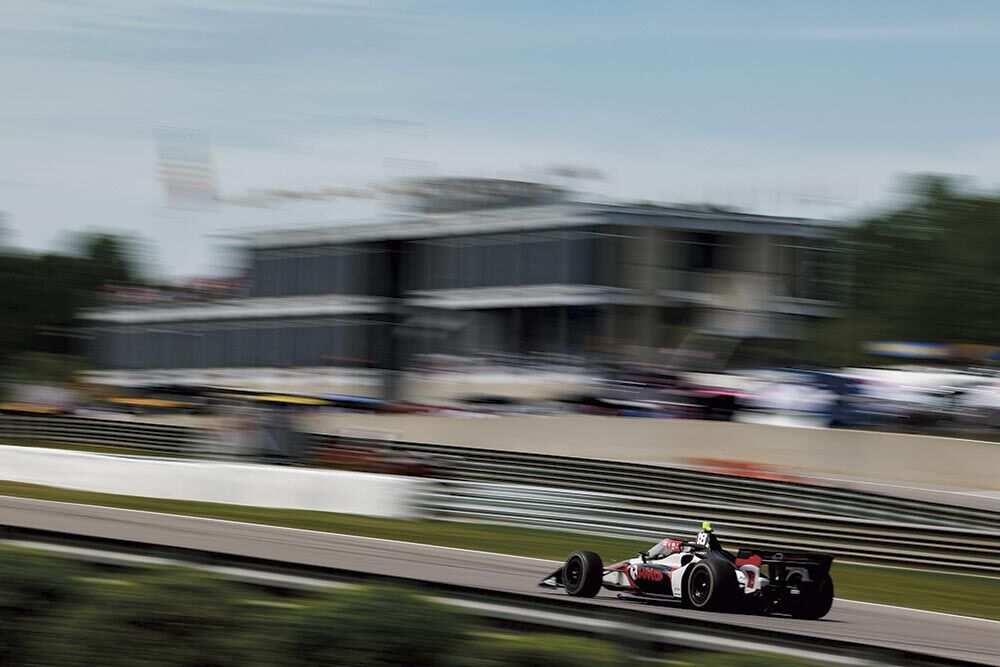
IndyCar has established a department focused on reducing its environmental impact. "What is exciting is that we're able to take technology and apply it to sustainability," says IndyCar chief of staff Mark Sibla. Here, a car runs at Barber Motorsports Park in Alabama.
CURRENTLY, EV COMPETITIONS ARE THE ONLY FORMS OF RACING TO ACHIEVE ZERO EMISSIONS ON TRACK. The auto industry and governments – from California to the European Union – have invested in the future of battery-powered road vehicles.
But many in the racing world, as well as some manufacturers, remain skeptical that battery power will ever adapt to race formats. In the first iteration of Formula E, teams prepared two vehicles for each event, and drivers swapped cars midway through the contest in order to make short race distances – putting the limitations of battery longevity on full display.
Battery output has improved, but the races are still shorter and slower than traditional formats. Still, Formula E, Extreme E and MotoE World Cup and the other EV competitions are a boon for manufacturers.
“Outright performance is easy for an electric car, but longevity and efficiency are important,” Sims says. The cars are extremely different – “too much to go into detail. You have a lot of software components you need to understand and manage during a race.”
The format of each event, as well as the technology involved, is intended to benefit the development of passenger EVs in terms of efficiency. And Sims points out that, as things stand, electric competition must be suited to the limits of the batteries, not the other way around.
So the goal of many sanctioning bodies and manufacturers is to achieve carbon neutrality without losing the soul of the sport.
“Racing is smell, racing is noise, racing is speed,” Rahal says. “But we can still be responsible.”
Biofuels and hybrid engines that can be adapted to street vehicles are considered a logical first step. Where this leads, however, remains uncertain.
“I believe the next generation will have some sort of engine,” Fu explains. “What should we prepare for? We’re preparing for all of them.”
One exciting possibility is hydrogen power. Like battery power, the fuel emits no greenhouse gases. And, like batteries, production of the source is not without environmental impact. Overcoming this, as well as the difficulty of storing hydrogen, are ongoing battles.
Yet Toyota and Honda have been developing hydrogen technology for decades. A few hydrogen fuel cell vehicles are on the road in the U.S., and hydrogen-powered race cars have been tested with modest success – as well as a fire that sent Toyota engineers back to the lab. Hydrogen can be used in fuel cells to generate electricity to power vehicles or as a gas to burn in internal combustion. According to Fu, Honda is more committed to fuel cell technology.
“It’s the ultimate solution,” Rahal says of hydrogen. “It ticks all the boxes.”
But that may be the distant future of racing. In the near term, hybrid power units like those in IMSA’s GTP class race cars represent the most feasible way forward.
“Just looking at what IMSA and IndyCar are doing, it’s a recognition that this is where we’re going,” Fu says. “I don’t think there are choices in the matter – not just for motorsports, for any sport.”
(0) comments
Welcome to the discussion.
Log In
Keep it Clean. Please avoid obscene, vulgar, lewd, racist or sexually-oriented language.
PLEASE TURN OFF YOUR CAPS LOCK.
Don't Threaten. Threats of harming another person will not be tolerated.
Be Truthful. Don't knowingly lie about anyone or anything.
Be Nice. No racism, sexism or any sort of -ism that is degrading to another person.
Be Proactive. Use the 'Report' link on each comment to let us know of abusive posts.
Share with Us. We'd love to hear eyewitness accounts, the history behind an article.