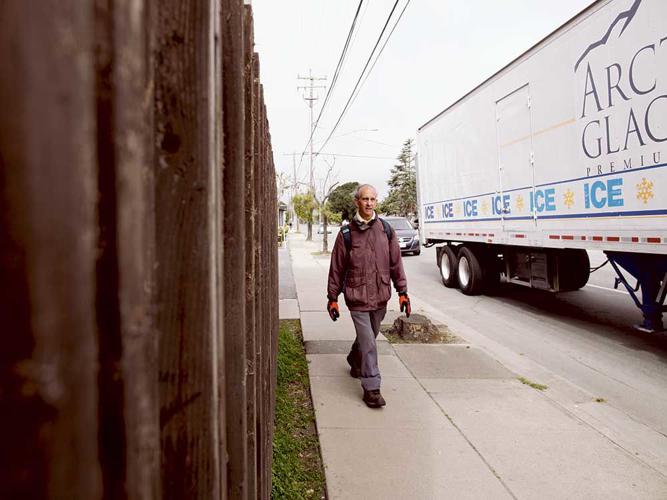

ON A RECENT FRIDAY MORNING at the Salinas Transit Center, 65-year-old John Bean is waiting for the 43 bus to get to a volunteer job at Loaves, Fishes & Computers on Main Street, where he tests refurbished hard drives every week. He’s a veteran of the Monterey-Salinas Transit system, having given up his truck back in 2009 when he could no longer afford to fill it with gas.
He walks the two-and-a-half blocks from his apartment to the transit center prepared for his day: He’s outfitted in sunglasses, two windbreakers to keep warm and hiking boots. He carries a navy blue backpack that contains his iPad, an extra reusable bag and other necessities. Sticking out of both of his ears are green foam earplugs.
“The bus is loud,” he explains. “I think it’s the turbine engines.” On smaller buses, the metal wheelchair hoists attached to the outside “make a terrible racket” as the bus travels down the road – sometimes the rattling is punctuated by the sharp, shrill sound of metal on metal. “My ears were not really bad until I started taking the bus eight years ago,” Bean says.
He finds it tiring to ride the bus, but it’s long been his only option to get around. For several years he commuted to Monterey Peninsula College and later CSU Monterey Bay while taking classes in video production, in hopes of finding a job. The long commutes from his rent-subsidized apartment in Salinas were especially difficult. Bean isn’t trying to complain, he says, he’s just being honest about what life is like on the bus.
“I’m being served, let’s put it that way,” he says pragmatically.
Seniors over age 65, including Bean, pay 50 percent for most MST fares, ranging from $1.50-$3.50. Recently, a case manager at the nonprofit Alliance on Aging told Bean he qualifies for 10 taxi vouchers a month – meaning rides valued at up to $17 will only cost him $3 each – which will give him another option for getting around to go shopping, and get to doctor’s appointments and the volunteer work he does while he waits for more paid projects, or employment.
“Option” is an operative word when it comes to transportation issues for Monterey County’s senior and disabled population. Many have lost the option to drive, either because, as in Bean’s case, they can no longer afford it, or because of health and mobility challenges. Similar to Newton’s Third Law – for every action there is a equal and opposite reaction – the momentous occasion and elation in a teenager’s life that comes from earning a driver’s license is met in our older years with great dread and disappointment. It’s the sense of freedom countered with a big loss.
“One of your last ties with independence is your ability to drive and come and go,” says Teresa Sullivan, executive director of Alliance on Aging. She hears often from seniors who grieve having to give up their keys. “It’s one more loss for them.”
Sullivan and others who serve seniors, disabled clients and veterans are hopeful about other options for alternative transportation becoming available, with more support on the horizon thanks to voter-approved tax measures in Monterey County, including Measure X (approved in 2016) and Measure Q (in 2014). They share a hope that those options – a combination of public transportation, taxi services, volunteer drivers, and even ridesharing apps like Lyft and Uber – will become more commonplace among their clients.
Transportation is one more key to keeping seniors and others healthy and living in their own homes, because it combats the scourge of isolation. Says Sullivan, “Isolation is a problem that the lack of transportation exacerbates.”

Bean walks a couple of blocks away to the Salinas Transit Center, where he picks up buses to various parts of the city, sometimes traveling to Monterey.
JOAN ROMERO HAD TO GIVE UP DRIVING 11 YEARS AGO, after diabetes left her eyesight permanently damaged. The 81-year-old says she accepted the change – for the most part.
“It’s a little hard at times, like when I have doctor’s appointments,” she says. She catches a bus in East Salinas by Cesar Chavez Library, transfers at the transit center in Oldtown to another bus, and gets off at the closest stop to the medical clinic, a walk of about six blocks. She estimates her total round trip transit time – walking, waiting and riding the bus, to go a distance of about three miles each way – is about two and a half hours.
“I accept it,” she says. “I figure I don’t have a choice and this is what I have to do.”
The schedule is a definite challenge, she says. Sometimes in order to make her appointments on time, Romero has to leave early and wait at the doctor’s for up to an hour. Similarly, Bean leaves early when he has to be somewhere at a specific time: “The best strategy is to try to schedule yourself with the bus that runs previously, so you’re ahead of it. That way, you make your appointments.”
While Romero can handle walking to and from bus stops, she can’t do it carrying heavy bags of groceries. For that she uses taxi cabs. It costs her $7 to get to the store. On the way home she gives drivers $10, because they load her bags into the trunk, then unload them at her building. They leave them in a pile in the carport, and she carries them upstairs to her apartment of 40 years, one or two bags at a time. She pays for the taxis out of her own pocket, rather than use the MST-managed voucher program. She says she got frustrated when cab companies told her there weren’t cabs available for disabled clients.
The minutes from a November meeting of the MST Mobility Advisory Committee include a report of complaints from other clients. At the time, Yellow Cab Company had six drivers who had gone through what’s called Taxi ADA Certification Training (TACT), and Green Cab had two trained drivers – not enough to serve the city of Salinas, the committee members were told.
MST Mobility Services Manager Cristy Sugabo says the transit agency is working to add more certified drivers, although only one cab company has accessible vehicles. And she says MST is making efforts to help seniors one-on-one when they experience problems. Sometimes educating clients on how best to use the program helps.
Clients who are new to using public transit can get extended training through MST’s Travel Training program. At no cost, MST employees will ride with them multiple times until passengers feel comfortable taking rides on their own. MST also does group trainings from the Senior Center at the Salinas Firehouse Recreation Center. Groups have taken day trips as far away as the Gilroy outlet mall. More recently they traveled together to the Del Monte Shopping Center in Monterey.
Other MST mobility programs include the ADA-compliant RIDES paratransit service, routes that don’t include transfers dubbed Senior Shuttles and Special Medical Trips to the Bay Area, available on a first-come-first-serve reservation basis. (See list of resources, p. 28.)
The most recent addition to the quiver of MST services is TRIPS, financed through Measure Q funds, with a primary goal to close some of the gaps in MST’s service for seniors, disabled people and veterans in rural areas of the county with no access to buses. Participants identify a volunteer driver – who could be a family member, a caregiver, friend or neighbor – and MST then reimburses the participants for 40 cents a mile, up to 250 miles a month, which works out to approximately $100. MST allocated $90,000 for a one-year pilot program that started in January, with a focus on South County to start.
As of early May, there are only three participants registered. Sugabo says MST is heavily promoting the program in hopes of getting the word out to more eligible clients.

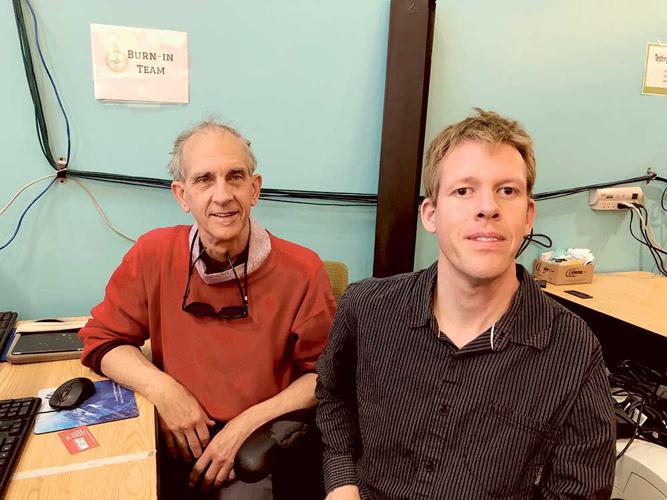
John Bean, left, plays the role of mentor to fellow volunteer Travis Kenyon, right, at Loaves, Fishes & Computers in Salinas. Kenyon is visually impaired and rides the bus everywhere.
PUBLIC RELATIONS TO SWAY PUBLIC OPINION and shift behavior from a car-centric tradition has been a challenge for mass transit in California for generations. Sullivan thinks part of the challenge for today’s seniors is that they did not use mass transit as young people in Monterey County. But if seniors are going to be able to get around, that has to change: “Our goal is to increase their comfort around using and trusting the public transportation system.”
Now Sullivan and her agency have some money to reach that goal. They recently received a three-year grant through Measure X monies for approximately $220,000 they’ll use to hire a bilingual, bicultural transportation specialist to run a program focused on helping seniors get access and training for using buses and other forms of alternative transportation. Alliance on Aging will work in partnership with MST to distribute bus and taxi vouchers and train Alliance clients. Bus vouchers will be distributed free for a limited time to entice clients to try the bus. Many of the programs they are proposing will be for all seniors, regardless of income level.
“This isn’t just for poor people; people across the board have transportation challenges,” Sullivan says.
She also foresees trainings on how to use Lyft and Uber for seniors who own smartphones. For those who don’t, there has been some movement in Silicon Valley to reach them. Startup GoGoGrandparent uses a call service – it can be done from a landline – to summon an Uber or a Lyft, and gives users the option of scheduling regular rides at set times. In 2017, through the AARP Foundation, UnitedHealth Group granted $1 million to medical researchers at the University of Southern California to look at the health effects for Los Angeles-area seniors of access to free Lyft rides – plus a phone service that would allow them to request rides without a smartphone.
Sullivan says that even at no cost, there are some seniors for whom new technology will not be an option, given some may not feel comfortable using new technologies or using a system that requires leaving a credit card on file: “There will be seniors that this option would just not be appropriate for.”
Bean believes there is a digital divide between senior transit users and younger users. On the bus to Loaves, Fishes & Computers, he’s riding across from Travis Kenyon, a young man whom Bean mentors at the nonprofit. The two work side by side checking computers as part of what’s called the Burn-In Team.
Kenyon has never driven due to a vision impairment he was born with. He depends on the bus to get everywhere, and even serves as a volunteer MST Navigator, someone who helps other people with disabilities on the buses. His smartphone is set to enlarge what he sees on the screen, and he uses several different apps, including the Transit app utilized by MST, Google Maps and Apple Maps – to get himself and others around on the various bus routes.
Bean admires Kenyon for his clever use of apps to get around. “I think the digital division comes into play,” he says. “I think a lot of people my age don’t understand how to make it work for them.”
To avoid relying on technology, Kenyon has memorized the MST schedule, and has developed the impressive ability to keep track of the number of stops to figure out where he is along a route. Sometimes drivers don’t call out the upcoming bus stop, he explains. He can feel the bus shift as it approaches a stop.
Bean now only goes into Monterey around one day a week to do some of his grocery shopping for organic products at Trader Joe’s and at a Mediterranean market where he gets ingredients he can’t readily find in Salinas. He says his vegetarian diet has helped him regain and maintain his health after some challenging medical issues.
More Coverage:

Riding the bus hasn’t always been easy for Bean, but he says there is a counterbalance to the negatives.
“I feel better when I get out rather than stay at home,” he says. He points to his contribution to the community at three volunteer positions he holds, and the people he gets to interact with.
“It’s helped me make some progress socially, mainly meeting and creating with more people and feeling more comfortable.”
(0) comments
Welcome to the discussion.
Log In
Keep it Clean. Please avoid obscene, vulgar, lewd, racist or sexually-oriented language.
PLEASE TURN OFF YOUR CAPS LOCK.
Don't Threaten. Threats of harming another person will not be tolerated.
Be Truthful. Don't knowingly lie about anyone or anything.
Be Nice. No racism, sexism or any sort of -ism that is degrading to another person.
Be Proactive. Use the 'Report' link on each comment to let us know of abusive posts.
Share with Us. We'd love to hear eyewitness accounts, the history behind an article.