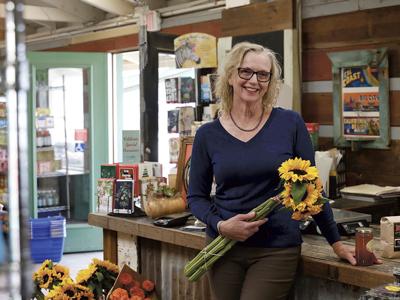

One Sunday at the Mid Valley Farmers Market in Carmel Valley, Sharon Runde was tending to her stand as usual when an unfamiliar husband and wife approached.
“They bought one of everything,” she recalls.
The fourth-generation baker – Runde named her business Sugar Science, because she had been studying toward a PhD in science before her love of pie dough called to her – prepares treats such as a popular triple apple pie, brownies and more. She sets up weekly at Mid Valley, as well as the Old Monterey Farmers Market on Alvarado Street on Tuesdays. Over three years she has developed a steady customer base.
None, however, like this couple. A week later, they returned to the Sugar Science space and again purchased one of each item.
If Runde was curious about the transactions, any questions were answered the following Sunday, when the husband stepped to the table and said, “We want you at our store.”
MICHAEL COHEN AND HIS WIFE took over Nielson Brothers Market in Carmel on Feb. 29 of this year, leap day – “A good omen,” he says with a chuckle. The store has offered locally produced foods for some time, and he was intent on finding more.
“We hunt around,” he explains. “If we like the product, if the packaging is decent, we buy it. It’s pretty straightforward.”
There is a surprising range of food items prepared by certified cottage food operations in Monterey County. There are chocolates and candies from brands like Lula’s and Qouign. Chef Jeffrey Thompson markets a line of seasoned or candied nuts. Another chef, Tony Baker, is known for Baker’s Bacon, while his wife Tara creates Witsch’s Brew teas. It’s a veritable county cornucopia: honey, olive oil, pasta, milk and cheese, wine, beer, cider and spirits – even health supplement gummies from Carmel Berry Company. Yet finding many of these requires a committed search, and often it requires relationships – internet research does not always get merchants to producers.
Windmill Market in Salinas stocks jams in flavors like spiced plum-tawny port or hot and smoky apricot from a home kitchen nearby known as Wild Roots Homestead. An online search yields a number of similar names, though none matching the jars in question. The shop along Highway 68 also has olive oil from Castle Ridge Ranch in Corral de Tierra – “The best olive oil, oh my god,” says Windmill’s Renee Murillo. At least there is a clue online, but not much more.
“Some of them you really can’t [track down],” observes Chloe Dolata of Elroy’s Fine Foods, a Monterey destination. She recalls a package of nuts brought in by a customer eager to see it on the shelves. There was a name and general location to go on, but Dolata eventually gave up. “I couldn’t find them,” she says.
Cohen makes the effort to stroll through farmers markets (and he’s equally enthusiastic about an olive oil he found, High Top Ranch; “it’s one of the best I’ve ever sampled”). Dolata likes to check out other shops, but she also receives tips from customers. One – spurred by the desire to avoid the long drive through Big Sur – introduced her to granola made by the monks at New Camaldoli Hermitage. In Renee and Joe Murillo’s case, cottage producers who happened upon the market will pause and say, “I have an olive grove.”
“The honey guy, he came to us,” Renee Murillo points out, a reference to Carmel Valley Honey, sold at Windmill. “Every week we get more. We’re like a farmers market every day.”
“We’re still looking for more,” Joe adds. “It would be nice to have 10 to 15 local producers.”
MIDDAY AT GROVE MARKET IN PACIFIC GROVE finds a few chatty customers poring over take-home food options behind the meat counter. The aisles are relatively quiet at such an early hour, but there is evidence of a rush on some products. Shelf space set aside for Karen Anne’s Granola, a product toasted just up the hill in a shared kitchen, sits empty.
A mere 15 years ago, sales of locally produced foods in the U.S. amounted to around $5 billion annually, according to the food industry research firm Packaged Facts. By 2019, that figure had jumped to $20 billion. Studies suggest that the increase is driven by a generational interest in seasonal, farm-to-table dining.
In a paper for the North Carolina State Extension titled “Overview of Local Food Trends,” professor Katie Sanders and graduate assistant Madison Lawson noted that those born between 1920 and 1940 were (and are) less interested in purchasing local, while people ages 30 to 44 “may have the most positive attitude toward local food.”
University of Missouri professor emeritus John Ikerd wrote that in 1940s Missouri there were still local canneries, mills and meat packers. Within a decade, however, those operations were consolidated as large agribusinesses took over the market, supplying the supermarket chains that were driving out mom and pop groceries. By the 1990s, he writes, estimates of the distance food traveled from farm to table fell between 1,200 and 1,700 miles.
“Over the past 20 to 30 years the pendulum swung back to the middle, a mix of local and national,” Cohen observes. “The big boys have realized they need local products.”
If so, they are following the lead of neighborhood markets like Nielsen Brothers and Bruno’s Market & Deli in Carmel, Star Market in Salinas and Jerome’s Carmel Valley Market.
“It’s great for our customers,” says Dolata. She estimates that Elroy’s stocks almost 100 local labels, double that when including produce. As research suggests, while not every customer looks to buy products made in the county, a growing number seek to support artisanal producers and small farmers. “I consider it fine food,” she adds.
And, Cohen notes, “It’s a great way to differentiate yourself from the chains.”
Having a presence on grocery shelves can be an important step for small businesses, as well. In 2023, Carlo Overhulser’s Big Sur Salts made and sold some 23,000 pounds of sea salt nationwide.
“Retail is our bread and butter,” Overhulser explains. His product is used at some destination restaurants, the kind bearing Michelin stars. But he downplays the importance of that when it comes to gaining consumer attention. “How many people are going to see us [at a restaurant]?” he asks. “They’re going to see us at Elroy’s.”
He remembers starting out a decade ago as an unknown. A few newspapers found him, followed by Edible Monterey Bay, which ran a full-color feature.
“I had to get the website built before that article came out,” he says. “I had to learn all of that, and it sucked.”
ONE OBSTACLE TO COTTAGE FOODS LANDING ON MARKET SHELVES is inexperience on the business side. Grocers look for packaging that will catch the eye of a passing shopper, labels with barcodes to make transactions smoother.
Cottage labels are also in competition with larger brands for shelf space. While Star Market or Elroy’s may encourage local producers, the owners are unlikely to bump a popular product to make way.
There are other matters, too, such as consistent production.
“Sometimes they don’t realize how big a job it is,” Dolata points out. She tells of putting in a reorder from one local artisan, only to hear excuses – or no response at all – when they couldn’t keep pace. “Maybe they don’t realize that each spot on my shelf costs money if it’s empty.”
The quality control aspect troubles Sugar Science’s Runde, which is part of what makes farmers markets and online orders more of a certainty, planning-wise. Her baked goods may have a shelf life of no more than three days.
“I did a trial and error of what works,” she says. “I don’t want anyone to have a subpar experience.”
Marketing, however, is often the most obvious shortcoming – or least obvious, perhaps, when it comes to labels that are difficult to find outside of farmers markets.
“I’m finding this in a lot of up-and-coming brands,” Overhulser notes. “They are really good products, but they lack marketing.”
His standard question, when speaking publicly on the matter, is about the goal in opening a cottage kitchen. Essentially, it’s a question of where the person wants to be, growing as a company or selling a few items on the side.
For the former, there is a tried and true formula that works, even in a digital age, Overhulser says. “You have to have a social media presence, you have to buy ads,” he explains. When a market like Jerome’s or Nielsen Brothers reaches out, he adds, you need to respond quickly: “If you’re not all over that, it’s going to be very slow.”
Runde is one who prefers a more measured approach. Her goal is to develop a restaurant clientele. And her farmers market regulars provided the name for Sugar Science’s “Epic Brownies.”
“I think farmers markets are the way to go,” Runde says. “I have a lot of customers.”
A year before the pandemic, the USDA reported that sales at farmers markets had flattened out. Those issuing the study reasoned that more local products reaching grocery shelves was the cause.
A glance at neighborhood markets indicates that there is considerable interest in local goods. When the Murillos at Windmill Market have bread from Ad Astra or pasta from Bigoli in stock, “It flies off the shelves,” Renee points out.
Which brings up an interesting entrepreneurial what if – a market that specialized in Monterey County items.
“That would be really cool,” Dolata says.
(0) comments
Welcome to the discussion.
Log In
Keep it Clean. Please avoid obscene, vulgar, lewd, racist or sexually-oriented language.
PLEASE TURN OFF YOUR CAPS LOCK.
Don't Threaten. Threats of harming another person will not be tolerated.
Be Truthful. Don't knowingly lie about anyone or anything.
Be Nice. No racism, sexism or any sort of -ism that is degrading to another person.
Be Proactive. Use the 'Report' link on each comment to let us know of abusive posts.
Share with Us. We'd love to hear eyewitness accounts, the history behind an article.