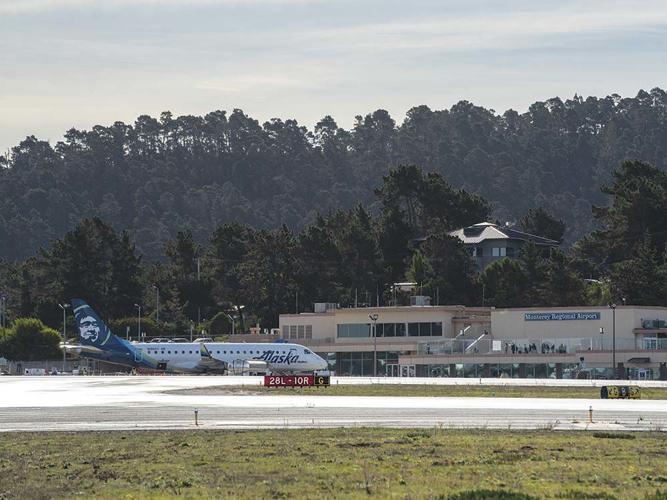

One day in 1929, the airport committees of the Monterey and Pacific Grove chambers of commerce set out to survey land for the best place for an airport. They visited two locations: Point Pinos in Pacific Grove and 150 acres east of Monterey, near where the present day airport is located.
“Men of flying experience definitely stated that the latter site was the best that could be had on the Monterey Peninsula,” according to a story in the Monterey Peninsula Herald on March 14, 1930.
In the year that followed the 1929 scouting trip, the community pitched in to make an airport a reality: donations totaling $3,000 were collected; Monterey, Pacific Grove and Monterey County offered heavy equipment to build runways; a local labor union volunteered to build the hangar on a Sunday; contractors and other companies offered materials and labor at cost. “Nobody made a profit,” according to the Herald. “All worked for the community.” Daily service between Monterey and Alameda began soon after completion in 1930.
The collaboration and furious building pace speaks to how anxious businesses and local governments were to open a portal from the Monterey Peninsula to the rest of the world. Commercial flights were only a few years old by 1930 but they were becoming increasingly popular. There were less than 6,000 passengers in the U.S. in 1926, but by 1929 that number was 173,000.
The tourists and business travelers that stepped off early commercial planes at what was then the Monterey Peninsula Airport meant a flow of cash and jobs. It’s as true now as it was 90 years ago. The Monterey Peninsula Airport District estimates that what’s now called Monterey Regional Airport, or MRY – now nearly 500 acres, greeting an estimated 400,000 passengers annually – brings $302 million in economic benefit to the region and supports more than 2,400 jobs. It’s a self-funded special district established in 1941 that collects no property taxes – only those who use MRY pay through airline passenger fees, $4.50 tacked on to every ticket sale.
The district is now working toward a new future for Monterey Regional Airport that includes reconfiguring nearly everything that surrounds the runways. That includes a larger LEED-certified terminal building (where parking is currently located), new hangars and general aviation services on the north side of the airport, plus a new fire station. If approved, the initial rounds of construction and demolition will take five to 10 years and cost $190 million. The ambitious master plan, known as Vision 2035, will unfold over 15 years.
Such sweeping changes come with controversy, however. Boxed in by development, the airport’s neighbors to the north say those changes will come at their expense. To make the development work, there has to be an access road. That road, in the approved environmental planning documents, goes through Del Rey Oaks where residents there say there’s no way they’ll accept it. Monterey residents in the Casanova Oak Knolls neighborhood, where a road to the airport already exists, say they don’t want any more traffic coming their way.
The airport district has another challenge. Only 37 percent of the region’s airline travelers use MRY at all; most of the rest fly out of San Jose and San Francisco. A group of civic leaders called Team Fly Monterey keeps scrambling to convince airlines to add more nonstop flights, and are now urging locals to prove to airline companies that those routes are in demand.
On Jan. 15, Team Fly Monterey officials announced a big get, after seven years of lobbying: a new daily nonstop flight to Seattle on Alaska Airlines.
“It’s up to our community. You asked for it, we delivered it and you need to use it,” said Mary Ann Leffel, chair of the airport district board. “That’s the only way we’ll keep it.”
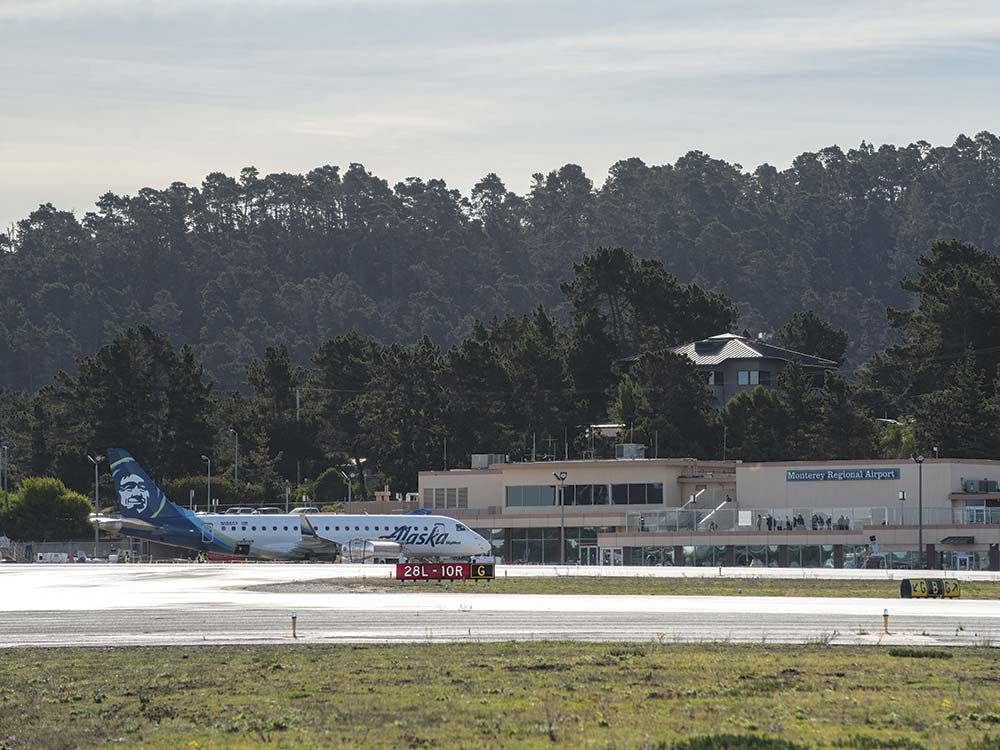
The airport district purchased the Fenton & Keller building, peeking out from the trees behind the terminal, and two other properties on Highway 68, in 2019 with a $6.8 million FAA grant. Officials wanted to prevent the airport from getting “boxed in” by future uses of the building incongruent with airport safety, such as a school or housing, MRY Executive Director Michael La Pier says.
ASK LEFFEL WHAT MRY NEEDS AND SHE DOESN’T HESITATE TO ANSWER: “JET BRIDGES!”Most people who regularly travel in and out of major airports take for granted those tunnels they walk through to get from the terminal into a plane. Monterey Regional, considered a “primary commercial service, non-hub airport,” doesn’t have them. Travelers exit the terminal to the outside, then walk up mobile boarding stairs or ramps.
While jet bridges are at the top of wish lists for the new terminal building, they are not the pressure point pushing the airport to undergo a massive renovation. The terminal is outdated – the original structure was built in 1950.
The main reason to build a new terminal is safety, says Executive Director Michael La Pier. Currently, the airport doesn’t meet a Federal Aviation Administration standard for the distance between the centerline of the main runway and the main taxiway near the terminal. The distance is less than the standard of 500 feet, which could in theory lead to wingtips clipping one another. Currently there’s no way to shift the taxiway further away from the runway without shutting down the terminal to commercial business, says La Pier.
For now, the airport is operating under a special permit from the FAA that allows commercial flights to continue until the issue is fixed. MRY personnel and FAA traffic controllers manage arriving and departing planes to eliminate hazards.
Seven years ago, the FAA told Monterey Regional Airport it was time to get serious about fixing the taxiway issue, La Pier says. The district hired consultants Coffman Associates, Inc., chosen under FAA guidelines, to create a master plan. That plan by was completed in 2015, and in 2018 the airport district board certified an environmental impact report for the development plan.
The result is a construction plan that, if approved by the district’s board, will happen in four phases. Phase 1 will be a new aircraft rescue and firefighting station, plus general aviation buildings, on the north side near homes along Rosita Road in Del Rey Oaks. Phase 2 is demolishing the old fire station and building the new terminal, roughly where the long-term parking lot is now located. The building is estimated to cost the airport district between $60.1 million and $76.7 million, with the FAA possibly chipping in $21.8 million.
After that is Phase 3 – “What started us on this escapade,” La Pier quips – shifting the taxiway away from the runway to meet standards. The fourth and final phase is demolition of the existing terminal building and creating a new surface parking lot. (The master plan shows a parking garage, but La Pier says parking lot use is down across the industry due to the popularity of rideshares like Lyft.)
That’s the basic short-range plan of Vision 2035, and La Pier says, it’s just that – a plan. “The decisions haven’t been made to move the program forward, this is a planning process,” he says. The plan went through California environmental review last year, and is now in a federal environmental review process.
La Pier expects the public comment portion of that review process to open up within the next couple of months. That’s where it gets dicey when it comes to neighbor relations.
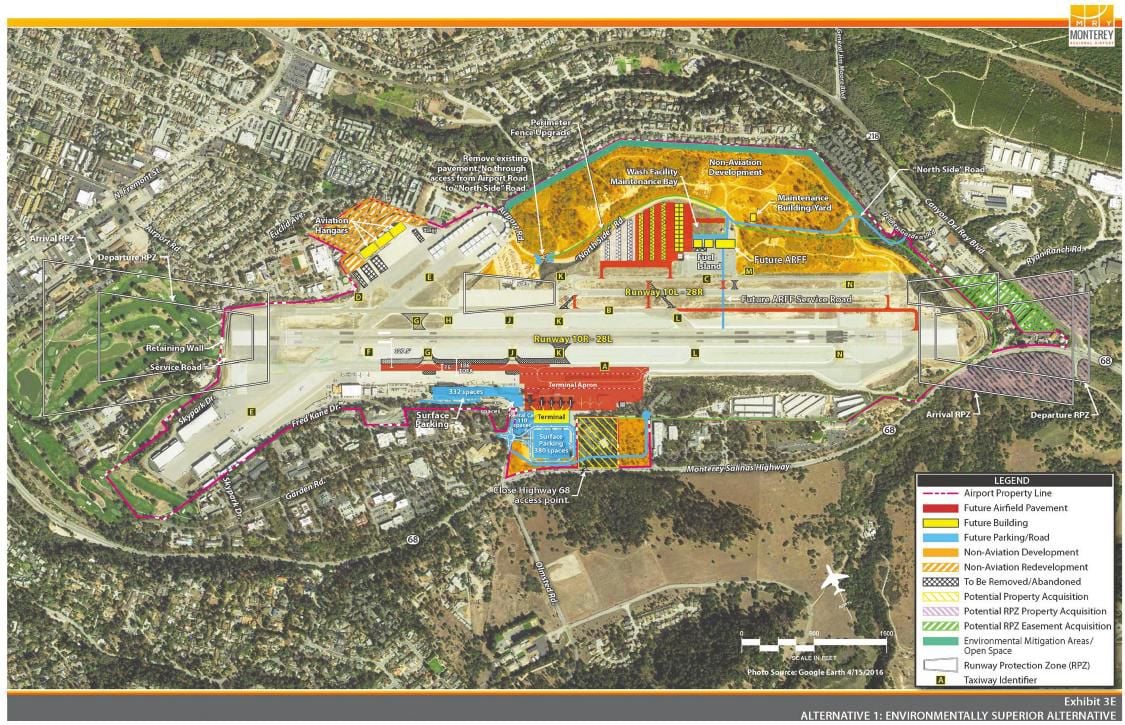
A SKEPTICAL AND, AT TIMES, ANGRY GROUP OF RESIDENTS SAT BEFORE LA PIER AND A TEAM OF CONSULTANTS and MRY staff on July 11 inside Del Rey Oaks City Hall. The small chamber was packed with people sitting on the floor, standing in the back and overflowing into the lobby. It was the first of two city workshops on the plans for the new airport and the proposed North Side Road, at Del Rey Gardens Drive to Highway 218.
Try as La Pier and his team did, residents weren’t buying what they were selling. In the days leading up to the meetings, a group against the North Side Road had plastered the small town with flyers warning that the road could bring up to 7,000 cars a day if the Vision 2035 project is fully built out on the north side, including more hangars and possibly a light industrial business park in the future. The group used donations to print signs that read, “NO ROAD DRO – Save our quality of life!”
The message from airport representatives was, don’t worry, the 7,000 number is a worst-case “theoretical number,” strictly for the purpose of environmental analysis. The “real number” is 92 average daily trips, one consultant said.
The main reason for the road is safety, the residents were told. The airport fire station – operated by the Monterey Fire Department under contract with the district and serving the surrounding community – needs that access road. If firefighters had to go the other way, through Monterey’s Casanova Oak Knolls neighborhood, it would add six minutes to their response time. Some in the audience scoffed at the explanation. “It sounds like something you came up with because we’re your last resort,” one man said.
Safety is not mentioned in the master plan as a consideration for the North Side Road. The plan states the road is “a critical consideration to accommodate future development potential.” Part of that potential is increasing the number of small plane hangars to meet future demand. It also fits into one of the plan’s objectives: increasing financial self-sufficiency by creating revenue streams, like rental income from a business park at the airport.
During the public comment period when the airport was circulating its environmental impact report for the master plan, Monterey Mayor Clyde Roberson sent a letter supporting the road through Del Rey Oaks, not Monterey, pointing to increased traffic and noise inconsistent with Monterey’s citywide and neighborhood-level plans.
Del Rey Oaks’ then-mayor Jerry Edelen sent his own letter insisting the road should go through Monterey, not Del Rey Oaks; his city’s master plan specifically states the city is against any road that cuts through to Canyon del Rey.
When it came time to vote on the final EIR, the airport district board unanimously went for the alternative route that put the road in Del Rey Oaks.
The stage was set for a political showdown.
THAT DAY IN JULY AT DEL REY OAKS CITY HALL, LA PIER WAS TRYING TO BUILD SUPPORT, but the meeting didn’t work out that way. At one point, Del Rey Oaks City Manager Dino Pick, trying to allay residents’ fears, said if the airport district comes asking for a general plan amendment to accommodate the road, the city could ask for mitigations, like a gate to restrict access or double-paned windows for nearby condominiums at The Oaks. La Pier bristled at the suggestion.
“It’s important to manage expectations here,” La Pier said. “You can’t always get what you want.” The audience gasped. While there were some things the airport could offer, he continued, “it’s not a Christmas gift shopping list.
“I don’t want you to go away thinking we’re going to pave the streets of Del Rey Oaks gold. That’s not going to happen.”
One woman from The Oaks put it bluntly: “We just want our peace and quiet. And the Christmas list? We don’t want your Christmas gifts. We just want you to leave us alone.”
In December, a group of residents showed up to a board meeting to challenge a five-year capital improvement plan that included some of the initial Vision 2035 construction projects, including building a “Northside Road DRO connection,” at a projected cost of $5.4 million.
In a concession to the residents, the board amended the capital improvement plan to take out the city’s initials “DRO” from the road’s description, but dozens of “NO ROAD DRO” signs still dot neighborhood front yards.
The district has the legal right to push the road through, but for now La Pier will only say the district is listening to residents’ concerns. “We’re still looking at alternatives,” La Pier adds.
WHEN PEOPLE COMPLAIN ABOUT MRY, no one suggests it shouldn’t be where it is or should go away. There’s an underlying understanding that the airport was there first and will always be there.
Some complaints can be mitigated, like double-paned windows for noise in adjacent neighborhoods. Noise remains an issue, however, like the small planes used by flight schools that take off and land throughout the day. The total number of flight operations is expected to grow from 53,000 to more than 80,000 by 2033.
For some on the Monterey Peninsula, the proximity and easy access are good things.
Richard Ruccello is president of the Casanova Oak Knoll Neighborhood Association and has lived in the Monterey neighborhood adjacent to the airport since the 1950s. As a kid, he delivered morning newspapers to Navy personnel living in barracks on the north side of the airport, when the Naval Air Facility was still there. (The Navy operated the airport during World War II to support the Pacific Fleet Air Units. After the war the airport returned to commercial flights, and the Navy continued operations until 1972.)
“It’s an unusual airport. It’s in the middle of a high-population area, which is great for convenience,” Ruccello notes. He knows of people who use Monterey Regional Airport so they don't have to fight traffic driving to San Jose or San Francisco.
Ruccello is describing part of the 37 percent of airline ticket purchasers in the region who do use MRY. Of the 63 percent that head north, 31 percent use San Jose, 28 percent use SFO and a slim 4 percent use Oakland, according to district officials.
“Passenger leakage” is the term the airport’s master plan uses for those passengers, noting the larger airports offer more carriers, more nonstop destinations and more schedule variety. They also offer lower airfares on average than Monterey. The 2015 master plan noted that MRY’s fares are 37-percent higher than SJC’s and 4.5-percent higher than SFO’s; Leffel says those differences have gotten lower in the past five years.
Weather can be another factor in travelers’ choice of airports, and there Monterey has an advantage over San Francisco. La Pier says the fog burns off before other areas thanks to the airport’s location, relatively inland and 257 feet above sea level.
MRY’s arrival flights were on schedule 80 percent of the time, with weather as the cause of delay only 0.23-percent of the time for the period of November 2018 to November 2019, according to the U.S. Bureau of Transportation Statistics. The most common reasons for delays were incoming aircraft arriving late (7.9 percent) followed by air carrier delay (6.1 percent) and National Aviation System delay (3.3 percent).
During the same period, SFO’s flights were on schedule 72.65 percent of the time, with weather delays accounting for 0.51 percent of those. San Jose was only slightly better than MRY, with 83 percent of flights on time and weather causing 0.21 percent of delays.
What will most likely draw more locals to choose MRY will be more flights to more destinations, which is why Team Fly Monterey, made up of tourism, agriculture and other business representatives, as well as elected public officials, has spent the last several years pushing for more nonstop routes.
The group was successful in bringing a Denver flight via United Airlines in 2018, followed by a seasonal Dallas flight through American Airlines last year. Starting June 18, Alaska Airlines will fly nonstop to and from Seattle, a prized hub connection Team Fly Monterey has been after for seven years.
Tourism is one reason for the push to add more flights and increase passengers, but Leffel sees the airport as an important link to local business success. She was appointed to the district board in June 2008 to fill an unexpired term, and has been re-elected twice. The former banker and a founder of the Monterey Bay Business Council says she joined the board because she saw great potential.
“I looked at the airport as an untapped economic development tool,” she says. “All I ever heard about was how the airport was for tourists, but I saw it as important for businesses.”
Agricultural companies fly employees to and from Phoenix, for example, when the growing season shifts. The airport is also well used by the military, higher education and other sectors.
Always the hometown booster, Leffel tells people that Monterey is what she calls a “micropolitan – everything that you find in a big city just on a smaller scale. We have an airport and it’s never going to be big, but it’s on a scale that we need.”

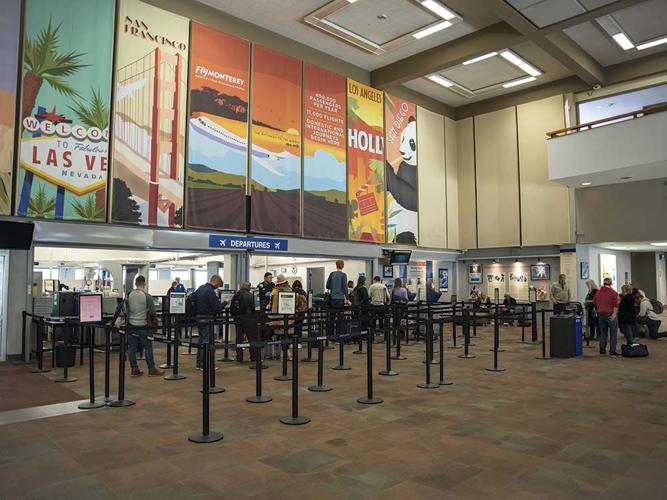
MRY’s terminal was built in 1950 and added onto three times. Officials say it’s poorly configured, with too much space on the public side and not enough on the secure side, among other problems. “It’s old and showing its age,” La Pier says.
OF ALL THE LOCAL GOVERNMENTS AND QUASI-GOVERNMENT AGENCIES like special districts in the county, the Monterey Peninsula Airport District might be the most financially secure. According to its annual financial report for fiscal years 2018 and 2019, the district was sitting on $63 million in assets at the end of June last year, with revenues of $9.4 million, up 3 percent over the previous year thanks to the Denver and Dallas route additions. The district gets a little more than half its revenue from commercial airlines and airline concessions; the rest comes from rental income from general aviation businesses and other businesses on the property, as well as FAA funding.
“We do pretty well,” says La Pier, ticking off how the airport has a positive cash flow for its operations, covers its debt service and is handling CalPERS pension obligations for employees.
Adopting a sustainability plan as part of its approved master plan – MRY is one of 12 airports in the country to have done so – has guided the airport toward economic savings, in addition to helping the environment. One dramatic example: the solar panels installed in 2017 at a cost of $2.8 million now supply 95 percent of the airport’s power. Electrical bills now run $45,000 a year, down from $285,000.
Leffel believes the district has enough to start construction projects through 2023, and thinks they’ll be able to cover more project expenses as more people use the airport – $4.50 a ticket adds up. A chunk of the estimated $109 million to pay for the first four phases will come from FAA grants. Those grants are how the nation’s airports get built and are maintained, with the money coming from user fees, fuel taxes and other sources. Between 1999 and 2014, Monterey Regional Airport has received 36 grants totaling more than $96.7 million.
According to the five-year capital improvement plan approved by the board in December, if the district decides to move ahead with master plan construction this spring, it could spend $16.6 million in 2020 on north side improvements, and another $12 million in 2021 on a northside road and the new fire station project. Those costs could be mostly covered by $24.7 million in FAA grants.
WITHIN THE FIRST TWO YEARS OF THE FIRST AIRPORT’S BIRTH, construction of a new, larger airport began on the site of today’s MRY, using money from the State Emergency Relief Administration. At the time, the land was owned by Del Monte Properties, which had a keen interest in bringing visitors to Pebble Beach and the Del Monte Hotel. A few years later, the Works Progress Administration took over construction, beginning in 1936, but there was a catch: the land had to be government-owned for the project to get federal approval, so the company signed the deed over to the city of Monterey. In 1938, United Airlines chose Monterey as one of 45 cities in the U.S. to add to its daily stops.
In 1940, a history of the WPA project was told in the Monterey Peninsula Herald starting with the first spadeful of earth – turned by the head of Del Monte Properties, S.F.B. Morse – and the improvements made up to that date, which included runways that already needed to be lengthened.
“Let people say what they want about the limitations of the present field,” the story concludes, “the fact remains that the Monterey Airport is a functioning part of the Peninsula that wouldn’t have been functioning at all if it hadn’t been created where it was and when it was.”
(1) comment
Would say MRY's fares can be as much as twice as high as San Jose's. For a round-trip ticket to LAX from San Jose, and a round trip fare, including tip, on the Monterey Airbus, I paid as much as I would have paid for a one-way ticket from MRY to LAX alone.
Welcome to the discussion.
Log In
Keep it Clean. Please avoid obscene, vulgar, lewd, racist or sexually-oriented language.
PLEASE TURN OFF YOUR CAPS LOCK.
Don't Threaten. Threats of harming another person will not be tolerated.
Be Truthful. Don't knowingly lie about anyone or anything.
Be Nice. No racism, sexism or any sort of -ism that is degrading to another person.
Be Proactive. Use the 'Report' link on each comment to let us know of abusive posts.
Share with Us. We'd love to hear eyewitness accounts, the history behind an article.