





At the time of its completion, on March 8, 1849, Colton Hall was the largest city building west of the Rockies, “erected out of the slender proceeds of town lots, the labor of convicts, taxes on liquor shops, and fines on gamblers,” Walter Colton wrote.
CALIFORNIA’S FIRST CONSTITUTIONAL CONVENTION CONVENED AT NOON ON SATURDAY, SEPT. 1, 1849, with 48 delegates gathered on the second floor of Colton Hall in Monterey. The two-story stone building was six months old, its construction overseen by Walter Colton, the city’s first alcalde – a combination of mayor, judge and tax collector – after the U.S. took over the western territories as the victor of the Mexican-American War in 1848. At the time, it was the largest city building west of the Rockies.
“It is not an edifice that would attract any attention among public buildings in the United States; but in California it is without a rival,” Colton wrote. “It has been erected out of the slender proceeds of town lots, the labor of the convicts, taxes on liquor shops, and fines on gamblers.”
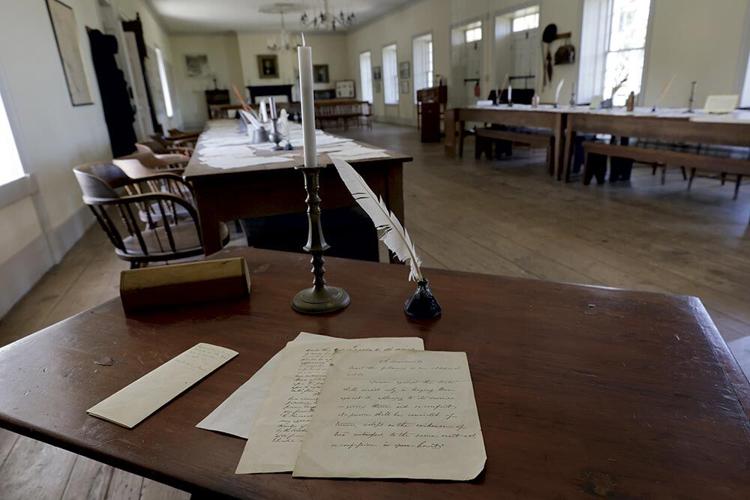
The building served the delegates well, allowing them to retreat in smaller committees down the steps to school rooms below, and to meet as a large group upstairs. They were tasked with debating and ultimately deciding to create the state of California. The men that signed the constitution on Oct. 13, 1849, could not imagine that their creation would become a place of dreams and innovations, a trendsetter and leader of industry and culture, and what is now the largest economy in the U.S. and the fifth-largest in the world.
California officially became a state almost a year later, on Sept. 9, 1850. Today, to walk up the same steps and across the same wood floors of Colton Hall is to connect with the very history of Monterey and California. Spending time inside the state’s own “room where it happened” brings to life a community of 173 years ago, a diverse collection of people from all over the world and all walks of life, where both Spanish and English were spoken as a matter of course in daily life – the state’s constitution was written in both English and Spanish.
“This is the most historic city in California, and maybe the West Coast,” says Bob Evans, chair of Monterey’s Museums and Cultural Arts Commission.
The city of Monterey and its residents are the duly designated caretakers of this historic treasure and are charged with making it available to the public. According to Monterey’s own city code, Colton Hall is supposed to be open every day of the year except Thanksgiving, Christmas and New Year’s Day. But in recent years it’s only been open on weekends for most of the year, then Thursdays through Sundays from May through August, plus school field trips.
Museums and Cultural Arts Commissioner Tim Thomas is a fourth-generation Monterey resident, as well as a leader of history walks in town. He says the city “has a moral and ethical obligation” to keep Colton Hall, as well as its other two museums – the Pacific Biological Laboratories on Cannery Row and Presidio Museum in Lower Presidio Park – open to the public, “and they know that.”
The issue is that city leaders also recognize they have a financial responsibility to today’s inhabitants. Keeping Colton Hall open year-round and maintaining a treasure trove of artifacts costs money, even with a team of volunteers. Spending money on museums would likely mean cutting other services needed or desired by residents today.
During the first year of the pandemic, when the city lost $32 million in revenues, the city’s staff overseeing the museums was slashed. The city used to have a designated historian on staff, but no more. How then to promote and present such important historic locations and artifacts to the public? How to make them open and accessible to all?
The answers may lie in what Colton himself put to paper 173 years ago upon completion of his hall “which will now go down to posterity with the odor of gamblers, convicts, and tipplers,” he wrote of those who made the hall’s construction possible. “I leave it as an humble evidence of what may be accomplished by rigidly adhering to one purpose, and shrinking from no personal efforts necessary to its achievement.”

Library and Museums Director Brian Edwards heads into the vault, once used by the Bank of America, now used by the city of Monterey to hold historic artifacts.

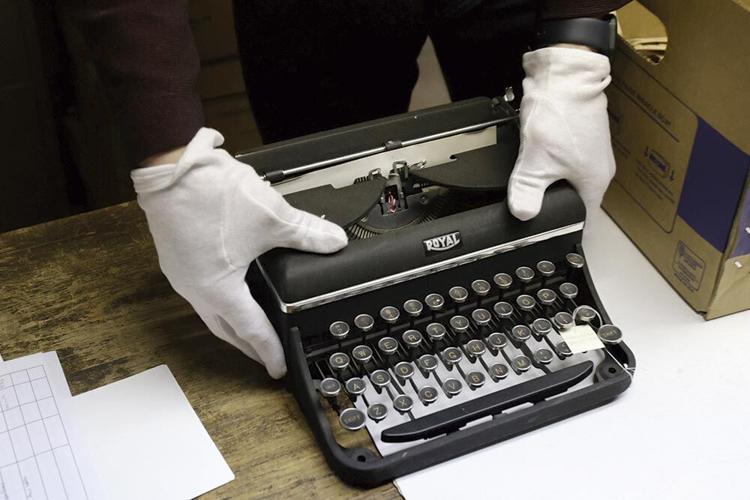
Monterey Artifacts Specialist Jordan Leininger holds a typewriter once belonging to marine biologist Ed Ricketts, kept inside the vault.
BRIAN EDWARDS, THE CITY’S LIBRARY AND MUSEUMS DIRECTOR, hired just 10 months ago, strikes a stylish presence on the job, sporting a neat beard, dapper suit jacket and fedora. His new job is a bit of a juggling act: He not only oversees the Monterey Public Library – California’s first library – plus the city’s three museums and historical artifacts, he also serves as staff liaison to two commissions and, when needed, fills in driving the library’s bookmobile.
When Edwards started and took stock of Colton Hall, he was alarmed to see original documents on display without any temperature control or light protection. Irreplaceable documents like the 1849 constitution signature page or the Declaration of Independence, written in both English and Spanish, should be held in a safe place with temperature, humidity and light controls, only to be brought out for brief periods. “These are things that are nice to have, but if you don’t take care of them, you won’t have them for future generations,” Edwards says.
The permanent displays within the hall have not changed in many years. For most visitors, if they’ve seen Colton Hall once, there’s little reason to return again. “This is a place that’s really great for class visits to learn about California history,” Edwards says, adding that it’s also good for special events, like music performances.
Back when the city had a larger museums staff, musical concerts brought people to the hall. Those concerts have not returned since the end of Covid-19 restrictions. It’s a conundrum: The city wants people to come back, but there’s not enough staff to plan and oversee events that would possibly bring them back.
“The museums took a big hit during Covid and multiple positions have not recovered since then. So it’s about, how do we continue to provide services here for the museums with a reduced staff?” Edwards says. They lost a full-time museum and cultural arts manager, split with the library, when former manager Dennis Copeland retired. The position of part-time cultural arts assistant, who organized events, was eliminated at the start of the pandemic. “That’s been something we’ve been working with since I’ve been brought on,” Edwards adds.

Ricketts’ lab building on Cannery Row.

Brian Edwards shows a replica of the skiff, Baby Flyer, in part made of planks from the actual Western Flyer, the fishing boat Ed Ricketts and John Steinbeck used for their voyage to Baja California. They used the original Baby Flyer to row to shore and collect specimens. It now sits in the basement of the Pacific Biological Laboratory.
ON AN OVERCAST SPRING DAY ON CANNERY ROW, tourists in sweatshirts are walking up and down the sidewalk in front of an old, square, weathered wood building sandwiched between the InterContinental Hotel The Clement and a T-shirt shop, just down the block from the Monterey Bay Aquarium. No one seems to take notice of the building or be aware of its significance to scientific, literary and music history.
This is the site of Pacific Biological Laboratories, also known as Doc’s Lab, founded by renowned marine biologist and ecologist Ed Ricketts. He may be better known as a friend to John Steinbeck – the author modeled the character of Doc in his novel Cannery Row after Ricketts. Following Ricketts’ untimely death at age 50 in 1948, it became the site of a men’s club, a social club where men gathered to swap stories, drink, listen to music and – famously – dream up the legendary idea that became the Monterey Jazz Festival. “The men’s club had this building longer than Ricketts did,” Edwards says. “There are multiple stories to be told here.”
Inside it looks like members of the men’s club will show up at any moment to flip on the record player, pour themselves a drink from one of their private bottles displayed behind the bar and pull up a chair for an informal bull session. Little has changed since the city took over the property in 1993. It is open for free tours, by reservation, on the second Saturday of each month and for the occasional private tour at $52.50 for groups of up to 15 people.
There are discussions about how to make it accessible, since entering the building requires climbing up stairs both in front and in the back. There is a small garage door facing Cannery Row and there are thoughts of putting a lift on the back of the building – something that was already done at Colton Hall.
After descending the back stairs outside to the lower level of the Lab, Edwards unlocks the door to the laboratory itself, a space that looks like someone’s basement workshop. It smells like a mixture of the sea, mildew and dust, with a faint aroma similar to that of a wine cellar. Later, Edwards mentions that he recently learned that the men’s club members would buy wine casks and bottle and label their own wine in the downstairs lab.
The basement also holds a small boat, a replica of a skiff known as the Baby Flyer. The original row boat was used by Ricketts and Steinbeck to reach the shore to collect samples while on their voyage upon the Western Flyer, made famous in Steinbeck’s book The Log from the Sea of Cortez. This replica is made with planks from the original Western Flyer, Edwards says. (The Western Flyer is currently being restored by a private nonprofit, the Western Flyer Foundation.) Also in the basement is a safe. Inside it, city staff found documents belonging to Steinbeck.
The basement area is underutilized, Edwards says, leaving him and his staff wondering how best to display items in a meaningful way. Overall, he says the building could use more interpretation for the thousands of visitors who stroll past the front of the lab – some sort of signage that would share at least some of the history and information about tours. It’s a missed opportunity, says Edwards, especially for those visitors who come to Monterey for Monterey Bay, the Aquarium, Steinbeck or the city’s rich history.
“If we can get [the lab] to be more visible to the public so they interpret it and know what it is and why there is such importance of that space to our history, it is really going to have a lot of value,” Edwards says.

Inside Colton Hall, where California’s first constitution, written in both English and Spanish, was signed on Oct. 13, 1849. The displays inside the hall have remained unchanged for many years.
ACROSS TOWN NEAR THE SOUTHERN END OF ALVARADO STREET the sun is now shining. Inside an old Bank of America building that houses a Rasta, reggae and roots store, emblazoned with photos of Bob Marley and a red, yellow and green color palette, there still exists the bank’s old vault. This is where the city stores its most precious historical artifacts and artwork, seldom available for public view.
Edwards leads visitors through a sliding glass door, and back to the 600-square-foot vault, complete with a steel door and classic spoked-wheel handle. They’re able to control the humidity, which helps protect the artifacts. The room is lined with shelves, boxes and objects too large or odd-shaped to fit into a box. Along one wall, dozens of paintings are stacked side by side.
There are items that are just plain odd, like the morbid-looking mold for Ed Ricketts’ bust tied up with rope and propped up in a dark corner of the vault. Lying on top of a file cabinet are small boxes, one labeled, “City of Monterey, Father Serra’s Hand.” Another is labeled, “Father Serra’s thumb,” and contains casts. It’s as if people or organizations who have items they don’t know what to do with pass them on to the city, which dutifully saves them for some unknown future purpose.
Down the middle of the room is another row of shelves, stacked high with archival boxes containing more artifacts and an estimated 15,000 old photographs and documents that Edwards hopes to digitize and upload to the internet so the public has more access to them.
“This is like a mini-version of Indiana Jones,” Edwards observes, referencing the final scene of Raiders of the Lost Ark. There are so many items, down to small coins and bits of cloth, it would be hard to quantify everything in the collection.
Monterey’s artifacts specialist, Jordan Leininger, who joins Edwards in the vault for the visit, dons white gloves to bring out Ricketts’ typewriter for inspection. They also have Ricketts’ record collection, donated by his daughter and already digitized for posterity. Another Ricketts possession is a box filled with extra blank catalog cards that he would use to record his finds.
Leininger produces another box. “In here – you may have heard of some guy named John Steinbeck – we have his checkbook from 1944,” Leininger says. There’s a notation for $8.95 to New York Telephone, and another notation of “baby clothes, $32.00.” The checkbook – found inside the safe at Doc Ricketts’ lab – was alongside other documents of Steinbeck’s, like the insurance form he filled out before going overseas as a war correspondent.
In the best-case scenario, more and more of the city’s collections would be digitized and uploaded to the internet for all to see, says Edwards. In addition, original documents, like those currently on display in Colton Hall, could be better protected in the vault, digitized and accessible online, and brought out occasionally for public viewing. Edwards also imagines a scenario where other museums and businesses could display items on loan.
At the end of the vault visit, Leininger is the last one to file outside of the heavy door. He closes it and spins the handle, locking it shut.

Inside the vault, Brian Edwards holds a drawing by artist Charles Christian Nahl, created in 1855, which became the basis for California’s bear flag.
WHEN THE MEMBERS OF THE MUSEUMS AND CULTURAL ARTS COMMISSION met on May 4 in Monterey’s council chambers, they were unhappy about the city’s proposed 2023-2024 budget. Edwards reported that he requested a 30-hour, part-time cultural arts position that would focus on creating events at Colton Hall as was done pre-pandemic. That position would join the 30-hour, part-time artifacts specialist role held by Leininger and an existing 25-percent administrative assistant. Edwards’ request was denied by the city manager’s office.
Edwards suggested an alternative: a part-time, seasonal cultural arts position of 1,000 hours a year, or approximately 20 hours a week. That was also denied. There was a possibility of using money from the Museum Trust Fund, but commissioners were adamant the city use the general fund for staffing, saving the trust fund for other expenses.
“We have three museums that are very important to the history of Monterey, to the locals and to the tourists,” a frustrated Commissioner Bill Wojtkowski said. “You have to provide sufficient staffing for them. If not, close the museums, maybe sell them. That would help the city’s revenue problems.” He wanted the commission to appeal directly to the City Council, requesting everything be paid for out of the general fund, which is the discretionary portion of the budget.
A month later, on June 6, the Monterey City Council approved a $98 million budget for the fiscal year 2023-24, which begins July 1. The total for museum services was $271,329. That includes $25,000 a year for a part-time seasonal employee to open up Colton Hall extra days during the summer and for classroom visits.
Before the vote for the new budget, Mayor Tyller Williamson listed off items that didn’t get much attention in this year’s budget but still need to be addressed, including Monterey’s museums. “There’s so much history in Monterey that we’re just leaving to the side, it feels a little bit more like an afterthought,” Williamson said. “There’s a whole layer that I feel like is deficient in regards to making sure we’re creating the full experience for visitors to want to come back and explore more. So it’s important we figure that piece out.”
WITH LIMITED CITY FUNDS, it may take a different approach to pay for what’s needed for the museums, including repairs, renovations and programs, Edwards says. “The thing that I see right off the bat is that we need some kind of nonprofit or some kind of group that’s going to help support running these operations long term,” he says.
Per city code, Colton Hall is free to the public. Meanwhile, the Presidio of Monterey Museum is in a building leased from the U.S. Army with free admissions, and the Lab tours are free as well. There’s no revenue to be made from admissions, Edwards says. He imagines something like a “Friends of Colton Hall,” group, created by citizens and formalized with a memorandum of understanding with the city.
Thomas, of the Museums and Cultural Arts Commission, agrees a separate foundation is a good idea. “It’s a lot of work finding those people who want to donate to the foundation, but I think it’s a step in the right direction because you can’t always rely on the city,” he says.
The city is currently in talks with the Community Foundation for Monterey County about creating what’s known as an agency stewardship fund specifically to support Colton Hall, says Monterey Assistant City Manager Nat Rojanasathira. It would allow people and organizations to make tax-deductible donations, which the city could then draw upon for museum operations, programs and projects.
“We believe there is community support to help maintain and preserve and increase access to Colton Hall for the community and visitors alike,” he says. Rojanasathira points to Pacific Grove, which turned operations of the P.G. Museum of Natural History over to a nonprofit as an example where a city museum is relying mostly on community donations to operate.
In another recent case, the city received a grant from the Monterey Peninsula Foundation toward updating the city’s Path of History, an audio walking tour, to be more inclusive of the Indigenous population and underrepresented groups throughout the city’s history.
Beyond current needs of the museums, Museums and Cultural Arts Commission chair Evans believes there is more to do to modernize the museums and leverage what’s known as heritage tourism, for people who travel specifically to experience places, artifacts and activities that authentically represent the past and present.
More funds are needed for making the Lab ADA-compliant and recreating Ricketts’ laboratory, he says. The museums need their own website.
“And then in all three museums, we need new technology to make the museums more interactive, not only for kids but for adults as well,” Evans says. An avid museum visitor wherever he travels on vacations who takes note of new technologies and how people interact with them, he imagines a person-sized tablet where visitors would stand face-to-face with people of the past. Imagine, he says, talking to Ed Ricketts or John Steinbeck. It is possible, but it takes money.
“We keep bumping up against this thing called the dollar sign,” Evans says.
Colton had the power in those early days to cobble together enough resources from the “gamblers, convicts and tipplers” to construct his hall. For today’s leaders, it’s not that easy to raise a tax here and issue a fine there. It likely will take a community effort in partnership with government, committed to Colton’s singular purpose.
(1) comment
The artifacts, books and other things should not be in hiding. They should be displayed for the public to enjoy periodically. Monterey seems to hire people who will be part of the secret club that keeps everything close to the vest. How will young residents appreciate their unique culture and history with such a stingy attitude towards those many exhibitions that never take place. Loosen your tight fist Monterey and share the wealth.
Welcome to the discussion.
Log In
Keep it Clean. Please avoid obscene, vulgar, lewd, racist or sexually-oriented language.
PLEASE TURN OFF YOUR CAPS LOCK.
Don't Threaten. Threats of harming another person will not be tolerated.
Be Truthful. Don't knowingly lie about anyone or anything.
Be Nice. No racism, sexism or any sort of -ism that is degrading to another person.
Be Proactive. Use the 'Report' link on each comment to let us know of abusive posts.
Share with Us. We'd love to hear eyewitness accounts, the history behind an article.