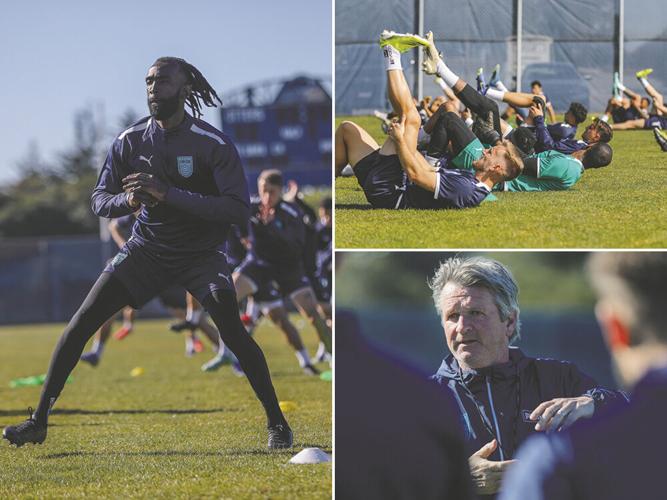


(clockwise from left): Hugh Roberts takes part in a drill during training camp in February. The players stretch before a morning workout. Head coach Frank Yallop provides instruction during a practice session.
Tables are set with precision on crisp white tablecloths in the upstairs dining room of Montrio. Menus are tucked neatly into folded napkins – it’s a dressy affair. The crowd is youthful for the most part and fit, but no one is ready to sit just yet.
As with almost any gathering where wine is poured, people congregate near the bar. Christian Volesky almost chuckles as he glances around the room. “Lots of new faces,” he says, gesturing with his glass.
The event is a mid-February team dinner for Monterey Bay F.C. (referring to football club), then a team still in the making. Walmer Martinez, the first player signed by the club, had just arrived after being on international duty with El Salvador’s national team during qualifying rounds for the World Cup. And several roster positions had yet to be filled.
From the easy flow of conversation and laughter, however, it would appear to be a reunion of classmates. Indeed, several have played together on other squads. Most have league experience under their belts.
Hugh Roberts, who at 29 is one of the team’s elder statesmen, points out several people in the crowd. “I played against a bunch of these guys, so I know them – from the other side,” he says. “It’s good to see them on my side.”
MONTEREY BAY F.C. BEGINS ITS INAUGURAL SEASON as part of the United Soccer League Championship on Saturday, March 12, in Phoenix. The team came to be because of one stadium that didn’t happen and one that sat dormant, no longer used for sporting events.
Frustrated after being unable to secure a space to build a soccer stadium in Fresno, where his Fresno FC shared a baseball diamond, MBFC owner Ray Beshoff dissolved the team and went searching for a more suitable location for his franchise. The luxury car dealership maven had ties to Monterey County – his daughters own Joyce Wine Company – and Freeman Stadium on the CSU Monterey Bay campus was little used. A relic from Fort Ord, the university turned to it only for outdoor graduation ceremonies.
On Feb. 1, 2021 the United Soccer League announced that Beshoff would establish a new team, based in Monterey County. The announcement that renovations on the stadium have been completed is still some weeks away.
While the season opens March 12, it will be almost two months before Monterey Bay F.C. takes the field at home. After Phoenix the squad visits Colorado Springs, Oakland, Sacramento, El Paso, Los Angeles and San Antonio. Their first match at what is now called Cardinale Stadium – Cardinale Automotive Group in Marina acquired naming rights – takes place on May 7.
Groundbreaking ceremonies for the facility were held on Sept. 16, 2021. But the old place needed a lot of work. which still continues; the playing surface was a jumble of debris and dirt, even at the beginning of March. Needing new seating, concession areas, a press box, hospitality suites, updated locker rooms, modern lighting and synthetic turf, Beshoff put together a reported $11 million in private funding to take on the project as part of the team’s partnership with the university.
“That used to be a big cement block,” observes Martinez, who played his college soccer at CSUMB. “I’m excited to see what it looks like.”
The league agreed to schedule Monterey Bay F.C.’s home opener seven weeks into the season in order to give crews time to put the finishing touches on the 6,000-seat facility. When completed, Cardinale Stadium will also serve as home to the CSUMB men’s and women’s soccer teams.
Monterey Bay F.C. is not the first professional team in the county. The California Jaguars survived from 1995-1999, first in the USISL and finally in USL D3. The history of professional soccer in the U.S. is littered with acronyms – NASL, APSL, NPSL and others. Major League Soccer (MLS) finally took hold in 1996 and continues to expand.
The USL Championship is considered the second tier in American soccer, and it is growing. There are 33 teams in two divisions and a regular season schedule that winds through spring and summer into fall. Compared to the MLS, the stadiums are generally not as large, the budgets not as bulging. Six-figure salaries at this level are not the norm (the minimum compensation level is currently $2,700 per month, although teams can apply six “flex contracts” at $2,200 a month, minimum). But the USL circuit is loaded with talent.
When Monterey Bay FC held open tryouts in October, 70 prospects showed up. At a second combine in January, another 90 or so took their shot. About 50 of this horde of would-be pros were from Monterey County. While several players from the open events were impressive enough to invite to training camp, none made the final squad.
The 18 players on the roster – 11 starters, seven in reserve – come from all over the country and beyond. Rafael Díaz, a goalkeeper, is originally from the Dominican Republic. Defender Sam Gleadle is out of Chichester, England. And for all of the players, Monterey County is now home.

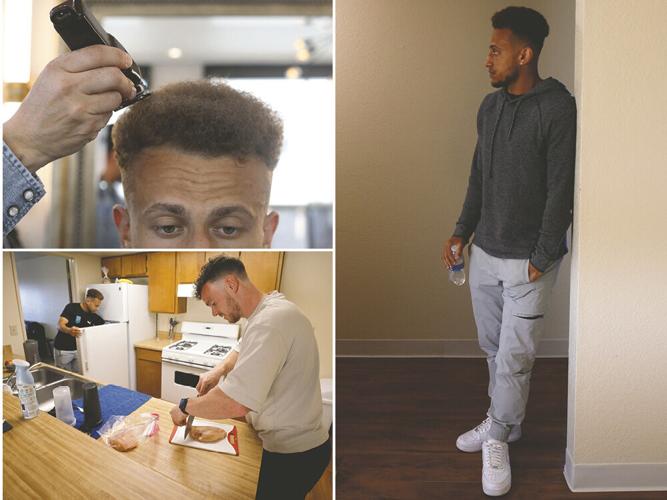
Most of the team live in CSU Monterey Bay East Campus housing, where they share apartments. On a weekday afternoon, Grant Robinson receives a trim then he and roommate James Murphy prepare dinner at home. Robinson stands in the doorway of a bare room. Although the apartments come furnished, the players are in a casual race to personalize their spaces.
PIECING THE TEAM TOGETHER HAS BEEN THE JOB OF FRANK YALLOP, MBFC’s head coach and sporting director, who comes with a lengthy resume as a player and coach. He spent 16 years with Ipswich Town in England’s Premier League and First Division. Before turning to coaching, Yallop joined the MLS side Tampa Bay Mutiny. As a coach he led the San Jose Earthquakes to two MLS Cup titles. He was named MLS Coach of the Year twice and has coaxed several USL Championship teams into existence.
One might imagine the process of filling an empty roster to be something like fitting pieces of an intricate puzzle. Yallop prefers a counterattacking style of play with opportunities created from the back, so he relies on central defenders who can take on threats one on one. He likes to harry the opposition and seize on chances to strike, so efficient passers and keen forwards are key.
But building a team from scratch is more mundane: Phone calls – and a lot of them – to player agents at first. “Basically I see who is available and what salary they’re at,” Yallop explains.
There is something more, however. The coach values a quality that used to be dismissed as an intangible.
Yallop can watch a player on video or in person and gauge his talent on the pitch. Yet he is intent on crafting a club, one with killer instincts on match day and a relatability the rest of the time.
“I want my team to feel like it’s family,” he says. “Let’s get our players integrated into the community. I’ve done that everywhere I’ve gone.”
So the coach tries to peer into a potential player’s character, a trait that can elude definition as it balances a desire to help the team, to improve as an individual, to both take instruction and take the lead, to applaud the fans and be a regular person. It’s not humility, because players are competitive and want to reach the top. It’s something different, and Yallop seeks it out. He will call a player’s coaches and teammates, maybe even a few acquaintances, asking dozens of questions, especially of the person in question.
“He called me a couple of times and it was great to have those conversations with him,” recalls Roberts, who has more USL experience than almost anyone, entering the season listed third all time in minutes played.
Bit by bit, Yallop assembled a team. Because soccer requires a unique intuition into a teammate’s mind as players create or fill spaces while in constant motion, he found a core of guys who played together in the past. He also selected a few he had encountered in the past as a coach – guys privy to his expectations who can pass on those insights to the others. The coach looked for players at different points in their careers, including many veterans. And he signed a few who have been through the uncertainties of launching a new team, such as Dallas Jaye.
For the Monterey Bay F.C. goalkeeper, it’s his third time on a startup squad, something he discussed with Yallop over the phone before he inked his deal.
“I told him ‘I understand how it goes,’” Jaye explains. “There will be growing pains, but a lot of these guys are experienced USL guys. We’re checking a lot of boxes you need to check early on.”
Just one player, Jesse Maldonado, enters the season without professional experience. Yallop signed the 19-year-old forward out of Yavapai College in Arizona after spotting him at a combine. At 33, Chris Cortez is the oldest member of the squad. The average age is 26.
“Many of these guys could play in MLS,” Roberts says. “We can compete.”
That was made clear in two preseason matches against the San Jose Earthquakes in February. In the first, a patchwork Monterey Bay squad with a number of players contending on a trial basis and just six days into spring training took on San Jose’s starting 11, who were wrapping up their preseason schedule. At halftime, MBFC held a 2-1 advantage on goals by Volesky and Chase Boone.
For the second half, Yallop’s sent in eight look-see players while the Earthquakes kept their starters on the field. The final outcome was a 4-2 defeat, but as Jaye points out, “we held our own.”
In the follow-up match, Monterey Bay knocked off San Jose’s reserves 1-0 – another solid performance. “We were able to extend the minutes for some guys,” says Jaye, noting that fitness level is critical to success, as is playing time against an opponent. “There’s no way to duplicate the pace, the speed and the mental fatigue of a game.”
“That was a good game for us,” Roberts adds. “We have our standard now.”
THE VETERAN STRIKER ROBERTS signed his contract on a Wednesday. He was to report to the team’s Seaside headquarters four days later.
“Man,” he says, shaking his head. “I looked from Monterey to Santa Cruz. There were only two apartments available from Monterey to Santa Cruz. Everywhere else I’ve been you don’t have that problem. In Charlotte, there were like 700 apartments available for me.”
There was some sticker shock for the few players who opted to find apartments. Roberts brings his dog along, so his own place was a must. Otherwise, the team provides housing on East Campus as part of the arrangement with CSUMB.
“The club taking that stress off of us is a big plus,” Jaye explains. He was one of the first to arrive on-site. “I walked in and the bed was made and the wi-fi was on. The club has done a great job.”
Although these are professionals familiar with a lifestyle of travel and one – or two-year contracts that can have them bouncing around the country, there is a sense of adventure, of excitement in the Monterey Bay F.C. family. Part of it is the mounting adrenaline as the season approaches. It’s also being part of a brand-new team – the thrill of this unknown was made clear by almost every player when their signing was announced to the press. But these are also young men seeing California’s Central Coast, mostly for the first time.
(Walmer Martinez is a Santa Cruz native and played college soccer at CSUMB. Jaye grew up in the Bay Area and as a child visited the Monterey Bay Aquarium with his family.)
Players were fortunate to arrive in an unusual February stretch of warm days and clear skies. Chase Boone and others hung out at Marina State Beach one afternoon. “I’d never be on a beach in Portland in February,” he exclaims. A group of them had a chance to watch the AT&T Pebble Beach Pro-Am and were awed by the experience. “It was awesome,” Jaye says. “I followed Patrick Cantlay for a while and I saw Jordan Spieth.”
The dividend paid by Yallop’s scrutiny of character is evident as the players settle in. An informal race to personalize the apartments, which come furnished, developed among players living in the complex. With most of MBFC living in CSUMB housing, the team remains close even off the practice grounds. They can gather to cook dinner – Jaye rooms with Chris Cortez, a former teammate at Phoenix, and admits that in their case Cortez is more experienced in the kitchen – and relax, and maybe check on progress.
“We were able to find a used futon,” Jaye reports after practice one day in late February. “Our apartment is the furthest along.”
There are responsibilities off the field. The team participates in community events, such as a Blue Zones Project cleanup of the Salinas Soccer Complex or a watch party at Alvarado Street Brewery when Martinez and the El Salvador national team took on team USA. The event served as a casual meet and greet between players and sponsoring partners, as well as fans. The brewery is one of these partners and figures in many of their plans when players have an evening off.
“You always need a brewery in your corner,” Boone says with a smile.
(Other sponsors include big names in local business and beyond: Montage Health, Puma, Monterey Regional Airport, 1st Capital Bank, Britannia Arms and Monterey Touring Vehicles.)
There’s a newness to the Monterey Bay F.C. experience. “I’m excited,” is a common refrain from the boys in blue. “You’re meeting fans and that engagement – a club is more than players and coaches,” Jaye says.
Yallop references Bobby Robson, an English player and manager so legendary he was knighted, who he played for at Ipswich Town. Despite his regal status, Yallop describes Robson as someone genuinely nice away from the game.
“That’s what I want,” the coach says. “I don’t think you can fake it.”

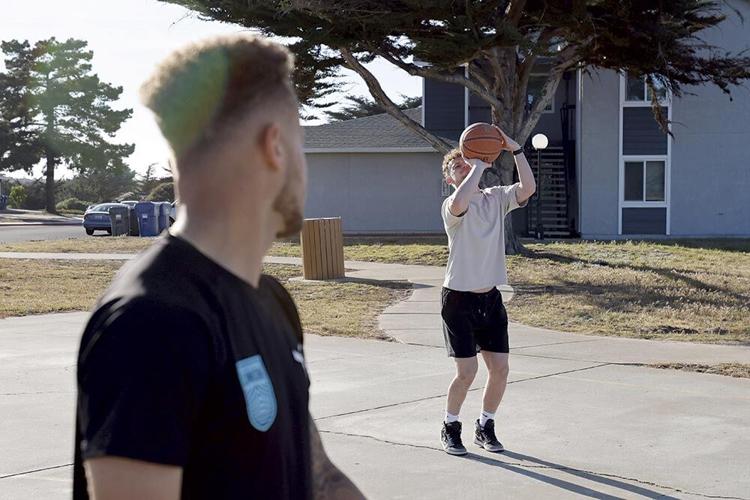
Murphy (shooting) and Robinson kill spare time with a little hoops. Last year, they were teammates at Rio Grand Valley FC.
THERE IS AN ADAGE ACCEPTED IN ALMOST EVERY SPORT OF A HOME FIELD ADVANTAGE. The crowd is on your side offering support, the surroundings are familiar and comfortable. It makes sense – except, perhaps, when it comes to MBFC. The team, after all, has yet to even see its pitch or hear its fans. For now, home is about as foreign as away.
The group gathered at Montrio in the middle of February with the season still in the distance dismissed the old axioms of the game. They would be able to ambush a few of their hosts, who may expect to dominate an untried squad. They would iron out some wrinkles and be a dangerous team to play when they finally meet their own fans. The schedule later in the season would be weighted in their favor. Bonding on the road would make them tighter as a family.
This was character as defined by Frank Yallop.
“Away games define a team,” Roberts says. “It’s hard to win on the road, but we’ll get wins on the road.”
(0) comments
Welcome to the discussion.
Log In
Keep it Clean. Please avoid obscene, vulgar, lewd, racist or sexually-oriented language.
PLEASE TURN OFF YOUR CAPS LOCK.
Don't Threaten. Threats of harming another person will not be tolerated.
Be Truthful. Don't knowingly lie about anyone or anything.
Be Nice. No racism, sexism or any sort of -ism that is degrading to another person.
Be Proactive. Use the 'Report' link on each comment to let us know of abusive posts.
Share with Us. We'd love to hear eyewitness accounts, the history behind an article.