



JUST OFF HIGHWAY 101, ABOUT A 10-MINUTE DRIVE SOUTH OF SALINAS, is an expanse of farmland that has become the heart of Monterey County’s cannabis industry. Next to fields replete with the vegetable crops that have made the Salinas Valley a powerhouse of California agriculture sit gated, fenced-off parcels, most of them spanning 10 acres or more, that house sprawling, canopied greenhouses of ganja.
Three decades ago, many of these greenhouses, previously full of flowers, were left empty in the wake of the North American Free Trade Agreement, which decimated the local flower-growing industry. But after California legalized recreational cannabis in 2016 and Monterey County soon followed with its own rules permitting cannabis businesses, cultivators flocked to this area to set up marijuana growing operations – breathing new life into the long-neglected facilities, creating thousands of jobs and generating tens of millions in tax revenue for the county. By 2021, cannabis was the third-most valuable agricultural product in Monterey County, with an estimated $618 million produced that year.
Yet these days, a drive down the patchy, cracked roads that run alongside those fenced-off properties finds many of them once again vacant and dilapidated – their canopies tattered and yards filled with detritus, abandoned by owners who either couldn’t get growing operations off the ground or who threw in the towel after being crushed by the economic realities of their business.
As is the case across California and North America at large, Monterey County’s cannabis industry now finds itself in recession, if not outright depression. According to the county, 32 local cannabis operators have gone out of business in the last 12 months – double the number across the previous two years combined. Cultivators have been squeezed by a combination of crashing marijuana prices – which they attribute to overproduction and a lack of legal retail outlets – and what they deem as overbearing taxation and regulatory requirements, at both the state and local level, that have made it impossible to pencil a break-even business, let alone a profitable one.
After generating $79 million in tax revenue that went into Monterey County coffers over the previous six years, the county’s cannabis sector contributed only $3 million in the last fiscal year. Of those operators who are still around, many are now on back tax payment plans with the county. While the Board of Supervisors has moved to alleviate the tax burden on the industry – repeatedly slashing a much-criticized cultivation tax from an initial $15-per-square-foot to now under $2-per-square foot – cannabis businesses say it is still not enough, and point to a myriad of costly licensing fees and infrastructure requirements that, they argue, are not demanded of any other agricultural producers in the state.
“California was the leader nationwide in regulating cannabis, and Monterey County was one of the top leaders statewide – and it lost its position because it got greedy and refused to adjust,” says Gavin Kogan, who co-founded two of the largest cannabis companies in the county, Lowell Farms and Grupo Flor. “If you tried to tax lettuce farms at $0.02 a square foot, let alone $15 a square foot, you’d have a riot on your hands.”
As a result, legal cannabis operators say the local industry is now overrun with illegal growers, including cultivators who were formerly licensed but opted out of regulatory costs and have continued to sell marijuana into the black market. Licensed dispensaries have also struggled with these dynamics – challenged by competition from cheaper illegal product, as well as their own taxes and licensing requirements.
While many blame the nature of Proposition 64, the 2016 ballot measure that legalized cannabis in California, for this state of affairs, they also point to a fundamental distrust toward the industry by bureaucrats, as well as opportunism by regulators who viewed the legal market as a cash cow to be taken advantage of.
“You throw the word cannabis in front of anything, and everyone thinks they can charge you 10 times more than it costs,” according to Grant Palmer, who runs the Crop Circles cannabis production facility in Moss Landing and also operates the CannaCruz dispensary chain, which has a location in Salinas. “We expect regulation, we expect taxes – but we’re just being preyed upon.”
Though some are optimistic that the market has bottomed out, with marijuana prices now stabilizing and even ticking upward again, there is a sentiment across the industry that more must be done to recalibrate the rules governing legal cannabis. Otherwise – absent a widespread shift at the federal level, where cannabis is still a Schedule I drug, resulting in all kinds of legal and financial restrictions – they fear the legal industry in Monterey County, if not California at large, is doomed to failure.
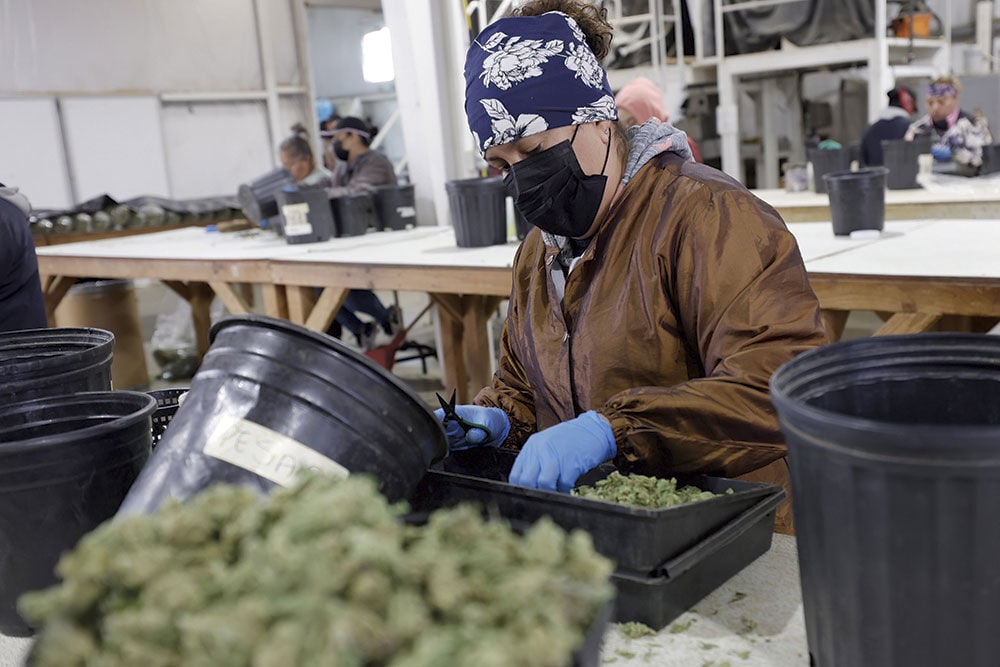
Cannabis growers like Riverview Farms often entail full-scale operations that not only grow plants, but also harvest them through a multi-step process. Such farms often employ dozens, if not hundreds, of workers – though many had to cut jobs amid an ongoing industry downturn.
MIKE HACKETT WAS ONE OF THE EARLY MOVERS IN LOCAL CANNABIS CULTIVATION. In the wake of the local flower-growing sector’s demise, Hackett snapped up abandoned greenhouse properties with an eye to renting them out for agricultural logistics like equipment storage. When Monterey County began permitting cannabis growers, Hackett and his daughter Michelle saw an opportunity.
Their company, Riverview Farms, now operates nearly 500,000 square feet of canopied greenhouses across two 10-acre parcels along Potter Road just off Highway 101. A recent visit finds a full-scale agricultural operation: Not just grow-houses but climate-controlled nurseries and facilities dedicated to the various steps of harvesting the plants.
“This is agriculture,” Mike Hackett says, noting that even visiting county inspectors are sometimes surprised by the sophistication and legitimacy of what they find. Whereas some Salinas Valley growers pride themselves on being “seed to salad,” Hackett adds, “we’re seed to smoke.”
Yet Riverview is neighbored by multiple empty and inactive parcels where cultivators have succumbed to the same pressures that have challenged the Hacketts’ business. Above all has been collapsing marijuana prices: Michelle Hackett, who runs Riverview’s day-to-day operations as president, says greenhouse growers – who, compared to indoor and outdoor growers, represent the overwhelming majority of the county’s cannabis cultivators – now expect to receive anywhere from $500 to $650 per pound of product “on a good day,” compared to north of $1,500 several years ago.
Meanwhile, Riverview’s production costs come in at $400 to $500 per pound, which doesn’t account for the various taxes and licensing fees they also have to pay, according to Michelle Hackett. “The market has basically stayed, for two years, at an at-cost rate,” she says. “What it’s cost us to produce is what it’s cost to sell – it’s been almost a push.” In turn, Riverview operated at a loss last year, she says, while having to dramatically downsize its staff (to around 60 people, from a peak of nearly 150) and cut expenses across its operations.
Compounding those market dynamics have been taxes and licensing fees that are considered across the industry, virtually unanimously, as untenable. As well as county cultivation, nursery and manufacturing taxes, as well as land use permits and cannabis business licenses – not to mention a per-square-foot cultivation tax imposed on county growers by the Monterey County Regional Fire District – there’s a separate array of taxes and licensing requirements imposed by the state.
Operators are particularly critical about layers of regulatory codes concerning their growing facilities, which they claim are not as strictly imposed on other agricultural sectors. These include fire sprinklers and water tanks, flushable toilets and accompanying septic systems, and other building regulations that can cost hundreds of thousands of dollars to comply with. (Mike Hackett notes that as a result of the mandated building improvements, Riverview’s property taxes have also climbed significantly – from $10,000 per year to $90,000, he claims – due to the revised assessed value of the company’s property.)
Growers complain of a stringent culture of enforcement around these requirements in Monterey County that results in constant scrutiny and little wiggle room around violations. They often point to the county department staffers tasked with administering those rules, which are often mandated at the state level, as the culprits.
“Monterey County is 100 times worse than Santa Cruz County,” according to CannaCruz’s Palmer, who runs cannabis businesses in both jurisdictions. “In Santa Cruz, we get inspected maybe once a year – they come through, make sure everything is fine, and leave. In Monterey, we were getting inspected monthly at one point. There’s no such thing as another agricultural crop that gets monthly inspections from Monterey County. They’re regulating cannabis as if it’s plutonium.”
AS A FORMER MONTEREY COUNTY DEPUTY AGRICULTURAL COMMISSIONER who worked in county government for years, Bob Roach is familiar with how the local bureaucracy operates.
Roach, who most recently served as executive director of the Monterey County Cannabis Industry Association, blames some of the code enforcement issues on the way legal cannabis was codified by the state via Prop. 64. The law established layers of oversight administered by various state agencies, which counties are mandated to enforce.
But Roach also reserves criticism for how the county has gone about interpreting and enforcing many of those rules. “The county never goes in a [non-cannabis] greenhouse and checks if they did all of their permits,” he notes. “For cannabis, they go out there and write up everything they can… [Cannabis operators] have been burdened with all of these costs and made to comply with the letter of the law with maximum enforcement pressure, which other [agricultural] businesses don’t face.”
Aaron Johnson, an attorney who sat on the Monterey County Cannabis Industry Association board, attributes that regulatory approach to lawmakers and bureaucrats “who didn’t want [cannabis] here” and “were reluctant to treat it like any other agricultural commodity.”
“Some of the concerns about having this type of product here forced them to focus on extreme oversight,” Johnson says. “Part of that was warranted, but if we’ve made the decision to allow for the product to be grown and distributed, you have to make it economically feasible for these entities to do that work.”
As a result of declining cannabis tax revenues, the Monterey County Board of Supervisors cut the budget for the county’s Cannabis Program by 30 percent in the 2023-24 fiscal year budget, to under $3.4 million. That budget funds positions and functions at county agencies, like the Department of Housing and Community Development, that are charged with overseeing the industry. The move will result in the streamlining of the county’s regulatory oversight, according to county officials.
Monterey County Cannabis Program Manager Joann Iwamoto says she understands the complaints lodged by operators – several of whom express a favorable opinion of Iwamoto and the work her staff has done to adapt the county’s policies and ease the burden on the industry. Still, she adds that county regulators must abide by the rules established at both the local and state levels.
“It is a very costly investment when you say you want to be a commercial cannabis operator; there are so many requirements at the state and local level,” Iwamoto says. “You have to remember, we’re not talking about lettuce or strawberries… It’s a highly regulated, highly taxed industry. And if the question is ‘Why can’t you treat me like a strawberry grower,’ it’s because there are different requirements.”
In the meantime, the industry has been left to limp along. Though Iwamoto says she still meets monthly with groups of local operators, some have complained about increasingly irregular meetings with the Board of Supervisors’ cannabis committee, while bemoaning how the board’s policy decisions have contributed to the current situation. The distress has reached the point where the Monterey County Cannabis Industry Association, led by Roach, is now effectively defunct due to members being unable to pay their dues.
As one of two supervisors on the board’s cannabis committee, Mary Adams has positioned herself as a key supporter of the industry within the halls of county government. Adams points to decisions made at the onset of the county’s Cannabis Program in 2016 that continue to have repurcussions – such as an initial ban on outdoor growing that “wiped out” established medicinal growers and forced most of the industry into “decrepit greenhouses” in need of upgrades.
“For a while, it felt like the powers that be did not want this industry to succeed and made decisions to do everything to combat it,” Adams says. “I think that’s changed in the last couple years, but it was clear that this was not a very welcoming county for cannabis growers.”

Cannabis greenhouses in Monterey County must pay a per-square-foot cultivation tax to the county. While the Board of Supervisors has repeatedly slashed that tax rate in recent years, growers insist it’s still too high given the industry’s current economics.
WALTER HUFF OPERATES ROUGHLY 180,000 SQUARE FEET of cannabis greenhouses off of Alisal Road near Salinas. As the one-time mayor of Monte Sereno in Santa Clara County, he’s no stranger to the workings of local government. And whether it’s Monterey County or other jurisdictions across the state (Huff also used to have a cannabis facility in Berkeley), he believes California is driving away its legal cannabis industry.
“We’re still treated in an incredibly hostile manner from the state,” Huff says. He notes that industry participants are still viewed as “dope dealers and castouts” by regulators, while federal scheduling of the drug prohibits operators from writing off business expenses in their taxes, accessing loans from major banks or even filing for bankruptcy.
Despite measures like the elimination of a statewide cultivation tax last year, Huff says California’s cannabis taxes and rules threaten to drive operators out of the state to friendlier places like Arizona, where he also has cannabis investments. “We have smaller operations [in Arizona] and I make eight times the money there than I do in California,” according to Huff. “If someone wrote me a check for $20 million and a piece of property, I’d say let’s go somewhere else [outside of California] – it’s not worth it.”
Kogan, formerly of Lowell Farms and Grupo Flor, describes Monterey County’s industry dynamics as a microcosm of the state’s, which he believes is costing itself in the form of now-declining cannabis sales and tax revenues. Beyond taxes and regulation, he points to an inverted supply chain that, by design, has allowed cultivators to produce far more than there is demand from a relatively limited amount of retail dispensaries.
“There are more producers than there are points of sale,” says Kogan, who partly blames a framework that allowed individual cities to opt out of permitting cannabis businesses. Kogan and others note that there are now roughly 1,000 operating dispensaries statewide – a sharp decline from the 2,000-plus stores open during the pre-Prop. 64 medical dispensary days.
Johnson, the cannabis industry attorney, says those market fundamentals have transformed “what people were calling the ‘green rush’ to market failure.” But he adds that “burdensome regulations and overtaxation” destroyed margins that, in the good times, would have allowed cannabis growers to save up for the lean years.
“When the agriculture industry has a good year, you don’t see Lamborghinis and Ferraris out in the fields,” Johnson says. “If you’re in the ag industry, you know to be frugal for the long term; when times are good you save, and when times are bad you dip into those savings to stay afloat… In the good years in cannabis, we really didn’t have an opportunity to save, because we were putting any money that we had back into capital improvements that were necessary for the regulations.”
THE ECONOMIC IMPACTS OF TAXES AND REGULATIONS mean that, even amid tanking cannabis prices, the black market for unregulated cannabis products has been left to prosper. Industry sources say the illegal market still represents an overwhelming majority of the marijuana that’s out there for purchase – up to 80 percent, by some estimates.
“The whole idea of this thing was to disenfranchise the illegal market, and you don’t do that by creating an atmosphere where illegal drugs are 150-percent cheaper than legal drugs,” according to Kogan.
Roach agrees that the black market has been allowed to flourish “because of the economic disparities between producing legally and producing illicitly.” He adds that many illegal growers may have previously been legal operators, but were driven out of business by onerous business requirements.
“We had medical cannabis here since 1996 and multi-generational families whose living has been growing weed,” Roach notes. “What do you expect them to do, go and flip burgers? Of course they’re going to go to the illicit side.”
In turn, legal growers say the black market has eaten into the prices that they are able to command for their products. “I think the fair market rate for Monterey County [greenhouse-grown] cannabis would be anywhere between $700 to $800 [per pound], but that’s not where the market is at,” according to Michelle Hackett. “Product is obviously being offered cheaper, and the only way is if you’re not paying taxes and following the rules.”
While cultivators appeal for more to be done to combat the illegal market, law enforcement authorities have made efforts to crack down on the problem. In June, the Monterey County District Attorney’s Office announced the raid of an “unlawful cannabis operation” in rural Salinas that saw authorities confiscate and destroy over 1,400 pounds of marijuana.
Though the grower in question held the requisite licenses and permits, they were not reporting cultivation activities to the county or state, according to the DA’s office – potentially enabling them to avoid paying taxes, testing fees and other costs on that product. Monterey County Assistant District Attorney Greg Peterson says the danger of such illegally grown cannabis is evidenced by the fact that subsequent lab testing of the seized product found “a number of harmful chemicals,” including arsenic.
Yet even that case study speaks to the regulatory pressures felt by the legal industry. CannaCruz’s Palmer estimates that the “same lab test” for cannabis products has become around 10 times costlier since Prop. 64, due to enhanced requirements placed on labs.
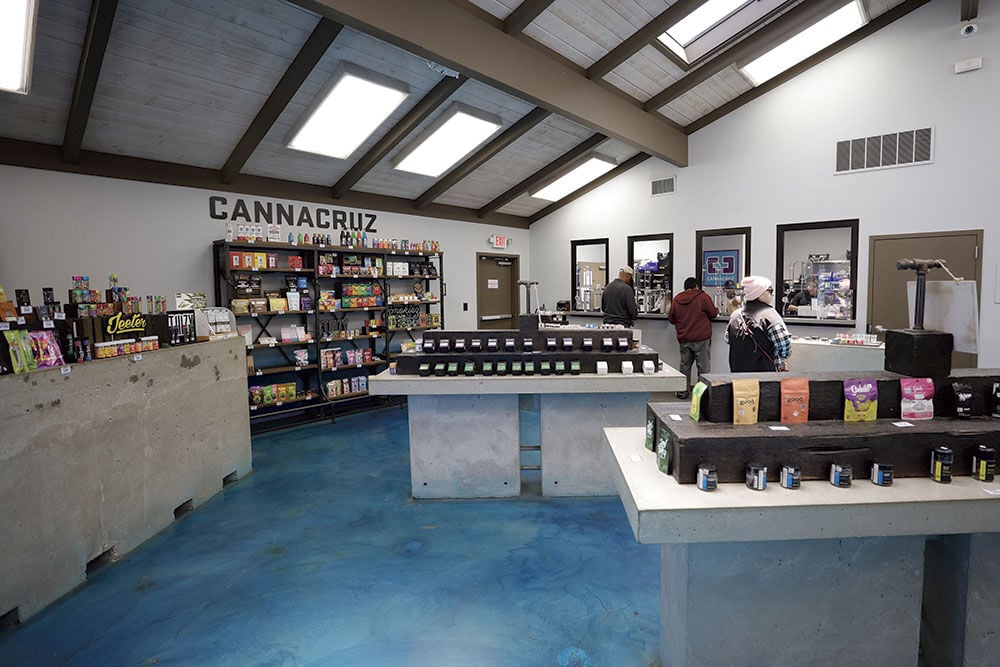
Dispensaries like CannaCruz in Salinas are facing many of the same headwinds as cultivators, such as high taxes and competition from the illegal market. CannaCruz owner Grant Palmer says Monterey County is “100 times worse” than Santa Cruz County, where the company also operates, when it comes to regulation.
DESPITE THE VARIOUS HEADWINDS, some in the industry see green shoots of optimism. There are signs that the market for greenhouse-grown cannabis is ticking upward to around $650 to $750 per pound, according to Roach – though he notes that the market could shift again, such is the nature of any cyclical agricultural product.
In June, the county’s Planning Commission signed off on a new state rule allowing greenhouse growers who don’t use grow lights in their facilities to apply for outdoor cultivation licenses, which are cheaper than the mixed-light cultivation licenses those growers were having to apply for.
Still, many note that the local industry is beset by debt, back taxes and unpaid bills between growers, distributors and dispensaries alike – many of whom don’t know if they’ll ever receive what they’re owed due to the precarious financial situations of those they’re doing business with.
“We’ve made a huge shift in our business,” Michelle Hackett says. “We’ve stopped all of our retail relationships. It’s all wholesale, cash on delivery… We’re not in the business to extend credit or give free weed – we’re in the business to sell weed for 100-percent marketable value.”
Long term, Hackett believes that the way forward for the industry is to open up cannabis retail options to pharmacies, convenience stores and other conventional outlets: “We need triple or quadruple the amount of legal outlets,” she says. And while federal legalization would raise the possibility of a national market flooded with product, she thinks California cannabis would prosper – not just because of its established infrastructure but because it connotes quality, akin to Napa Valley wine.
Kogan adds that the current state of affairs is an opportunity for state and local governments alike to make structural reforms to how they regulate the industry. “I think this is a morphing period,” he says. “This is probably an opportunity for regulatory structures to realize that they got caught up in a ‘green rush’ hysteria and poorly regulated without a long-term view. Monterey County did not take the long view.”
(3) comments
Santa Barbara unanimously passed the ruling that if you are 30 days past due on your operator cannabis tax, then you have to close up shop. Not in Monterey. It's almost to the point that all taxes are being forgiven, which will signal the illegal marijuana to grow exponentially. They think by funding "education" programs about the negative effects of pot, then the illegal pot will magically disappear and the legal cannabis industry will thrive and make Monterey the "Napa" of cannabis in comparison to the wine industry. People that think that are really having a serious pipe dream.
Monterey County is also driving its legacy Big Sur growers to extinction because nobody can meet the county’s conditions. Big Sur is so important to the history of cannabis that the Berkely Oral History Center is documenting it before it is all gone; look it up. The ridiculous and onerous “fire tax” that the Monterey County Regional Fire District passed, the only fire district in the state to do that, is a heavy burden. The county has reduced their tax over time while the MCRFD has raised theirs and says they can’t reduce it because the tax measure they wrote does not allow it.
From the article: "Long term, Hackett believes that the way forward for the industry is to open up cannabis retail options to pharmacies, convenience stores and other conventional outlets."
That will ease the cost factor also, since it won't be necessary to maintain a whole building for retail sales, just a section of an aisle.
There is some justification for the extra taxes on alcohol and tobacco. Because of their massive harms, they create huge social costs. The extra taxes, at least partially, compensate for those costs.
Science and widespread experience have shown cannabis has no significant harms. Hence, there are no associated social costs and no justification for extra taxes.
Because of its near harmless nature, the only regulation cannabis really needs is to prohibit sales to children and require adequate sanitation - as we do for all produce.
Welcome to the discussion.
Log In
Keep it Clean. Please avoid obscene, vulgar, lewd, racist or sexually-oriented language.
PLEASE TURN OFF YOUR CAPS LOCK.
Don't Threaten. Threats of harming another person will not be tolerated.
Be Truthful. Don't knowingly lie about anyone or anything.
Be Nice. No racism, sexism or any sort of -ism that is degrading to another person.
Be Proactive. Use the 'Report' link on each comment to let us know of abusive posts.
Share with Us. We'd love to hear eyewitness accounts, the history behind an article.