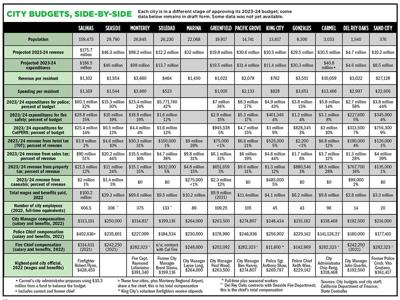


Salinas
The city of Salinas will start the 2023-24 fiscal year with a conservative budget, foreseeing an economic slowdown in a city that derives more than half of its revenue from sales tax. “Overall, the forecast assumes the next 10 years’ revenue growth will slow compared to the last five years,” the draft budget reads. Measure G, a sales tax approved by voters in 2014, is currently set to sunset in 2030; if it’s not extended, revenues then will drop by an estimated $35 million annually.
Various departments, including police, finance, and library and community services, remain understaffed. Staffing levels at the Salinas Police Department led Chief Roberto Felice in February to announce a new system for prioritizing calls, with “quality-of-life” calls for issues like noise and traffic not generating a response. Police have been directed to work mandatory overtime, which totals some 900 hours a month to keep officers on the streets, and costs roughly $2 million a year. City Council approved a new cash incentive program to recruit more officers.
The budget process featured multiple bilingual meetings in Spanish and English to gather community input; streets and sidewalks were a priority for many participants. The Public Works Department, however, is getting the same slice of the pie as it did in previous years, 10 percent; that is up from $11.8 million last year to $13.7 this year. That amount won’t come close to meeting the city’s projected cost for improving the state of its roads citywide, a figure that officials put at a minimum cost of $24 million.
Public meetings on the budget took place in person and virtually, and once the budget is approved, City Manager Steve Carrigan says they plan to print copies in Spanish for the first time.
Among upcoming projects, the city will be working on the completion of the new Hebbron Resource Center; affordable housing on Laurel Drive and Division Street; adding Lucas CPR (a mechanical chest compression device that increases the chances of saving lives) to all Salinas Fire Department fire engines; designs for a new fire station; and expanded hours at all Salinas Public Library branches.
Seaside
During the last two years, the city of Seaside “experienced exceptional and unexpected growth,” according to its draft budget. And yet: “The city’s revenue streams have begun to flatten out, while at the same time the city’s costs continue to rise.”
Why?
Victor Damiani, Seaside’s finance director, attributes it to sales tax revenue from increased consumer spending, the two biggest categories being auto sales and online shopping.
All the money pumped into the economy due to federal legislation passed in that time achieved its primary goal – staving off a recession, for now at least – but at the same time all the money floating around has had an unintended consequence: all the money is worth less, i.e. inflation. That’s in part why Seaside’s costs, just like the average consumer, have gone up – everything, including labor, is more expensive. (For the most part, those who provide labor in Monterey County also have to be able to afford to live here.)
And as anyone who lives in the area knows, it’s not cheap. And while the pandemic has hurt commercial real estate values in big metro areas, there was an increase in residential real estate values – they “skyrocketed,” Damiani says – which boosted property tax revenue 29.4 percent in the last four years, from $8.5 million in fiscal year 2019-20 to a projected $11 million in the coming fiscal year.
An analysis of the situation in the city’s draft budget document projects property tax revenues to flatten in the coming year – just a 4-percent increase – and notes, “with home prices elevated, however, affordable housing remains problematic in the community.”
Seaside is not unique in that respect, but there are several housing projects in the hopper that, should they ultimately get built, will add much-needed supply. It’s a bit of a mixed bag as to how that will impact the city’s overall fiscal health: Damiani says that while the biggest of those projects, Campus Town, is expected to add about $4 million annually in net impact to the city’s budget, he points out that the new fire station the city is planning to build near Seaside’s northern border will cost an estimated $16.5 million and, in the near term, add about $1.2 million-$1.8 million to staffing costs. Other costs for the city, he says, are expected to keep rising as well.
Seaside’s fiscal future, in the near-term at least, is rosy – it has a big tax base with auto sales, transient occupancy tax revenue and property taxes – but its challenge will be in whether, as a city government, it can meet the moment in serving the needs of its residents.
Monterey
The Covid-19 pandemic hit the city of Monterey’s bottom line hard, to the tune of $32 million lost in the first 15 months of the pandemic – mainly because the city depends heavily on transient occupancy taxes collected from hotel guests, Monterey’s biggest revenue source. At the start of the pandemic, the city cut nearly 20 percent of its workforce. That was then – the city is now building itself back up and City Manager Hans Uslar says he’s feeling quite optimistic about Monterey’s future.
One reason he’s feeling optimistic is that despite the city’s fiscal challenges they have been able to add money into emergency reserve funds for future economic upsets. In addition, for the first time in the city’s history, they are putting aside funds specifically for maintenance of the Conference Center. He expects a fund for CalPERS will reach $6 million by next year in case of unexpected rises in employer contributions required by the state. That will allow the city to pull from the fund, instead of making cuts elsewhere.
The city is still carrying 50 to 60 empty positions that are fully budgeted and departments have been striving to underspend over the past two years, further keeping the city in a positive cash flow situation. It contributes to Uslar’s positive outlook, despite ongoing worries over a recession: “We have lived through several recessions in the past. Visitor volume never changed drastically,” he says. “They still want to enjoy the coast, buy meals and a souvenir.” (The influx of tourists causes the city’s daytime population to swell from nearly 27,000 people to as high as 70,000 a day during summer months, which puts a strain on city services – and per-resident figures included in the chart below don’t take into account the tourist population. Transient occupancy tax accounts for 31 percent of Monterey’s revenue, more than any other local city. “It’s great [residents] aren’t bearing the burden of city services, but it also means we have to rely on tourism dollars to provide the services our residents and visitors desire,” Assistant City Manager Nat Rojanasathira says. )
And while tourism is still slightly below pre-pandemic levels – a recent study reported that in 2022 tourism spending was $3 billion, a 5.5-percent decrease from 2019 – Uslar says gains have been made that give him confidence the city will do well in the coming fiscal year.
Soledad
Soledad is facing a “pretty much status quo budget” for fiscal year 2023-24, per City Manager Megan Hunter. Revenues are softening (not unusual across the state, Hunter says) after a few years when they performed perhaps better than expected. That’s due to how the small South County city makes its money – sales tax is a major source of revenue for Soledad, but the city doesn’t have much retail. During the pandemic, when people stayed home and shopped online, the city did well, considering. Now that people are out and about again, Soledad is once again losing money to its bigger, more developed neighbors – primarily Salinas. (Weathered by inflation, consumers are also spending less in general.)
The city is actively working to capture more retail spending in the future, primarily through development of Soledad Marketplace, a commercial center where a Premiere Cinemas opened in May 2022 (the Marketplace also has a Grocery Outlet). “All of the jurisdictions [that don’t rely on tourism] probably need to pump up retail,” Hunter says, adding that this definitely applies to Soledad.
Despite a conservative budget, there are a lot of projects underway in Soledad. These include American Rescue Plan Act-funded projects like a sewer project on Dixie Street, a violence prevention initiative and a new kitchen for the community center. Hunter calls ARPA “one of the best things federal government has ever done for local government.” The city also has funding to start site development work at the site of an envisioned village composed of shipping containers, with restaurants, drinks, retail and an outdoor stage. “For a small community, there are a lot of projects that are happening right now,” Hunter says.
Marina
Marina is a small but growing city – “a city in huge transition,” says District 2 City Councilmember Kathy Biala. This means new development and big future projects, most of which must be funded through Marina’s three main revenue sources: sales tax, property tax and transient occupancy tax (TOT). Some of the big investments Biala sees on the horizon include ongoing blight removal at the former Fort Ord (per Biala, the city has an estimated $15 million still to do); ongoing expenditures on legal services related to the conditionally approved Cal Am desal plant – the city has an annual budget of $2 million dedicated to groundwater litigation; and investment in permanent infrastructure for city facilities currently operating out of portable structures like City Hall, the police station, senior center and more. This last item is estimated to cost $53 million – far more than the city can manage to raise by putting away money each year. Instead, Marina plans to fund that construction with a $50 million bond measure.
Despite the big investments needed and the projects ahead (and the rising costs of all these projects), Biala says “overall, our city has done phenomenally well” – boasting an AA credit rating according to an independent auditor.
City Council is also working with a new process for prioritizing city projects – from new riding mowers for Public Works to presenting designs for the new sports and aquatic center and developing a sidewalk improvement plan. Instead of reintroducing preferred projects each year, the council made a master list of 126 proposed projects. Next, each councilmember ranked their preferences, from #1 to #126 and checked this against the lists of other council members to come up with agreed-upon priorities. After this, Marina’s city manager will come up with a smaller list of “which [projects] can feasibly be attended to” in the coming budget cycle.
Projects that don’t make the cut for this coming fiscal year will remain on the master list – the goal is to introduce some continuity in the process of deciding how to spend city funds.
“We’re trying to really have a systemic way of dealing with our ever-changing budget priorities,” Biala says.
Greenfield
With the July 1 deadline approaching, the city of Greenfield is still working to balance its budget. City Manager Paul Wood told the City Council on June 1 the city has three main priorities: provide a safe environment for residents, diversify the economy for long-term sustainability, and increase residents’ lifestyle options.
“It’s really about, what do we do to make sure that we’ve got enough revenue to provide the services that we’re providing?” Wood said.
There is good news: City staff is predicting up to an 8-percent increase in property taxes for the upcoming fiscal year. Plus, “We currently have $27 million in cash and investments,” Wood said. “That’s a really good bit of saving that prior administrations and councils have done.”
The Greenfield Police Department is requesting funds for a school resource officer (to be split 50/50 with the school district) in a city that is facing a high rate of teen arrests; in January and February alone, nearly 30 youth under age 18 were arrested on various charges. Many residents have voiced a lack of recreational programs in the city and a need for more diversity of sports they can participate in. The city is also starting a Youth Council and an internship program, modeled on the neighboring cities of Gonzales and Soledad, to engage young people in civic life.
Police Chief Guillermo Mixer believes funding a school resource officer will increase public safety: “We want to have a bigger impact and be more visible and have a bigger footprint within the schools,” Mixer says.
Greenfield is working to modernize its wastewater treatment plant; update software to improve City Hall operations; and restore and clean up athletic fields and parks.
Wood also wants to move forward with long-term projects such as a community center, downtown revitalization and low-cost, high-internet access. City officials are also working on a rental assistance program, emergency food and shelter program and expanded digital literacy among seniors.
Pacific Grove
America’s Last Hometown is also a tourist town, and relies on three primary revenue sources that reflect that split: property tax; hotel tax, or transient occupancy tax; and sales tax. After a Covid-era dip in some of those, the revenue outlook is relatively rosy.
Property tax revenue was not negatively impacted by the pandemic, and went up 6-percent last year. “TOT took a huge hit at the start of the pandemic. We have seen that recover since then,” City Manager Ben Harvey says. And sales tax is back to pre-pandemic times, and estimated to generate nearly $6 million in the coming fiscal year, thanks largely to Measure A, a half-cent increase approved by voters in 2022. (Technically, it was actually approved twice by voters, but on its first go-round as Measure L, the State Department of Finance discovered a discrepancy in the language and it was never enacted.)
Part of the rosy outlook comes thanks to new hotel rooms coming to P.G. A 102-room Kimpton hotel, located behind the Holman Building, is expected to generate $1 million in tax revenue from combined TOT, property tax and sales tax once it opens. “The big revenue hope the city has is we anticipate a big hotel breaking ground this year,” City Manager Ben Harvey says. While another, bigger hotel concept, approved for the American Tin Cannery, is tied up in litigation, Harvey sees the revenue as critical. “We’re bullish on both hotel projects because they’re very important to the future of our town,” he says.
Another potential revenue hope is cannabis; analysts believe one dispensary could generate up to $400,000 annually in taxes. But first City Council would have to give that direction.
Where council has already given direction is in establishing priority areas, which should be reflected in the budget. This year, those priorities are recreation; infrastructure; affordable housing; and environmental stewardship.
“Any money that might not be used for a prior obligation first and foremost goes toward fulfilling those goals,” Harvey says. That appears in the 2023-24 budget as $170,000 in funds for recreation staff positions and over $4 million for one-time capital projects, including a last-minute boost from City Council during budget hearings in June.
King City
There was a time just a few years ago that King City was looking at the prospect of bankruptcy. Two years ago, for the first time in 18 years, the city had a positive fund balance, generating more revenue than it spent in its general fund; last year came its first reserves in 19 years. This year city officials are forecasting to end the year with over $2 million in reserves. “We’ve come a long way,” says City Manager Steve Adams. “That’s the good news. The challenge is because we had 20 years of financial hardship, we have a lot of deferred maintenance.”
To that end, the next budget includes one-time capital projects. Projects are small and large, and include a restroom upgrade at City Park, water fountain replacements, new sidewalks and bulb-outs in downtown, a sewer line replacement on Lynn Street, painting City Hall and installing an access road to the wastewater treatment plant at San Lorenzo Park.
“Each year we spend a lot of time prioritizing and trying to focus on key areas, instead of trying to do everything,” Adams says. Those areas include violence prevention and this budget includes a full-time school resource officer within the King City Police Department, to be funded jointly with local school districts.
The small city has gotten out from under debt by selling off some city-owned property and going all out on applying for grants, while also investing in downtown in an effort to create more economic activity. There have also been some failed efforts to create revenue, but King City voters can again expect to see a half-cent sales tax measure on 2024 ballots after voters defeated a similar measure in 2022.
“We’ve still got a ways to go, but we’re proud of our progress,” Adams says. “We’re definitely not going to rest on our laurels.”
Gonzales
Gonzales has drawn up a “status quo” budget for the 2023-24 fiscal year that is little-changed from the previous year’s, according to Mike Howard, the city’s finance director. “We’re not anticipating a recession, but an economic slowdown,” Howard says of the conservative approach to city finances. “There hasn’t been a lot of major shifts [to the general fund].”
Longer-term, Gonzales is focused on initiatives like the construction of a new community center, slated to be located on Fifth Street across from Gonzales High School, as well as a new industrial wastewater treatment facility to accommodate the growth of the city’s industrial park, which houses agricultural producers like Mann Packing and Taylor Farms. Those projects aren’t accounted for in this year’s budget, Howard says, noting that the city expects to finance both with a combination of grants and low-interest loans from the state.
The industrial park and its tenants represent the largest tax revenue driver for Gonzales’ general fund, according to Howard. But that could change in the coming years given the expansive, long-gestating residential projects drawn up by the city, which could potentially triple its population of 8,300. Those plans are contingent on the annexation of surrounding farmland, which remains subject to county approval. “If those things come to fruition, we could see a significant number of homes added to the city, which would shift these [revenue] numbers,” he says, adding there are “still many hurdles” to address before those plans move forward.
The pandemic, meanwhile, did not significantly impact the city’s finances, Howard notes. “Property taxes continued to increase and home sales were still happening during the pandemic,” he says.
Carmel
Carmel City Administrator Chip Rerig is taking a glass-half-full approach to the incoming 2023-24 budget. “The data we’re looking at is a deceleration of growth in the village,” he says. A combination of punishing winter storms that kept visitors at bay, three years of deferred capital improvement projects in need of attention, an unstable economy and the high cost of housing regionally which impacts the workforce, among other challenges, led to staff presenting the City Council with a conservative budget.
They are projecting $30.5 million in revenues and nearly $41 million in expenses, which Rerig plans on balancing by using $10 million from another fund, made up of revenue saved over recent years. That money will be used for those deferred capital improvements, like pavement, sewer work and seawall repairs. Included in the budget is funding for much-needed and long-awaited renovations to the Carmel Police Station.
The city dramatically cut its workforce at the start of Covid-19 and then started filling vacancies last year at a fast clip. For the next fiscal year Rerig does not want to increase the number of employees, however he told the City Council he wants to consider increasing library staff when they do a mid-year budget review. While library hours have been expanded post-pandemic to 10am-6pm, weekdays, it remains closed on weekends.
Del Rey Oaks
Like other cities, Del Rey Oaks has drawn up a “status-quo budget” compared to the previous fiscal year, according to City Manager John Guertin.
Yet there have been changes in the city’s revenue composition, he says. Annual tax revenues from the city’s sole cannabis dispensary, Del Rey Farms, have declined to less than $100,000 from a high of around $900,000 just a few years ago – part and parcel of an overall struggling cannabis industry.
Guertin credits his predecessor, Dino Pick, and the City Council for having “the foresight not to go on a spending spree” with cannabis tax revenues, instead keeping them in reserves and putting them toward future staff retirement costs. “They used that money to build a stronger financial foundation, rather than hiring new staff or buying equipment,” he says.
As one of the smallest municipalities in Monterey County, Del Rey Oaks faces a unique set of circumstances in planning a budget, with revenue overwhelmingly coming from sales taxes from retailers like the Safeway on Canyon Del Rey Boulevard and Tarpy’s Roadhouse. “We have very narrow revenue streams and they’re all impacted by the same economic drivers – so if there’s an [economic] downturn, that impacts most of our revenue sources,” Guertin notes.
Fortunately, most of those businesses “weathered the pandemic well,” according to Guertin, with sales tax revenue now rising “at a pretty good pace,” offsetting some of the lost cannabis tax revenue.
The city has also benefited from higher transient occupancy tax revenue due to an increase in its number of short-term rentals, he adds; next year’s budget forecasts $190,000 in TOT revenue, up from $25,000 in 2018-19, pre-pandemic.
Guertin says the city and its financial auditors aren’t very concerned about another economic downturn in the cards. Rather, they “have a pretty rosy outlook for the next year” and don’t forecast a recession. “I feel better going into the next fiscal year than I did this one,” he says.
Sand City
Sand City does not yet have a draft 2023-24 budget available to review as of the time of this writing, but there isn’t reason to believe its fiscal situation will be markedly different than the last fiscal year.
But it’s also a city that, from a fiscal perspective at least, should be viewed through a different lens: Hardly anyone lives there – the population is 376 as of Jan. 1, according to the California Department of Finance – but hundreds of people pour in every day to stock up at its shopping centers.
It also houses a lot of industry – its founders over 60 years ago wanted to literally name it City of Industry, but the name was already taken by a city in the Los Angeles area – which also contributes to its impact in the region.
Financially, the city, which has a very small staff, is sitting in somewhat of a catbird seat – the city had $8.5 million in revenue in fiscal year 2020-21, against $6.7 million in costs. That’s a difference of $1.8 million in one year, and in the last two years, the city has added about another $1.75 million to its coffers from the same revenue-versus-cost delta.
The city also has a major project coming online in the next few years – South of Tioga – which will add hotel rooms (Sand City currently has none) and hundreds of apartment units, if the project is indeed built. But City Manager Vibeke Norgaard says she doesn’t expect the city to see any revenue coming in over the next fiscal year from that project, as it will not yet be completed.
Norgaard adds that there are other miscellaneous expenses the city is working to tabulate – the city bought two new police vehicles a couple of years ago, for example, which just recently arrived, and that “you pay for them when they arrive.”
While the fiscal landscape of Sand City’s future shows good reason for optimism, there is some headwind: in June of last year, the city received its last $850,000 annual lease payment from California American Water for Sand City’s desal plant – payments going forward until 2039 are only $7,000 annually.
But Sand City voters, by a 67-percent margin (only 131 residents voted), passed Measure L last November which will boost the city’s transaction and use tax (a sales tax, essentially) by 0.5 percent. That is expected to generate about $1.4 million revenue (or more) annually.
Running any city is expensive – roads and sewers, salaries and pension liabilities – but Sand City is in a better position (if not the best) than most local cities.
(0) comments
Welcome to the discussion.
Log In
Keep it Clean. Please avoid obscene, vulgar, lewd, racist or sexually-oriented language.
PLEASE TURN OFF YOUR CAPS LOCK.
Don't Threaten. Threats of harming another person will not be tolerated.
Be Truthful. Don't knowingly lie about anyone or anything.
Be Nice. No racism, sexism or any sort of -ism that is degrading to another person.
Be Proactive. Use the 'Report' link on each comment to let us know of abusive posts.
Share with Us. We'd love to hear eyewitness accounts, the history behind an article.