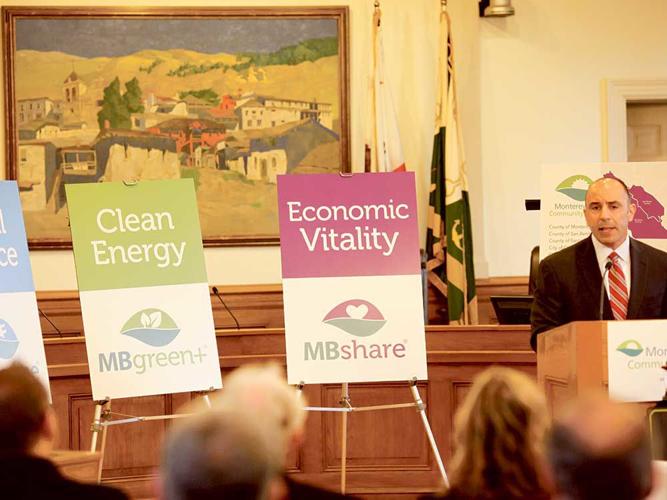

ON MARCH 1, A STORM SHOOK THE WINDOWS OF MONTEREY CITY HALL. It was the hardest rain of the season, and a press conference planned for the front steps of Colton Hall was moved indoors due to the downpour. It didn’t dampen the mood; more than a dozen elected and appointed officials from Monterey, Santa Cruz and San Benito counties had convened to celebrate day one of energy delivery by newly formed Monterey Bay Community Power.
U.S. Rep. Jimmy Panetta, D-Carmel Valley, delivered opening remarks. “I am absolutely honored to be here, I am proud to be here,” he said. “This is another example of our community coming together. We’ve got a group here that’s from different backgrounds, and yes, even different political parties. Despite your differences, you got together to get something done.”

U.S. Rep. Jimmy Panetta speaks at the March 1 launch of Monterey Bay Community Power for non-residential customers. The power mix of solar, wind and hydropower is expected to keep about 557,000 metric tons of carbon dioxide out of the atmosphere per year.
The Community Choice Aggregation model, or CCA, had been years in the making. After dozens of public meetings, about 100 presentations and more than five years, Monterey Bay Community Power formed as a new government entity in March 2017.
A year later, they were lighting a symbolic lantern in Colton Hall. With the exception of Panetta taking a comic jab at Texas – “California is number-one in solar, number-one in geothermal and number-two in wind after Texas; they’ve got a lot a hot air there” – the speakers all focused in earnest on the bridging of disparate interests to form the CCA.
“I’m so excited by all the partnerships,” Salinas City Councilman Steve McShane said. “I can say with confidence the energy in this room is greater than the energy we’re turning on today.”
Officials had labored “to ensure this agency would be embraced, from the south in San Ardo to the hills in Hollister, from the coastline to our rural communities,” said Watsonville City Councilmember Trina Coffman-Gomez. “We’ve addressed and met the unique needs of each of our partners.”
Those partners are 19 government entities: the three county boards of supervisors, and almost every city – 16 of them – within the three counties. (The only two cities to opt out are Del Rey Oaks and King City.) MBCP is governed by an 11-member board made up of representatives of the city councils and county boards of supervisors.
San Benito County Supervisor Jerry Muenzer spoke about the benefits Monterey Bay Community Power would create, thanks to its 100-percent renewable energy commitment.
“It will provide clean, sustainable energy,” he said. “In doing so, it will also provide jobs to create that energy here locally. We all have commuters that go to Silicon Valley. We need to create local jobs. This is going to help us do that; we need to get commuters off the highway, which will help us clear the air, and decrease our dependence on oil.”
It’s a grand vision, one that launched for non-residential customers on March 1, and launches for residential customers in all 19 jurisdictions on July 1. But for now, the local jobs and local power projects remain mostly a thing of the future.
THE LIGHTS ARE OFF IN THE MONTEREY OFFICES OF MONTEREY BAY COMMUNITY POWER– a nod to its renewable-energy mission – even on an overcast afternoon. A sleek blue e-bike from Santa Cruz-based Blix is propped up on a kickstand in the entryway, the raffle prize that will be given away at the end of July. Otherwise, the dim office is austere, no plants or decorations, except a small dish of solar-powered flashlight keychains.
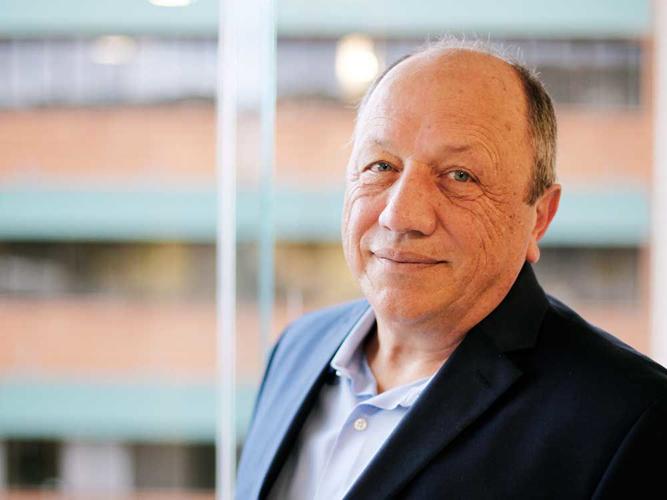
CEO Tom Habashi sits in the corner office, where the lights are also off. He was hired as interim CEO in September – after “a short, blessed retirement” – with six months to go before the March 1 launch. He then became the permanent CEO six days after the launch, when the board of Monterey Bay Community Power was divided, but voted 7-4 to approve a generous contract with a $27,500 per month salary, plus a yearly bonus of up to $30,000.
Throughout his career, Habashi has moved up the ranks as an engineer. Originally from Egypt, he came to New York after studying engineering, then landed his first job in the U.S. as an entry-level drafting engineer in the Los Angeles area. For more than 30 years, he worked for community-owned utilities (“sort of mini PG&Es”) and became an engineer, then manager of power supply, then assistant director in charge of resource management. Most recently, he launched a similar CCA just to the north, Silicon Valley Clean Energy Authority.

CEO Tom Habashi wants to see the next big evolution in alternative fuels for vehicles, a step toward “moving to a day when burning fossil fuels will be a way of the past.”
Since joining MBCP, his work has been a blend of managing a startup (things like finding office space, hiring staff) and procuring power.
Procurement means negotiations on the electricity marketplace, or California ISO. “Think of it as a commodity,” Habashi says. “We are really hedging.”
For now, Monterey Bay Community Power isn’t generating any power of its own; there aren’t shovels in the ground for new wind turbines or solar farms. Instead, Habashi is signing contracts with big power players.
The criteria is that the power is “carbon-free,” meaning no fossil fuels. (MBCP’s definition also means no nuclear.) Instead, the power is coming from solar wind, and predominantly – 70 percent – from hydroelectric sources.
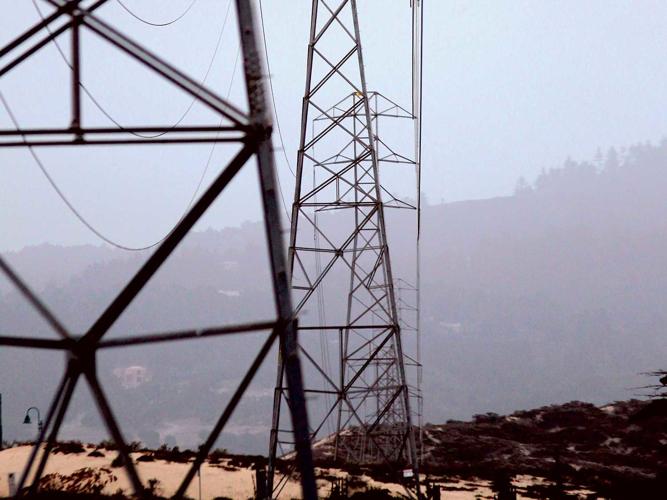
Pacific Gas & Electric still owns and operates the grid, and remains the purveyor of power to Monterey County customers. What’s new is that MBCP is buying wholesale power – in keeping with its carbon-free specifications – then sells it, via PG&E, for some $750,000 a day.
MBCP is buying power from 14 companies all over the West. Ironically, one supplier is PG&E. Others include Shell, Omaha-based Tenaska and Silicon Valley Clean Energy, as well as other CCAs.
In the immediate future, Monterey Bay Community Power is trying to provide reliable power, at rates that are competitive to PG&E’s. (That will come in the form of a 3-percent rebate this December, followed by a 4-percent rebate in 2019.)
While greener and more local projects are likely to make it into the supply mix in the future, for now it’s about keeping the lights on at a fair price in time for a complete July 1 launch.
“People don’t think of buying electricity,” Habashi says. “They think you’re going to build stuff, and you’re going to be kicking the tires. You can’t get that done physically or technically, never mind financially.” For now, he stresses that it’s important to negotiate good rates so MBCP can become a credible and sustainable new player. “It’s all just commodity hedging, that’s it.”
COMMODITY HEDGING DOESN’T FLY AT THE MONTEREY BAY AQUARIUM. As Monterey Bay Community Power was preparing for a March 1 launch for non-residential customers – by far the larger category, about double residential usage – aquarium officials looked at the carbon-free offerings. It was better than PG&E, but they weren’t thrilled about 70-percent reliance on large hydro sources. Dams disrupt river ecology and limit fish mobility. And while large hydropower is free of fossil fuels – MBCP’s base requirement when it comes to procuring energy – it is not defined as “renewable” by California’s standards. (California law requires that 33 percent of power comes from renewable sources by 2020, and 50 percent by 2030.)
So the aquarium asked MBCP for different power sources. With marine life support systems that must run 24/7, they’re a large consumer, using about 10 million kilowatt-hours per year.
MBCP came up with a greener option. It’s called MBprime; for an extra penny per kilowatt-hour, the aquarium gets 100-percent “renewable” energy, a step up from “carbon-free.”
It’s all wind and solar, and huge ecosystem-devastating dams from hydropower are excluded.
“It’s a modest increase over our base power bills, and for what our goals are – to inspire conservation of the oceans – the benefits far outweigh the cost,” says Amy Wolfrum, the aquarium’s California ocean conservation policy manager. “We have the ability as a very large power user to help create this opportunity that is a benefit to us all.”
When MBCP rolls out for residential customers on July 1, all ratepayers have the option to enroll in MBprime for an extra penny per kilowatt hour. (That equates to about $1.50-$3 per bill for the average residential customer.)
Monterey County Supervisor and MBCP board member Jane Parker credits the aquarium for advocating for a greener alternative. “I am excited about the launch of residential service, especially with the option of 100-percent renewable energy,” she says.
Parker expects a high bar when it comes to MBCP’s eco-cred, as well as community involvement – two areas she hopes will benefit from a newly formed community advisory council, which is set to have its first meeting on July 10. (Wolfrum is one of the 11 appointed members of the advisory council.)
“I’ve had concerns that the CEO was slow to respect and embrace community input and participation,” Parker says. “That seems to be improving.”
Benjamin Eichert is director of the Greenpower initiative at the Romero Institute, an interfaith law and policy center based in Santa Cruz. He advocated for a permanent community advisory council, and sees the formation of that council as a sign of MBCP’s success to date. “They’re publicly run; there was a dialogue,” Eichert says. “MBCP is a startup, and if anyone expected it was going to look like everything we wanted on day one, that was an unrealistic expectation.”
Habashi’s focus for now is on price point. He’s skeptical that many customers will opt to join the aquarium and pay an extra penny for MBprime.
“The likelihood of having a mass migration [from cheaper options] is just a big, giant zero,” Habashi says. “It never happened anywhere, even in the most enlightened, environmentally conscious community, when it comes time for the customer to actually pay.”
THE CALIFORNIA LEGISLATURE FIRST AUTHORIZED CCAS IN 2002, but only one, in Marin County, formed in the next nine years. Lawmakers revisited the concept in 2011 with SB 790, laying out more clearly the powers of CCAs, and since then, 12 more have launched. By the end of the year, another six are expected to launch.
One of those is King City, which opted not to join MBCP, and is set to launch its own King City Community Power on July 2. The motivation, City Manager Steve Adams says, was for the tiny city to control its own cost savings; they plan to invest in streetlights, a priority for violence-reduction efforts in King City.
PG&E customers will be automatically enrolled in Monterey Bay Community Power unless they opt out. In the four months since launching for agricultural and commercial customers, under 5 percent, just 176 of some 37,500 customers, have opted out. (It’s free to opt out within 60 days of the transition to MBCP, or it costs $5 to make a change back to PG&E.)
Customers who opt in can expect their first rebate at the end of this calendar year, or they can choose to give back their savings through the MBshare program (which will give the rebate amounts to nonprofits, through the Community Foundation in each county), or the MBgreen+ program, which will go toward local renewable energy projects.
With input from the board and community members, MBCP is getting ahead of Habashi’s plan to stick with lower-cost, large suppliers to start. They’re accepting offers (through Aug. 1) for small generation or power storage projects to be built in the tri-county area, which would generate up to a combined 20 megawatts, about 3 percent of the load at peak times in summer.
Pete Scudder, president of Marina-based roofing and solar company Scudder Roofing, is working up offers for multiple small-scale solar projects, ranging from five to 30 acres, on various parcels throughout the region. “We like to keep the jobs here local,” Scudder says. “Right now, they’re releasing 20 megawatts. If we can make that a success, maybe they’ll release another 20 megawatts.”
Eichert sees the local bidding process as another indicator of early success. “Is the launch on day one everything we hoped for? No. Will it be everything we hoped for in year three or four? Yes. This process showed us [MBCP] is working the way it should be working.”

(0) comments
Welcome to the discussion.
Log In
Keep it Clean. Please avoid obscene, vulgar, lewd, racist or sexually-oriented language.
PLEASE TURN OFF YOUR CAPS LOCK.
Don't Threaten. Threats of harming another person will not be tolerated.
Be Truthful. Don't knowingly lie about anyone or anything.
Be Nice. No racism, sexism or any sort of -ism that is degrading to another person.
Be Proactive. Use the 'Report' link on each comment to let us know of abusive posts.
Share with Us. We'd love to hear eyewitness accounts, the history behind an article.