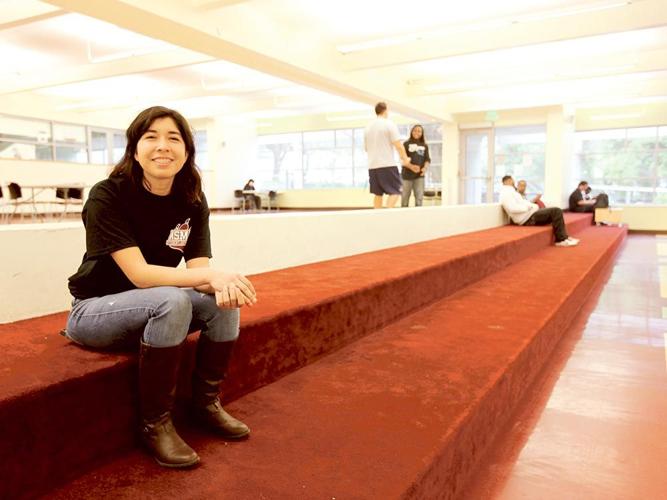

While the national political machine roars, its gears lubricated with hundreds of millions of dollars in campaign contributions, it’s a normal day in the student center at Monterey Peninsula College. Students cram calories at the cafeteria just as they cram information from open books before they hastily scramble to class. The students here on this morning are mostly young, but community colleges are full of students of all ages looking to further skills or advance their education in the most affordable way.
Maria Lopez, a second-year student, may be busier than most of the students around her. She commutes to school an hour every day from Soledad, where she moved last year with her family. On top of a full load of classes, applying to four-year schools, working as a teacher’s assistant at Castroville High School and waiting tables four nights a week at El Torito on Cannery Row, she is also the president of the Associated Students of MPC.
She’s motivated, driven and a bit of an over-achiever. She grew up in Castroville and is of her family’s first generation to go to college. Her mother didn’t get much more than an elementary education before she emigrated from Guadalajara, the second-largest city in Mexico. Her father graduated from high school and after years in real estate found his fortunes change during the Great Recession.
Lopez, who recently turned 20 years old, is conscious of her position in student leadership and is reluctant to take partisan stands on the presidential race.
“I like to see both sides,” she says. “It feels like it’s a big decision, and I want to make sure I make the right choice.”
When asked which candidate sparks her interest the most, she smiles and says, “Bernie.” This falls in line with the majority of millennials – loosely defined as those 35-and-under – whose choice candidate around the country is a 74-year-old democratic socialist from Vermont with a distinctive Brooklyn accent.
When asked why, she says the costs of higher education, health care and the effects of global warming are some the issues she cares about most. While she gets financial aid and scholarships to cover MPC, she’s worried about the loans she’d have to take out at her top choices of CSU Fullerton or UC Davis.
Part of Sanders’ appeal to millennials is that he wants every public university in the United States to be tuition-free. To counter, Democratic frontrunner and former Secretary of State Hillary Clinton has continued President Barack Obama’s pledge to make every community college, MPC included, tuition-free.
Republicans? Their line is, essentially, pick yourself up by your bootstraps, kids.
At MPC’s Lobo Day on Feb. 24, where student clubs and services set up informational tables and interact with students, Lopez set up a ballot box for students to vote for their favorite candidates on both the Democratic and Republican tickets – or Green or Libertarian for that matter – at the ASMPC table.
Santos Gonzalez sits behind the table passing out information on student government as he oversees the improvised ballot box that’s been decorated with colorful markers. The 20-year-old student from Seaside is another Sanders supporter who plans on voting for his first time. He says his main grievance is the cost of tuition.
While making small talk with friends he comments on how most students just look at the ballot box and walk by. But, he adds, he’s been surprised to see some students actually voted for the two Republican frontrunners: the dominating Donald Trump and the pursuing Texas Sen. Ted Cruz.
At the end of the day, when all the votes are tallied up, the informal MPC poll reflects most national polls of college students’ preferences. Sanders comes in first with 58.3 percent, Trump in second with 19.4 percent and Clinton in third with 8.3 percent.
Also reflecting national voting trend: The millennial turnout is staggeringly low.
Of the hundreds of students who walked past the voting table, only 36 students cast a ballot.
~ ~ ~
This year millennials will match the Baby Boomers, those between 52 and 70 years old, as the generation with the largest pool of eligible voters. By 2020 they’re projected to be the largest by a margin of 6 percent. They have also replaced Generation X, 36 – to 51-year-olds, as the largest generation in the U.S. workforce.
It’s a generation born into high healthcare costs, skyrocketing student debt and a more fragmented job market that pushes precarious, gig-based work as opposed to the steady jobs known to previous generations.
But it remains to be seen if this generation will throw its weight around and help shape the results of this year’s presidential, state and local elections.
As demographics shift in the U.S. and non-white people make up a more significant portion of the total population, millennials reflect this change – 43 percent of them are people of color, making it the most diverse generation since demographers and sociologist began making classifications generations ago.
While it’s difficult, if not ill-advised, to lump a single age group made up of diverse people into a series of political postures, the diversity of millennials doesn’t bode well for a Republican Party that has traditionally relied on the white vote.
Identity politics aside, a recent USA Today/Rock the Vote survey found more than 80 percent of millennials surveyed supported background checks for all gun purchases and a transition to renewable energy by 2030. The same study found 76 percent of millennials support requiring police to wear body cameras and 68 percent would like to reduce prison sentences for nonviolent crime.
These positions are more likely to be represented on the Democratic ticket, but it’s still up in the air whether anywhere close to half the millennial electorate will turn out to vote as they did in 2008 and 2012.
In 2012, 67 percent of millennials who voted sided with Obama. Had their vote been a 50-50 split between Obama and Mitt Romney, the Republican likely would have been in the White House the past four years.
~ ~ ~
~ ~ ~
On nights when Monterey High School social studies teacher Alex Petersen brings his class to Monterey City Council meetings, there’s a striking juxtaposition in the council chambers. At the dais we see mostly white faces with graying hair. Looking toward the back of the room there’s a gradient effect of age and ethnicity.
The future appears in the young people of color looking on at the local political process from the back of the audience.
The city of Monterey is demographically older, whiter and wealthier than the countywide average, and elected officials mirror the demographic.
While younger voters are unlikely to vote for presidential candidates, they’re even less likely to participate in local elections, which amplifies the older-whiter-richer influence.
But Petersen, who teaches civics, economics and U.S. history, senses that is changing.
“Some of them are just warming a seat,” he says, “but I’m amazed at the growing number of students becoming engaged.”
While it’s not surprising to see students’ attention grabbed when elected officials discuss medical marijuana, he says, their ears also perk up when the council discusses jobs and economic growth.
“I try to tell them all the time, their voice can be heard loudest at the local level,” Petersen says.
In 2015, a Knight Foundation survey found the midterm election had the lowest voter turnout in 72 years, with only 36.3 percent of eligible voters casting ballots, and only 21.5 percent of millennials participating.
The same Knight Foundation study found that millennials are the age group with the least amount of trust in all levels of government. While 60 percent of voters in the U.S. have trust in local government, only 33 percent of millennials have faith their local governments to do the right thing.
Russell Swartz is a well-spoken 20-year-old who graduated from Monterey High in 2013. While he never went to a council meeting with a class, he did attend a council meeting after students staged a walkout to protest teachers being transferred to Seaside High School.
Since that local political action, his focus has shifted away from local issues. Unlike many of his peers, who overwhelming support Bernie Sanders, he’s inclined to support Hillary Clinton.
“I’m with Hillary. Bernie speaks to the values of people who doesn’t see the nuance of the world, people who don’t see bureaucracy is a necessary evil,” he says. “Change is a slow and incremental process. If you try to change too much too quickly things can easily get worse.”
For a young man still unable to purchase alcohol legally, he approaches his political positions and life choices with a business sensibility. He’s not overly concerned with student debt, saying most economists still believe an education is a good investment in the long run, debt and all. He’s scared of Sanders’ and Trump’s position on free trade, calling them protectionist and isolationist.
After attending MPC for a few years, Swartz dropped out after landing a stable IT job at Language Line Solutions. He sees tech as something different, an arena where skills, not degrees, are how one advances. But in the end he says he’d like to be a writer – probably unaware of the low pay associated with the profession.
Swartz has thought out opinions on a variety of topics: dealing with ISIS, the migration crisis in Europe, climate change and the electoral detail of Super Tuesday on March 1.
He likes living in Monterey, and although he worries about housing costs, he says it’s a well-run place. When asked if he’s interested in local politics he responds: “What, a bunch of incestuous old white men trying to protect their interests? Nobody my age cares about local politics.”
Then he digests what he just said – and changes his mind, agreeing local politics are important. But when asked if he can name the mayor or any city councilmembers of his home city, he says no.
He sighs and self-consciously says, “It’s a staggering shame.”
~ ~ ~
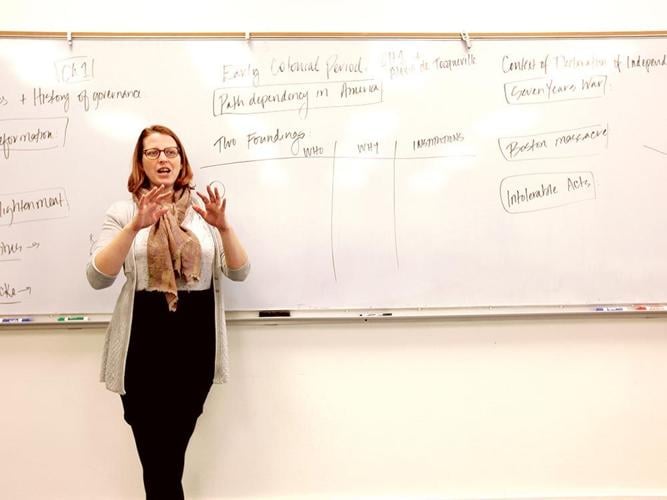
MPC Political Science Department Chair Lauren Handley loves to talk politics. She opens each of her classes with a discussion on the hot-button issues of the day. Sitting in an empty classroom in the social sciences building at MPC, she reveals an acute awareness of the political desires and outlooks of many of her students, as well as their frustrations and, at times, their disenfranchisement.

Lauren Handley, chair of the political science department at Monterey Peninsula College, says a large turnout of millennial voters would be dangerous to the status quo.
“Hardly any of them read newspapers or seek out information independently,” she says. “If it’s not streaming or if it’s not on social media then it’s not on their radar, which makes it especially hard for students to get interested in local politics.”
Born in the 1980s, she is also considered a millennial. Handley likes to say if you can remember the world before a search engine, then you’re not a millennial.
Millennials have been known to be the most socially liberal generation on issues like same-sex marriage and legalization of cannabis, but Handley thinks it’s unfair to pigeonhole millennials to those issues, or even think those issues will motivate millennials to vote.
When she overhears her students discussing politics, the point of their discussion might surprise most.
“My students talk more about the Republican process,” she says. “They’re specifically interested in Donald Trump. That doesn’t mean they support him by any means; I think they just find him entertaining.”
In 2012, Handley found that Ron Paul, the anti-war libertarian candidate on the Republican ticket, was the most discussed candidate. Young voters aren’t all that interested in the status quo, she says, largely because they have no faith in the system.
“Get a degree, get a job, get a home is what they feel is expected of them, but they know they can’t afford to live in Monterey,” she says. “Students here see the vast extremes of wealth every day. That’s why Bernie Sanders is so popular among millennials – he’s speaking to their anxieties.”
Dismayed and frustrated that it’s likely only one in six of her students will vote, Handley fears the soon-to-be largest voting block in the country won’t likely be represented for decades: “They feel their vote won’t make a difference, but I try to tell them all the time that it absolutely does.”
She gives Al Franken’s win for the Minnesota Senate seat in 2008 as an example of how every vote counts, since Franken won by an exceedingly narrow margin, 312 votes to be exact.
While there may be electoral apathy among millennials, the political establishment isn’t particularly worried about it, says Handley.
“Student and millennial engagement is very dangerous for the status quo,” she adds.
~ ~ ~
Elizabeth Hensley, former editor-in-chief of CSU Monterey Bay’s award-winning Otter Realm student newspaper, graduates this year and looks forward to graduate school at an Ivy League school like Brown or Yale. At 29, she didn’t take the traditional route toward a degree. She went from high school to work to community college to CSUMB. (And, full disclosure, she also did a stint as a Weekly intern.)

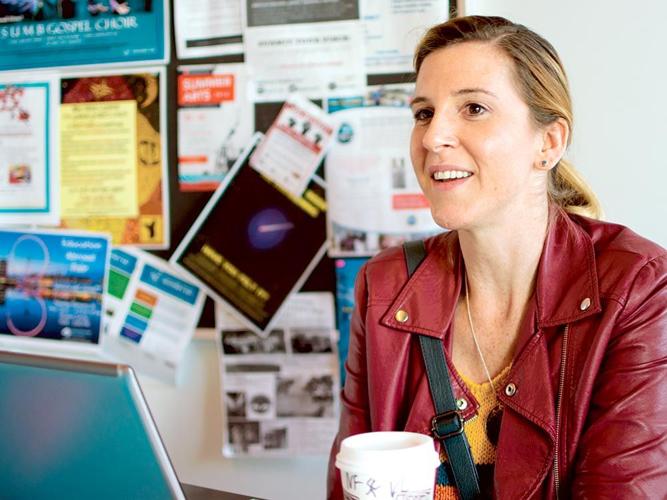
While Elizabeth Hensley has voted in the past two presidential elections and plans to vote this year, she says one person can’t bring about the change she would like to see.
Unlike most of her peers, Hensley will graduate debt-free thanks to financial aid and scholarships.
While she is more politically engaged than most, she also feels jaded by the current political realities the country faces.
“In 2008 there was an electric energy in the air. When Obama won it felt like there would be a new nation,” she says. “But there was such a lack of respect for the president, he never had the power to bring about the progress many expected of him.”
Unlike younger millennials who were unable to vote in 2008 or 2012, Hensley says the lingering disappointment from the victory of her favored candidate has soured her belief that any one candidate is the answer to the challenges the nation faces.
“As millennials, we were brought up to believe that this nation is great, that anything is possible here,” she says. “And many people in our generation have discovered that is not the case.”
Hensley hasn’t committed herself to vote for anyone candidate in the upcoming election, preferring to be cautious of everybody vying for the Oval Office. Her biggest concerns are women’s rights and the chipping away at reproductive freedoms established by Roe v. Wade. She’s also concerned with food security and our collective ability to sustainably feed a global population that will reach 9 billion by 2050.
Hensley is heartened by the rise of Bernie Sanders, that for the first time there’s a candidate in a mainstream party willing to put capitalism in question.
“Voting is important, but we can’t think one person is the answer,” she says. “Change is going to come about in more radical ways.”
~ ~ ~
Some stereotype the youngest voting block as Generation Me or the Peter Pan Generation that refuses to grow up. They see obsessions with selfies and $5 single-origin coffee, a group living with their parents longer, getting married later and not buying houses or starting businesses as have generations past. They observe apathy – a collective stunted-developmental psychology.
But the malaise is more economic than anything else. Baby boomers came of age in a time of low-cost higher education, a highly unionized workforce, manufacturing jobs, higher taxes and significantly less concentrated wealth. Millennials, on the other hand, often start their careers in debt, find insecure contract work and service jobs and face the prospect that homeownership is often out of reach.
“We are truly generation effed,” Hensley laments.
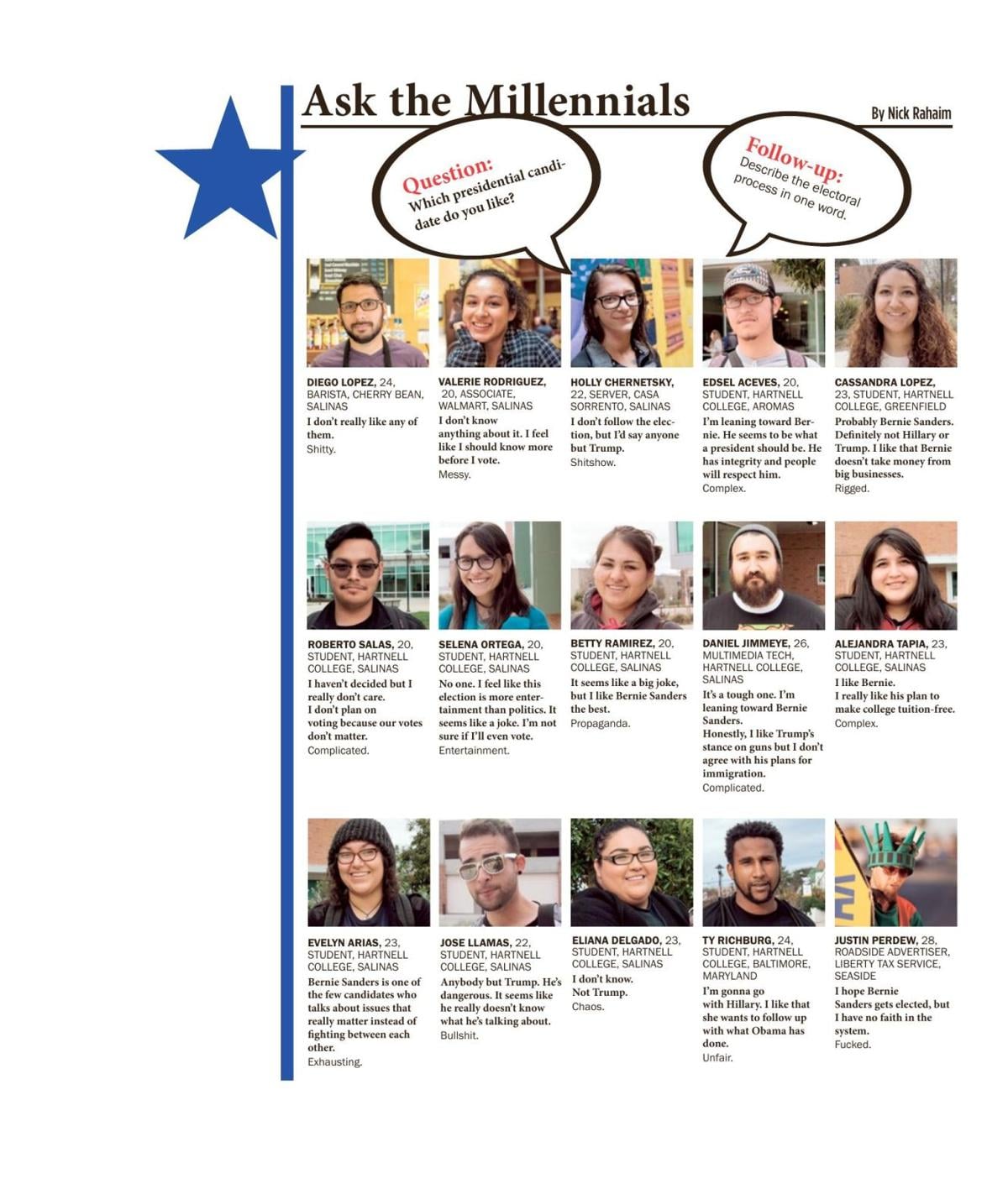
Many millennials echo her sentiment. Most are knowledgeable of the electoral process, yet very few express confidence in it – the words they use to describe it are: “unfair,” “shitty” and “rigged” (see sidebar, this page).
Millennials can swing elections this year. If they don’t it won’t be what many identify as apathy. It will be a matter of disillusionment.
(0) comments
Welcome to the discussion.
Log In
Keep it Clean. Please avoid obscene, vulgar, lewd, racist or sexually-oriented language.
PLEASE TURN OFF YOUR CAPS LOCK.
Don't Threaten. Threats of harming another person will not be tolerated.
Be Truthful. Don't knowingly lie about anyone or anything.
Be Nice. No racism, sexism or any sort of -ism that is degrading to another person.
Be Proactive. Use the 'Report' link on each comment to let us know of abusive posts.
Share with Us. We'd love to hear eyewitness accounts, the history behind an article.