
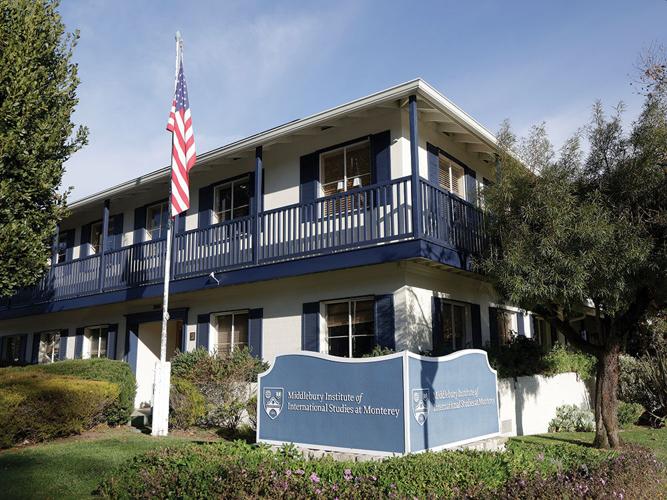

ON JAN. 29, FACULTY, STAFF AND STUDENTS AT THE MIDDLEBURY INSTITUTE OF INTERNATIONAL STUDIES AT MONTEREY gathered for a town hall meeting on campus in downtown Monterey. The focus was on enrollment goals. The graduate school had for years been lagging, and more students (specifically more full-paying students) would be needed to meet financial goals. Five new programs were set to launch, among them translation and interpretation focused on executives and diplomats, which leaders hoped could help boost revenue in the professional graduate school known globally for translation and interpretation, among other things.
The proportion of scholarship-funded students in the Chinese translation and interpretation program had increased to 27 percent in 2024, up from 14 percent in 2019.

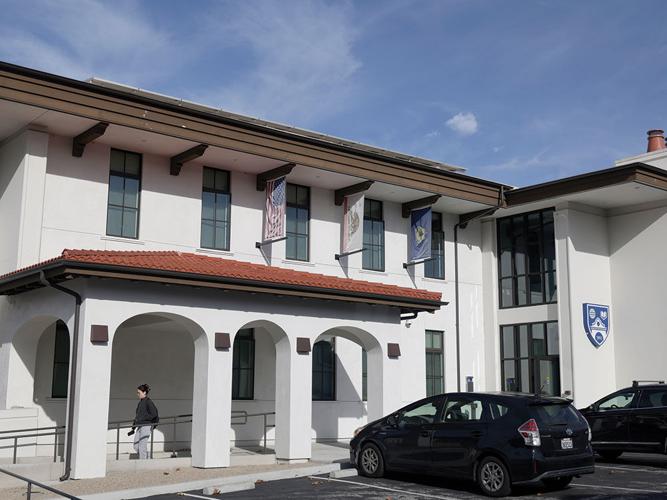
Middlebury converted a 1971 office building into a dormitory for up to 88 students, one of its recruitment efforts. It opened in 2021, the first residences in MIIS history.
Some presenters came from Middlebury, Vermont, where MIIS’ parent, Middlebury College, is located. Middlebury Provost Michelle McCauley was hopeful about boosting enrollment thanks to a new online degree program. “We are trending in the right direction and we are optimistic,” she said.
Several speakers emphasized the shared role everyone plays – faculty, students, alumni – in recruiting new students into the pipeline.
And Middlebury’s interim president at the time, Stephen Snyder, said he was encouraged by the incoming president, Ian Baucom, despite the challenges facing MIIS, Middlebury and higher education more broadly.
“I think we are in good hands,” Snyder said. “He is deeply human and he has already understood Middlebury and all of its parts and has mentioned a number of times how important the institute was to his thinking about where we’re headed.”
FIVE MONTHS LATER, ON JULY 1, HIS FIRST DAY ON THE JOB AS PRESIDENT OF MIDDLEBURY, Baucom shared a video message with the campus community that included his thinking about where they were headed. He spoke about the students, the faculty, the magic of a residential liberal arts college, founded in 1800, and his responsibility in assuming leadership at a 225-year-old institution.
“You’ve helped me see a Middlebury whose history and whose values have prepared us to meet the shifting currents and possibilities of this complex moment,” he said. “That fills me with optimism for our future.”
Baucom committed to quickly addressing the future, specifically Middlebury’s other institutions, including MIIS.
“That question has been left open for too long. It is time to answer it, and we will, within my first year as president if not sooner.”
Six weeks later, on Aug. 18, he and McCauley visited MIIS. In meetings with administrators, they laid out several options for how to answer the question of MIIS in light of financial challenges.
One option was to keep working on a four-year improvement plan that had launched a year earlier, in 2024, with the goal of boosting enrollment and, therefore, revenue. (That plan had been the main subject of the January town hall meeting.)
Option two was to merge certain programs. The third was the nuclear option: shut it all down.
On Aug. 25, students began arriving on campus in Monterey for welcome week, with classes set to begin on Sept. 2. Meanwhile, back in Vermont, the Middlebury board met on Aug. 27 and Baucom recommended option three. The board agreed that the incoming class at MIIS would be its last, and the institute would close in 2027.
The next day, Aug. 28, Baucom flew to Monterey, and announced the plan. The day after that, the first round of layoffs were announced. By then, Baucom was back in Vermont.
MIIS faculty and staff already knew the school was in trouble. Enrollment had been declining for years, and the pandemic didn’t help. But most people did not expect the nuclear option.
“I am surprised it was one of Ian Baucom’s first decisions,” says a senior administrator (and MIIS alum). “I thought there might have been attempts to really truly integrate us.”
In a series of interviews with faculty and staff – many of whom spoke to the Weekly on the condition of anonymity with layoffs coming and job prospects uncertain – they describe frustration building in the 20 years since Middlebury took over MIIS that the two institutions were doomed never to mesh or worse, that they were set up to fail, with unreachable enrollment targets and lacking the support that would have enabled them to meet them.
When it started, the merger with Middlebury saved MIIS from financial trouble. Now that MIIS is in existential crisis mode, some faculty are pursuing negotiations in hopes that another institution takes over where Middlebury leaves off.
“We would like to avoid repeating the mistakes of the past,” says Stephanie Cooper, a professor of French translation and interpretation. “We would like to find an institution that is not private, that is not seeing the school as a way to make a profit – a public higher education institution that has a different philosophy and strategy.”
LIKE MANY MIIS EMPLOYEES, COOPER IS ALSO A MIIS ALUM, who graduated in 1999. And like many of her colleagues, she is also an active practitioner; last year, the French native was one of 64 interpreters hired to work at the Olympics in Paris. (She saw one of her MIIS classmates there interpreting in Spanish, after he worked for years at the White House.)

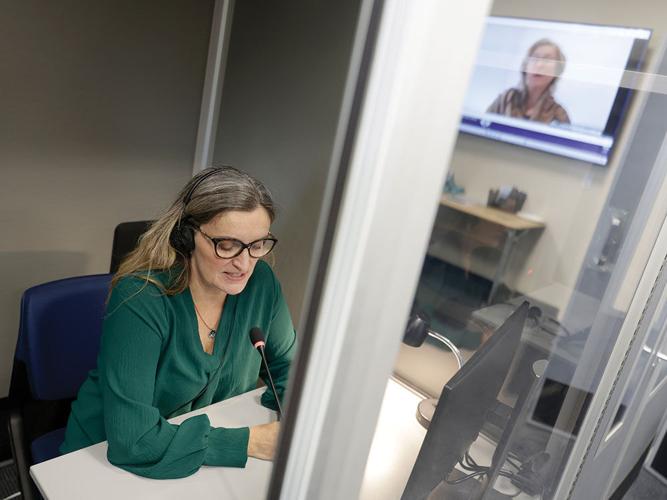
Stephanie Cooper in the simultaneous interpretation lab at MIIS, with 12 booths so up to 12 students can practice at once. They must learn to listen, understand, speak and anticipate all at once. “You need to be able to do a good half-hour, without flinching,” Cooper says.
Graduates have gone on to achieve great careers and interpret for high-stakes diplomatic assignments, including for agencies such as the United Nations, Department of Defense and the World Bank. For Cooper, the value of the program is obvious, but getting enough students to enroll has been an ongoing challenge.
“Sadly, over the last 10 to 15 years, because the classrooms were not full enough, we were gradually but very surely defunded in different ways,” she says.
Many translation and interpretation faculty, like Cooper, have a business interpreting in addition to teaching. “We were very involved in recruiting by default, because we know our market so well,” she says. “Then we were told there’s no more budget for that, even a little visit somewhere.”
Cooper says program faculty also advocated for lowering tuition – perhaps a counter-intuitive strategy when the problem is insufficient revenue – but they thought it would motivate more students to enroll, including students from overseas. (Tuition per semester this academic year is $24,935.)
There was a suggestion from some faculty about charging higher tuition for a business degree. The MBA program started strong, drawing almost 200 students in a cohort in the 1990s, then dwindled and was canceled at the end of the 2019-2020 school year.
When MIIS announced in 2017 that the MBA program would end, a press release noted a decline in enrollment, “a phenomenon experienced at a number of business schools nationally.” (Some at MIIS argue that Middlebury had failed to promote the program effectively.)
The press release struck an optimistic tone for other programs, including translation and interpretation: “The Middlebury Institute will see its third consecutive year of enrollment growth when students arrive next fall.”
That optimism did not hold up, part of a broader trend across institutions of higher education. “Schools are failing, schools are merging, schools are closing,” says Jeff Dayton-Johnson, vice president of academic affairs and dean of MIIS. “Students and parents are questioning whether a degree is worth what it used to be worth.”
The industry chatter is about an impending demographic cliff, when instead of long-sustained growth in prospective college students year after year, there will be fewer high school graduates than there were the year before. Some right-sizing in that landscape, he says, is inevitable.
Still, MIIS leadership, under pressure to increase enrollment, were getting closer to meeting their goals. Then the Covid-19 pandemic came, and the institute never recovered.
“We were close to closing the gap,” Dayton-Johnson says, “but we never got back in the black. The growing pressure on Middlebury College to balance its budget just put more pressure on us.”
HOW AND WHY MIDDLEBURY COLLEGE, A RESIDENTIAL UNDERGRADUATE SCHOOL IN VERMONT, ever came to own a professional graduate program in Monterey, is an earlier story of financial failure. MIIS was grappling with insurmountable debt, and back in the early 2000s, went looking for another institution to take it over.

The dean of MIIS, Jeff Dayton-Johnson, is known by the campus community as “JDJ.” Even as layoffs begin, he is encouraging the public to attend events and participate in campus offerings as much as possible. “I want to make sure we embrace this community we have while we still have it.”
One prospect, according to a retired administrator who spoke to the Weekly on background, was UC Santa Cruz. Talks advanced, but a belt-tightening directive from the UC Chancellor’s Office put that plan on the shelf. Stockton-based University of Pacific, which had experience with acquiring a dental school, expressed interest. There was a pitch to make MIIS into a Chinese institution, but the board decided that was the wrong path.
In various tellings, it’s a series of pretty random coincidences that led MIIS and Midd, as it’s known, to begin talking. A Middlebury alum living in Pebble Beach had served on the boards of both institutions, and knew that MIIS was looking for a savior. He made an introduction.
Administrators began flying back and forth between Monterey and Vermont, sharing a passion for languages and global consciousness. “Quickly there was a sense that wow, our cultures gelled, this is really a good fit,” says the retired administrator. “It just seemed like it made sense.”
Part of the negotiations focused on whether Midd would take on MIIS’ $10 million debt – for MIIS, a deal-breaker. Middlebury agreed, and they inked a deal in 2005. In 2010, they formally became one entity.
But any sign of a real merger was slow. Middlebury made some needed infrastructure improvements – new roofs, painting – and there was an institutional sigh of relief that somebody else had taken on the debt.
“Five years in, the honeymoon had been really good,” the former administrator says.
But budgetary realities started to catch up.
In June 2024, Middlebury Provost McCauley wrote to MIIS staff about “our specific, attainable goals” for 2028. They included increasing student enrollment from 446 at the time to 680 four years later, and reducing the cost of instruction to 40 percent of net tuition – down significantly from 77 percent in 2024.
In May 2025, just before Baucom began, the Middlebury board of trustees wrote an open letter announcing they had just borrowed $45 million to finance current operating deficits. “We cannot do so again, and we must realize a structurally balanced budget,” they wrote.
Cuts were coming.
Middlebury administrators announced $10 million in budget cuts. Eligible employees got an offer for early retirement. The retirement match for Vermont staff went from 15 to 11 percent, which was already the highest match at MIIS.
That did not go over well in Vermont, even though the college had its own deficit of roughly $12 million. MIIS, a much smaller institution, was facing an $8.7 million projected deficit. (As a nonprofit, the institution’s finances are reported publicly only in aggregate to the IRS.)
According to reporting by college newspaper The Middlebury Campus, a group of 300 faculty and students walked out of classrooms to protest the cuts in May. Signs included messages like “Sell Monterey, Midd Profs Deserve Fair Pay.” A group of economics faculty (a dozen of them, dubbed the “Econ 12”) urged the administration to ease budget pressure in Vermont by divesting MIIS.
That message took on new urgency in the face of budget cuts, but it was not new. There had been opposition to Middlebury’s acquisition of MIIS from the very beginning, with faculty in Vermont voting 80-22 to object before the board pursued the deal in 2010, even if that vote was just symbolic.
“There’s no tuition point that would have saved us,” says Scott Webb, associate director of the Center for Advising and Career Services, who is also an alum. “We couldn’t recruit our way out.”
He imagined layoffs or some other dramatic austerity measures would’ve been needed, but he expected some such approach, not all-out closure.
“It would have been nice to have some solidarity from Middlebury to weather this storm together, but their internal politics out there made it impossible,” Webb says.
One senior MIIS administrator explored the tension between the two institutions in a dissertation for a doctorate of education at Johns Hopkins University in 2021.
“In response to economic pressures, colleges and universities may seek mergers with other institutions to strengthen finances or broaden academic programming,” Patricia Szasz wrote. Her dissertation is perhaps a cautionary tale for the future of consolidation in higher ed.
She focused on the Midd-MIIS merger and surveyed people involved. “There was a perception among employees on both campuses of conflicting organizational cultures and an ‘us versus them’ mentality,” she found.
She tried to distill what success would look like from either vantage point. From the Monterey perspective, sheer survival instead of bankruptcy was success. From the Vermont perspective, “The acquisition of a West Coast graduate school appealed as it would create an ‘alternate revenue stream’ for the institution,” according to one respondent. “This expansion was perceived as a means to ‘ensure its long-term competitiveness and survival by broadening out of being exclusively a liberal arts college.’”
Unless and until MIIS was financially sustainable, it would be a drag on Middlebury. Even with investments like a new dorm to provide housing for up to 88 students – a big recruitment incentive – the institute was still a drag.
TWENTY YEARS LATER, THE MIDDLEBURY ACQUISITION IS ENDING catastrophically for MIIS. An ad hoc working group hopes another prospective buyer might go better – if they can find one.
The group convened almost immediately after Baucom’s announcement.
“The bulk of our time has been devoted to collecting information and ideas, including suggestions from students, alumni, friends, staff, and faculty about schools that we might want to approach about a possible interest in taking over MIIS,” Philip Murphy, a professor of policy analytics who is char of the committee, wrote on behalf of the rehoming group in a Nov. 10 email to the campus community.
Faculty are courting prospective buyers, but they are not the negotiators; any deal would be up to Middlebury.
The ad hoc committee has, however, gathered a few key facts. The school’s original $10 million debt remains on the books at Middlebury, and would likely be part of any negotiation.
One unnamed institution has been in discussions with senior leadership, subject to a nondisclosure agreement. And the previous name, before it was changed to the Middlebury Institute in 2015 (Monterey Institute of International Studies), appears not to be trademarked.
Middlebury has been silent so far on what it intends to do with its property holdings – at least 24 parcels assessed at a value of over $40.4 million, according to Monterey County Assessor property records. (A strategic planning process now underway in Vermont includes the possibility of a West Coast undergrad campus.)
“Our top priority has been to see if we can preserve MIIS and its degree programs as a whole, and as an entity that teaches students in person in Monterey,” Murphy wrote. “But we also recognize that this might not be achievable.”
For example, sources say some Chinese institutions have so far expressed interest in translation and interpretation – the closure announcement was covered extensively in Chinese-language media, describing MIIS as “the Harvard of translation.”
Murphy realizes the group is aspirational for now – he says there have been leads, but no prospect that he’d wager offers more than a 10-percent likelihood of success. “We are very serious about trying to keep the whole institute together, buildings and all,” he says. “But that’s of course a pie-in-the-sky thing.”
As the group approaches other institutions, they find that everyone is impacted by the broader trend in higher education making an acquisition unlikely at the moment.
“We’ve carved out a niche in so many really important, crucial areas,” adds Sharad Joshi, a member of the committee and a professor of nonproliferation and terrorism studies. “You go anywhere and say ‘Monterey Institute’ and everybody knows it in international relations. The reach is huge.”
The rehoming group hopes a white knight might see that and, despite the broader trend in higher education, save the institute.
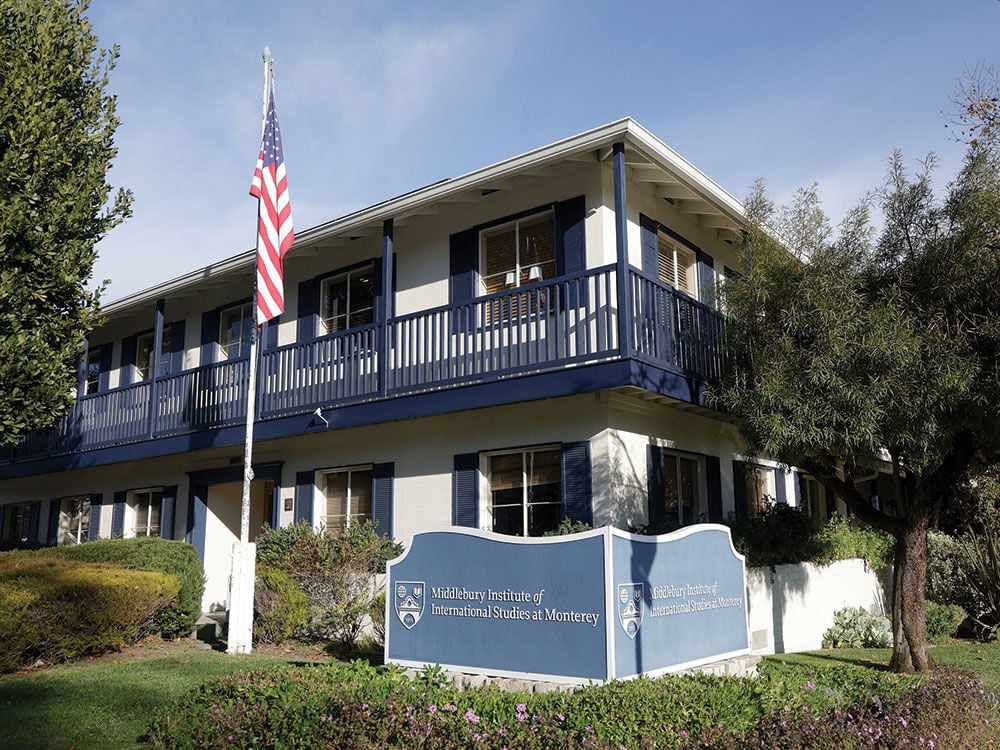
The James Martin Center for Nonproliferation Studies is one of the few programs that is financially self-sustaining and therefore not scheduled to close in 2027.
IF THERE IS SUCCESS IN FINDING A NEW HOME FOR MIIS, MIIS is unlikely to still be the unit it is today. MIIS faculty are not tenured, but serve on contracts of up to seven years; as those contracts end, they will not be renewed. The total workforce of 125 (61 faculty and 63 staff) will be phased out, with the first round of 15 layoffs already announced for Jan. 1.
Some of those staff members are demanding fairness. Some have consulted with attorneys to see if they might have a legal remedy.
When Middlebury last laid off staff at MIIS, they offered two weeks of pay for every year of service. “A lot of us thought if the time comes, at least there’s going to be a decent package,” says one senior administrator. Now, they are offering just $500 per year of service, something they view as a “final indignity.”
Middlebury, meanwhile, is in the midst of a capital campaign, seeking to raise $600 million. As of Dec. 8, they are almost there, reporting over $579 million raised.
GASPARD ETIENNE WEISS WAS BORN IN 1901 AND EDUCATED IN PARIS. After World War II, in 1948, he immigrated to the U.S. and taught at Smith College, University of Massachusetts and Ohio State University, among others. In 1951, he moved to Monterey to teach French at what is today called the Defense Language Institute.
Four years later, in 1955, he founded the Monterey Institute of Foreign Studies. (It was renamed the Monterey Institute of International Studies in 1979. By then, Weiss had already been forced out by people he had helped recruit to serve on the board, faced with a different management style and also suspicion that dogged him for the rest of his life that he was a Nazi sympathizer based on his work for the Vichy government bureaucracy, something he denied.)
The school went on to include a range of specialized master’s programs in international relations subfields. The leadership at its James Martin Center for Nonproliferation Studies essentially invented the field, and has offices in Vienna and Washington, D.C. (The center is one of few MIIS programs that Middlebury is set to keep, as it is financially self-sustaining.)
Degree programs at MIIS today include nonproliferation and terrorism studies; translation, interpretation and localization management; environmental policy and management; threat intelligence; and cybersecurity.
In November, teams from 14 colleges and universities (including a team of four from Middlebury College) traveled to MIIS to participate in the Atlantic Council’s Cyber 9/12 Strategy Challenge, the first time the event was ever held on the West Coast, giving students a chance to try out their cybersecurity skills in a simulation.
“It was a great event, exactly the kind of thing we like to do – experiential, outside the classroom,” Dayton-Johnson says. He was particularly impressed by the Midd students he met, a glimmer of what could’ve been. “I remember thinking as I was talking to them: This could’ve worked. I think it was a great idea, and we showed just last month that it can work.”
It did not work for Middlebury, but maybe it will work for another institution, or maybe not.
And those who are able are already moving on. Cooper’s contract ends in June. She continues her work as an interpreter, and she’s already gotten another job doing written translation for a furniture company that recently expanded to Paris.
“I’m going to miss the students the most,” she says. “It’s kind of a thrill to train the next generation, and then you’re in the booth interpreting with them.”
(0) comments
Welcome to the discussion.
Log In
Keep it Clean. Please avoid obscene, vulgar, lewd, racist or sexually-oriented language.
PLEASE TURN OFF YOUR CAPS LOCK.
Don't Threaten. Threats of harming another person will not be tolerated.
Be Truthful. Don't knowingly lie about anyone or anything.
Be Nice. No racism, sexism or any sort of -ism that is degrading to another person.
Be Proactive. Use the 'Report' link on each comment to let us know of abusive posts.
Share with Us. We'd love to hear eyewitness accounts, the history behind an article.