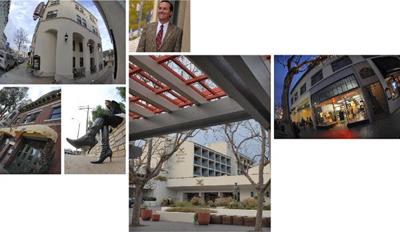
Mayor Chuck Della Sala walks down Franklin Street and stops in front of the landmark Professional Building at the corner of Franklin and Calle Principal. The building is an ornate, five-story structure that looks like an old fortress in the middle of downtown Monterey.
“Beautiful architecture, the Professional Building,” Della Sala says, “and the one across the street.” He points across Calle Principal (which he calls by its local nickname, “Calley P”) toward the building that houses a Subway and Plumes coffee shop. The Osio Plaza, with its 29 affordable apartments, movie theater, retail shops and cafe, sits across Franklin to the north, and the backside of the Monterey Hotel, now under construction, lies to the south. “This will be the new entrance,” he says, pointing toward what will be the front of the renovated hotel. And eventually, Della Sala wants this intersection to be a new entrance to downtown—the center of the city’s renewal.
The mayor has been describing his vision of a completely renewed downtown since last December, through a series of interviews for this article. But today, there has been a tragic turn of events.
Earlier this morning, Della Sala and other city officials held a press conference about the Alvarado Street fire that destroyed a 100-year-old building and shuttered more than 20 small businesses. City officials announced that the blaze did more than $2 million worth of structural damage. The mayor sounds devastated when he talks privately about the loss of so many people’s businesses. But in public, he wears a confident face.
After the press conference, we walk from City Hall past the historic buildings and adobes of Old Monterey, hoping to talk about a vision for a new Monterey. Only it is difficult to talk about downtown’s bright future when dozens of businesses here are sure to suffer huge loses from the fire, financial and otherwise. Della Sala does say that the city’s grant writers have already begun looking for money to help the displaced businesses, and the fire doesn’t seem to have weakened the new mayor’s resolve to revitalize the city’s business districts, and in particular, its downtown core.
Della Sala walks across the street once again to the Monterey Hotel. He says the hotel’s renovation shows what can be done when the city works with local business owners. In addition to building a new facade on Calle Principal and 24 additional hotel rooms, the hotel’s owner plans to build 18 rental units—all priced to be affordable to low-income and middle-income residents—as well as retail space on an empty lot next door.
“All affordable,” Della Sala says, “and that was able to be done because the city of Monterey provided a low-interest loan. It is a partnership between a private party and the City and it will provide affordable homes for the people of Monterey.”
As he continues walking south on Calle Principal, Della Sala passes Montrio Bistro, “the restaurant that once was a fire station,” and the freshly-painted, recently refurbished building next door that houses new office condos.
Across the street, moss grows on the back side of the old Regency Theater, with its broken and boarded-up windows, graffitied walls and dumpsters. The City Council recently approved a mixed-use development plan to build housing and shops here that will front onto Calle Principal. “It will be a huge improvement,” Della Sala says.
“This hasn’t happened overnight,” he points out. “This has been years in the making. But let’s take advantage of this energy. Let’s take a look at the entire picture and let’s improve it. Move in some attractive trees. Pedestrian-scale lighting. Wider sidewalks and less parking here.”
The mayor’s got big plans for this street, the 400 block of Calle Principal. But he’s not stopping here. His vision for revitalization spans downtown, from Pacific Street to Washington Street. It’s an ambitious vision, but Della Sala believes the city has the political will to put this progress in motion.
~ ~ ~
Monterey’s got a reputation for being a city that basically runs itself, and one where nothing really changes. Perhaps this perception comes from the the city’s storied history: Long before the founders signed the Declaration of Independence, Monterey served as the capital of Spanish and Mexican California. In 1849 civic leaders met at Colton Hall and drafted California’s first Constitution—a progressive document in its time that outlawed slavery and was written in both English and Spanish. Today, city residents live and work in Monterey’s historic buildings. Some worship on Sunday in the Royal Presidio Chapel (also called San Carlos Cathedral), founded in 1770 by Father Junipero Serra. The city’s Spanish and Mexican heritage melds with more recent immigrants’ influence—Chinese fishermen who helped make Monterey a successful fishing port in the 1850s, and the Sicilian, Spanish and Portuguese families who followed at the start of the 20th Century. And now, the city’s history meshes with the thoroughly modern—the cafes and trendy restaurants; the hybrid cars driven by city employees; the mixed-use developments like the Osio Plaza, where residents live above a theater and retail shops.
In many respects, Monterey’s seeming complacency signals something good. It means the city’s staff and elected officials are doing a pretty good job running the city—they plan proactively, and they’re not draining money from city coffers or cutting services. Crime rates remain low in Monterey, and its cops and firefighters are well paid.
“There are major things going on all over town,” City Manager Fred Meurer says. “North Fremont Street—we’ve got the new shopping center there. Windows on the Bay. Cannery Row. We’ve had things going on, all the time, but a lot of folks don’t really realize it. There is a great deal of economic investment going on in Monterey right now. I want to believe it’s because folks see a very bright future in Monterey, so they’re investing in that future.”
But Meurer, who has worked as city manager for almost 17 years, says he understands the delicate balancing act between moving forward with new hotels and housing and the like, and preserving the coastline, the open space and the historic character of Monterey.
“We always have to be careful because we have an absolutely unique beauty,” he says. “All you have to do is leave town, go somewhere for a week and come back, and you really appreciate that quality of life we have here. We’ve got to be very careful we don’t destroy that very reason people want to invest here. And it can happen if we’re not watchful.”
~ ~ ~
Even in the wake of last week’s fire, it seems the stars may be aligning for downtown Monterey. Or at least several property owners have jumped through enough legal and bureaucratic hoops to break ground and begin construction.
At the outskirts, on the corner of Camino El Estero and Munras Avenue, the restoration of the Chinese-styled Marsh Building is nearly complete. San Francisco art dealer Jerry Janssen bought the building a year ago from the Catholic Diocese of Monterey, which was planning to demolish it. He’s painted the building, replaced parts of the roof and exterior tiles, landscaped the three interior gardens and will soon open an Asian-art showcase and tea room in the structure, with living space above.
Heading into downtown, on Munras Avenue, exterior construction work on the new Trader Joe’s project will begin on March 1. And last week, the City Council voted to move forward with a plan for a mixed-use project at the city-owned property across the street that was a Valero gas station. Trader Joe’s developer, Foothill Partners (which includes Carl Outzen, the former councilman who built the Osio Plaza, among others), plans to build affordable housing, retail shops and parking on the site.
Back on Calle Principal, Mayor Della Sala says the soon-to-be-built 18 affordable units that are a piece of the Monterey Hotel project earned the City a $200,000 grant from the Transportation Agency of Monterey County (TAMC). “It’s because we have a transient-oriented development,” Della Sala says. “In other words, we’re putting housing near transit. We’re minimizing the use of cars.”
This week, Della Sala will meet with city staff to discuss how and where to spend the grant money. “My hope is that the $200,000 will be spent on Calle P, right here, in this area.”
In Della Sala’s vision of the future, downtown Monterey looks similar to downtown San Luis Obispo or Santa Barbara. It’s got trees, flowers and benches, walkways and public art, outdoor cafes, plazas and gathering places. Downtown becomes a real community center.
“Let’s move away from a vehicular environment and towards a pedestrian environment,” Della Sala says. “Let’s widen some sidewalks. Let’s make them spectacular, maybe with stones or pavers. It must be better and different than the gray sidewalks everyone else has. Let’s move the parking to the periphery, not in the center. If it’s a welcoming environment, people will walk.”
Then, in a manner of speaking, Della Sala moves to East Downtown, an area defined by Del Monte Avenue to the north, Figueroa Street to the west, Camino el Estero to the east and Webster Street to the south. Residential neighborhoods dominate this area. City leaders envision higher density redevelopment in East Downtown, with a limited amount of commercial uses—corner-stores, and some professional offices—mixed in.
“This is the ideal place for housing,” Della Sala says. “Perhaps three-story housing elements, so we would be able to pick up the views and have higher densities. It would serve the downtown businesses. It’s a short walk to the beach, a walk to the Wharf. Three stories would provide views of the lake, views of the bay. You don’t need to use your vehicle if you’re close to services.”
Once Della Sala gets started talking about the City’s plans for downtown, he builds up steam. He usually speaks in a calm, quiet voice, but now he’s talking faster and expanding his vision outwards. “The WAVE Trolley,” he says, referring to the free MST bus that runs from Memorial Day weekend through Labor Day, serving Downtown, Fisherman’s Wharf, Cannery Row and the Monterey Bay Aquarium. “I foresee a time when we will have that trolley running year round.”
Della Sala mentions the City’s plans to open Windows on the Bay further, buying up the Mohr Imports property on Del Monte Avenue—“it is my hope that we will be able to demolish that building before summer”—and, someday, the building that houses Rotor Rooter, although “at this point, there’s no deal,” he says.
In April, the City Council will vote on several traffic-improvement projects intended to eliminate gridlock on Lighthouse and Del Monte avenues. The first project, Della Sala says, would widen Del Monte Avenue between El Estero and Sloat Avenue. “An extra lane on Del Monte,” he explains, “and then, through the tunnel.”
City officials remain committed to building affordable housing for people who work and live in Monterey, he says, and to that end, the City Council recently approved a project to convert 19 apartment buildings on Laine Street into for-sale condos. He says the idea came from the building’s residents: “Five tenants—two are teachers, the others young professionals, who currently reside there—said, ‘We would like to buy these condos.’”
And after nearly three decades of delay, construction has finally begun on the new Cannery Row Hotel, a multi-story waterfront hotel with rooms and retail on both side of Cannery Row.
“As part of the City’s permission to allow the development of that hotel,” Della Sala says, “we requested that the owner provide us with MacAbee Beach, adjacent to the Spindrift Hotel. Right now there’s a chain link fence, but that fence is going to come down and we are going to build a pathway down to the beach, with handicapped access.
“Eventually, when the development is complete, we would like to see a complete promenade all along Cannery Row. If we’re going to allow development on Cannery Row, we’re going to make sure the residents are going to benefit.
“In a nutshell, what I am proposing is that we make Monterey a more pleasant, walkable community.”
~ ~ ~
Kim Cole, a senior planner for the city, sees the future of downtown Monterey. It’s outlined in a proposed set of design guidelines for the area that promote mixed-use. And it looks a lot like the Osio Plaza.
“It’s a reflection of what we have been doing,” she says, “with Osio Plaza, with the construction on the Monterey Hotel, and with the Regency Theater, that new mixed-use project. It’s a realization that maybe we can do this all along Calle Principal.”
The city’s General Plan, approved in 2005, says future development will occur in three core places: Downtown and East Downtown, North Fremont Street, and the Lighthouse Avenue and Wave Street areas.
The 20-year growth plan mandates design guidelines for new development, and, to that end, the City hired Winter & Company to draft a document that outlines what mixed-use projects in the downtown area will look like. The Boulder-based planning and urban design firm has worked with more than 150 communities in 48 states and Canada to develop similar projects.
The City Council will likely vote on the design guidelines by early summer. Between now and then, Cole continues to meet with area residents and business owners and to seek comments on the proposal. Planning Commissioners will vote on a revised document in May.
But as with most development plans on the Peninsula, the fact that there is no long-term water supply—and existing waiting lists for things like a second bathroom—threatens to stunt even the most progressive proposals.
“Water is going to be a stumbling block,” Cole says. “We recognize number one that the water situation does exist. But we also need to be forward-thinking about our vision for our community. Where do we want to see things going?
“It would be interesting one day if we woke up and there is water and we don’t have a plan in place. I think it’s better to be forward thinking than reacting.”
~ ~ ~
In late January, Winter & Company principal Noré Winter gave planning commissioners a first draft of the Downtown and East Downtown design guidelines. He also prepared a slide show for the commissioners and the public, which highlighted some of the goals of mixed-use development: Increased home ownership. Enhanced alternate transportation—buses, pedestrian access, bike paths and the like. More jobs downtown.
Parking structures and lots downtown could be redeveloped as mixed-use buildings, Winter said, and he showed slides that demonstrated what the new structures might look like.
“Right now, if you walk by and there’s only parking, you have to be really intent to continue down that street,” he said. But, if the building included retail on the ground level and office space or residential units above, all of which wrapped around the parking structure, “you energize the street,” he said. “It’s an economic strategy as well as a design element.”
The guidelines also encourage trees, planters and public art, and say new development should “respect and complement” historic landmarks. For example, buildings adjacent to smaller historic adobes should step down in scale, and views from the public right-of-way to such landmarks should be maintained, and not blocked by bulky new buildings.
Commissioners and members of the public held their comments until the meeting’s end, but they nodded in agreement and stared at the projection screen with its bulleted highlights of Winter’s talk, and pretty pictures of downtown buildings, the bay, and examples of other cities’ mixed-use projects.
And then, the water debate surfaced.
“Obviously, we’re going to need water,” said Nelson Vega, a Monterey property manager. “That will probably put this whole plan on hold for 10 years. None of us will probably be around to see these guidelines implemented.”
Eugene Hayden, who sits on the Architectural Review Committee, didn’t seem to mind. “The best preservation tool we have on the Peninsula is a lack of water,” he said. “If we pull the stops off the water, and this was not a limiting factor, would this be a city we want to live in? I’m not sure. I think we can increase density in some of the downtown areas, but maintain the scale that is historic downtown.”
“The city will grow,” countered Planning Commissioner David Stoker. “The world will grow. It will change and if we don’t make plans on how it will change, we will be stuck with change that we don’t want.”
Planning Commission Chair Leon Garden said he’s an optimist. “I’m going to see water available in the city of Monterey to develop the developments we have planned for so long,” he said. “And I’m going to see water available in the city of Monterey to do the kinds of developments we would like to do.”
(0) comments
Welcome to the discussion.
Log In
Keep it Clean. Please avoid obscene, vulgar, lewd, racist or sexually-oriented language.
PLEASE TURN OFF YOUR CAPS LOCK.
Don't Threaten. Threats of harming another person will not be tolerated.
Be Truthful. Don't knowingly lie about anyone or anything.
Be Nice. No racism, sexism or any sort of -ism that is degrading to another person.
Be Proactive. Use the 'Report' link on each comment to let us know of abusive posts.
Share with Us. We'd love to hear eyewitness accounts, the history behind an article.