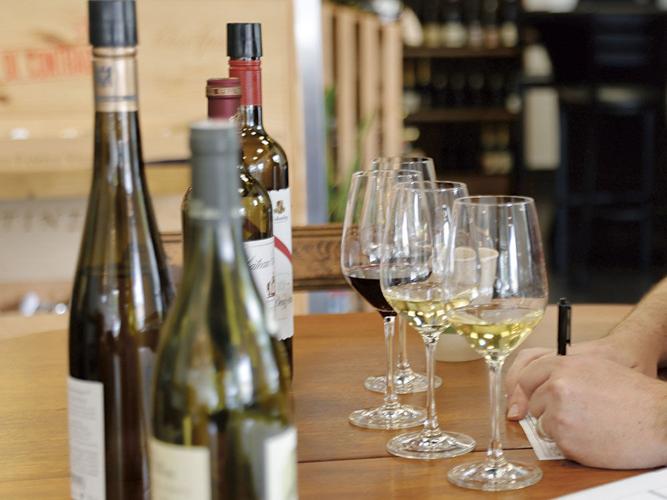


Four stemmed glasses, a paper cup and two bags containing wine bottles wait on a table in an empty Salinas restaurant. It’s a clear, sharp, late-April morning, and Jeffrey Birkemeier settles into a chair and gazes for a moment at the arrangement.
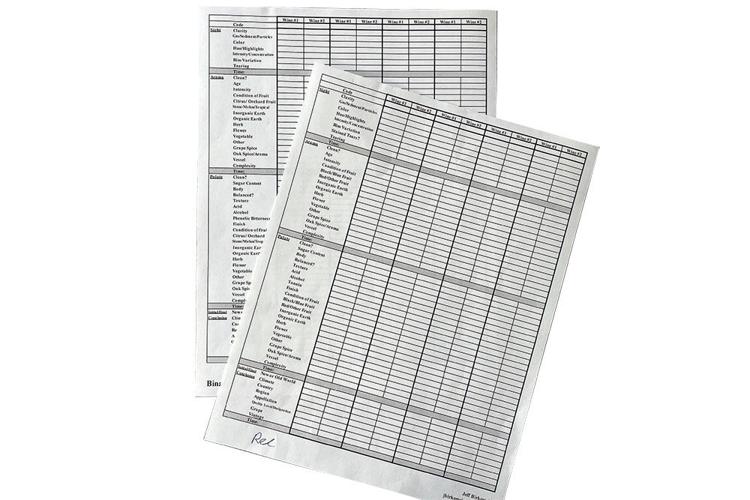
He has a couple of sheets of plain white paper to serve as a neutral backdrop as he checks the color of each wine. There is also a printed chart – a grid in his terminology – on which he can note the finer points of clarity, aroma and flavor.
Birkemeier’s exercise is part of a routine that continues through much of the year. The owner of Amapola Kitchen & Wine Merchant on Gabilan Street already reached the level of advanced sommelier. Before that he became a certified sommelier. He served as beverage director for Casanova in Carmel and wine manager at Pebble Beach’s Stave Wine Cellar before opening his wine-centric restaurant and shop – which is to say he knows quite a bit about the subject.
But there is one goal that continues to elude him.
“Being a great blind taster doesn’t come naturally to me,” he admits with a note of resignation. “It’s the part of the test I’ve never passed.”


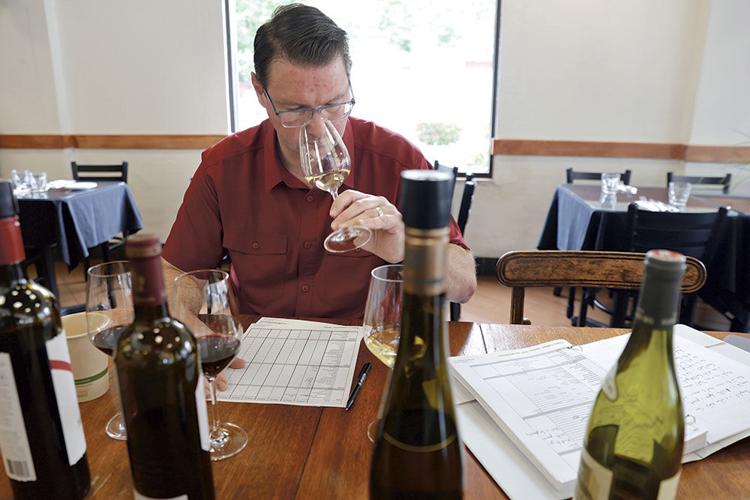
Jeffrey Birkemeier’s preparation for the master sommelier examination involves several different exercises, including flashcards that prompt him to tick off the qualities or particular wines, growing regions and other details. Here he compares a selection of varietals, learning the visual and aromatic clues that distinguish one from another. On a printed grid, Birkemeier notes his impression of such details as the suspected condition of the fruit at harvest, the type of soil the vines grew in and the fermentation process, all culled from sight, smell and taste.
FOR A DECADE, BIRKEMEIER HAS BEEN IN DOGGED PURSUIT OF THE MASTER SOMMELIER TITLE, bestowed by the Court of Master Sommeliers through a grueling evaluation. The Master Sommelier Diploma Examination has a reputation for frustrating the hopes of many a wine expert. On average, only 8 percent of those who attempt to scale all three stages of the exam are accepted into the court – a coveted honor currently held by just 273 people worldwide.
Birkemeier made his first attempt in 2013.
“I got blown out of the water,” he says, recalling the moment when he first entered a hotel conference room in Dallas with naive confidence. “I knew the answers, but I just couldn’t remember.”
He tried again three years later and was back in 2017, when he finally made progress by passing the theory portion of the three-part trial.
As Birkemeier prepared for the 2023 exam, the clock was ticking. Acing theory once again in 2021 gave him three years, by rules of the court, to successfully complete the next two sections, service and tasting.
By April, he felt good about his progress. For months he had been flipping through stacks of flash cards, poring over books such as Message in a Bottle: A Guide for Tasting Wine by master sommelier Tim Glaiser, and challenging his palate. And he still had three months before traveling to Houston for the test.
“It’s a year-round process,” he says of studying. “Post exam is a recovery, but you have to get right back into it.”
The examination probes a person’s depth of knowledge, their ability to think quickly and show poise under pressure and, of course, the dexterity of their palate.
A test of theoretical familiarity comes first – a verbal exchange of 100 questions in 50 minutes, covering anything from laws governing alcoholic beverages in different countries to the growing conditions favored by grape varieties to methods of distillation. The topics venture from wine to include spirits, beer and cider.
“There’s nothing in the world but you and the wine.”
Passing this portion of the exam moves hopefuls to the next steps – service and tasting. During the former, they tend to a table of masters who lob real-life scenarios: Which wine pairs with grilled swordfish in an apricot glaze? I like dry reds but my partner prefers sweet whites, what is a good compromise? Hey, your waiter brought the wrong wine, what kind of joint are you running here? At the same time, they scrutinize your choice of stemware, the way you pour and other technical details.
Birkemeier has passed both theory and service in previous attempts. But Covid-19 suspended operations for 2020, and Birkemeier was forced to start over, taking theory again in 2021 to reset the clock.
“It’s taken longer than I expected, but the process rewards resilience,” he explains. “I’m kind of stubborn.”
THIS ISN’T A STORY WITH A HAPPY ENDING – not just yet. In September at The Post Oak Hotel in Houston, Birkemeier again fell below the required 75 percent in both service and tasting.
He now finds himself in a familiar place, where “almost” exists in its most tangible form, both within and beyond one’s grasp. But he also remains resolute in his quest.
“One year I was really torn up about it,” Birkemeier admits. “This year – I don’t feel devastated. It almost seems inevitable that I’d get to this point.”
Few candidates pass all three parts of the master sommelier exam on their first try. Three or more is the norm, although many give up after a few attempts. It can be a costly endeavor, with travel to distant cities like Houston or St. Louis, and the schedule of fees. Although there are scholarships available (and Birkemeier has earned assistance in the past), each step of the test comes with an entry fee of close to $1,000.
Cost is one of the reasons a Court of Master Sommeliers Americas was created, thanks in part to the influence of Ted Balestreri of the Sardine Factory in Monterey. Before the late 1980s, candidates from the U.S. had to travel overseas for the exam.
“I said, ‘We can’t afford to send people to London,’” Balestreri recalls. “My dream was for all the fine dining restaurants in the U.S. to have a master sommelier, but I can’t live long enough for enough of them to pass.”
The men and women who attempt the test are already accomplished, having reached level three – Advanced Sommelier – to become eligible. Failure can be difficult to accept, and most of them fail.
“Some of the angriest people I’ve met are people who have failed the test,” says Chris Miller of Seabold Cellars winery, who earned the Master Sommelier title in 2012. “It’s very difficult on people.”
When Miller passed the master sommelier exam in Dallas, he was the beverage director at a restaurant with two Michelin stars. Every day involved tasting, serving, learning the wine regions and strengths or weaknesses of each vintage.
In other words, his job essentially was practice for the test. Even so, Miller failed on his first attempt.
“You have to have a very good day – that’s the unfortunate part,” the winemaker points out. “You have to be really on it.”
Tasting has been Birkemeier’s nemesis throughout the process.
The test is a blind tasting of six wines, three reds and three whites. In the 25 minutes of total time allotted – or about four minutes for each wine – master sommelier hopefuls must ascertain almost 50 impressions about each one before coming to a conclusion on which of the world’s countless wines they are sipping.
Keep in mind that wine is an elusive target. Winemakers fuss over their product, playing with different barrels and techniques. The flavors of a varietal from one vineyard can change year to year, depending upon the weather. And there are about 65,000 wineries around the world.
It’s a lot to keep track of.
“The test throws you curveballs,” Birkemeier says. “I’ve seen so many really great sommeliers not pass this test. I’ve seen people younger than me flame out.”
When he last missed the cut on tasting in 2019, Birkemeier learned that he correctly identified the reds, but whiffed on the three whites. So in preparation for the 2023 exam, he relied on the grid.
The grid is a sheet of paper divided into four categories. The first three are sight, aroma and palate, each subdivided into eight to 22 line items that clarify such details as color variation around the rim, whether or not the vines grew in organic soil, condition of the fruit at harvest, as well as points of bouquet and flavor.
A final category nails down the candidate’s conclusion. Before the judges, they must state the varietal, the vintage, the origin of the wine, right down to its narrow appellation, or growing region, and the climate that particular year.
In the past, Birkemeier would spend day after day preparing for the exam by tasting blindly, essentially replicating test conditions – a logical approach, but one with a flaw.
“I’ve seen people younger than me flame out.”
“What it doesn’t get you is a deliberate look at the wine itself,” he points out. Birkemeier discovered that in such a setting, he tended to focus on visual, aromatic and flavor cues. What he overlooked was the need to understand characteristics common to the varietal and its terroir. So, he adds, “getting it wrong doesn’t help you get it right the next time.”

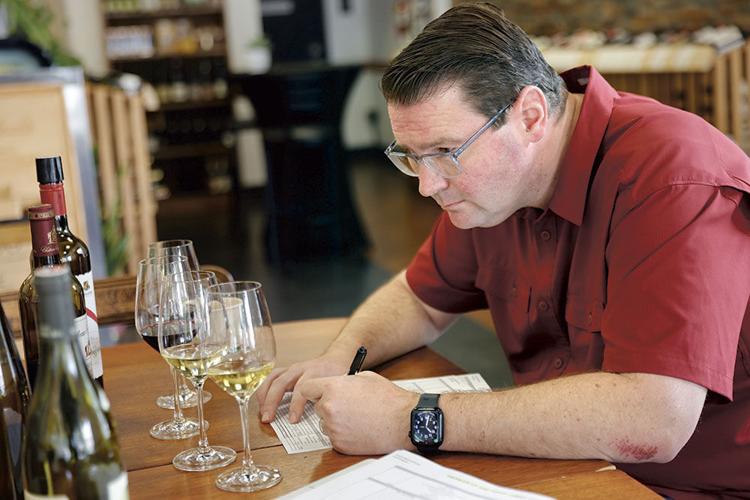
Throughout the year, Birkemeier takes a few minutes during a day to test his palate. Here he takes notes on the grid, a paper that helps dissect and define a wine.
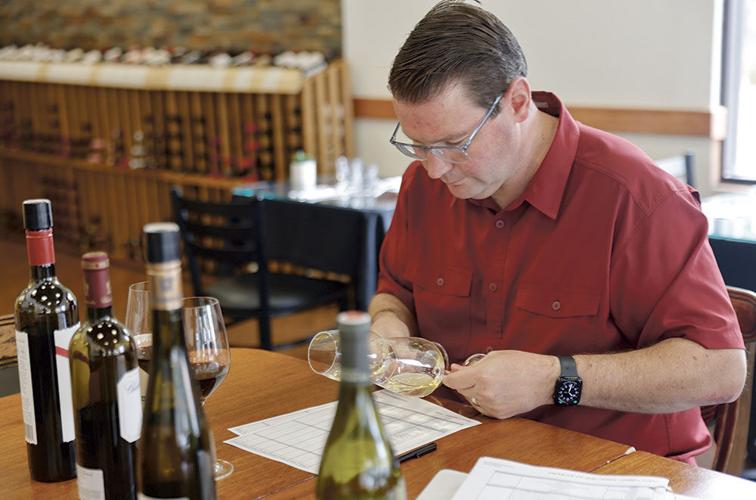
SITTING AT A TABLE IN THE AMAPOLA DINING ROOM a few hours before the restaurant opens for lunch on that April morning, Birkemeier is intent on four wines, turning to the whites first. One is a Chardonnay from France, the other an Australian Riesling. Birkemeier compares them against the white background of paper. A thin ring of bubbles indicates that one is probably from a screw top bottle. An almost imperceptible lime green hue on the fringe of the other suggests a young wine, perhaps new world in origin.
There is a reason for everything perceived in a wine. As one progresses, it becomes possible to catch the impressions left by growth in organic soil or the techniques used by a particular winemaker.
“This was aged in a barrel,” Birkemeier observes, holding a red wine against the white paper. “Not the usual barrel, but a big vat,” noting by the color how little contact the juice had with wood.
He refers to this side-by-side tasting as a binary comparison, using this approach as he studied almost daily through the spring months. At the end of June he brings out an aroma kit full of tiny glass vessels, each releasing a different scent. There are 54 scents in the kit, and Birkemeier has been known to rummage through craft stores for candle-making kits with aromas that are not packed inside Le Nez Du Vin – not ideal, he adds, because “they stink up the house.”
On this morning he is nitpicking the differences between Chablis and Albariño. As he leans toward a vial, he notes “If you have a Chablis with new oak, you might get some toast.”
The grid is a safety net, forcing those studying for the exam to consider visual, aromatic and flavor cues – quickly – before making a firm decision. There’s a risk if you jump to a conclusion too soon on, say, the flavor profile, that you start to paint a picture that’s not really there. So the grid aids in refinement.
“You begin to lock in what those wines are,” Birkemeier says.
Turning to the grid, he goes into meticulous detail, in this case with a Pinot Noir in hand. The wine is ruby in color, with highlights ranging from garnet to pink. The flavors are developing toward full maturity, with a range of fruit showing, but also notes of limestone, mushrooms, potting soil, floral tinges and curious notations of rhubarb and beet. An impression of vanilla and spice tells of time in neutral oak, with some new staves. And clearly it was cool in the Cote d’Or that year.
“We do everything to take the fun out of wine,” Birkemeier says with a laugh. “But when you’re on a flow, that’s fun. There’s nothing in the world but you and the wine.”
WHEN HE BECAME A WINEMAKER, Miller was able to let go of some of the minutiae demanded of a master sommelier. “There are a lot of sacrifices,” he points out. “You have to study a lot of things you don’t really want on your brain, unless you’re a masochist.”
The Master Sommelier Diploma Examination and Court of Master Sommeliers are relatively new creations, with the first exam taking place in England in 1969. The court dates to 1977, formed as a governing body for the test and to uphold the stature of the title.
Both quickly gained acceptance rising to the level of reverence.
“It’s a weird thing – a very difficult, prestigious exam that matters only for a small number of people,” Miller observes. “But it resonates; it’s taken on an elusiveness.”
Just four masters or former members of the court are associated with Monterey County. Miller is the only one still active in the area. Seabold Cellars operates a tasting room in Carmel Valley and has vineyards in the county, although its main facility is in Hollister. Jim Rollston now works at a restaurant in Woodside, but once handled wine service for Casanova and The Lodge at Pebble Beach.
Alpana Singh dropped out of Monterey Peninsula College when she got the wine bug, taking a job at Nielsen Bros. Market in Carmel. But she gained fame at a series of Chicago restaurants – and when she renounced her master sommelier status three years ago when reports of sexual harassment within the court surfaced.
Best known is Monterey native Fred Dame. The first person ever to pass all three portions of the exam on the first attempt, he was featured in the popular documentary series Somm. A 2008 story in the Weekly spoke of his legendary nose, able to determine a varietal and vintage by its bouquet alone.
“Some of the angriest people I’ve met are people who have failed the test.”
Dame helped establish the Court of Master Sommelier America, with jurisdiction over the examination in the U.S. and other countries in the hemisphere. At the behest of Balestreri, he also put together the first master sommelier exam administered in the U.S., which was hosted at the Sardine Factory in 1986, where Dame served as wine director.
The event was a stark reminder of the test’s difficulties. One person passed. Dozens buckled in tears.
“It was a disaster,” Balestreri says, thinking back to that day and the humiliated expressions of those who missed the cut. “I thought, ‘This is the worst thing I’ve ever done in my life.’”
Balestreri reminisces with mixed emotions. At the time, he observes, American wines were consigned to the back of the menu at fine dining restaurants. But at the Sardine Factory, they were assembling a selection of American labels, with particular pride in California wines – right alongside with European names. It was crucial to develop a class of experts.
In 1968, when the restaurant opened, liquor made up 90 percent of beverage sales. But demand has changed dramatically since. Today, wine accounts for around 75 percent at the Sardine Factory.
“I’m sad and I’m proud,” Balestreri says of that historic first, still lingering on the disappointment in the room, but recognizing the significance of the event. “It launched a thousand ships.”
Dame went on to work with several California wineries. But his name was removed from the court, along with several other masters, following allegations of sexual harassment in 2020 and the conclusion of a third-party, non-criminal investigation into the matter.
(The Weekly reached out, but could not locate Dame by deadline.)
There has been one other serious blow to the court’s reputation. In 2018 an unprecedented 24 candidates passed the exam, held at the Four Seasons in St. Louis, earning master sommelier honors – temporarily. It soon came out that a proctor for the event, master sommelier Reggie Narito, had tipped a few of the candidates off as to the identity of two wines included in the blind tasting. Twenty-three of the new masters had their titles stripped, although the court is allowing them to retake the exam.
Narito was dismissed from the court.
Birkemeier took part in the St. Louis test. He was unaffected by the scandal, but it was particularly difficult. He is originally from the city and had family duties in addition to the demands of the test. Yet he sailed through the service portion, only to be foiled again by the blind tasting.

The grid for studying red wines (foreground) and white wines. Birkemeier says it can take time to become comfortable with the grid.
ON SEPT. 5 IN HOUSTON, Birkemeier was summoned to a conference room of The Post Oak Hotel, where he learned the outcome of his efforts studying for the 2023 exam. Of the 34 wine professionals who made the attempt, only Jonathan Eichholz of New York and Mark Guillaudeu from Phoenix passed, accepting the title of Master Sommelier and the coveted red lapel pin that goes with it, as well as the prestige and potential for increased income.
The Salinas restaurateur has come to expect the result. But he is not giving up. Instead, he is returning to the routine of practice and study with renewed vigor – to the flashcards, the books, the grid, and maybe adding new techniques.
“Analytically there’s something else I have to do,” he says. “I have to figure out what that is.”
For Birkemeier, the exam has become a journey. But the clock is counting down. If he doesn’t pass both the service and tasting portions in 2024, the timer resets to zero.
If that happens, he will reevaluate whether pursuit of the master sommelier title is worth the sacrifice. For the next many months, however, he is striking ahead, undaunted.
Having the designation MS after one’s name brings opportunities – book deals, consulting gigs, a higher paycheck. Birkemeier began the journey knowing this. After a decade, however, money is not the motivation.
“I set the challenge for myself and I’ve been chasing it ever since,” he explains. “It’s made me a better person. If I don’t become a master, at least I can say I gave it everything I had.”
(0) comments
Welcome to the discussion.
Log In
Keep it Clean. Please avoid obscene, vulgar, lewd, racist or sexually-oriented language.
PLEASE TURN OFF YOUR CAPS LOCK.
Don't Threaten. Threats of harming another person will not be tolerated.
Be Truthful. Don't knowingly lie about anyone or anything.
Be Nice. No racism, sexism or any sort of -ism that is degrading to another person.
Be Proactive. Use the 'Report' link on each comment to let us know of abusive posts.
Share with Us. We'd love to hear eyewitness accounts, the history behind an article.