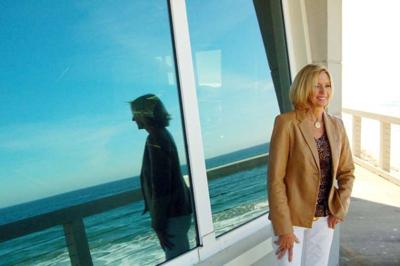
Dr. Marcia McNutt has trained in underwater explosives with the Navy, studied nuclear physics and run what may be the world’s most sophisticated oceanic research institute at Moss Landing’s MBARI. But her latest gig makes those demands look casual (and makes it hard to retreat to her Corral de Tierra home): She was appointed by President Barack Obama to helm the $1 billion-budget U.S. Geological Service, whose charge is to manage science confronting everything from volcanoes, earthquakes and climate change to wildfires, avian influenza and invasive species.
The Weekly spoke with McNutt as she headed to Copenhagen for the United Nations Climate Change Conference.
Q What’s the best thing that can come out of Copenhagen?
A We have opportunities for carbon sequestration on federal lands. The role my agency would play is as the organ that would do the science basis—in geology and biological forms, and the monitoring and follow-up inventory of how it worked. Quite a bit translates to international efforts. USGS is in charge of Landsat, a powerful program using a satellite that does multispectral imaging. Scientists can use algorithms to take that data and convert it to how much carbon is contained in the forest and the canopy and different kinds of land use.
Q What would surprise people most about how much USGS does?
A All my years at MBARI, it was easy to comprehend how much oceans were paying the price for our bad energy policies—absorbing 1 million metric tons of CO2 an hour. As oceanographers, there wasn’t much we were able to do about that: The real solutions lay on the land side. USGS has authority in assessing key reserves and carbon sequestration, doing climate science, increasing forests, soils and grasslands. Therein lie the opportunities.
Q What might surprise locals about the climate change front?
A I think they’d be surprised how often the policies and ways of doing things, that have been in practice a long time in California, are held up as models here—for example, the way the state has increased its population with negligible increase in water use.
Q What’s been the most surreal shift, personally or professionally, in your move to D.C.?
A No surprise: how lousy the weather is. Also no surprise: going to work for the president is basically a 24/7 job. You have to use all the resources at your disposal. There are an awful lot of good people working here. Have you ever seen the Buddha with many, many arms? Sometimes I sort of feel like one of the statues, with people firing a lot of balls at me, and I want to get them handed off to the right experts.
Q Does it scare you that science has almost become politicized?
A Now that I’m in Washington, it’s easy to see how even well-meaning people being super vigilant can make very small mistakes and be seen as politicizing science. All scientists think they’re just looking at evidence and drawing conclusions, but they’re human beings—they feel passionate about some part of science, so a little part of them loses objectivity. That’s why I never completely trust the objectivity of a scientist unless he or she changed his mind—from climate change skeptic or vice versa. We design our experiments with lots of oversight and peer review to make sure no bias sneaks into science.
(0) comments
Welcome to the discussion.
Log In
Keep it Clean. Please avoid obscene, vulgar, lewd, racist or sexually-oriented language.
PLEASE TURN OFF YOUR CAPS LOCK.
Don't Threaten. Threats of harming another person will not be tolerated.
Be Truthful. Don't knowingly lie about anyone or anything.
Be Nice. No racism, sexism or any sort of -ism that is degrading to another person.
Be Proactive. Use the 'Report' link on each comment to let us know of abusive posts.
Share with Us. We'd love to hear eyewitness accounts, the history behind an article.