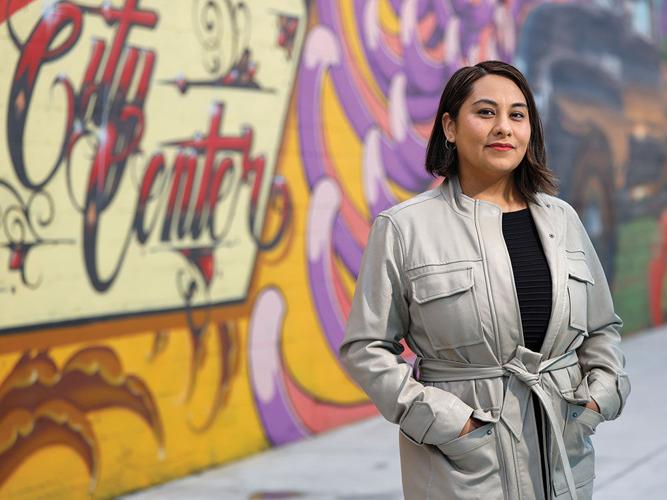

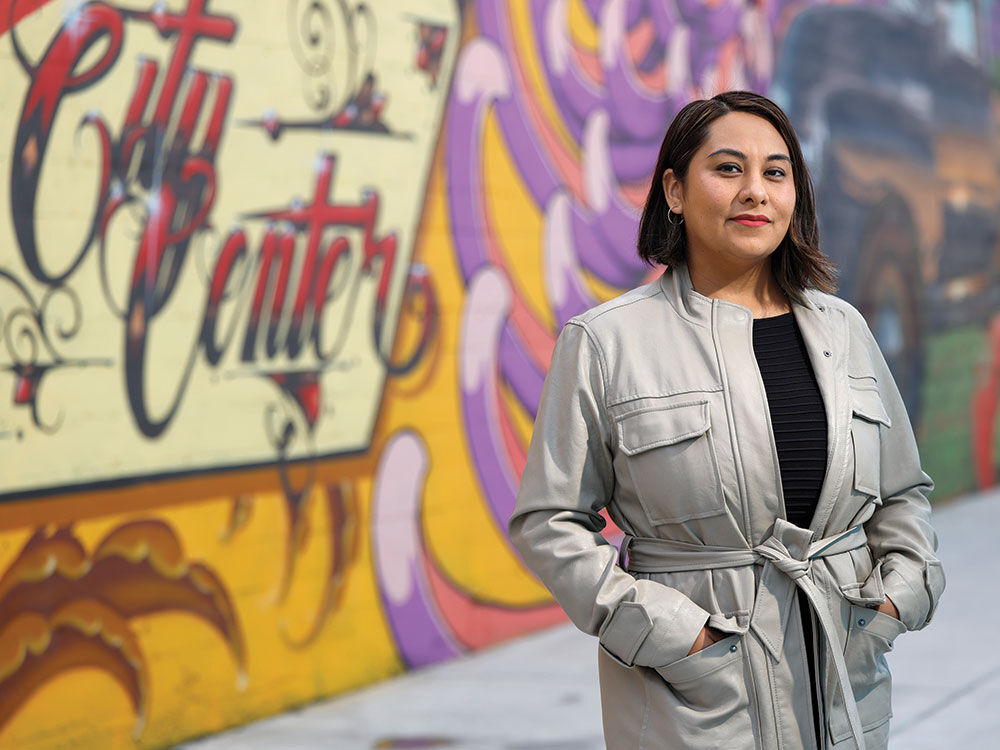
Sandy Santos, above, was a reporter/anchor/journalist of many hats at Telemundo 23 until it closed in 2025. She focused on South County, which has a large Latino and Indigenous population. Even when the station had a local newsroom, she says, “I don’t feel that we had enough coverage.”
LESS THAN SIX MONTHS AFTER KION-TELEMUNDO 23 ABRUPTLY CLOSED ITS LOCAL NEWSROOM, Telemundo 23’s Facebook page still shows an image of Sandy Santos, Telemundo’s journalist, behind the news desk, with a backdrop showing the Salinas downtown arch.
The last post is a goodbye from Santos thanking viewers. “Today marks the end of a chapter in the life of our local channel, in our Spanish-language news coverage for the Monterey-Salinas region,” Santos said in Spanish, signaling the turning off of another Spanish news outlet in the region on Sept. 25, 2025.
Tuesday morning, Sept. 23, had started out like a normal day at KION-Telemundo 23. Reporters started their shifts by grabbing a cup of coffee, checking in with sources and preparing a list of pitches for the news meeting, while others were getting ready to be on the road chasing a story. During the meeting, they all learned they were being fired – the local newsroom was closing.
Over recent years, the number of English- and Spanish-language journalists across TV, radio and print has decreased significantly.
According to a 2023 Pew Research Center study, Latino immigrants are most likely to watch news in Spanish, 41 percent, while only 2 percent of U.S.-born Latinos watch the news in Spanish. In Monterey County, about 55 percent of the population speaks a language other than English at home, with Spanish being the most common.
“Newsrooms are getting smaller and smaller and smaller, and at the same time, one person is doing more tasks than having two or three people doing that job,” says Santos, who was a reporter, producer and anchor at Telemundo 23.
Santos also wrote stories for the website, translated and dubbed audio in English for the sister station as well. The newscast team was two full-time positions compared to 15.5 for its English counterpart, KION. The advantage of having two newscasts is that they can share information and expand local coverage; although other times, the small Spanish team pushed through to get enough content for their newscast. “We didn’t really have enough resources in the Spanish portion,” Santos says.
Journalists and reporters for Spanish media must have proficiency in both English and Spanish, something that isn’t necessarily required in English-only media. Santos and other former TV talent have mentioned their workload was higher, but their pay was lower than that of their KION counterparts, with gaps of up to $20,000.
According to research conducted in 2019 by Fundamedios, a nonprofit based in Ecuador and the U.S. that monitors, promotes and fights for freedom of expression, Latinos experience lower salaries and inferior working conditions.
Erandi Garcia Escareño, who worked at Univision 67 in Monterey, El Sol de Salinas and Telemundo 48 in the Bay Area, says expectations for reporters in Spanish are higher and must perform several tasks at the same time. During her time at Univision, she anchored the 6pm newscast and was the news director.
Before Covid, the country had an estimated 624 Latino news media outlets, 91 of them were in California. Last year, Univision left Portland and Telemundo left the Central Coast, leaving tens of thousands of people with less access to news in Spanish.
SPANISH-LANGUAGE NEWS not just on TV but also in print and on the radio has dwindled. Growing up, Santos says watching the news was part of her family’s daily routine. She remembers newspapers such as La Bamba and El Sol de Salinas, a weekly newspaper published by the Salinas Californian, folding.
Currently, local written content in Spanish is sporadically published on Monterey County Now and Voices of Monterey Bay, a bilingual online outlet.
Delia Saldivar is Radio Bilingüe’s regional manager. She has been in Monterey County since the ’80s and she says Spanish-language news coverage has shrunk over the years, noting Univision used to have a weekend edition. (Old photos show a team of at least seven people including producers, reporters and anchors at Univision.)
“They just keep one reporter that covers five minutes of news per day,” Saldivar says. “It has a big impact, because people are getting the information from social media, and sometimes that information is not accurate.”
Last year, a raid on a Pajaro cannabis farm caused fear and chaos among the immigrant population, after videos and photos of law enforcement in North County fields circulated on social media. Many people thought it was a federal immigration-related crackdown.
Escareño says the station had a staff of nine people when she started in the 2000s; a similar number remained in 2015 after Univision closed its sister station in Santa Maria (in Santa Barbara County). Univision 67, now called Univision Costa Central, expanded its coverage from Santa Cruz to Santa Barbara and had at least one local reporter in that region. In 2023, Telemundo 23 consolidated and expanded its coverage to Ventura County.
Eventually, in 2017, most decision-making and production for Univision 67 were moved to El Paso, Texas and eventually to San Diego. San Diego manages and produces newscasts in a region including Palm Springs, the Central Coast and Yuma-El Centro in Arizona. All reporters turned into “multimedia journalists,” meaning instead of a two-person team doing the work, each journalist is a one-person band from start to finish: gathering information, writing the script, editing the video, doing promos and posting it online.
The 6pm and 11pm newscasts are aired in five counties: Santa Barbara, San Luis Obispo, Monterey, Santa Cruz and San Benito.
In 2017, Univision Costa Central, which is operated by Entravision (the largest Univision affiliate), had three multimedia journalists covering the entire region. In 2018, that number went down to two, focusing on the tri-county area. During the pandemic, it was cut to one. (Editor’s note: This reporter worked at Univision Costa Central from June 2019-April 2020.)
Today, Adriana Frederick Sutton is the only reporter in the field covering the tri-county area for Univision Costa Central. In 2023, Univision added a local producer, Bernardo Romero.
The newscast is prerecorded in San Diego and then aired at 6pm and 11pm (it is prerecorded before each airing time), a practice Escareño says can be detrimental. “The news changes by the minute. If there’s a developing story [and] you’re pre-recording something, you’re not going to have the most updated information,” she says.
“I think Adriana does a great job with the limited resources that she has,” Escareño adds.
Carlos Tamez, Univision’s news director, says Entravision has adapted to audience preferences and it has expanded its digital presence, launching 27 local news websites. Tamez also recognizes its shortcomings: “No digital strategy can replace the value of field reporting.”
Representatives from Telemundo did not respond to a request for comment.
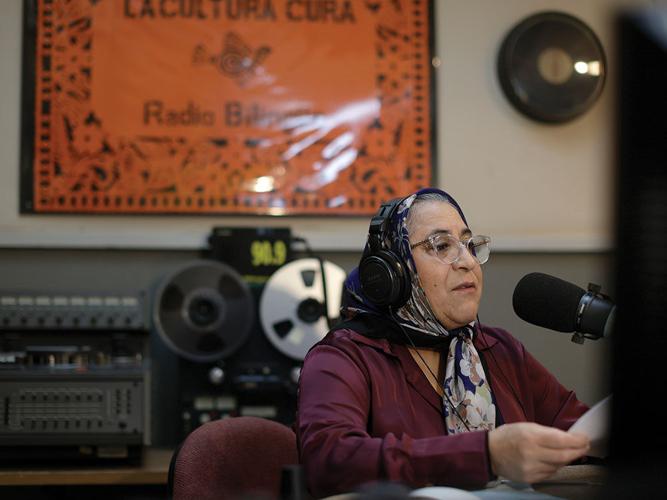
IN MONTEREY COUNTY, there is no dedicated local radio newscast in Spanish. Saldivar says it’s expensive to produce a news show, noting the local station has only four workers, one of them part-time, and they rely on volunteers to create content that airs on KHDC (90.9 FM).

Delia Saldivar at the Salinas station of Radio Bilingüe where she is a host of the program Comunidad Alerta.
Instead, they focus on public affairs shows, inviting local nonprofit, government and grassroots leaders to talk about current issues including health, immigration, civic engagement and more. Locally, this program is called Comunidad Alerta, or Community Alert, focused on issues with local, state or national interest. It airs at 10-11am Tuesdays through Thursdays, and Saldivar is one of the hosts. The program is interactive and people can call to ask questions or make comments on Facebook since it’s also live on the social media platform.
Radio Bilingue is a nonprofit Latino public radio network based in Fresno that operates at more than 30 stations across the country. The station offers news content through various programming, including Edición Semanaria, a national newsmagazine, and Línea Abierta, a national public affairs show similar to Comunidad Alerta, and five minutes of daily news segments.
Samuel Orozco, Radio Bilingüe’s news director based in Fresno, says bilingual stations were hard hit when the Corporation for Public Broadcasting disappeared after funding cuts from Congress last year. Radio Bilingüe lost 10 percent of its budget, as well as grants that would have been used to upgrade obsolete equipment.
Orozco adds news in Spanish has been historically poor and worsened over the years.
“The impact has been brutal,” he says in Spanish. He has worked in radio for more than 40 years and in that time, news content and programming in Spanish has stagnated: “It’s comparable to what it was about 40 years ago.”
Both Saldivar and Orozco say radio stations prefer to wager on entertainment content and profit margins rather than news. Orozco has hoped for decades that Spanish content would expand to include more news, educational and cultural content.
“Unfortunately, these offerings rarely include news of interest to the communities… or serious journalism. They only offer entertainment,” Orozco says.
Social media has become an increasingly prominent place for people to communicate and keep themselves informed. Escareño and Orozco say in many instances, the information they receive is not always accurate or reliable.
Social media expands the reach for news and independent journalism but it has also increased the number of influencers or content creators who don’t have a journalism background and do not follow a journalistic code of ethics.
Some Spanish-language journalists have gone independent, such as Antonio Sánchez, a former news anchor from Univision Portland who launched his own Spanish-language YouTube newscast, Noticias Noroeste, to keep the Latino community informed.
Escareño says this trend has not taken hold locally, but she sees a place for those journalists who are finding an audience this way: “They are using social media as the way of informing the community about what’s going on in the world.”
(0) comments
Welcome to the discussion.
Log In
Keep it Clean. Please avoid obscene, vulgar, lewd, racist or sexually-oriented language.
PLEASE TURN OFF YOUR CAPS LOCK.
Don't Threaten. Threats of harming another person will not be tolerated.
Be Truthful. Don't knowingly lie about anyone or anything.
Be Nice. No racism, sexism or any sort of -ism that is degrading to another person.
Be Proactive. Use the 'Report' link on each comment to let us know of abusive posts.
Share with Us. We'd love to hear eyewitness accounts, the history behind an article.