

Cesar Chavez’s victories didn’t come easy.
He confronted dangerous working conditions, shameful living standards, thick corruption, scary racism and ruthlessly rationed drinking water. He worked through social services and court interpreters. He sacrificed time others spent with friends and family for more meetings and rallies. He led marches, strikes and boycotts. He organized the poorest laborers against California’s most powerful agricultural concerns.
Gilbert Padilla, now 86, was there as one of the founders of the United Farm Workers that changed agriculture, labor law and civil rights forever.
“There were a lot of scary moments,” he says. “We had people killed, hurt, jailed, beat up.”
It’s only fitting, then, that filming a definitive movie about Chavez – despite his place as the most influential Latino organizer the country knows – has been a struggle.
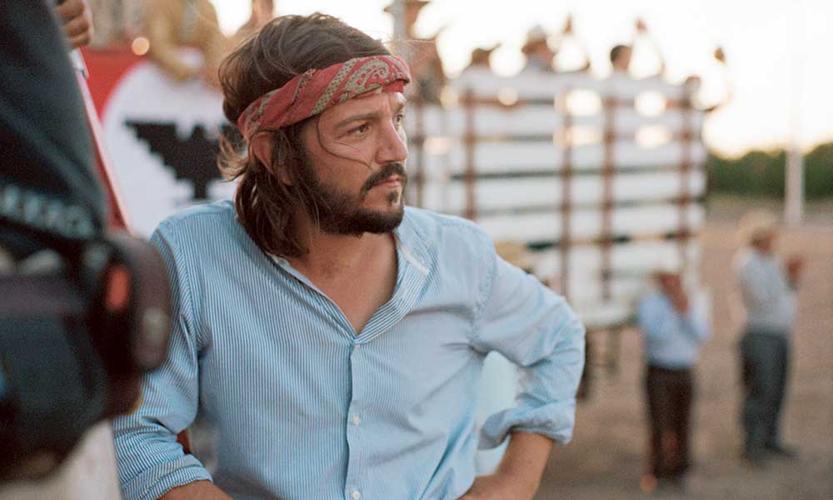
Writers and directors have tried for years to get the movie made and failed repeatedly. Cesar Chavez, debuting in theaters March 28 and receiving a red-carpet screening March 30 at Maya Cinemas in Salinas, is the first feature film ever made about one of the most important Mexican-American political figures of the 20th century. It took celebrated director Diego Luna – despite clout gathered from his early life as a Mexican soap opera idol and his roles in hits like Frida, Milk and Y Tu Mama Tambien – four years to complete and far longer to get to that point.

Of shooting Cesar Chavez, director Diego Luna says, “The first day of shooting we did [a unity] clap and it connected us all before we went on this journey. The first day there were thousands of farmworkers who showed up as extras. But then they realized how slow [shooting a film] is and left. The feeling of being in that place…visually, it’s so gorgeous.”
Some of the delays this time around came courtesy of a Mexican-American film community protesting that a Mexican filmmaker and production company were intruding on their rightful storytelling turf. Luna tried to get financing in the United States, and though all comers agreed the movie should be made, none would invest their own money. He had to go back to his native Mexico to get most of the financing before any U.S. companies signed on.
Now critical appeal has been uneven. Early reviews from Variety and Hollywood Reporter were lukewarm, although the film took the populist audience prize at the South by Southwest festival in mid-March.
But the real battle with the film is whether it shows the man fairly.
• • •
Pulitzer Prize-winning L.A. Times and Newsday journalist Miriam Pawel launched a countrywide tour for her brand new birth-to-death biography The Crusades of Cesar Chavez from the National Steinbeck Center in Salinas earlier this week, on March 25. Her appearance was part of Hartnell College’s Farm Worker Awareness Week (March 25-April 3) which continues with a Hartnell student-only preview of Cesar Chavez at Maya Cinemas this Friday, screens other films Tuesday-Thursday and ends with a panel next Thursday.
Pawel feels she knows why a book, like the movie, was so hard to bring to harvest.
“There’s been no biography written in the 20-plus years after his death because the people who know his complexity didn’t want to go near [the real story] and tarnish one of the only Latino heroes in the country,” she says.
She credits Chavez with foresight that extended from the esoteric – like practicing yoga and vegetarianism when both were fringe notions – to the profound.
“‘Our accomplishments cannot be undone,’” she quotes him. “‘La causa, our cause, doesn’t have to be experienced twice.’ The consciousness and pride that were raised by our union are alive and thriving inside millions of young Hispanics who will never work on a farm.”
Tanis Ybarra joined the UFW as a volunteer in 1970 and was there in Delano at 40 Acres, the first permanent agricultural labor union in the United States. He was present when the union won the long-fought contracts to represent farmworkers with Delano grape growers, which is the central battle in the film. He stayed with the UFW for 30 years, only leaving last year.
“At one point [Cesar] had 17 million people stop eating grapes,” he says. “These farmworkers who spoke no English, he sent them to major cities, he put it in their hearts and minds that they could launch a successful boycott. Passage of the Agriculture Labor and Relations Act in 1976 was huge. The banning of the short-handled hoe. I participated in the strike in Salinas. We did so many things. We were the first ones to begin to push [out] DDT and a lot of dangerous chemicals.”
That work to drive an entire country toward greater justice earned Chavez a posthumous Presidential Medal of Freedom in 1994. (Huerta was bestowed the same while the film was shooting.)
That’s the side his family was ready for a film to focus on.
Pawel, who also wrote 2009’s The Union of their Dreams: Power, Hope, and Struggle in Cesar Chavez’s Farm Worker Movement, reports Luna ran into that head-on when he sought input on the screenplay: “He said that there was a point in time when the script revisions submitted by the family were lengthier than the script.”
Experts like Marshall Ganz, Harvard’s senior lecturer in Public Policy, take issue with the results.
Ganz, who lived in Pacific Grove, dropped out of Harvard as a student to join the Civil Rights Movement in Mississippi and then joined Chavez and the United Farm Workers from 1965 to 1981, ending his time there as Director of Organizing. He also trained Barack Obama’s staff on grassroots campaign tactics during Obama’s first run for president.
“This film made me sad,” Ganz said, according to a March 4, 2014, Harvard Gazette piece by Sarah Sweeney. He was appearing as a panelist, along with Luna, at a Harvard University screening of the film. Referring to how Chavez was a portrayed, Sweeney reports that Ganz said, “He’s almost a cartoon.
“When I met [Cesar], he was reading Churchill. He knew how to weave the Mexican, the Catholic, the revolutionary traditions. He fueled progressive politics for many, many years to come.”
Luna agreed that Chavez was a complex man with multiple facets to his public and private life but replied, writes Sweeney, that Diego felt it was "unfair to ask a film to cover everything. 'You only have an hour and 45 minutes.'”
Jerry Cohen, now 72 and living in Carmel Valley, was the UFW’s first general counsel. For 14 years starting in 1967, he fought the Teamsters – among others – when they allied with Salinas growers. He attended the screening at UC Berkeley’s Center for Latin American Studies on March 5. Aside from laughing at the “hippie” portrayal of his younger self, he, too, had mixed reviews for the film.

As one-time UFW counsel and Carmel Valley resident Jerry Cohen observes, “The filmmakers used real farmworkers – you don’t get those sunburns and calluses in a make-up studio.”
He understands why scenes he felt were vital – like a Bakersfield courtroom moment in which Chavez, on the 16th day of his fast to rededicate the union to nonviolence, is charged with contempt for not dispelling a strike – weren’t included. But for Chavez, the UFW and Latino farmworkers everywhere, it was a pivotal moment in history. On that day in 1968, farmworkers peacefully filled and surrounded the courthouse. The prosecuting attorneys asked presiding Judge Walter Osborne to clear the courtroom.
The judge’s response: “If I kick these workers out of the courtroom that will be just another example of gringo justice,” the judge said. “I can’t do it.”
It signaled the law, often an enemy of the workers and an ally to crooked authorities and those in power, could be swayed – a turning of the tables.
That scene didn’t make the movie; Cohen is resigned and realistic.
“They wanted to make a movie that was positive and that’s fine,” he says. “Peter Matthiessen wrote a book. Miriam Pawel wrote a book. Frank Bardacke wrote a book. The time to have a complex conversation is with a book.”
He does identify one of the biggest pluses: Many don’t know the importance of Chavez in California or the world. The Hollywood version of the Chavez story stands a good chance at changing that. “On the positive side, you have a young group of people who think of Cesar Chavez the boxer,” Cohen says. “[The film] introduces him to them.”
Luna told the Harvard audience he kept a subplot about Chavez abandoning fatherhood in favor of his place at the head of the movement because the film needed a touchstone. Cohen took exception there too.
“They spent a lot of time on Cesar and his son,” he says. “They could have done a more complex story. Cesar at his best pulled together a lot of forces – churches, synagogues, colleges, environmental groups. You don’t get that sense of what it means to organize.”
The demands of organizing can come with unsightly side effects too, and ones that historians find underreported with heroes like Chavez. In a March 31, 2010, L.A. Times piece titled “Not just to praise Cesar,” Miriam Pawel prefaced the article with Webster’s definition of an icon: “an object of uncritical devotion.” With The Union of their Dreams she includes perspectives from dedicated union workers like Ellen Eggers, Sabino Lopez, Jerry Cohen and others who she says were forced out by Chavez’s growing cult of personality and reliance on destructive management exercises.
“There are tremendous archival resources in multiple places,” she says. “[Cesar] was very aware of his own place in history and the importance of preserving documentation of that.”
Other sources similarly struggle with Chavez’s shifts.
“[Cesar] had a change of mind, of philosophy,” says Padilla, the former UFW Secretary-Treasurer who preceded Ybarra. “He was no longer interested in the union, the movement. All the people who started the union left. I left. And he surrounded himself with his family.”
• • •
The audition that landed Hollywood star Rosario Dawson (Sin City, Rent) a key role as Dolores Huerta was atypical.

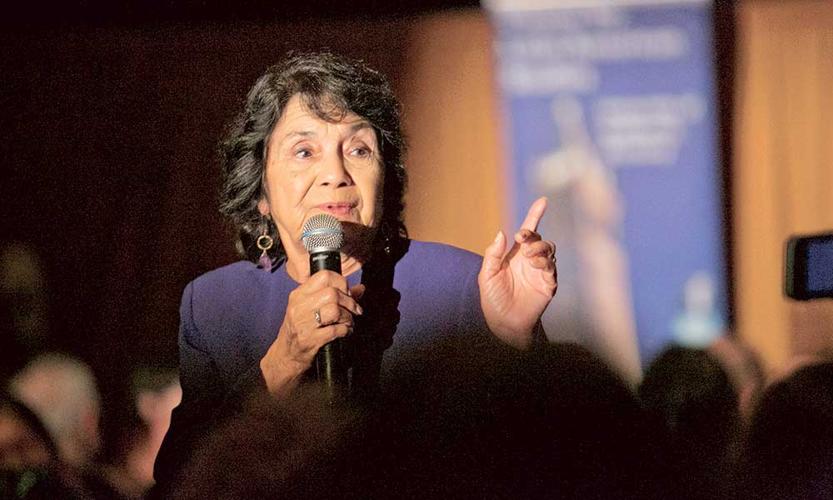
Dolores Huerta at the Berkeley screening of Cesar Chavez, which won the Audience Award at the more populist South by Southwest Festival earlier this month.
Huerta is a living champion of La Causa and the co-founder, alongside Chavez, of the UFW. As Luna told the Berkeley preview audience: “With Rosario, we didn’t even get to the audition because we sat down and she spoke for hour about [her social media political platform] Voto Latino and I realized I was in front of an organizer.”
The film isn’t short on star power. It stars Michael Pena (Crash, End of Watch) as Chavez; America Ferrera (Ugly Betty) as his wife, Helen Chavez; and John Malkovich (Being John Malkovich) as grape grower Bogdanovitch.
It also borrows some power from another sort of star community organizer and celebrity.
On March 19, Huerta was to participate in a panel discussion at Hartnell College. Instead, she joined the movie’s director, its other stars, UFW leaders and members of Chavez’ family to watch the movie at the White House at the invitation of President Barack Obama, who names Chavez as an influence on his decision to become a community organizer.
“We are here to celebrate the life of an American hero,” Obama said before the film. “Cesar Chavez was a man who devoted this brief time that we have on Earth to making sure that this country lived up to some of its lofty ideals, the words of our founding, the idea that all of us are created equal.”
The president was, himself, introduced by White House Deputy Director of Public Engagement Julie Chavez Rodriguez, Chavez’ granddaughter.
In Salinas, where Chavez served 20 days in the decrepit former county jail in 1970 for refusing to call off a lettuce boycott, a red-carpet screening is set for Sunday, March 30, the day before what would have been Chavez’ 86th birthday, at Maya Cinemas.
Huerta flagged the occasion personally at the Berkeley preview screening, and tied it into a current populist push.
“Cesar’s birthday is March 31,” she said. “We want to give him a big old present by getting people to see the film. On March 31, we [also] have to get everybody signed up for the Affordable Care Act. If you don’t sign up, it’s not going to make it.”
That power to connect – then and now – is at the heart of the film for people like Arturo S. Rodriguez, UFW President and Chavez’ son-in-law.
“We have a whole new generation of folks who were weren’t around 50, 40 years ago when this started,” he says. “This gives them the opportunity to learn about the heroes and pioneers, the people who went against powerful agribusiness. I hope the younger generation utilizes it as a guide on issues like immigration reform. What people did back then, can still be done today.”
Lauro Barajas agrees. He’s been in the UFW for 18 years and is the regional director overseeing Salinas. He says the union has racked up substantial victories since Chavez’ death: Getting more than 70 percent of the mushroom industry under contract, scoring strawberry contracts in the late ’90s and inking Dole Berry and D’Arrigo Brothers vegetable contracts in 2007. His team continues to administer contracts and look for new companies to organize, but there is a significant gap that the movie can remedy in the meantime.
“We hope a lot of sons and daughters of the farmworkers see it,” he says.
Pawel views the disconnect as more dramatic.
“There is no legacy in the fields,” she says. “[Chavez’s] legacy is in the cities. Farmworkers don’t know who he is. The UFW is trying to build itself up from his memory.”
That’s a haunting thought for a community that would love to honor Chavez and his hope that, “‘La Causa, our cause, doesn’t have to be experienced twice.’”
And that seems the greatest promise of the film: To provide an unprecedented opportunity for many to experience La causa – many of them for the first time in their lives.
THE UFW FUNDRAISER SCREENING OF CESAR CHAVEZ takes place 4pm film, 6:30pm discussion at Maya Cinemas, 153 Main St., Salinas. $20/film; $100/VIP reception. secure.ufw.org/page/contribute/Chavezmoviesalinas. A 7pm cocktail reception takes place at Steinbeck Center.
[Editor's Note: Due to an editing error, proper attribution was not given to a conversation between Marshall Ganz and Diego Luna. The quotes were taken from a March 4, 2014 piece by writer Sarah Sweeney and the Harvard Gazette.]
(0) comments
Welcome to the discussion.
Log In
Keep it Clean. Please avoid obscene, vulgar, lewd, racist or sexually-oriented language.
PLEASE TURN OFF YOUR CAPS LOCK.
Don't Threaten. Threats of harming another person will not be tolerated.
Be Truthful. Don't knowingly lie about anyone or anything.
Be Nice. No racism, sexism or any sort of -ism that is degrading to another person.
Be Proactive. Use the 'Report' link on each comment to let us know of abusive posts.
Share with Us. We'd love to hear eyewitness accounts, the history behind an article.