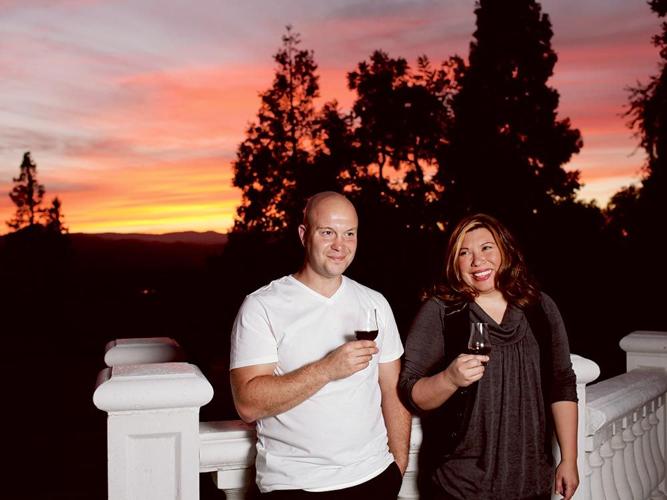


When Bryan Davis told his complicated story on the TEDx stage in Bermuda this summer – one that involves ancient dinosaur teeth and futuristic technology, Prunedale hooch and Silicon Valley capital, elegant chemistry and gross rotting goat heads – he started with a simple introduction.
“My name’s Bryan, and I make booze.”
That sauce proves sexy enough that the Salinas native, at 34, has been called “perhaps the most inventive booze maker in all America” by New York City’s The Daily Beast and “a mad scientist” by many. For a time he avoided media because he couldn’t keep up with demand for his peated whiskeys and surprisingly smooth 136-proof navy rums. He created those award-winning spirits with an old-fashioned steam-driven copper-and-log still he built by hand in the front yard of his rural home, out between Prunedale and Castroville, complete with an exhaust shaped like a dragon head.
But that’s not why he was invited to speak. He was on stage because, with the constant support of his partner in life and liquor, Joanne Haruta, he has invented a reactor that gives whiskeys and rums many of the qualities of 20 years of barrel aging in less than a week.
In other words, he’s built and patented a time machine.
That marks an apex of an entertaining tale that flows from Salinas to San Francisco to Spain to Salinas again (and now Morgan Hill), and from rum to absinthe to gin to whiskey to rum again.
Something happens along the arc of his speech. Things drift away from booze, a shift mirrored by the Lost Spirits label, which has gone dormant, so Davis and company can focus on tech start-up Lost Spirits Technology. It becomes about something bigger, more creative, more conceptual, more human.
The shift speaks to what his inventions mean for a booming craft liquor industry and, ultimately, human ingenuity.
“My name’s Bryan, and I make booze.”
At Lost Spirits’ original home in Prunedale, the weeds got so tall they obscured a broken-down tractor among them. Its shiny new headquarters in Morgan Hill, by contrast, is a little bit different.
It enjoys three stories (including an off-limits attic where secret experiments happen), a big pool (with a 1-meter diving board) and a tennis court (with a glass-backboard basketball hoop). The four-car garage currently holds the second and third Targeted Hyper-Esterification Aging (THEA) reactors ever made. On a recent visit, so-called Swami of Electrical Engineering Eric Dunham and Techmaster 3000 James Haruta were arranging one that looked like a glowing space pod the size of a skinny coffin.

In describing the pair who co-created Lost Spirits, one investor says, “They’re two sides of one person, a perfect team. Bryan is somewhere between mad scientist and a wizard; Joanne is more quiet but no less talented. He makes exceptional spirits and she knows why people buy them.”
A customized voice welcomes guests at the front door, reminds residents of the time on the East and West Coast, and pumps sound to rooms of the house on command. Those include descriptions of artifacts scattered about, like the ancient megalodon tooth and model ship Napoleon. (More on those in a minute.)
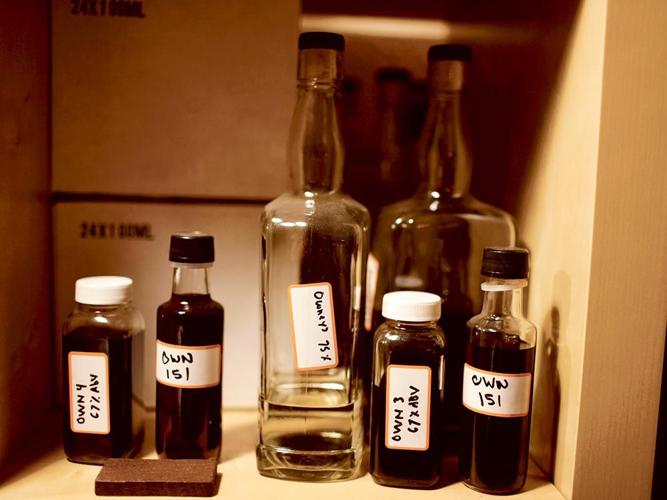
In the kitchen, padded briefcases carry decades-old spirits for analysis and comparison. Elsewhere jars and bottles of dark liquor with Sharpie-scrawled tags occupy countertops and shelves.
A slinky dragon chandelier Davis created purely from wire and tape hangs from the ceiling in the entryway. He assembled it because he needed something to do for several days while making sure his prototype reactor’s test run didn’t explode.
“I’m making fruit from scratch. Whiskey is the fruit God forgot.”
One of the great ironies of Lost Spirits’ increasingly scientific tale is that the guy who cracked the chemistry-wrapped riddle at its core – faster than far better funded and staffed corporations – has a background in art and sculpture.
As he explained on the TEDx stage, he acquired insight by asking the Internet.
The first key thing he threw out: How do you make alcohol? He was an awkward Salinas High 16-year-old who spent a lot of free time at Hartnell College’s ceramics lab and didn’t have anyone he felt comfortable asking to buy him Bacardi Silver. So he punched his question into AltaVista, collected yeast, molasses, copper tubing and some silicone sealant, and started making rum in a bucket.
In college he discovered absinthe, which led to another question. This time the ingredients proved trickier to obtain, but eventually he found wormwood at a witchcraft supply store.
“One of the more terrifying moments of my distilling career,” he says.
Suddenly he had his bribe to get onto the coolest art cars at Burning Man. Later he would do absinthe illegally for a bar he helped design and build in San Francisco.
The questions would change. When Davis and Joanne Haruta absconded to Lleida, Spain, to start Obsello Absinthe, it was things like, “How do you get a trash dumpster in Spanish?” But the pattern would keep: Ask, learn, execute.
As the absinthe market cooled they sold their brand and returned home. When they asked distributors what spirits they sought, the chorus was, Davis remembers, “Whiskey, whiskey, whiskey, aged Scotch, whiskey.”
The problem there: They’d need a bunch of barrels and years of patience to make anything worth doing.
As one of their current investors says, “You have to tie up a huge amount of time and capital to bring a product that tastes really good to market.”
So Davis asked the Internet, “How do you age booze fast?”
What sparse answers existed contradicted one another. “I hit the outer edge of Google,” Davis says.
“If we invented flight, broke the sound barrier, walked on the moon and split atoms, how can we not hack the chemistry in a barrel?”
Something is amiss with Tessa, the house’s voice. Davis can’t consider an interview until he finds what ails her. As he checks various computers and iPads, linked to the house’s programs, no frustration surfaces. He seems more alive than anything. And that’s it: Davis lives, palpably so, to figure things out, grinning as he goes.
“But isn’t that the most fun thing in the world to do?” he says, with a laugh. “To investigate and understand?!”
Joanne Haruta has a front row seat.
“Every time he finds an answer a new question emerges,” she says. “The questions are challenges, and that’s what Bryan seeks out and enjoys.”
That quality is fundamental to Davis and Lost Spirits, and it’s clear the first time you meet him. While some talk in sentences, he talks in passages, his eyes alit with a Disney villain’s mischievous joy. Or as I wrote when I first met him in 2013: “He is so into what he’s doing he’ll talk about volatile phenols and toasted late harvest semillon casks and Prohibition precedents for hours, easy.”
One of his favorite things to talk about would be esters, the chemical compounds that gives everything from fresh grass to feces scent and taste. As he said in our first meeting: “Every time you smell a flower or bite into fruit, you’re testing esters. Sweet, bitter, chocolate, everything you eat and drink is made of esters. I’m making fruit from scratch. Whiskey is the fruit God forgot.”
That enthusiasm helped inspire Dunham, the engineering swami, to walk away from his own $225,000-a-year electrical contracting business to help program software and hack electric circuits. (“We thought we’d have to hire two people but we got them in one guy,” Davis says.)
“I didn’t do it lightly,” Dunham insists. “But there’s something about Brian that’s hard to explain. He just believes in what he’s doing. I got rid of the construction truck and it’s not coming back.”
Davis deciphered the glitch that was choking up Tessa in a few minutes. It took him a little longer to figure out what happens in whiskey barrels over time. Not that he was ever dismayed.
“If we invented flight, broke the sound barrier, walked on the moon and split atoms,” he says, “how can we not hack the chemistry in a barrel?”
He started by buying a mass spectrometer and analyzing aged spirits at a molecular level. (Today he reads a chemical signature the way a master composer does complex sheet music.) He compared the elements in a brand-new white whiskey and a whiskey from 1975. He flagged compounds that create flavors found in old stuff: vanilla, wood, smoke, spice.
“What aged booze actually involves,” he says.
He taught himself how to force esterification – essentially the development of flavors – in his spirits.
He added smoked barley, smoked malt or peat smoke from stuff he gathered from all around the world, giving his spirits some of the elements of an aged liquor, albeit not all of them.
“Frankenstein monsters,” he calls them. “Lots of pieces of what you’d find in nature but things nature couldn’t make.”
But his “fun little abominations” sold out quickly, at prices well over $50 a bottle. Like Spirits Buyer David Driscoll of K&L Wine Merchants said in 2013, “Five years from now we’ll all be kicking ourselves [because] we didn’t buy more early collectables. Easily one of the most fascinating whiskies of the past few years.”
He didn’t let onto it then, but Davis was really chasing extraction, the unlocking of phenolic acids and carboxylic acids from wood. That takes years and years, bringing delicious depth and complexity as it does. At least it did, until Davis noticed a need for a Prunedale paint job.
“We’re not not turning shit into roses but we’re close.”
The original inspiration for the Lost Spirits name was a hope to revive creations like “rye steam,” abandoned eras ago, through nerdy recipe research and chemical signature study. Davis built the front-yard still based on abandoned models – stills popular in the pre-Prohibition 1900s – though he adds “they stopped doing them that way for a reason.”
He was in tinker mode two years ago, scuttling between the still and the garage, when he noticed the wood deck could really use a fresh layer of paint. After a decade in the sun, one corner was visibly breaking down, or as Davis said to himself, “The polymers are totally splitting.”
He continued on, then froze.
“What did I just say?” he thought.
It takes liquid spirits decades to break down wood. If it took 10 years for sunlight to break down his deck, what if he pumped a ton of light into his reactor?
Or as he puts it, “Several suns worth, at the equator, at noon. Bingo!”
His tests revealed wood exposed to an intense beam of light broke down in three days. In geek speak: full phenolic aldehyde extraction with no compromises or additives. In laymen’s language: twenty years worth of oak degradation in hours.
Today the THEA One reactors, which Lost Spirits calls the “21st century barrel” take spirits through three phases.
The first phase: the esterification, or conversion, of short-chained fatty acids with gnarly flavors into fruity, short-chained esters. Something like butyric acid, which approximates vomit, binds with ethyl butyrate (the flavor of pineapple) to create ethyl phenylacetate, which tastes like honey.
“We’re not not turning shit into roses but we’re close,” Davis says.
Phase two brings on the sunlight, bombarding chunks of twisted or knotty barrel planks (called staves) that are unusable in barrels – and normally discarded or burned – in the spirit. That extracts compounds that complete esterification. Those include aldehydes and some undesirable medium-chained acids, which are forced by temperature and pressure settings to bond, in phase three, into complex and longer-chained esters previously found only in very mature spirits – providing the feel and flavor of a quality aged alcohol.
It’s the second phase that inspired the acronym THEA, a take on the name Theia, the Greek goddess of light.
“What makes everything ridiculous is average joes can now buy what only the very rich could afford,” Dunham says.
“What makes everything ridiculous is average joes can now buy what only the very rich could afford.”
Lost Spirits Technology could be called disruptive, but explosive might be a better term, and not because THEA’s volatile reactions could go boom (if four layers of safeguards hadn’t been put in place).
The craft distillery industry is exploding. It started in 1982, with the founding of St. George Spirits, Jepson Spirits and Germain-Robin, and is quickly and quietly following the pattern of the craft beer boom (which started decades earlier). At the turn of the century, there were a handful of distilleries; now there are 700, the first time the number has surpassed pre-Prohibition levels. Around 100 a year are currently cropping up. In January, California’s AB 1295 goes into effect, allowing in-state distilleries to host tasting rooms, add restaurants and sell bottles.
Carmel native and Carmel High grad Andrew Faulkner is vice president of American Distilling Institute and managing editor of Distiller. He’s been observing it all closely, and adds the first time ADI held a conference no more than 80 people showed, though no one really counted. This spring 1,600 attended.
“It’s huge,” he says. “You go back a decade, and there were no more than a few dozen [distilleries] in business.”
The most memorable moments of the ADI’s Annual Spirits Conference in Louisville, Kentucky, belonged to one Bryan Davis. He told Faulkner and the other organizers he wanted to present on Gas Chromatography Mass Spectrometry, the tool he uses to measure the quantity of certain molecules in spirits.
Only Davis, with characteristic theater, was bluffing. He brought up a specific and popular craft rum, a 124-proof Lost Spirits Colonial American Inspired Rum released in December 2014.
At the time of its release, critics swooned. “It’s a bracing, navy-strength rum with intense coffee, dried fruit, and chocolate notes, with a gentle smoky finish,” writes noted critic Christopher Null in Wired. “[It] tastes like very old, overproof rum.”
It was welcomed – and celebrated – in a $100 cost category reserved for those who invest serious time and barrel.
People knew Lost Spirits hadn’t been around enough to have such mature rum, so they accused the upstart of buying Caribbean rums to blend, or assumed it was able to accelerate aging so three years tasted more like three decades.
In Louisville – on April 1, auspiciously enough – Davis announced the colonial rum was produced with no barrels, in a garage, in six days, with technology he just patented. He directed them to his white paper, up on the Lost Spirits website, for more.
“There was definitely a lot of ‘Huh?’ and ‘What?’” he recalls.
Then the art teacher delivered a math lesson. Even if – and these are ifs the size of a mastodon – 1) the assembled distillers found financiers willing to wait 20 years on their loan payback, 2) barrel evaporation was 2 percent rather than the typical 30, 40 or 50, and 3) there was minimal markup, you would still need to sell your spirit at $80 to turn a profit.
Even with “a magic bank,” imaginary evap rates and fantasy wholesalers, it’s a tough ask for would-be craft distillers.
Next topic: chemistry. He took them through the reactor’s stages, and pointed out how the technology would allow for richer spirits without the crazy overhead, empowering upstarts to contend with global liquor powers like Constellation and Campari by presenting a quality niche product closer to $30 than $100.
“I feel like the craft distillery community needed this to survive,” Davis says.
There were 27 inquiries on the spot and nine beta testers signed up to fill his five openings for reactors.
Now a practical process is in place: Davis vets the quality of the distillery, they develop a recipe for a liquor and, as the Lost Spirits team builds one THEA a week in the garage, Davis and Dunham travel to various craft distilleries to install them. Craft operations lease the equipment and pay about $1 per bottle aged with THEA One’s help.
“We need a whole segment to change the world,” Joanne Haruta says, “and there are a lot of great distilleries out there. We are the only people that produce this technique and results.”
Distillery Institute VP Faulkner puts things in perspective.
“It’s a potential gamechanger,” he says. “Almost everybody making a brown spirit is trying to figure out how to bring it to market quicker.”
That includes the use of smaller barrels, racks that rock spirits, heated barrels, pressure cookers and more.
The game it stands to change is a big one: Some 7.5 billion bottles of aged spirits are made every year.
“I feel like the craft distillery community needed this to survive.”
As rich as the story gets, it gets richer when the rum hits the lips. And that happens with an assist from rotting goat heads.
Old-school Jamaican rum makers use a stomach-turning device called a dunder pit to give their rums the signature presence of intense esters. The pit, often dug in a jungle, holds distillery waste including fruit scraps and molasses, but also goat heads and dead bats.
When they added a little of the resulting dunder “muck” to rum fermentation tanks, those nasty esters combine with compounds from the barrel and other esters and emerge on the other side as potent fruit flavors.
Santeria Rum from Rational Spirits is made in that style, and dives through a deep swirl of sweet banana, wild cinnamon-like spice and 115-proof heat.
It just made history in Charleston, South Carolina, as the first commercial batch of Lost Spirits’ THEA-aged rum to hit markets. Fittingly enough, it evokes history by using dunder-style techniques.

The Morgan Hill home is every part a working lab. Davis calls his ideal spirit “like walking into a 100-year-old British library: old books, burning tobacco on the table, wood, varnish.”
As he has so many times, Davis started with what he wanted – in this case, the acid signature he sees in dunder-pit rum – and searched out what could create it. In this case, it was bacteria that didn’t require goat heads and dead bats.
He tracked down two funky, exotic cheese-making bacteria strains never used in booze, and added them to rotting bananas and molasses.
The ultimate result finds a sweet spot tastemakers aim for: proven yet new, familiar but exciting, classic but innovative.
“The result is a new category of rum,” Davis says.
Alex Burns, who founded the Rational distillery after a lucrative career in finance, sees something the legion of investors drawn to Lost Spirits also see. Those include intellectual law property firms, scientists, biologists and venture capitalists, who are each extremely involved in strategy but otherwise kept secret, as are investment amounts, though Davis concedes they’re “certainly in the millions.”
“I knew Brian had something,” Burns says. “I wasn’t sure how it was going to work. But I called him, we talked for an hour and a half, I ordered a bottle of navy rum, tried it, and told him, ‘You are about to become prettiest girl at the dance. How do I get to the front of the line?’”
The investors are feeling what spirits critic Christopher Null announced when he wrote, “Those of us who’ve tasted the results are already believers.”
Null continued: “The transformative effect Davis’s technique could have on the spirits industry cannot be overstated – not only from a production standpoint, but also in the challenge it presents to long-held attitudes about distilling. It’s something that takes time, and lots of it, to be done correctly. By all but removing time from the equation, Davis could end up rebooting the entire culture.”
Not only can craft operators make deeper brown spirits quickly – as Burns says, “we have the ability to react to market demands on a dime” – they can experiment with those spirits that have been lost to time. Or, in other words, extinct.
“The scientist sat down to the same problem, and started with way more knowledge, but he didn’t know how to use the tools of the Internet like the kid with the art degree.”
The 100-million-year-old megalodon tooth contains a lesson. The way the Lost Spirits team tells it, when the giant shark-like dinosaur couldn’t compete with dolphin predecessors doing their smaller, faster, smarter thing, it helped push the monsters to extinction. Also on display at Lost Spirits’ Morgan Hill headquarters is a tooth from the spinosaurus, which successfully adjusted to changing competition by downsizing its anatomy and territory.
Other artifacts add further depth to the abiding theme of adaptation, including the replica of the steamship that revolutionized naval warfare, the Napoleon, and an Egyptian amulet that evokes one appearing on the cover of the first edition of H.G. Wells’ Time Machine.
Thirty copies of the book are scattered throughout the home lab, and a quote from the story appears on the website: “To welcome change and challenges, because they are what help us grow. Without them we grow weak… We need to constantly be challenging ourselves in order to strengthen our character and increase our intelligence.”
Davis says the artifacts are there for laughs. “Why wouldn’t you get dinosaur bones? They’re so cool.”
But they’re also there to provide perspective. Hacks are coming. Those best evolved to adapt will win.
For Davis, a turning point came when he taught himself more about esters and extraction than a biochemist with a doctorate with whom he worked. He ascribes that to his comfort with technology.
“The scientist sat down to the same problem, and started with way more knowledge, but he didn’t know how to use the tools of the Internet like the kid with the art degree,” he says.
In his TEDx talk, he points out that his generation is the first to come of age with the power of the Internet in its grasp, with dozens more coming behind his.
He asks his audience, “Are we ready for that change, that fast? Is venture capital ready? Is government ready?”
He closes with a picture not of THEA or rum or goat heads. Instead it’s with a photograph of a young boy with an iPad and a basic question: “What happens when this kid grows up?”
Later Davis fields the question himself.
“That kid is going to come,” he says, “and make us look like dinosaurs.”
(0) comments
Welcome to the discussion.
Log In
Keep it Clean. Please avoid obscene, vulgar, lewd, racist or sexually-oriented language.
PLEASE TURN OFF YOUR CAPS LOCK.
Don't Threaten. Threats of harming another person will not be tolerated.
Be Truthful. Don't knowingly lie about anyone or anything.
Be Nice. No racism, sexism or any sort of -ism that is degrading to another person.
Be Proactive. Use the 'Report' link on each comment to let us know of abusive posts.
Share with Us. We'd love to hear eyewitness accounts, the history behind an article.