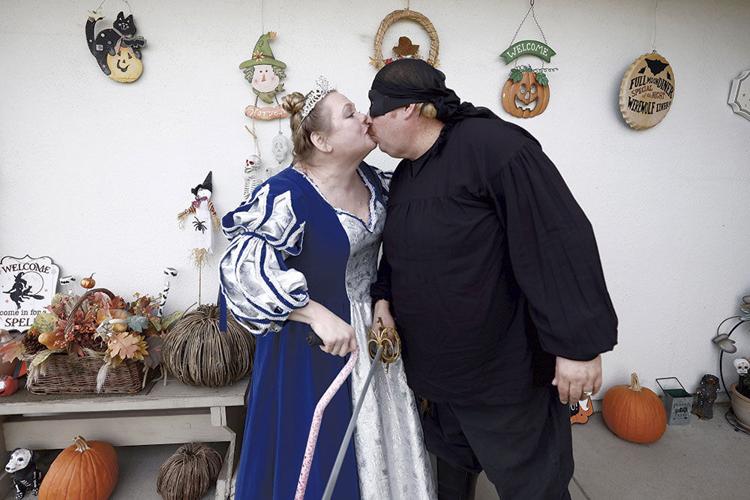


Lori Long and Mark Contreras, dressed as Princess Buttercup and Dread Pirate Roberts from the movie The Princess Bride, get ready in their Salinas home to go to a Halloween party in San Jose in 2022.
WHEN LORI LONG AND MARK CONTRERAS MET ON A DATING SITE IN 2015, she thought coffee would be the right approach for a first date. But Contreras could right away tell there was a connection. “I already know I want to spend time with you, and I want to take you to dinner,” Long remembers him saying. So they went big, with dinner at Tarpy’s Roadhouse.
Long’s bubbly, positive approach to life aligned with Contreras’ more subdued, yet similarly positive attitude. They fell in love. And on Christmas of 2016, about a year after their first date, he proposed. She immediately said yes.
Right away, they began planning a wedding. Their plan was to move quickly with a small, budget-conscious wedding. Long’s mother’s health was failing, and she wanted to be married with her mom there. But then Long learned about a bureaucratic complication that would come to derail those plans. As an adult with a disability she’s had since childhood, Long qualifies for Social Security Disability Insurance (SSDI). It’s a benefit that some 1.1 million Americans receive.
But there’s a catch: Adults with disabilities can keep their SSDI if they remain single, or if they get married to somebody else who has a disability. If they get married to somebody who is not on SSDI, the benefit goes away.
“When the man I love asked me to marry him I said yes, I was unaware that the U.S. government allows the Social Security Administration to discriminate against people with disabilities by restricting whom we can marry,” Long says.
Finding love is hard enough. Once you find it, you don’t expect it to put your health care at risk.

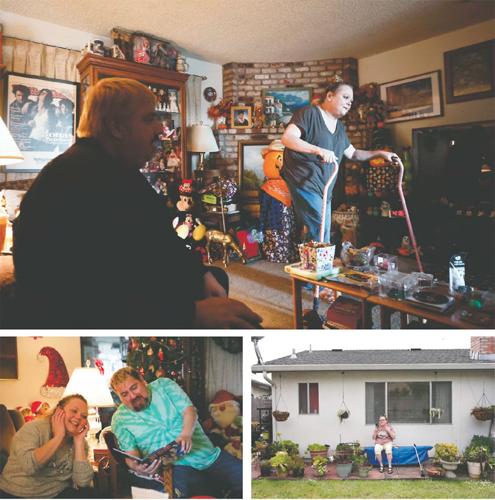
Top: Long, shown in the couple’s living room at their home in Salinas, walks with help of canes. Left: On Christmas Day in 2022, Long and Contreras exchange gifts. He gives her a cartoon book about Die Hard; the couple has a running debate about whether Die Hard is a Christmas movie. Right: Long meets virtually with DREDF staff attorney Ayesha Lewis and disability activist Kaitlin Kurr-Heidenreich, who helped pass MAWD (Medical Assistance for Workers with Disabilities), which prevents a disabled person from losing their health benefits in the state of Pennsylvania. Lewis and Long are seeking advice on getting a similar bill passed in California.
Long, who is known as a DAC in Social Security parlance – Disabled Adult Child – began researching her options. Giving up her benefit of $1,224/month was not an option. Contreras works full time as an accountant and could add her to his insurance, but it would cost an additional $12,000 annually in premiums, more than the Salinas couple could afford.
Long began asking everyone who might be able to do something. Long has become an activist by necessity: “I never saw myself in this role until it happened,” she says. But she felt that she had to take action: “I didn’t want to close myself off from joy.”
She brought her cause to her representative in Sacramento, State Sen. Anna Caballero, D-Merced. Caballero introduced Senate Joint Resolution 8, which passed unanimously in both chambers of the California Legislature in 2022. The resolution urges the president and Congress to allow DACs to continue to receive their SSDI benefit, regardless of their marriage status.
“Loss of DAC benefits is simply not an option for most disabled adults, as they depend on their insurance coverage to survive,” the resolution reads.
Caballero presented a framed copy of the resolution to Long and Contreras in her Salinas district office on Oct. 10. The couple went to Gino’s for dinner (and an Old Fashioned for Long) afterward to celebrate – a partial victory in a long bureaucratic journey. But Long, who wears a butterfly tiara in her hair for the occasion, loves reasons to celebrate.

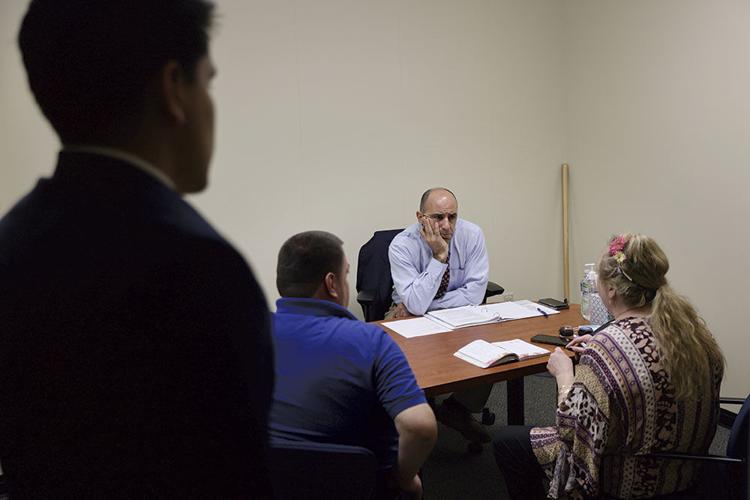
Long and Contreras meet with U.S. Rep. Jimmy Panetta in his Monterey district office. In addition to fighting for the right to get married, Long is also an advocate for reforms related to pain management. Growing restrictions on opioids have created challenges in her day-to-day life.
The state cannot solve a federal problem, but only ask Washington to fix it. To that end, Long has also recruited U.S. Rep. Jimmy Panetta, D-Carmel Valley, to her cause. When his staff first heard about her conundrum, they could not believe it was even true, but research showed it was. Panetta introduced H.R. 6405, the Marriage Equality for Disabled Adults Act in 2022, with a provision known as “Lori’s Law,” that would eliminate the marriage penalty for DACs. That bill stalled in committee, and never went up for a vote.
An analysis prepared by the office of the chief actuary in the Social Security Administration showed “Lori’s Law” would cost an estimated $1 billion over 10 years. Thanks to various other adjustments in the bill, in total it is estimated that it would end up saving Social Security $6 billion over that same time period.
By the end of July, Panetta plans to reintroduce the bill. “We are in it for the long game,” he says. “The current law can put people in a position where they are forced to choose between their health care or their happiness. That type of marriage penalty is antiquated.”
Meanwhile, Long tried another approach. In November 2022, represented by the Disability Rights Education & Defense Fund (DREDF), she filed an administrative complaint with the Social Security Administration calling upon them to strike the provision.
“We are asking for freedom to marry,” says Ayesha Elaine Lewis, staff attorney for DREDF. “This is an issue that has been important to the disability community for a long time. People feel really strongly about the freedom to marry and have relationships with the people that they choose… In the not-so-distant past, a lot of people with disabilities lived in institutions, where they didn’t have that much autonomy over their lives.
“We all deserve to feel like we can be part of our communities. There’s this idea [about people with disabilities] that you need to be taken care of, that you’re not an adult fully – that’s not true, and it’s hurtful.”
The complaint is still pending, with no response.

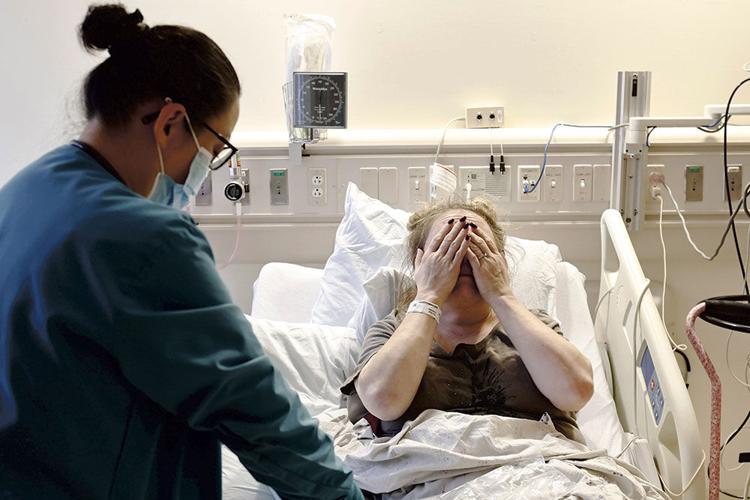
Long expresses frustration after days stuck in the hospital.
Meanwhile, Long and Contreras are still engaged but not married. They continue to work as activists both for themselves, and on behalf of others, to change an antiquated marriage law.
They missed the opportunity to have Long’s mom at their wedding; she died in 2018.
“It was her dying wish to see Mark and me married. But at least she got to know him and love him as well,” Long says.
Long’s health and pain is a continuous challenge. She was born with a rare autoimmune disease, ankylosing spondylitis, which causes fractures in her spine, leading to spinal deformity and pain, and many surgeries – including about three months into their relationship. “At 2 in the morning, we were driving to the hospital,” Long recalls. “I should’ve been thinking, ‘please don’t let me die today.’ Instead I was thinking, ‘please don’t let me throw up in his truck.’” (She received emergency surgery for an obstruction, an issue related to the shape of her spine.)

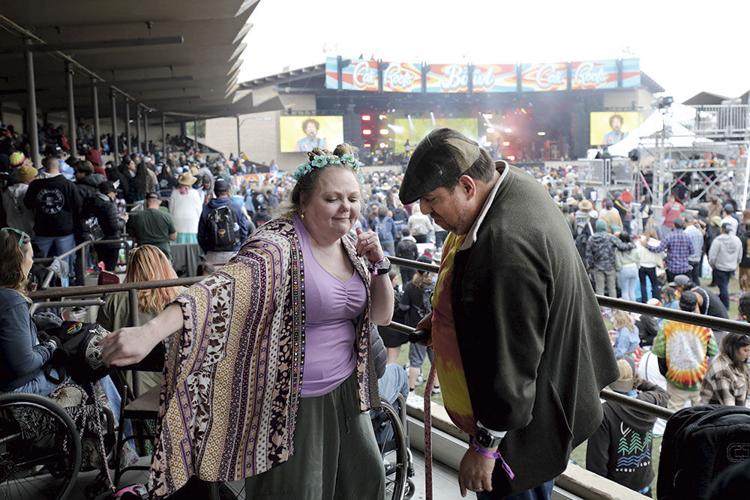
At Cali Roots, Long is especially excited to see Kolohe Kai. During a show by Dispatch (pictured), she and Contreras get up to dance. “There is a lot to be bitter about, but I want to be as positive as possible,” Long says. “The cards I was dealt…it’s not fruitful. I don’t want to live unhappy.”

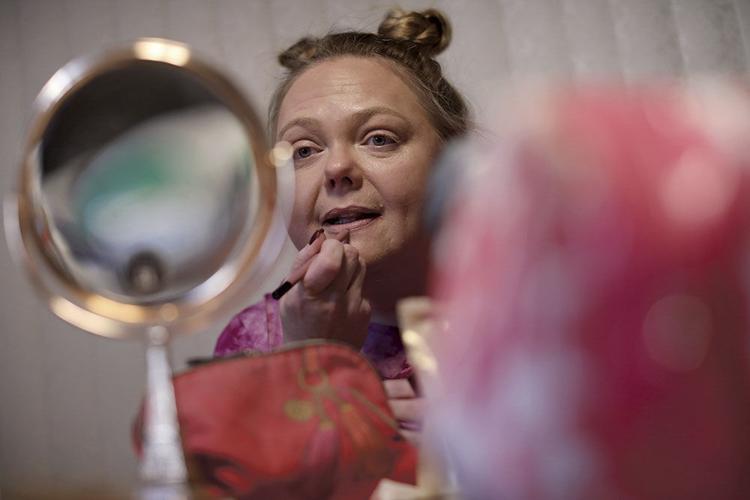
Long puts on makeup. She got an aesthetician’s license, but has been unable to land a job using those skills, with prospective employers requiring her to be on her feet for an extended period. Instead, she works as a cashier at Home Goods, a job she loves.
Still, the couple travels, goes out with friends, and attends church every Sunday at Madonna del Sasso in Salinas. Long keeps joking about all of it, and Contreras responds easily with laughter. Even through years of hardship, she embraces light banter. “I’ll say, I drove him to drink and to church. He didn’t drink much and he didn’t go to church much… ”
“It really helped,” Contreras chimes in.
“Drinking or church?” Long asks with a half-smile.
Contreras answers seriously. “Church. It helped me reset.”
Driven by a combination of love, faith – according to their Christian beliefs, they should only live together after marriage, something that makes them uncomfortable – and a sense of justice, they continue fighting for marriage equality. “Love is at the forefront – this is a really beautiful love story between two people. There’s no way in hell I am going to let this policy be the last chapter of this love story,” Long says. “I hope we can be a face and voice for positive change.”
The photographs in these pages document that story, including beyond the roles they have come to occupy as activists – just as two people, living their lives, and hoping they can fulfill a dream.

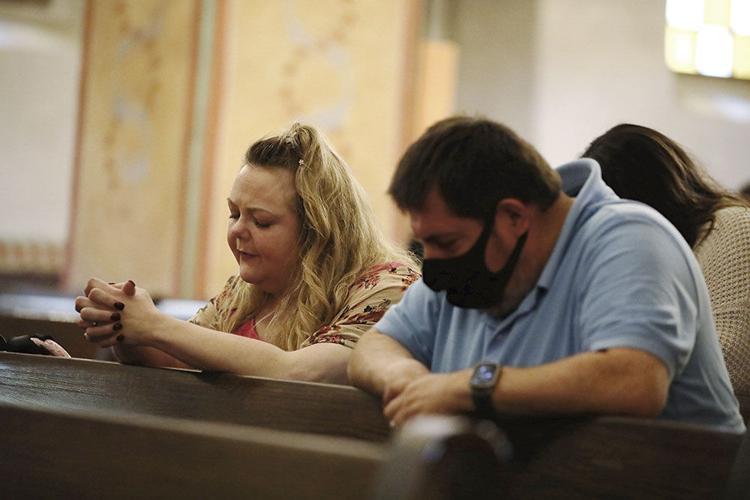
Contreras and Long attend church most Sundays, seen here in the mission in San Juan Bautista. Primarily they go to Madonna del Sasso in Salinas. Their pastor, Father Greg Sandman, wrote a letter in support of Lori’s Law to Congressman Panetta.
(0) comments
Welcome to the discussion.
Log In
Keep it Clean. Please avoid obscene, vulgar, lewd, racist or sexually-oriented language.
PLEASE TURN OFF YOUR CAPS LOCK.
Don't Threaten. Threats of harming another person will not be tolerated.
Be Truthful. Don't knowingly lie about anyone or anything.
Be Nice. No racism, sexism or any sort of -ism that is degrading to another person.
Be Proactive. Use the 'Report' link on each comment to let us know of abusive posts.
Share with Us. We'd love to hear eyewitness accounts, the history behind an article.